

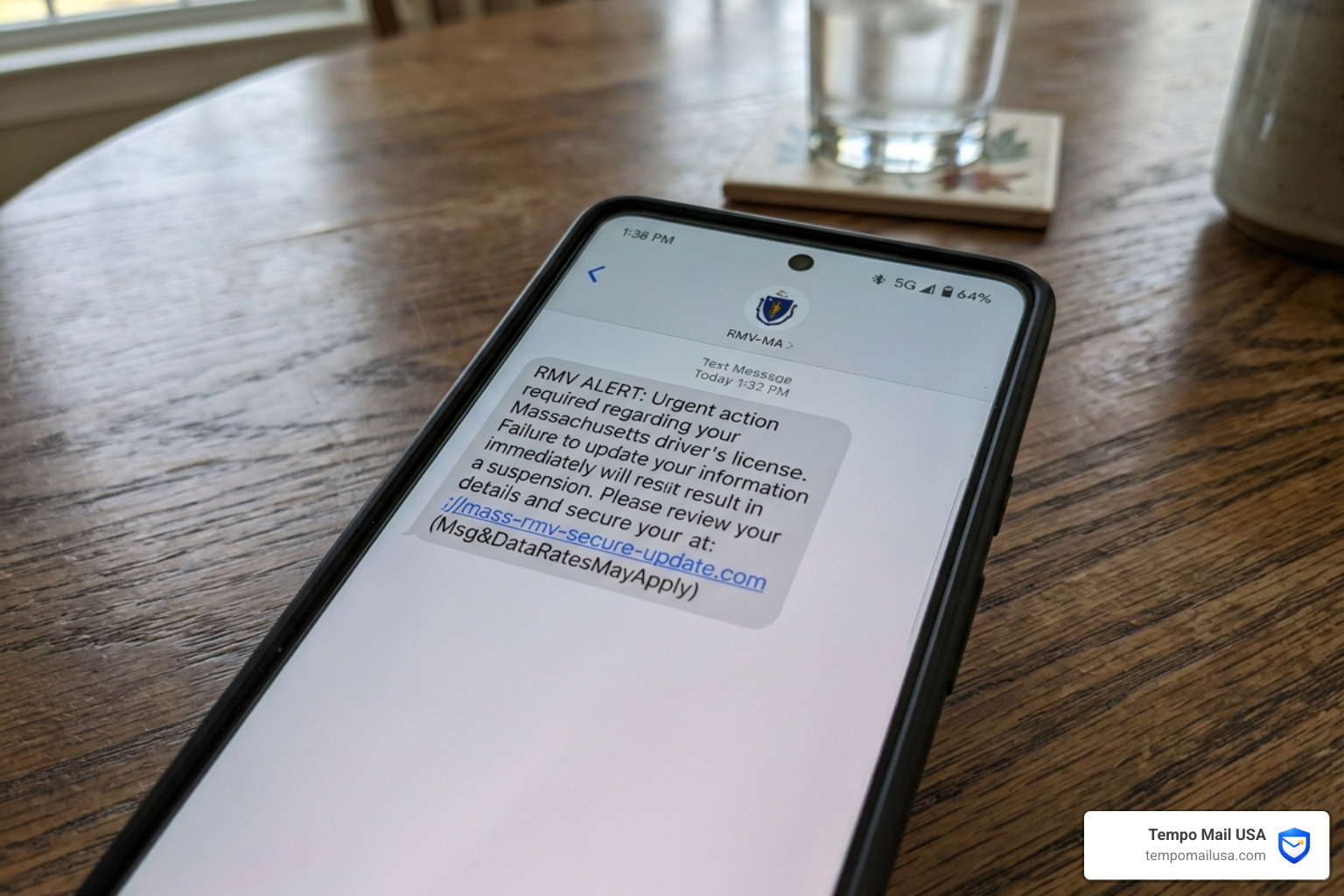

Massachusetts Drivers Are Being Targeted — Here's What You Need to Know
If you've received a mass rmv scam text, here's the fast answer:
It's fake. Delete it immediately. Do not click any link.
- The Massachusetts RMV will never text you asking for payment
- Official RMV transactions happen only in person or at mass.gov/RMV
- Scam texts typically claim you owe money for an "unpaid traffic violation" and threaten license suspension, registration revocation, or even credit damage
- Texts may come from numbers starting with +63 (Philippines) or contain misspellings like "massachusEEts"
- Report suspicious texts to the Massachusetts Attorney General's Office or the FTC
These texts are spreading fast — and they're getting harder to dismiss.
Residents across Massachusetts have reported receiving multiple scam texts in a single week, each one dressed up to look like an official government notice. The phrasing is urgent. The threats are specific. And the links look just close enough to legitimate government URLs to cause a moment of doubt.
That moment of doubt is exactly what scammers are counting on.
The Massachusetts Registry of Motor Vehicles has issued repeated public warnings about this ongoing smishing campaign — a term that combines "SMS" and "phishing" — targeting drivers with fake claims of unpaid motor vehicle violations. The texts threaten serious consequences: suspended licenses, revoked registrations, collection fees of up to 35%, legal action, and damage to your credit score.
None of it is real. But the financial and privacy risks of clicking that link absolutely are.
Many residents are now turning to secure platforms, identity protection services, and advanced privacy tools to reduce their exposure to exactly this kind of threat — and for good reason. Once scammers have your personal or financial information, the damage can extend well beyond a single fraudulent payment.
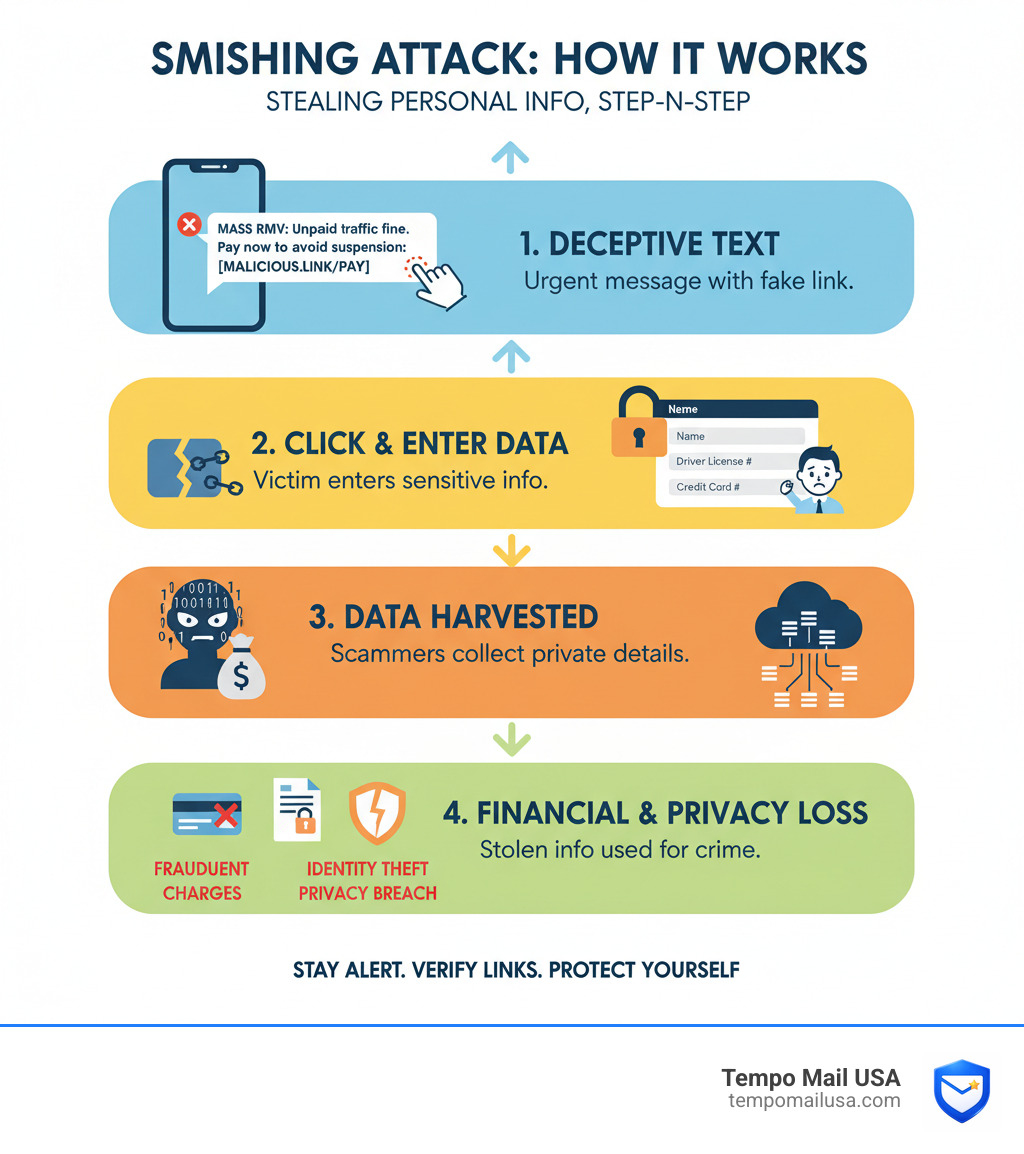
Anatomy of the mass rmv scam text
To protect ourselves, we first need to understand the beast we’re fighting. The mass rmv scam text is a textbook example of "smishing"—a portmanteau of SMS and phishing. In these cyberattacks, criminals use deceptive text messages to trick us into revealing sensitive information like credit card numbers, Social Security digits, or account passwords.
The goal is simple: fraudulent payments and identity theft. By mimicking the authority of a state agency, scammers bypass our natural defenses. As noted in recent reports, MA RMV Warns Of Scam Texts Asking For Money, these messages are designed to create a sense of panic that overrides logic.
Identifying the mass rmv scam text Phrasing
The language used in these texts is carefully crafted. You won't see a friendly "Hello." Instead, you’ll see "Final Notice" or "Immediate Action Required." The messages claim you have an "unpaid traffic violation" and that failure to pay will result in license suspension or registration revocation.
Common phrases include:
- "Final Notice: Unpaid Traffic Violation – Payment Required"
- "Action required to avoid license suspension"
- "Your vehicle registration will be revoked in 24 hours"
If you see these high-pressure tactics, it is a major red flag. For a deeper dive into these linguistic tricks, check out our guide on How to Spot a DMV Text Scam.
Official RMV Notices vs. Scam Texts
| Feature | Official RMV Communication | Scam Text Message |
|---|---|---|
| Delivery Method | Physical Mail or Official Email (if opted-in) | SMS/Text Message |
| Payment Requests | Never requested via text | Always demands immediate payment via link |
| URL Type | Ends in .gov or .mass.gov | Ends in .com, .net, or random strings |
| Tone | Formal, procedural | Urgent, threatening, aggressive |
| Language | Uses "RMV" (Registry) | Often uses "DMV" (Department) |
Why the mass rmv scam text is Surging
As we move through 2026, these scams have become more sophisticated. Scammers are now using "geo-targeting," meaning they specifically target phone numbers with Massachusetts area codes. They also include customized dates to make the "violation" seem recent and credible.
One particularly nasty evolution in the DMV Text Scam 2026 is the threat of "35% collection fees" or claims that the "unpaid fine" is already impacting your credit score. These financial threats are highly effective at scaring people into clicking before they think.
How to Spot a Fake RMV Message
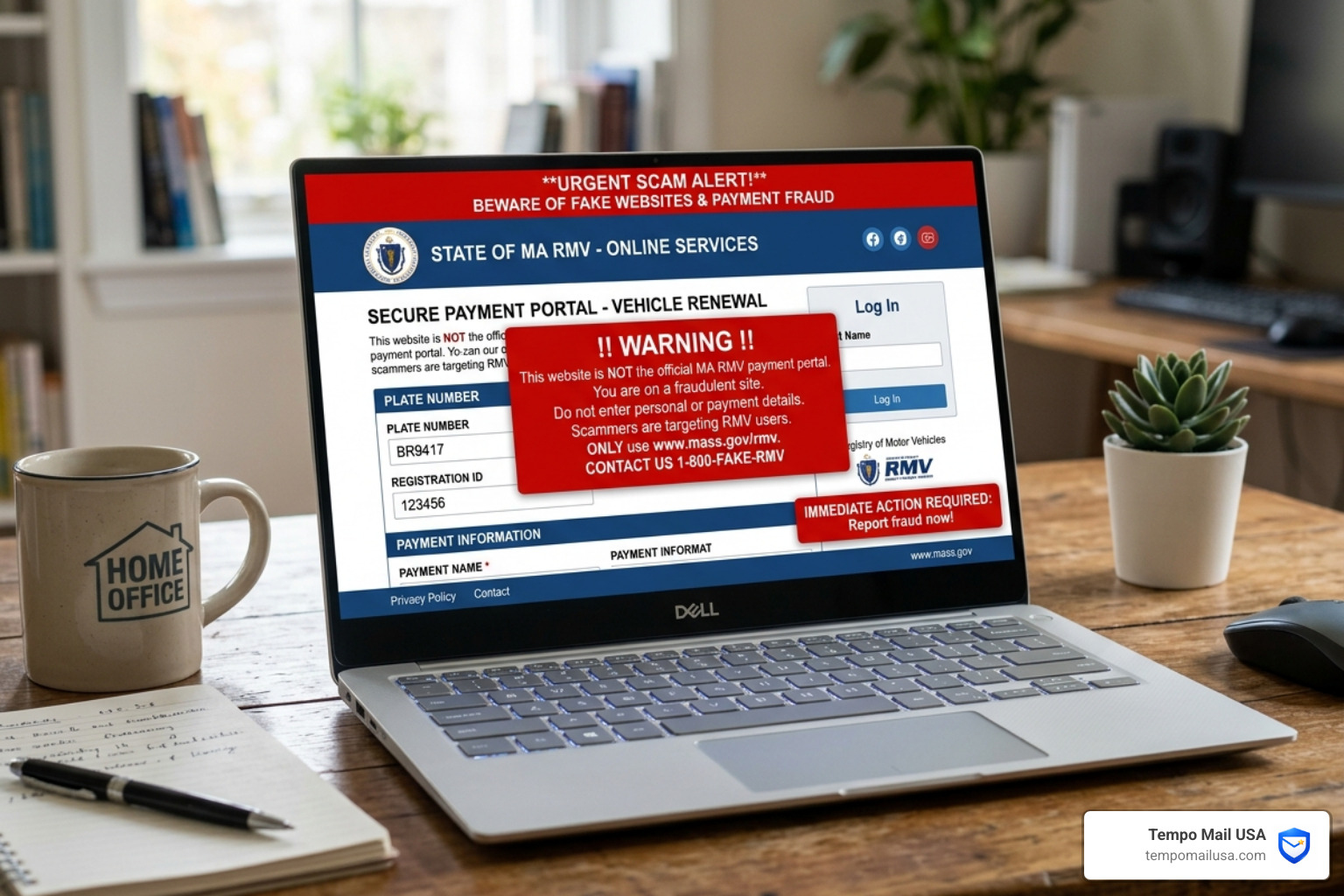
Spotting a fake is easier when you know what the real thing looks like. In Massachusetts, we have a Registry of Motor Vehicles (RMV). Many of these scam texts are created by out-of-state or international crime rings that use the term "DMV" (Department of Motor Vehicles) instead. If a text mentions the "Massachusetts DMV," you can be 100% sure it’s a scam.
Furthermore, official state websites always end in .gov. Scammers try to trick us by using URLs that look official, such as mass-rmv-notice.com or pay-ma-fines.net. These are not legitimate. As highlighted by local news, Text scam claiming to be RMV is going around Massachusetts, these sites are designed to harvest your data the moment you arrive. Similar tactics have been seen in other states, such as the NJ MVC Scam Text.
Red Flags in Digital Communications
Beyond the URL, look for these specific indicators:
- International Senders: Many users have reported texts originating from country codes like +63 (Philippines). The Commonwealth of Massachusetts is not texting you from overseas.
- Spelling and Grammar: Look for errors like "massachusEEts" or "state" instead of "Commonwealth."
- QR Codes: The RMV does not send QR codes via text for you to scan and pay. This is a common tactic to hide a malicious URL.
- Direct Payment Demands: If the text asks for a credit card number or bank details directly through a linked form, it’s a trap. As seen in the MVA Scam Text in Maryland, these "pay today or be arrested" threats are classic phishing.
Cost vs Value Breakdown of Official Services
Scammers often charge "convenience fees" or "processing fees" for things that are actually free on the official site.
- Status Checks: Checking your license or registration status on mass.gov/RMV is Free.
- Address Changes: Updating your address with the RMV is Free.
- Forms: Accessing official RMV forms and applications is Free.
- Third-Party Sites: Any site that charges you $20 or $50 just to "access" these services is a third-party scam or a data-harvesting operation. Stick to the official portal to save your money and your identity.
Official Channels vs. Fraudulent Tactics
The Registry is very clear: they do not use text messages to collect money. If you truly owe a fine, you will receive a formal notice via the U.S. Postal Service.
According to the official RMV cautions public to beware of scam texts press release, there are only two ways to pay:
- In-person at an official RMV Service Center.
- Online via the secure Online Service Center at mass.gov/RMV.
If a message tells you otherwise, it’s a lie. This policy is standard across many states; for instance, the SC DMV Scam Text warnings confirm that South Carolina also never texts for payments.
Verified Payment Methods
When you are on the official mass.gov site, look for the padlock icon in your browser's address bar. This indicates a secure, encrypted connection. Official payments are processed through secure state gateways, not random third-party processors. Always verify the domain before entering any financial data. Similar warnings have been issued regarding the PennDOT Text Scam to help drivers in Pennsylvania stay safe.
Related MassDOT Toll Scams
It isn't just the RMV. Scammers also impersonate MassDOT and EZDriveMA. You might receive a text or email claiming you have "unpaid tolls" that must be settled immediately to avoid a "late fee."
These follow the same playbook as the mass rmv scam text. They use fake invoices and phishing links to steal your credit card info. If you are worried about a toll, log in directly to your EZDriveMA account at ezdrivema.com or call their customer service. Do not trust the text. This mirrors the WSDOT Text Scam currently targeting drivers in Washington state.
What to Do if You Receive a Suspicious Text
If a mass rmv scam text lands in your inbox, your first instinct might be to reply "STOP" or click the link to see what it's about. Don't.
- Do Not Click: Clicking the link can install malware on your phone or track that your number is "active," leading to even more spam.
- Do Not Reply: Replying confirms to the scammer that a human is reading the messages.
- Block the Sender: Use your phone’s built-in features to block the number.
- Delete the Message: Once blocked, get rid of the evidence so you don't accidentally click it later.
- Report It: Help protect others by reporting the number to your carrier (forward the text to 7726) and to the authorities.
For more state-specific advice, you can read the CT DMV Text Scam alert, which offers similar "delete and block" guidance.
Reporting Scams to Authorities
In Massachusetts, we have several resources to fight back:
- Massachusetts Attorney General’s Office: File a consumer complaint online.
- Federal Trade Commission (FTC): Report the scam at
reportfraud.ftc.gov. - Consumer Hotline: Call (617) 973-8787 or toll-free at (888) 283-3757 for guidance from the Office of Consumer Affairs and Business Regulation.
Reporting is vital. It helps agencies track the origin of these attacks and issue broader public warnings, much like the Georgia DDS Text Scam alerts that protected residents in the South.
Steps for Victims of Identity Theft
If you did click the link and entered your information, don't panic—act fast.
- Contact Your Bank: Immediately freeze any credit cards or bank accounts you shared.
- Credit Freeze: Place a freeze on your credit reports with Equifax, Experian, and TransUnion to prevent scammers from opening new accounts in your name.
- Update Passwords: Change passwords for your email and financial accounts, especially if you use the same password across multiple sites.
- Monitor Your Credit: Use an identity protection service to watch for suspicious activity.
Drivers in the Lone Star State faced similar issues, as detailed in the Texas DMV Scam Alert.
Protecting Your Digital Identity
The surge in the mass rmv scam text highlights a broader problem: our personal information (PII) is too accessible. Scammers get our phone numbers from data breaches, public records, or by scraping the web. To stay safe in 2026, we need a "PII Firewall"—a way to keep our real data out of reach.
Even public figures aren't immune; remember when a SCDMV Scam actually targeted a traffic reporter? It can happen to anyone. Using PII Protection Services is no longer a luxury; it's a necessity for digital survival.
Best Options Compared for Data Privacy
| Protection Tool | Function | Best For... |
|---|---|---|
| VPN | Encrypts your internet traffic | Public Wi-Fi and hiding your IP address |
| 2FA (Two-Factor) | Requires a second code to log in | Securing bank and email accounts |
| Identity Monitoring | Alerts you if your data is on the dark web | Long-term identity theft recovery |
| Temporary Aliases | Masks your real email/phone | Signing up for services without giving away real PII |
Whether you're dealing with a Utah or Louisiana DMV Scam or a local Massachusetts threat, these tools form the foundation of a modern security stack.
The Role of Tempo Mail USA in Scam Prevention
At Tempo Mail USA, we operate in the privacy and cybersecurity industry with a single mission: to provide a secure PII firewall. We offer temporary email aliases that act as a proxy for your identity.
When you use our secure alias generation, you shield your real personally identifiable information (PII) from services that might be vulnerable to data breaches. If a service you signed up for is hacked, the scammers only get your alias—not your real, permanent email address. This prevents them from linking your data to other accounts or targeting you with sophisticated phishing attacks like the DMV Scam Text. By using an alias, you break the chain that scammers use to build a profile on you.
Frequently Asked Questions about Mass RMV Scams
Does the Massachusetts RMV ever send text messages for payment?
No. The Massachusetts RMV will never contact you via text message to request payment for fines, violations, or transactions. Any text claiming you owe money to the RMV is a scam.
How can I tell if an RMV website is official or a scam?
Official Massachusetts government websites always end in .gov (specifically mass.gov/RMV). If the site ends in .com, .net, or uses "DMV" instead of "RMV," it is a fraudulent site. Additionally, the official RMV site will never charge you a fee just to check your license status or download a form.
What should I do if I already clicked a link in a scam RMV text?
If you clicked the link but didn't enter info, run a malware scan on your phone. If you did enter financial or personal info, contact your bank immediately to freeze your accounts, place a credit freeze with the three major credit bureaus, and change your passwords for all sensitive accounts.
Conclusion
The mass rmv scam text is a persistent threat, but it loses its power the moment we stop falling for its urgency. By staying informed, using only official channels like mass.gov/RMV, and reporting suspicious activity to the Attorney General, we can protect ourselves and our community.
In an era where our data is the primary target for criminals, adopting a proactive defense is essential. Using PII Firewall Solutions like temporary aliases and encrypted connections ensures that even if a scammer finds your number, they can't find the keys to your life. Stay vigilant, stay skeptical, and never let a text message bully you into a bad financial decision.