

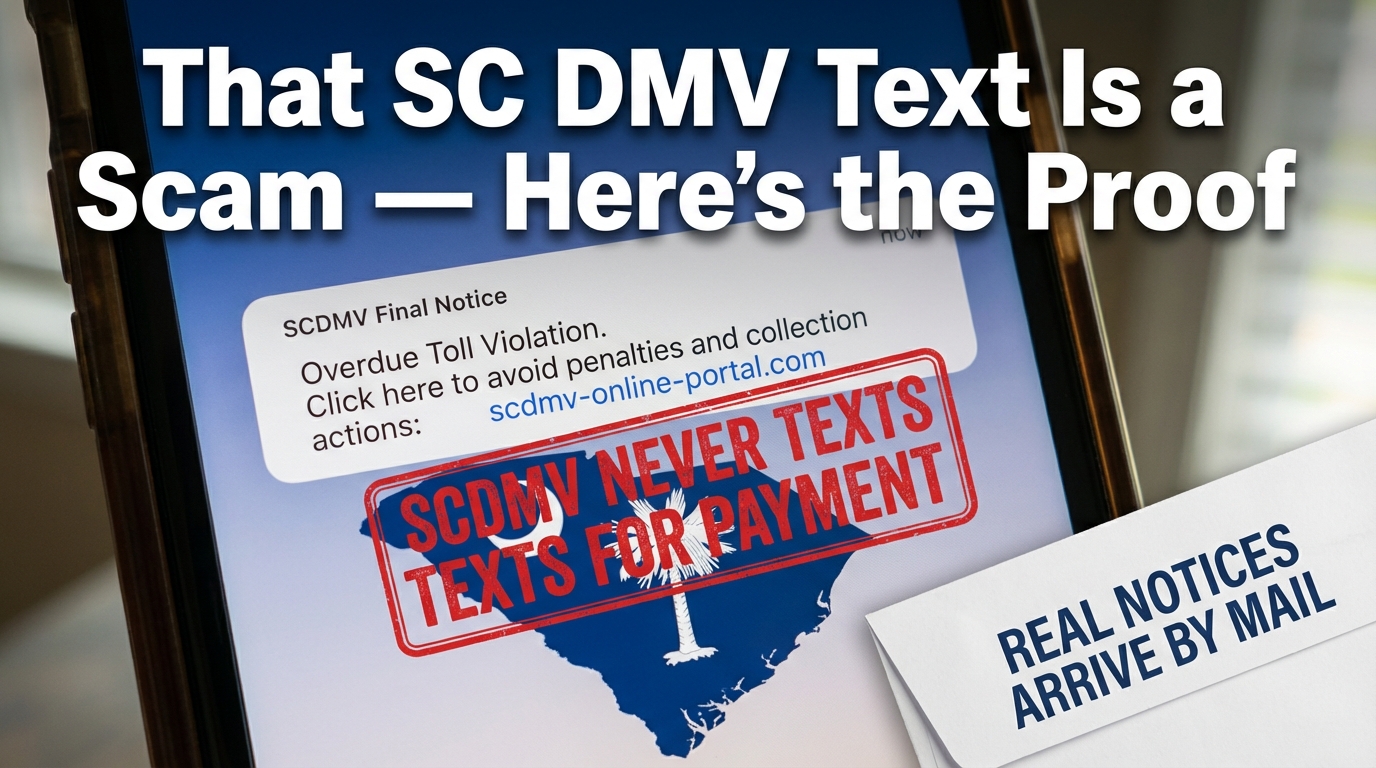

SC DMV Scam Texts Are Targeting South Carolinians Right Now
SC DMV scam text messages are flooding phones across South Carolina — and they're designed to trick you into handing over money or personal information.
Quick answer: Is that DMV text real?
- No. The South Carolina Department of Motor Vehicles (SCDMV) does not contact customers by text message.
- Any text claiming to be from SCDMV about unpaid tickets, toll violations, or license suspensions is a scam.
- Do not click any links. Delete the message immediately.
- If you already clicked, monitor your bank accounts and report to the FTC at reportfraud.ftc.gov.
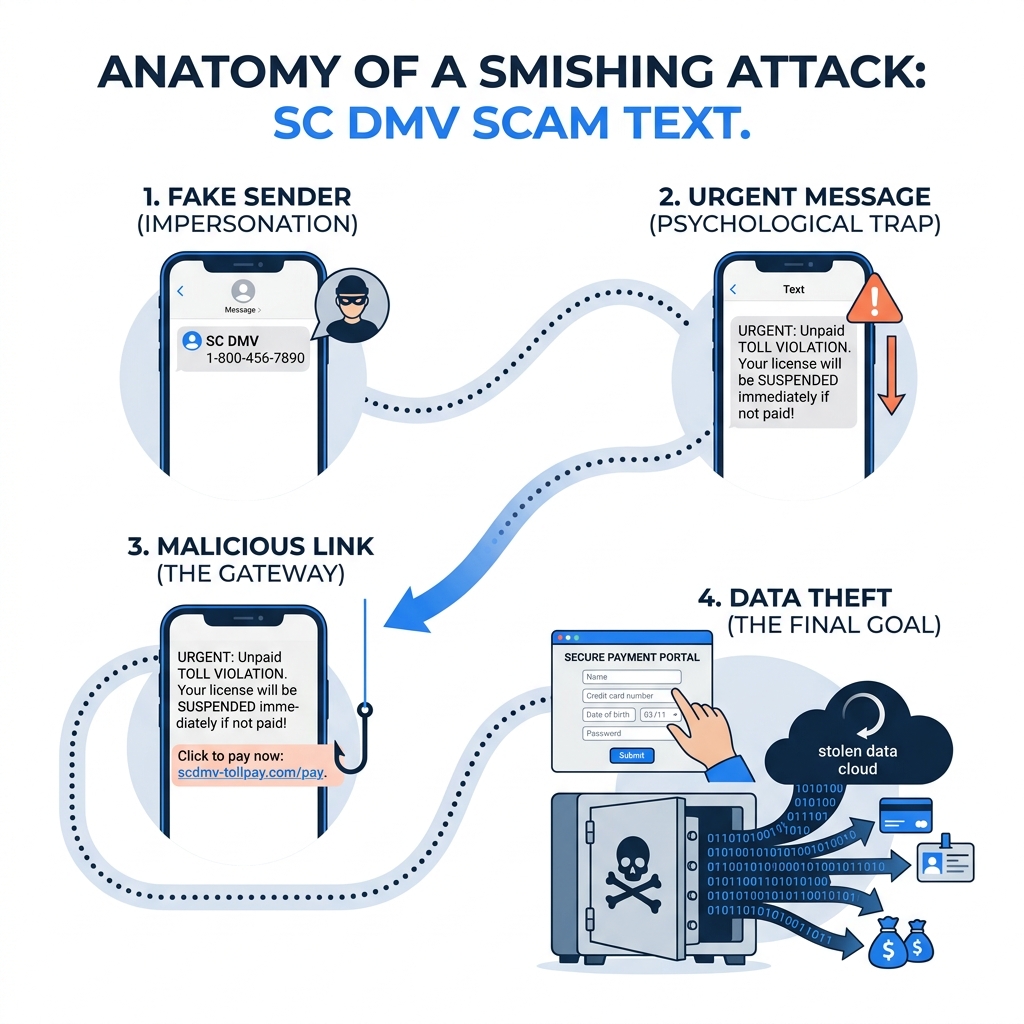
These texts are a form of smishing — phishing via SMS. Scammers impersonate the SCDMV and send urgent messages claiming you owe money for overdue tolls or traffic tickets. They threaten to suspend your license or vehicle registration if you don't pay immediately.
The goal is simple: panic you into clicking fast before you think twice.
Both the SCDMV and the South Carolina Law Enforcement Division (SLED) have issued public warnings about this scam. Local police departments have also flagged it after residents contacted courts asking whether the texts were real.
The urgency feels real. The links look official. But it's all fake.
This guide walks you through exactly how to spot these messages, what to do if you got one, and how to protect your personal information going forward.
Identifying an SC DMV Scam Text and How It Works
Understanding how a SC DMV scam text works is the first step in building your digital defenses. These attacks aren't just random messages; they are carefully crafted social engineering attempts. Scammers use "spoofing" technology to make the sender's number look local or official, and they utilize psychological triggers—specifically fear and urgency—to bypass your natural skepticism.
The scam typically follows a predictable pattern. You receive a text message out of the blue. It claims you have an "overdue toll violation" or an "unpaid traffic ticket." To make the threat feel heavy, the message warns that your driving privileges or vehicle registration will be suspended if you don't settle the debt immediately.

The most dangerous part of the message is the link. These malicious links often lead to a fake SCDMV website that looks nearly identical to the real portal. Once there, you are prompted to enter your name, date of birth, driver's license number, and—most importantly—your credit card information to "pay the fine." In reality, you aren't paying a fine; you are handing your financial life over to a criminal.
To help you distinguish between a scam and a real notice, we’ve put together this comparison table:
| Feature | Legitimate SCDMV Notice | SC DMV Scam Text |
|---|---|---|
| Delivery Method | U.S. Postal Service (Mail) | SMS / Text Message |
| Urgency | Provides at least 30 days' notice | Demands immediate action |
| Link Type | Directs you to SCDMVOnline.com | Uses shortened or slightly misspelled URLs |
| Payment Request | Through official portal or in person | Directly through a link in the text |
| Threats | Outlines legal process for non-payment | Threatens instant suspension |
Common Phrases in an SC DMV Scam Text
Scammers aren't known for their massive vocabulary; they tend to stick to scripts that work. If you see a text containing these phrases, your "scam radar" should be at full tilt:
- "Final notice: Overdue toll violation detected."
- "Your driver's license is at risk of suspension."
- "Unpaid ticket #4920 - Action required immediately."
- "Click here to settle your SCDMV balance and avoid penalties."
These tactics aren't unique to South Carolina. Our neighbors are seeing similar issues, as detailed in our guide on how to Beware Georgia DMV Scam Texts Targeting Drivers. The "toll violation" angle is particularly popular right now because many people travel through different states and might actually wonder if they missed a toll booth somewhere.
The Risks of Clicking Fraudulent Links
You might think, "What's the harm in just looking at the website?" Unfortunately, the risks of clicking a SC DMV scam text link go far beyond just losing the "fine" money.
- Identity Theft: By providing your driver's license number and DOB, you give scammers the keys to your identity. This can be used to open fraudulent accounts or commit "synthetic" identity theft.
- Malware Installation: Simply clicking the link can trigger a "drive-by download." This installs malicious software on your phone that can track your keystrokes, steal your passwords, or even access your camera and microphone.
- Financial Loss: This is the most immediate threat. Once they have your credit card or bank details, scammers can drain your accounts in minutes.
- Data Breaches: Your phone number and confirmed "active" status are sold on the dark web to other scammers, leading to an explosion of spam calls and texts.
According to the FBI IC3 report on phishing losses, phishing and related scams accounted for over $1.4 billion in losses in the United States recently. It is a massive industry, and clicking that link makes you a target.
Official SCDMV Communication Policies
To protect yourself, you need to know how the "real" DMV operates. The South Carolina Department of Motor Vehicles is very clear about its communication standards. They do not want you to be a victim, which is why they have gone on record stating that they do not use text messages to collect payments for unpaid traffic tickets or toll violations.
Official SCDMV business is conducted almost exclusively via the U.S. Postal Service. If there is an issue with your license or registration, you will receive a paper letter in a standard envelope. Furthermore, the agency is legally required to provide you with at least 30 days' advance notice before taking action against your driving privileges. A text message demanding payment "by tonight" is a dead giveaway of a scam.
For more details on identifying these types of communications, check out our Quick Guide - How to Spot Phishing Emails. While that guide focuses on email, the principles of checking the sender and looking for red flags are identical to text scams. The SCDMV news on traffic ticket scams reinforces that the agency simply does not operate through SMS for financial transactions.
Verifying Your Status Without Clicking an SC DMV Scam Text
If a text message has you worried that you actually do owe money, don't use the link provided in the message. Instead, go directly to the source.
The only official website for the South Carolina Department of Motor Vehicles is SCDMVOnline.com. You can also access it via dmv.sc.gov. Any other variation—especially those ending in .net, .org, or weirdly spelled versions like "sc-dmv-gov.com"—is a fake.
If you want to verify your status, you can:
- Log in to the Official Portal: Go to SCDMVOnline.com and check your driver's record or registration status.
- Call Customer Service: Dial 803-896-5000. This is the official SCDMV help line. A real representative can tell you if you have any outstanding fees or violations.
- Visit a Branch: If you're still unsure, visit a local SCDMV office in person.
Whatever you do, follow the golden rule of the internet: DMV Text Scam 2026 - Do Not Click That Link Until You Read This. Verification should always happen through a channel you initiate, not one that initiated contact with you.
What to Do if You Receive a Suspicious Message
If you see a SC DMV scam text pop up on your screen, don't panic. The scammer's only power is your reaction. If you don't engage, they lose.
The first and most important step is immediate deletion. Do not reply "STOP" or "Who is this?" Replying to a scam text, even to complain, tells the scammer that your number is active and that a real person is reading the messages. This will only lead to more scams.
After deleting the message, you should:
- Avoid clicking any links: Even if you're curious, the risk of malware is too high.
- Block the sender: Use your phone’s built-in "Block Contact" feature.
- Update your mobile security: Ensure your phone's operating system is up to date, as these updates often include patches for the latest smishing vulnerabilities.
For a deeper dive into staying safe, read our guide on how to Protect Yourself - How to Avoid Phishing.
How to Report an SC DMV Scam Text to Authorities
Reporting these scams helps authorities track the "campaigns" and potentially shut down the malicious websites the scammers are using. Here is the step-by-step process for reporting:
- Forward to 7726 (SPAM): This is a universal number for most major cell carriers. Copy the text of the scam message and forward it to 7726. Your carrier will use this data to improve their spam filters for everyone.
- Report to the FTC: Visit reportfraud.ftc.gov and fill out a report. This helps the Federal Trade Commission build cases against large-scale fraud rings.
- Check SLED Alerts: The South Carolina Law Enforcement Division often posts updates about active scams. Staying informed through official SCDMV advisories on misleading texts can help you stay one step ahead.
Steps to Take if You Interacted with a Scam Link
We’ve all had those moments where we’re tired, distracted, or just not thinking clearly. If you clicked the link or, worse, entered your information, you need to act fast to minimize the damage.
- Contact Your Bank Immediately: If you entered credit card or bank info, call your financial institution's fraud department. They can cancel your card and issue a new one before the scammers can use it.
- Monitor Your Accounts: Check your bank and credit card statements daily for the next several weeks. Look for small "test" charges that scammers often use before making a large purchase.
- Update Your Passwords: If the scam site asked you to "log in," change the password for your DMV account and any other account that uses the same password.
- Enable Multi-Factor Authentication (MFA): This is your best line of defense. Even if a scammer steals your password, they can't get into your account without the second code. According to Microsoft research on MFA effectiveness, MFA can prevent over 99.9% of account compromise attacks.
- Place a Credit Freeze: If you provided your SSN or driver's license number, consider freezing your credit with the three major bureaus (Equifax, Experian, and TransUnion). This prevents anyone from opening new lines of credit in your name.
Frequently Asked Questions about SC DMV Scams
Does the SCDMV ever text customers to collect money?
No. The official policy of the SCDMV is that they do not use text messages for fee collection, payment demands, or notifications regarding traffic tickets and tolls. All such business is handled via the U.S. Postal Service.
What should I do if I already entered my credit card info?
Immediately notify your bank or credit card issuer. Request that the card be canceled and a new one issued. You should also place a fraud alert on your credit report to monitor for any unauthorized activity.
How can I tell if a DMV website is legitimate?
A legitimate government website will almost always end in .gov. For South Carolina, the primary site is SCDMVOnline.com. Look for the "padlock" symbol in the browser address bar, which indicates a secure connection, and double-check the spelling of the URL for any "typosquatting" (e.g., "SCDMV-Online" instead of "SCDMVOnline").
Conclusion
In an era where our smartphones are extensions of our identities, staying vigilant against the SC DMV scam text is essential cybersecurity hygiene. Scammers are becoming more sophisticated, using AI to craft more convincing messages and spoofing local numbers to gain your trust. However, by knowing the official communication policies of the SCDMV and refusing to act on urgent, unsolicited texts, you can keep your data safe.
At Tempo Mail USA, we believe that your personal information deserves a "PII firewall." One of the best ways to prevent these scams from reaching you in the first place is to compartmentalize your digital life. By using temporary email aliases and being cautious about where you share your phone number, you reduce the footprint that scammers use to find you.
Protecting your privacy isn't just about reacting to scams; it's about proactive defense. Stay safe, stay skeptical, and always verify before you click. For more tools to shield your personal information, visit us at https://tempomailusa.com.