



CT DMV Text Scam: What Connecticut Residents Need to Know Right Now
If you've received a text about a ct dmv text scam, here's the short answer:
It's fake. The Connecticut DMV does not send text messages about unpaid tolls, traffic citations, or violations — ever.
Do not click any links. Do not reply. Delete the message immediately.
Quick facts at a glance:
| What the text claims | The truth |
|---|---|
| You have an unpaid traffic citation or toll | The CT DMV never notifies residents by text |
| You must pay now or face suspension | This is a scare tactic — it's not real |
| The link goes to an official payment page | The link leads to a phishing site |
| References laws like "CT general statute code 15C-16.003" | These laws do not exist |
| Sent from an official DMV number or email | Scam texts use fake or spoofed sender IDs |
Police departments across Connecticut — including in New Milford, Thomaston, Watertown, and Wolcott — have issued warnings about these fraudulent texts. The CT DMV itself has confirmed it does not contact residents via text or phone regarding violations, fees, or payment demands. All legitimate DMV correspondence arrives by mail.
These scams are part of a broader wave of "smishing" attacks (SMS phishing) targeting drivers statewide. They're designed to create panic — sometimes even arriving late at night — pressuring you to act fast before you stop to think.
And that urgency is exactly the point.
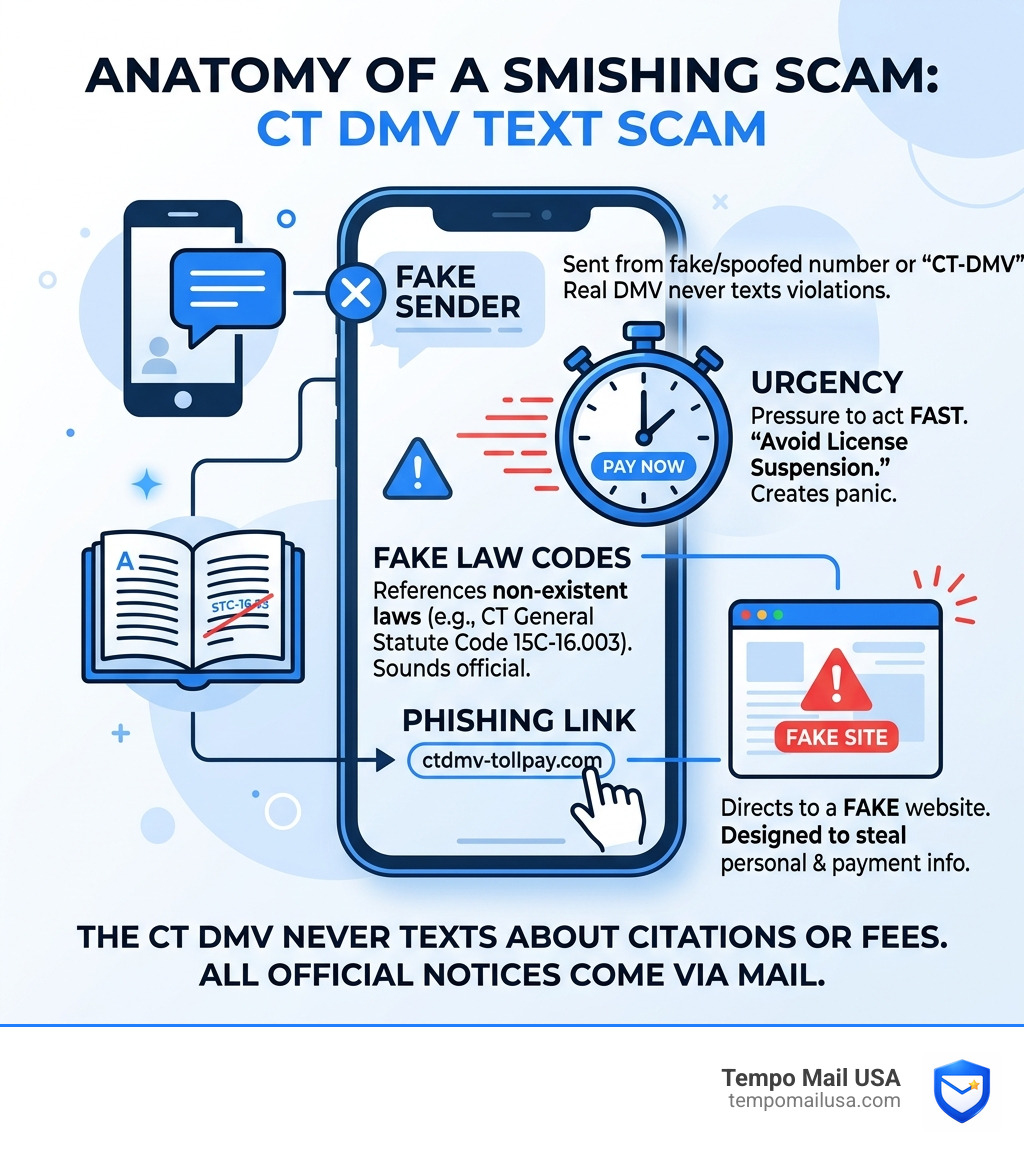
Anatomy of the CT DMV Text Scam
To protect yourself, we need to look at how these scammers operate. The ct dmv text scam usually follows a very specific script designed to bypass your natural skepticism. It isn't just a random message; it’s a calculated psychological attack.

The messages typically claim that you have an unresolved traffic citation or an unpaid toll. To make the message seem "official," scammers often include fake legal jargon. You might see references to the "Northern Connecticut State Administrative Code" or "CT general statute code of 15C-16.003."
Here is the catch: These codes do not exist. The scammers make them up to sound authoritative. According to reports from News 12 Connecticut, these texts often threaten that failure to pay will result in immediate license suspension or even criminal prosecution.
As noted by GovTech, the timing of these messages is also a tactic. Some residents have reported receiving "urgent" texts as late as 9:42 PM. The logic is simple: if you are tired or distracted, you are more likely to click a link without checking the sender’s details.
Identifying Red Flags in a CT DMV Text Scam
Identifying a ct dmv text scam is easier once you know what to look for. While scammers are getting better at mimicking official logos, they almost always leave behind digital "fingerprints" of their fraud.
- The Sender's Address: Real government agencies use short codes or verified numbers. Scam texts often come from strange email addresses or out-of-state phone numbers. If the "From" field looks like a random string of characters, it’s a scam.
- Extreme Urgency: If the text says you must pay "within the next hour" or face "immediate arrest," it’s fake. The DMV moves through a slow, paper-based legal process, not through "panic texts."
- Suspicious URLs: Look closely at the link. It might say something like
ct-dmv-pay.comortoll-violation-notice.org. Official Connecticut government websites always end in.gov. - Generic Greetings: Often, these texts don't use your name. They use generic terms like "Valued Citizen" or "Vehicle Owner."
For more detailed breakdowns on these tactics, check out our guides on How to Spot a DMV Text Scam and the Texas DMV Text Scam, which use very similar red flags.
How to Report a CT DMV Text Scam
If you receive one of these texts, your first instinct might be to reply with "STOP" or a piece of your mind. Don't do it. Replying confirms to the scammer that your phone number is active, which only leads to more spam.
Instead, take these steps:
- Take a Screenshot: This provides evidence for authorities.
- Report to the FTC: Use the official portal at reportfraud.ftc.gov.
- File an IC3 Complaint: The FBI’s Internet Crime Complaint Center (IC3) tracks these trends nationwide. You can file a report at ic3.gov.
- Contact Local Police: If you’ve lost money, contact your local Connecticut police department immediately.
We’ve seen similar patterns in other states, such as the PA DMV scam, and reporting is the only way to help authorities shut down these domains. You can find more advice on handling these fake messages in our article on the Unpaid Traffic Violation Text Scam.
Why These Phishing Attacks Are Dangerous
It might seem like a small thing—clicking a link just to "check" a violation. However, the risks behind a ct dmv text scam are significant and long-lasting.
When you click the link in a scam text, you aren't just looking at a fake ticket. You are entering a "credential harvesting" site. These sites are designed to look exactly like the official CT.gov portal. Once you enter your driver’s license number, Social Security number, or credit card info, the scammers have everything they need to commit identity theft.
The danger doesn't stop at your wallet. These scams often lead to:
- Data Brokering: Your "clean" data is sold on the dark web to other criminals.
- Financial Fraud: Scammers can drain your bank accounts or open new lines of credit in your name.
- Account Takeover: If you use the same password for the DMV site as you do for your email, hackers can lock you out of your entire digital life.
According to a report from CT Post, the DMV has seen a rise in these sophisticated "smishing" attempts. In other states, like Ohio, victims have lost thousands of dollars in a matter of minutes. You can read about the devastating impact of these attacks in our post about the Ohio BMV Scam.
Official Verification: Does the DMV Ever Text You?
In the age of instant notifications, it’s easy to assume the DMV has finally "gone digital." However, the Connecticut DMV remains very traditional for security reasons.
| Communication Type | Official CT DMV Policy | Fraudulent Text Scam |
|---|---|---|
| Method | Physical Mail (USPS) | SMS / Text Message |
| Payment Links | Never included in texts | Always the primary focus |
| Urgency | Standard legal deadlines | "Immediate" or "24-hour" threats |
| Verification | Check via ct.gov/dmv | Directs to third-party URLs |
The DMV's official stance is clear: they do not notify residents of tickets, penalties, or registration issues via text or email with embedded payment links. If you receive a text about a toll, it is also likely a scam. As we noted in our WSDOT Text Scam Alert, tolling agencies across the country are facing the same impersonation issues.
To verify your status safely, always go directly to the official DMV website. Never use a link provided in a text message.
Protecting Your Digital Identity from Smishing
At Tempo Mail USA, we believe the best way to stop a scam is to prevent your real information from reaching the scammers in the first place. Think of your digital identity as a house; you wouldn't leave the front door wide open, would you?
The PII Firewall Strategy
The reason these scammers have your phone number and name is often due to data breaches at third-party sites where you've signed up in the past. To prevent this, we recommend using a PII (Personally Identifiable Information) Firewall.
By using temporary email aliases and secure identity proxying, you can keep your real email and phone number off the "sucker lists" that scammers buy and sell. When you sign up for a non-essential service, use an alias. If that service is breached, the scammers get a useless alias instead of your primary contact info.
Advanced Defensive Tools
Beyond using temporary aliases, we recommend several layers of protection:
- Advanced Malware Protection: This can block your browser from even opening a known phishing link.
- Enterprise Password Managers: These tools won't "auto-fill" your credentials on a fake site, which is a huge red flag that you're on a fraudulent page.
- Secure VPNs: Using a service like NordVPN encrypts your traffic and can provide an extra layer of "Threat Protection" to block malicious domains.
These scams aren't just happening in Connecticut. From Illinois to Hawaii, Secretary of State offices are being impersonated daily. Vigilance is your best defense.
Security Checklist: Free vs. Paid Protection Methods
Staying safe doesn't always have to cost money, but premium tools can offer peace of mind. Here is how we break down the best protection methods for 2026:
Free Protection (Essential Habits):
- Multi-Factor Authentication (MFA): Always use an app-based authenticator (like Google Authenticator) rather than SMS-based MFA, which can be intercepted.
- Credit Freezes: You can freeze your credit for free with Experian, Equifax, and TransUnion. This prevents scammers from opening new accounts even if they steal your data.
- Manual Verification: Always call the agency at a number you find on an official
.govsite.
Paid Protection (Advanced Defense):
- Identity Theft Protection Services: Services that monitor the dark web for your Social Security number and provide fraud resolution experts if you are compromised.
- Credit Monitoring Software: Real-time alerts whenever someone pulls your credit report.
- Identity Proxying: Using services like Tempo Mail USA to create a barrier between your real identity and the public internet.
Whether you are dealing with the Idaho DMV scam or a Kentucky transportation scam, the checklist remains the same: verify, protect, and report.
Frequently Asked Questions about CT DMV Scams
Does the Connecticut DMV send text messages about unpaid tolls or tickets?
No. The Connecticut DMV's official policy is to communicate exclusively through the U.S. Postal Service for all matters regarding violations, license suspensions, and registration fees. Any text message claiming to be from the DMV is a fraudulent attempt to steal your personal information.
What should I do if I already clicked a link in a scam text?
If you clicked a link, immediately disconnect from Wi-Fi to stop any potential malware downloads. If you entered financial information, contact your bank to freeze your cards and dispute any recent charges. You should also change the passwords for your primary email and any sensitive accounts. For a step-by-step recovery plan, see our guide on staying safe after a scam.
How can I verify if I actually have an outstanding traffic violation in Connecticut?
The safest way to check for violations is to visit the Official CT.gov portal and use their "Check Status" tools. You can also call the DMV directly at their official customer service numbers. Never use the contact information or links provided in a suspicious text message.
Conclusion
The ct dmv text scam is a reminder that our digital world requires constant vigilance. Scammers are banking on your stress and the "official" appearance of their messages to steal your hard-earned money and your identity.
By following simple digital hygiene practices—like never clicking unsolicited links, using a VPN for secure browsing, and employing a PII firewall through Tempo Mail USA—you can stay one step ahead of the fraudsters.
We encourage all Connecticut residents to share this guide with friends and family. Education is the most powerful tool we have to shut down these scams for good. Stay safe, stay skeptical, and keep your primary data protected.