

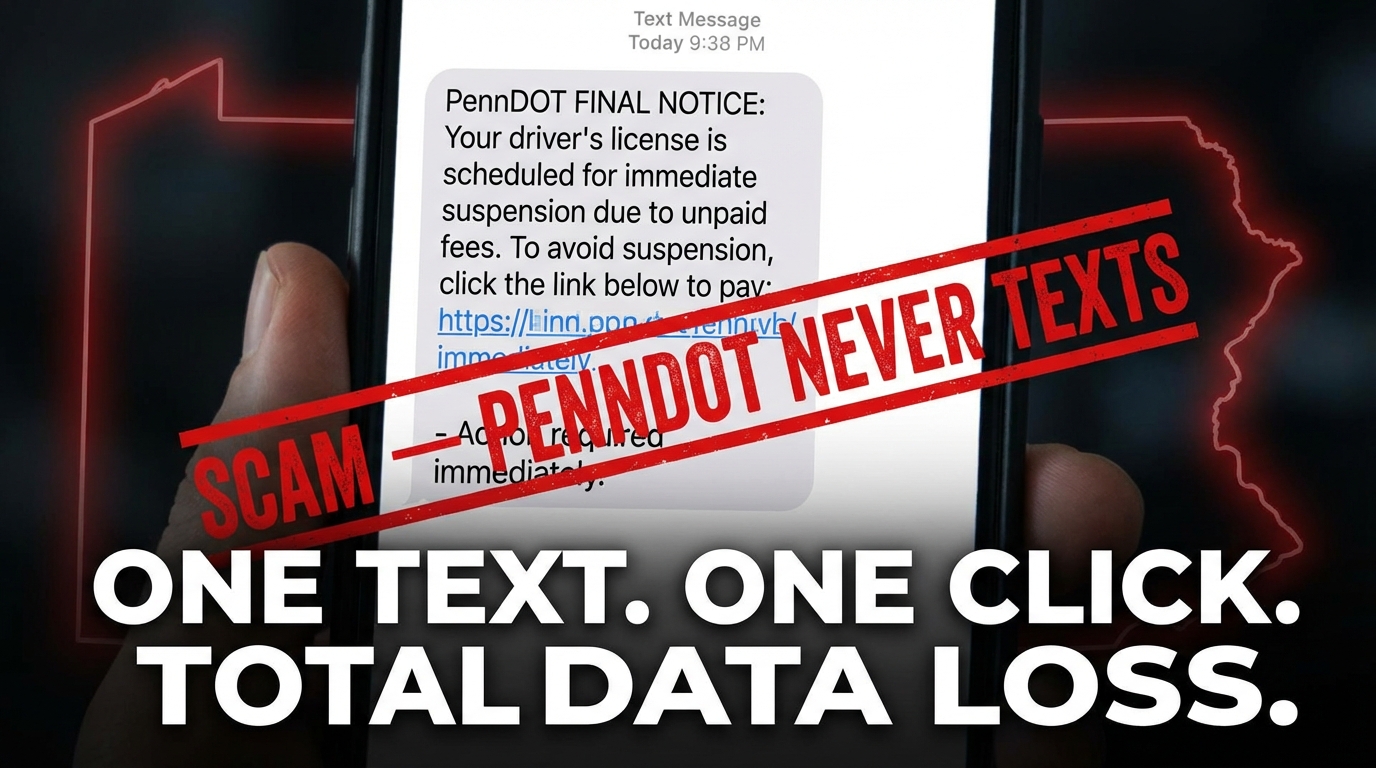

Is That PennDOT Text Real? Here's What You Need to Know
If you got a text claiming to be from PennDOT, the penndot text scam is almost certainly what you're dealing with — and you should not click anything in it.
Quick answer:
- PennDOT does not send text messages — ever
- Any text claiming to be from PennDOT about fines, tolls, or license suspension is fake
- Do not click any links in the message
- Delete it immediately and report it
Pennsylvania drivers across the state have been receiving alarming texts on their phones. The messages claim to be from PennDOT — or sometimes the Pennsylvania DMV — and warn that your driver's license or vehicle registration will be suspended unless you pay an outstanding fine right now.
It feels urgent. It's designed to.
But every single one of these texts is a scam.
Multiple Pennsylvania agencies — including PennDOT itself, the Pennsylvania State Police, and the Pennsylvania Turnpike Commission — have confirmed they do not contact residents by text message. Official communications from PennDOT arrive only by U.S. Postal Service mail. Nothing else is legitimate.
This type of scam is called smishing (SMS phishing). Scammers impersonate trusted government agencies to pressure you into clicking a malicious link, which can steal your personal information, banking details, or install malware on your device. Pennsylvania residents already lose close to $3 billion annually to online fraud — and these fake government texts are a growing part of that problem.
Since 2024, this wave of fake toll and transportation texts has hit states across the country. Pennsylvania is no exception.

What is the PennDOT Text Scam?
The penndot text scam is a fraudulent scheme where malicious actors send text messages to your mobile phone pretending to be the Pennsylvania Department of Transportation. These messages are carefully crafted to mimic official government language, often using terms like "DMV violation" or "unpaid traffic ticket."
The goal of the scam is simple: to scare you. By claiming that your driving privileges or vehicle registration are at risk of a 30-day suspension, the scammers hope you will panic and click the link provided in the text. According to PennDOT warns of scam texts about fake traffic tickets, residents in counties like Bedford, Blair, and Somerset have been specifically targeted by these fake notices.
It is important to remember that these messages are not unique to Pennsylvania. We have seen similar tactics used in the Unpaid Traffic Violation Text Scam: Don't Pay This Fake DMV Message, where scammers use the same "pay now or lose your license" script to target drivers nationwide.
How the penndot text scam targets drivers
Scammers use a "scattergun" approach. They send out thousands of these texts at once, often targeting specific area codes within Pennsylvania. They don't necessarily know if you actually have an unpaid fine; they just hope that out of a thousand people, a few will be worried enough to click.
Once you click the link in a penndot text scam message, you are usually taken to a "phishing" website. This site is designed to look exactly like an official PennDOT or PA Turnpike payment portal. It will ask for:
- Your full name and address
- Your driver's license number
- Your Social Security number
- Your credit card or bank account information
This is a classic data harvesting operation. Once the scammers have this information, they can commit identity theft or drain your bank account. This mirrors the massive EZPass Scam Text: 60,000 Reports and Counting trend we’ve tracked, where tens of thousands of people are targeted by fake toll requests.
Red Flags: How to Spot a penndot text scam
Identifying a penndot text scam is actually quite easy once you know the "Golden Rule" of Pennsylvania government communications: If it’s a text, it’s a fake.
However, scammers are getting better at making their messages look real. They might use official logos or reference specific Pennsylvania laws. To help you stay safe, we’ve put together a comparison of how the state actually communicates versus how scammers operate.
| Feature | Official PennDOT Communication | PennDOT Text Scam |
|---|---|---|
| Method | U.S. Postal Service (Paper Mail) | SMS / Text Message |
| Urgency | Formal notice with clear deadlines | Aggressive threats of "immediate" suspension |
| Links | None (Instructions to visit .gov sites) | Shortened or suspicious links (e.g., bit.ly) |
| Payment | Check, Money Order, or Official Portal | Direct credit card entry on a linked site |
| Personal Info | Already on file | Asks you to "verify" or "update" PII |
According to the Shapiro Administration Warns of Text Phishing Scams Aimed at Pennsylvanians, these malicious actors are becoming increasingly sophisticated. They often use high-pressure tactics, much like the Parking Violation Scam Text: That Fine is Stealing Your Card strategy, where the message implies that the longer you wait, the higher the fine becomes.
Common claims in a penndot text scam
While some texts focus on license suspensions, others target your wallet through fake tolls. You might receive a message claiming you have an "outstanding E-ZPass balance" or a "Toll By Plate" invoice that is past due.

These messages often include a link that looks vaguely official but usually contains extra words or strange extensions. For example, instead of a .gov or .pa.us address, the link might end in .com, .net, or a series of random characters. If you see a link like "pa-turnpike-bills.com," it is a 100% certainty that you are looking at a penndot text scam.
Official Communication Channels vs. Fraud
We cannot stress this enough: PennDOT, the Pennsylvania State Police, and the Pennsylvania Turnpike Commission do not send text messages for fines, tolls, or violations.
When the state needs to reach you regarding your driving record or vehicle registration, they use the U.S. Postal Service. This is a secure, verifiable method that ensures you are receiving official documentation. If you haven't received a letter in your physical mailbox, you likely don't have a problem.
This "mail-only" policy is standard for many state agencies across the country. For instance, the Illinois DOT Text Scam: IDOT Will Never Text You warning highlights that Illinois follows the same protocol. Similarly, the Texas DMV Text Scam: Fake Messages & Red Flags alert reminds drivers that legitimate DMV offices will never text you out of the blue asking for money.
If you are ever in doubt, don't use the contact information provided in a text. Instead, look up the official phone number for PennDOT or the PA Turnpike on their verified .gov websites and call them directly.
What to Do if You Receive a Suspicious Message
If a penndot text scam lands in your inbox, your first instinct might be to reply "STOP" or click the link just to see what it is. Do not do this. Replying to the text confirms to the scammer that your number is active, which will only lead to more spam.
Here is our recommended step-by-step survival plan:
- Stop and Breathe: The urgency is fake. You are not going to lose your license in the next five minutes.
- Screenshot the Message: This can be useful for reporting the scam to authorities later.
- Delete and Block: Use your phone’s built-in features to report the message as junk and block the sender.
- Report to the Bureau of Consumer Protection: The Pennsylvania Attorney General’s office actively tracks these scams. You can submit a complaint online or call 1-800-441-2555.
As noted in PennDOT scam texts are back: What you should do if you get one, blocking the number is essential, though be aware that scammers often "spoof" numbers or change them frequently to bypass blocks. This is a tactic seen nationwide, including in the Idaho DMV Scam Text Alert: Fake Messages Targeting Drivers, where scammers rotate through hundreds of VoIP numbers to keep their campaign alive.
Frequently Asked Questions about PennDOT Scams
Does PennDOT ever send text messages about fines?
No. PennDOT’s official policy is that all notifications regarding traffic violations, driver's license suspensions, or vehicle registration issues are sent via traditional U.S. Mail. They do not use text messages or unsolicited emails to collect payments or threaten legal action.
How can I safely check my toll or violation status?
If you are worried that you might actually owe a fine, go to the source safely:
- For Tolls: Log in to your official account at the PA Turnpike E-ZPass website or use the official "PA Toll Pay" app.
- For Driver's License/Registration: Visit the official PennDOT Driver and Vehicle Services website (look for the .gov extension) or call their customer service center at 717-412-5300.
- Verify via Phone: If you receive a suspicious "invoice," call the agency using a number from their official website, not the number that texted you.
Where should I report a Pennsylvania smishing attempt?
Reporting helps authorities shut down the fraudulent websites these scammers use. You should report the penndot text scam to:
- The FTC: Visit reportfraud.ftc.gov.
- The FBI: File a complaint with the Internet Crime Complaint Center (IC3) at ic3.gov.
- PA Attorney General: Email a screenshot of the scam text to the Bureau of Consumer Protection.
Conclusion
The penndot text scam is a high-pressure tactic designed to steal your hard-earned money and your identity. By staying calm and remembering that PennDOT only communicates via official mail, you can protect yourself from these digital predators.
Our personal information—like our phone numbers and emails—is constantly being leaked or sold, making us easy targets for smishing. This is why we believe in a "PII Firewall" approach to cybersecurity.
At Tempo Mail USA, we provide temporary email aliases that act as a proxy for your real identity. While we can't block every text to your phone, using secure aliases for online services helps shield your personal information from the data breaches that scammers use to find their next victim. By minimizing the amount of your real data living on the internet, you reduce the chances of your number ending up on a scammer's hit list.
Stay vigilant, Pennsylvania. Don't let a fake text ruin your day. For more tips on staying safe online, visit us at https://tempomailusa.com.