


The Texas DMV Scam Is Targeting Drivers Right Now — Here's What You Need to Know
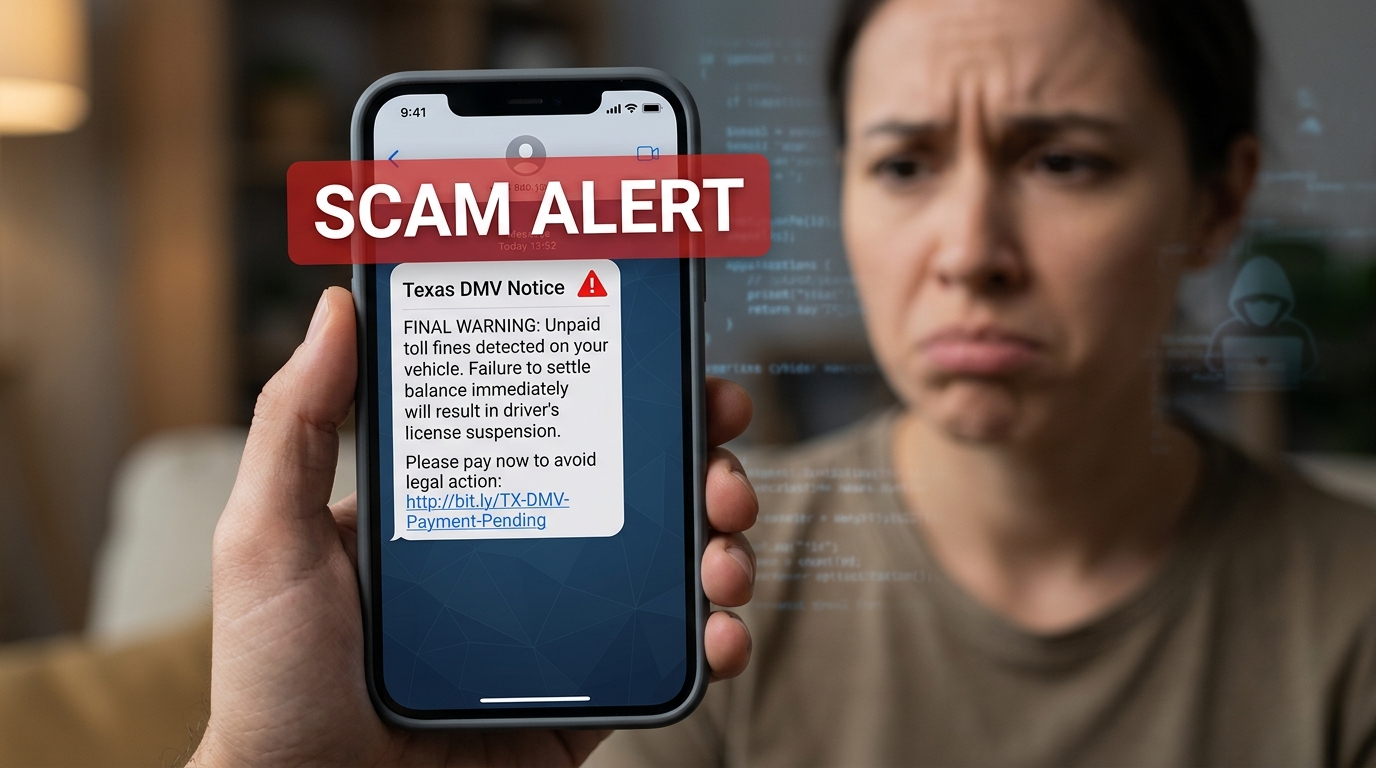
The texas dmv scam is an active fraud campaign where criminals send fake text messages pretending to be from the Texas Department of Motor Vehicles, threatening fines, license suspensions, or legal action to trick you into clicking a malicious link.
Quick answers if you just received a suspicious text:
- Is it real? No. TxDMV does not send unsolicited texts about unpaid tickets or fines.
- Should you click the link? Absolutely not.
- What should you do right now?
Drivers across Texas have been flooded with these messages. They look urgent. They use official-sounding language. And they're designed to make you panic and act fast.
As the Texarkana Police Department put it when warning residents about these texts: "The real DMV isn't sending out threats filled with random big words and weird phrases."
That's exactly right. And yet people still fall for it — because the scam is engineered to exploit fear.
Multiple Texas police departments, including those in Amarillo, League City, and Texarkana, have issued public warnings about this ongoing threat. TxDMV itself released an official press release as recently as July 2025 with the blunt message: "Don't click it. It's not a ticket."
The stakes are real. Clicking the link can expose your personal and financial information to criminals who will exploit it immediately.
Understanding the Texas DMV Scam and How It Works
To beat a scammer, we first have to understand their playbook. The texas dmv scam is a classic example of "smishing" (SMS phishing). These aren't just random messages sent by a bored teenager in a basement; they are part of a highly organized, bulk-SMS operation.
Scammers start by sending out thousands of text messages at once. They don't necessarily know if you even own a car in Texas—they play a numbers game, knowing that in a state as big as ours, a huge percentage of the population are drivers. The messages usually claim there is a "final notice" or an "outstanding balance" on a traffic ticket or toll.
When you click the link provided in the text, you aren't taken to an official government website. Instead, you land on a fake DMV payment portal. These sites are designed to look identical to the real TxDMV website, complete with official logos and colors. This is where the real damage happens. The site will ask for your:
- Full name and address
- Driver's license number
- Social Security number
- Credit or debit card details (often under the guise of paying a small "processing fee" or "fine")
One of the cleverest parts of this scam is domain rotation. Scammers know that once a URL like txdmv-pay-fine.com is reported, it will be blocked. To stay ahead of the law, they constantly register new, gibberish domains like txdmv.gov-kljv.win/portal or txdmv-gov-xyz.net. They rotate these domains daily or even hourly to evade security filters.
We see this same pattern across the country. For instance, the nys-dmv-scam-text-170-reports-in-rochester showed that scammers are using the exact same tactics in New York. For a deeper dive into the technical mechanics, you can read more about how the Texas DMV “Outstanding Traffic Ticket” Text Scam Explained breaks down the deceptive link structure.
Why the Texas DMV scam uses fake traffic tickets
Why do scammers focus on traffic tickets? Because tickets involve two things humans hate: losing money and dealing with the law. By claiming you have an unpaid citation, they create an immediate sense of anxiety.
However, there is a massive logical flaw in the texas dmv scam that most people miss: The Texas DMV does not issue traffic tickets.
In the State of Texas, traffic citations are issued by law enforcement agencies—think local police departments, County Sheriffs, or State Troopers (Texas Department of Public Safety). The DMV's job is vehicle registration, titling, and licensing dealers. They are an administrative agency, not a "ticket-writing" agency.
If you actually had an unpaid ticket, you would hear from a municipal court or a justice of the peace, usually via a physical letter in the mail, not a text from the DMV. Scammers frequently invent fake departments to sound official, a tactic explored in our guide on the traffic-compliance-department-scam-that-agency-doesnt-exist.
Common red flags in a texas dmv scam text
If you look closely at these texts, the "professional" facade starts to crumble. Scammers often use "thesaurus-itis"—they use big, intimidating words that don't actually make sense in a legal context.
Here are the most common red flags we've identified:
- Non-U.S. Prefixes: Many of these texts come from phone numbers starting with country codes other than +1 (the USA). If "Texas" is texting you from a number in another country, it's a scam.
- Bizarre Jargon: Look for phrases like "immutable credential endorsement" or "registration voidance." As the Texarkana Police noted, they aren't even sure what that "crap" means. Real government agencies use plain, standard English.
- Nonsensical Penalties: Some scam texts threaten a "3.0 days" suspension or a "55% administrative charge." These numbers are arbitrary and don't align with any actual Texas law.
- The "Low-Dollar" Trap: They might only ask for $5.00 or $9.75. They do this because people are more likely to "just pay it to make it go away" without investigating. Once they have your card info for that $5 payment, they have everything they need to drain your account.
| Feature | Official TxDMV Communication | Scam Text Message |
|---|---|---|
| Primary Method | U.S. Mail (Physical Letter) | Unsolicited SMS/Text |
| Link URL | Always ends in .gov | Ends in .win, .xyz, .net, or .com |
| Payment Request | Through secure, official portals | Requests card info via text link |
| Language | Standard, clear legal terms | Intimidating, "big" words that make no sense |
| Urgency | Provides a clear deadline and process | "Final Notice" or "Immediate Action Required" |
Impersonation of TxTag and Other Texas Agencies
The texas dmv scam isn't the only one on the road. Scammers are also aggressively impersonating TxTag, the electronic toll collection system operated by the Texas Department of Transportation (TxDOT).
Since April 2024, there has been a massive spike in "toll smishing." Customers receive a text claiming they have an outstanding toll balance that must be paid immediately to avoid a "service fee" (often cited as 35%).
Here is the truth: TxTag does not send unsolicited texts regarding balances due. While you can opt-in to receive notifications from TxTag, they are only sent from the official shortcode 22498. If you get a toll alert from a standard 10-digit phone number, it is a fraud.
This isn't just a Texas problem. We've seen similar massive campaigns with the ezpass-scam-text-60000-reports-and-counting on the East Coast. Interestingly, scammers sometimes get lazy and send these texts to people in states that don't even have tolls, like the mdot-scam-text-michigan-has-no-toll-roads incident.

What to Do If You Receive a Suspicious Message
If your phone buzzes with a message about a "Texas DMV violation," don't panic. Your best weapon is doing absolutely nothing.
- Do Not Click: The link is the trap. Even clicking it can sometimes trigger a malware download or alert the scammer that your phone number is "active," leading to even more spam.
- Do Not Reply: Replying "STOP" or "Who is this?" just confirms to the scammer that a real person is reading their messages.
- Block the Sender: Use your phone’s built-in features to block the number immediately.
- Delete the Message: Once you've reported it (see below), get it off your phone so you don't accidentally click it later.
How to Report the Scam: We highly encourage you to report these messages. It helps authorities track the scammers and shut down their fake websites.
- FBI’s IC3: Report the message to the FBI’s Internet Crime Complaint Center.
- FTC: Report fraud to the Federal Trade Commission.
- 7726: Most major carriers allow you to forward scam texts to the number 7726 (which spells "SPAM").
Consequences of Falling for DMV Fraud
What happens if you did click and enter your info? It’s important to understand the gravity of the situation so you can take the right corrective steps.
The primary goal of the texas dmv scam is Personally Identifiable Information (PII) theft. Once a scammer has your name, address, SSN, and driver's license number, they can:
- Open new credit lines in your name.
- File fraudulent tax returns to steal your refund.
- Sell your data on the dark web.
If you provided your credit card info, the fraud usually starts small. Scammers often run "micro-charges" of $1 or less to see if the card is active. If it works, they follow up with massive purchases or cash withdrawals. In some cases, clicking the link can even install malware that tracks your keystrokes, giving them access to your bank passwords.
This is a nationwide epidemic. The toll-scam-text-million-lost-here-s-how-to-stay-safe report highlights just how much money is being drained from unsuspecting drivers. Similar warnings have been issued for the tennessee-dmv-scam-text and the secretary-of-state-text-scam-illinois-maine-hawaii-all-warned.
Frequently Asked Questions about Texas DMV Scams
Does the real Texas DMV send text messages about unpaid tickets?
No. The official policy of the Texas Department of Motor Vehicles is that they never contact individuals via unsolicited text message or email to request personal information or payment for fines.
The TxDMV handles vehicle titles and registrations. If there were an issue with your registration, they would send an official notice through the U.S. Mail. Any payments you need to make should only be done through their secure, official website at txdmv.gov or in person at a county tax office.
How can I verify if a message from TxTag is legitimate?
If you receive a text that you think might be real, do not use the link in the message. Instead:
- Go directly to
TxTag.orgby typing it into your browser. - Log into your official account to check your balance.
- Check the sender's number. Legitimate TxTag texts only come from the shortcode 22498.
- TxTag requires you to opt-in to receive text notifications. If you never signed up for them, any text you get is a scam.
What should I do if I already clicked the link and provided my information?
If you’ve been victimized, you need to act fast. We recommend this checklist:
- Contact Your Bank: Call your credit card issuer or bank immediately. Tell them you’ve been a victim of a phishing scam. They will cancel your card and issue a new one.
- Place a Fraud Alert: Contact the three major credit bureaus (Equifax, Experian, and TransUnion) to place a fraud alert or a credit freeze on your accounts.
- Change Passwords: If you used the same password on the fake site as you do for other accounts, change them immediately and enable Two-Factor Authentication (2FA).
- Monitor Your Identity: Keep a close eye on your credit report for the next 12 months.
Conclusion
The texas dmv scam is a reminder that our personal information is constantly under fire. Scammers are getting better at mimicking official agencies, but by staying vigilant and knowing the red flags—like weird jargon and fake "DMV tickets"—we can protect ourselves.
One of the best ways to stay safe in the long run is to reduce the amount of real data you have floating around the internet. When you sign up for online services, vehicle forums, or third-party apps, you don't have to give away your primary contact information.
At Tempo Mail USA, we believe in providing a "privacy firewall" for your digital life. By using temporary email aliases, you can protect your real identity from being harvested by scammers. If a service gets breached or sells your data to a list that scammers use for these text campaigns, your real email and identity remain safe behind our proxy.
Stay safe on the roads and in your inbox. For more privacy tips and to secure your digital identity, visit us at https://tempomailusa.com. Remember: if the DMV "texts" you about a ticket, it’s not a ticket—it’s a trap!