



The Jury Duty Scam Calls Targeting Americans Right Now
Jury duty scam calls are one of the most widespread phone fraud schemes in the US today — and they're working.
Here's what you need to know right now:
- It's always a scam if someone calls demanding money for a missed jury summons
- Real courts never call to threaten arrest or demand payment over the phone
- Official jury notices always come by mail — never by surprise phone call
- Never pay via gift cards, cryptocurrency, wire transfer, or prepaid debit cards
- Hang up immediately and verify your jury status directly with your local court clerk
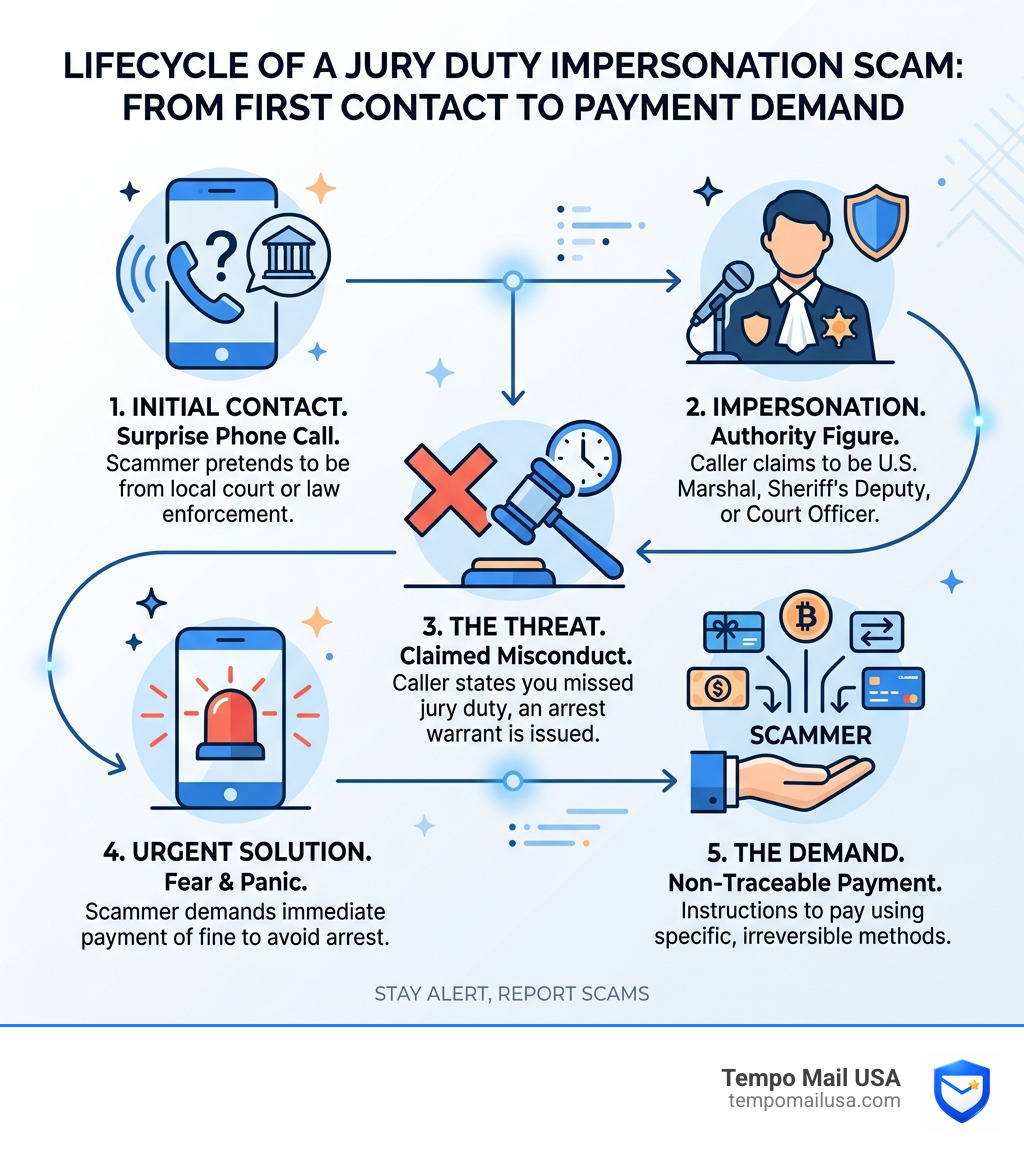
The scam follows a simple but effective playbook. Someone calls claiming to be a U.S. Marshal, sheriff's deputy, or court officer. They tell you that you missed jury duty and a warrant has been issued for your arrest. The only way to avoid jail, they say, is to pay a fine right now.
It feels urgent. It feels real. And that's exactly the point.
Reports show victims have lost anywhere from $400 to $2,000 in a single call. In North Carolina alone, the scam has targeted thousands of residents — particularly the elderly around the holiday season. Washington state has seen a significant increase in jury scam calls, texts, emails, and even physical mailings.
What makes this scam so effective is that it exploits a very real fear: the legal consequences of ignoring a court summons. Scammers know most people aren't sure what happens if they miss jury duty — so they fill that uncertainty with panic.
The good news? Once you know how the scam works, it's easy to spot and shut down.
How Jury Duty Scam Calls Work
The mechanics of jury duty scam calls rely heavily on authority. Scammers don't just call as "someone from the court"; they often impersonate specific high-ranking officials. We have seen reports of scammers posing as U.S. Marshals, Sheriff's Deputies, or even specific local judges whose names they find on public websites.
The call usually begins with a stern tone. The "officer" informs you that you failed to appear for a jury summons. To make the story more believable, they might mention a fictitious case number or an "Order to Show Cause." They claim an arrest warrant has already been signed, but—lucky for you—there is a way to resolve it without going to jail: paying a "civil fine" or "bond" immediately.
According to the U.S. District Court, these callers are highly sophisticated. They use "caller ID spoofing" to make your phone display the name of a local police department or the courthouse. This makes the threat feel legitimate before you even pick up the phone. If you see a call from a number that looks official, scammers can easily fake that information. For instance, residents have reported issues with the Area Code 332 Scam, where local-looking numbers are used to bypass our natural skepticism.
Identifying Spoofed Numbers in jury duty scam calls
One of the biggest red flags is the use of local prefixes. Scammers know we are more likely to answer a call from our own area code. They might use a local number to build a false sense of security. In some cases, people have been targeted by the 737 Area Code Scam, proving that just because a number looks like it’s coming from down the street doesn't mean it is.
Government agencies, including the courts, do not use "spoofable" consumer lines to demand money. If the caller ID says "Sheriff’s Office" but the person on the other end is asking for a Bitcoin transfer, you can be 100% certain it is a scam.
Variations of the Scam Across States
While the core of the scam remains the same, the "flavor" changes depending on where you live.
- Washington State: Authorities have noted a massive spike in jury scam calls, texts, and emails. In Pierce County and Snohomish County, scammers have even gone so far as to use the names of real jail inmates to add "authenticity" to their threats.
- North Carolina: This state sees a seasonal surge, particularly around the holidays. Scammers often target the elderly, and while the real penalty for missing jury duty in NC is a mere $50, scammers regularly demand thousands.
- Oregon: The Oregon Judicial Branch warns that while they might send text reminders for jury duty, they will never ask for money or sensitive info via text.
- Maryland: The District of Maryland has reported scammers transferring victims between "departments" to simulate a real government office environment.
Common Tactics Used in jury duty scam calls
Scammers are essentially actors. They use a script designed to keep you on the defensive. They might provide a fake badge number, a "warrant ID," or a "court district number." They may even play background noise that sounds like a busy police station or a courtroom to sell the lie.
The most telling tactic is the demand for immediate payment through untraceable methods. Real government agencies do not accept gift cards. If someone asks you to go to a local pharmacy or grocery store to buy "vouchers" or load a "prepaid card" to pay a court fine, it is a scam. We have also seen an overlap with other digital frauds, such as PayPal Scam Emails, where scammers use familiar platform names to trick you into sending funds. Learning how to avoid phishing is your best defense against these multi-channel attacks.
Requests for Sensitive Personal Information
Beyond money, scammers are after your identity. They may ask you to "verify" your Social Security number, birth date, or home address to "clear the warrant." Providing this information is extremely dangerous, as it can lead to long-term identity theft. This tactic is similar to Tax Abatement Scam Calls, where fraudsters use the guise of official government business to harvest PII (Personally Identifiable Information).
High-Pressure Threats and Urgency
The "ticking clock" is a scammer's favorite tool. They will tell you that the police are on their way to your house right now and that the only way to stop them is to stay on the phone and complete the payment. They may threaten to suspend your driver's license or throw you in jail for 30 days.
Remember: the real government moves slowly. No one is going to be dispatched to your house over a missed jury summons while you are still on the phone. Much like the American Tax Advocates Scam Calls, these criminals rely on the fact that the IRS and the courts never call out of the blue to threaten you with immediate arrest.
Real Court Protocols vs. Scammer Demands
To protect ourselves, we must understand how the legal system actually functions. There is a wide gap between how a scammer operates and how a real court handles a "Failure to Appear."
| Feature | Real Court Procedure | Jury Duty Scam Tactic |
|---|---|---|
| Initial Contact | Official U.S. Mail (First-Class) | Unexpected Phone Call, Text, or Email |
| Payment Method | Check, Credit Card (via official portal), or Cash at Clerk's Office | Gift Cards, Crypto, Wire Transfer, Prepaid Debit |
| Urgency | Provides weeks to respond or a court date | Demands payment "within the hour" |
| Threats | Legal notice of potential fines | Immediate arrest, "officers are en route" |
| Sensitive Info | Requested via secure paper forms | Requested over the phone (SSN, DOB) |
According to FTC Consumer Advice, courts do not request payments over the phone. If a fine is truly owed, it is typically imposed by a judge in open court, where you have the opportunity to explain why you missed your service.
Official Notification Methods
The primary way courts communicate is through the U.S. Postal Service. You will receive a physical "Failure to Appear Notice" or a second summons in the mail. If you have questions, you should always look up the number for your local Jury Commissioner or Clerk of Court yourself. Never use a phone number provided by a caller.
We see similar patterns in other government impersonation frauds, like the NYS DMV Scam Text, where scammers try to move communication away from official mail and onto your smartphone.
Real Penalties for Missing Jury Duty
The actual penalties for missing jury duty are rarely as severe as scammers claim. For example:
- North Carolina: The statutory penalty is only $50 per failure to appear.
- General Procedure: You are usually sent a notice to appear at a hearing to explain your absence. Only after failing to show up to that hearing would a judge consider more serious actions.
Scammers will try to tell you that you owe $1,500 or $5,000 for a "bond." These numbers are entirely fabricated. We've seen similar inflated threats in FLHSMV Scam Texts, where scammers invent massive fines to scare drivers into paying.
What to Do if You’ve Fallen Victim to a Scam
If you have already paid a scammer or shared your personal information, do not be ashamed. These criminals are professionals who spend all day perfecting their lies. One victim in Alexandria, VA, lost $1,000 recently, and another was taken for $2,000 via a Walmart GO2 bank transfer. It can happen to anyone.
The first step is to stop all communication with the scammer. If you paid via a credit card or bank transfer, contact your financial institution immediately to report the fraud. If you provided your Social Security number, you need to treat this as a case of identity theft. Much like recovering from a Gold Bar Scam, time is of the essence when protecting your assets.
Reporting jury duty scam calls to Authorities
Reporting is crucial because it helps law enforcement track these groups.
- FTC: Report the incident at ReportFraud.ftc.gov.
- FBI: If the scam involved federal court impersonation, contact your local FBI field office. For instance, residents in Maryland should contact the FBI Maryland Field Office.
- Local Court: Notify the Clerk’s Office or the U.S. District Clerk’s Office in your area. They need to know that their name is being used for fraud.
- State Resources: Use the Federal Court Finder to find legitimate contact info. If you are in Ohio, you might also want to stay updated on other local threats like the Ohio BMV Scam Text Alert.
Steps for Identity Recovery
If you shared sensitive data, you should:
- Place a fraud alert on your credit reports with Equifax, Experian, and TransUnion.
- Monitor your bank accounts for any unauthorized activity.
- Change passwords for your sensitive accounts (banking, email, etc.).
- Be on the lookout for other government-themed follow-up scams, such as Penndot Text Scams.
How to Prevent Future Jury Duty Scam Calls
The best way to deal with jury duty scam calls is to ensure they never reach you in the first place—or that if they do, the scammers have nothing to work with.
We recommend using call-blocking apps and built-in smartphone features that silence unknown callers. If you don't recognize a number, let it go to voicemail. A real court official leaving a message will provide a legitimate callback number that you can verify on a ".gov" website. If you are tired of the constant ringing, you can learn how to stop spectrum spam calls using various filtering methods.
At Tempo Mail USA, we focus on the "PII Firewall" concept. Scammers often get your phone number and name from data breaches or "people search" websites. By using temporary email aliases and identity proxies when signing up for non-essential services, you keep your real contact information out of the hands of the brokers who sell lists to scammers.
Verifying Your Jury Status Safely
If you are genuinely worried that you might have missed a summons, verify it the right way:
- Go to the official website of your county or district court.
- Look for the "Jury Services" section.
- Call the Clerk of Court using the number listed on the official ".gov" or ".edu" site.
Never trust a text message with a link. As the SC DMV Scam Text warning reminds us: legitimate government agencies almost never text you out of the blue to ask for action.
Protecting Your Personal Information Online
Identity protection is a marathon, not a sprint. To reduce your "digital footprint":
- Use a temporary email for online shopping and newsletters.
- Avoid oversharing on social media (scammers use your "check-ins" to know which local court to impersonate).
- Be wary of "loan offers" or "credit checks" that might be phishing attempts, such as Personal Loan Review Spam Calls.
Frequently Asked Questions about Jury Duty Scams
Will the court ever call me to demand a fine?
No. Courts and law enforcement agencies will never call you to demand immediate payment of a fine. Fines are handled through official mail or in person at the courthouse. If a caller asks for money over the phone, it is a scam. As the FTC warns, this is a classic government impersonation tactic.
What should I do if a caller threatens me with immediate arrest?
Hang up the phone. Do not engage with them. Take a deep breath and remind yourself that this is not how the American legal system works. Once you've hung up, you can call your local Clerk of Court to verify your status if you're still concerned. Check out our guide on BMV Unpaid Ticket Scam Texts to see how similar threats are used in other contexts.
Can I be scammed via email or text message about jury duty?
Yes. Scammers have expanded to "smishing" (SMS phishing) and email. They may send you a link to a "fake warrant" or a "court payment portal." These links are designed to steal your credit card info or infect your device with malware. If you receive a suspicious email, it might be part of a broader campaign like those from US Tax Consultants Spam Calls.
Conclusion
Jury duty scam calls are designed to hit us where we are most vulnerable: our respect for the law and our fear of getting in trouble. By keeping a cool head and remembering that real courts communicate via U.S. Mail, you can protect your bank account and your identity.
The key takeaways are simple:
- Never pay over the phone.
- Never share your Social Security number with an unsolicited caller.
- Always verify through official court channels.
At Tempo Mail USA, we believe that privacy is your best defense. By shielding your personal information from the start, you make it much harder for scammers to find you. Stay vigilant, stay informed, and remember that you have the power to just hang up.
For more information on protecting your digital identity, visit us at https://tempomailusa.com.