

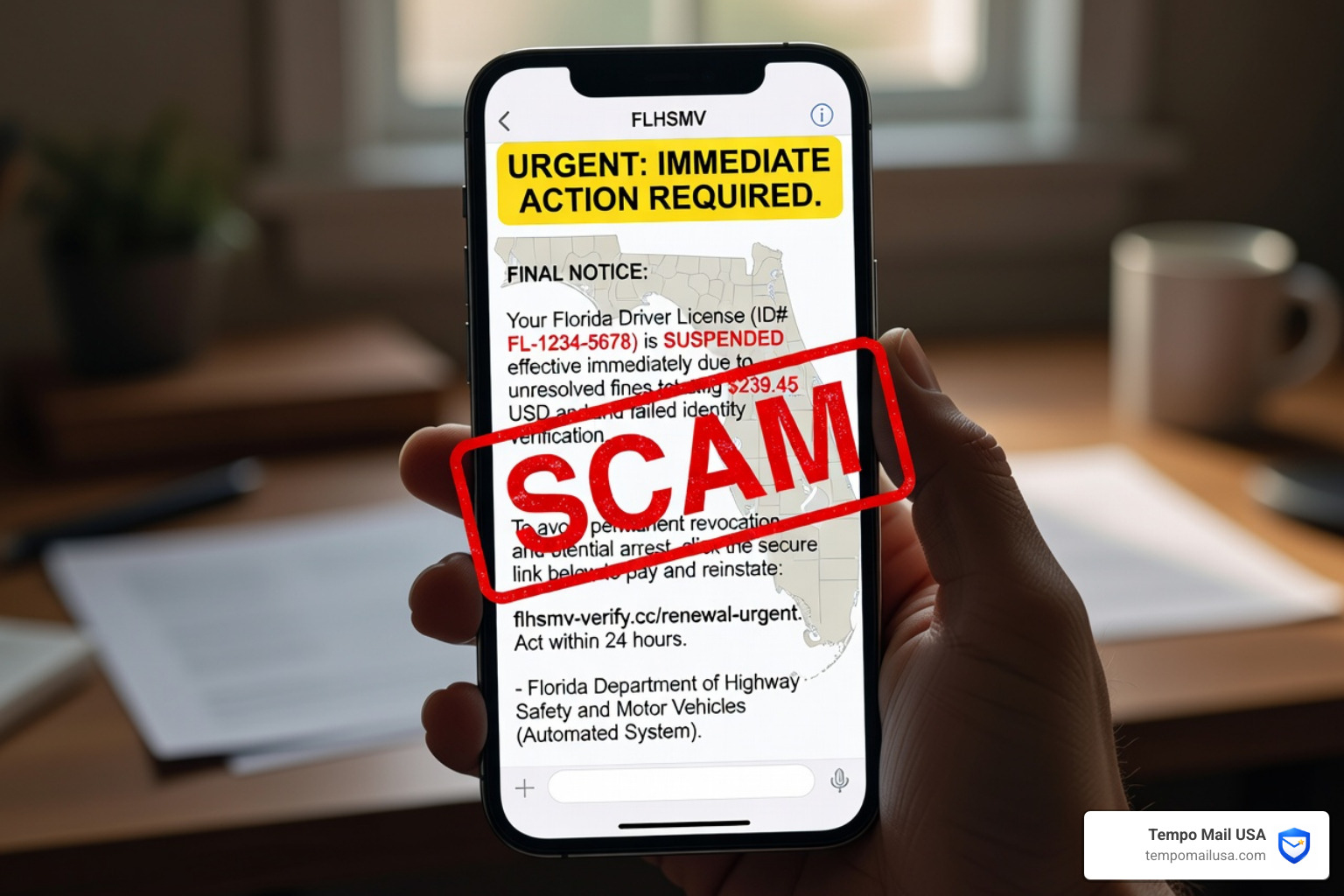

The FLHSMV Scam Text Targeting Florida Drivers Right Now
If you got an FLHSMV scam text on your phone, here's what you need to know right now:
- It is a scam. The Florida Department of Highway Safety and Motor Vehicles (FLHSMV) never contacts drivers by text to demand payment or threaten license suspension.
- Do not click any links in the message.
- Do not pay anything or enter personal information.
- Report it to the FTC at reportfraud.ftc.gov and forward the text to 7726 (SPAM).
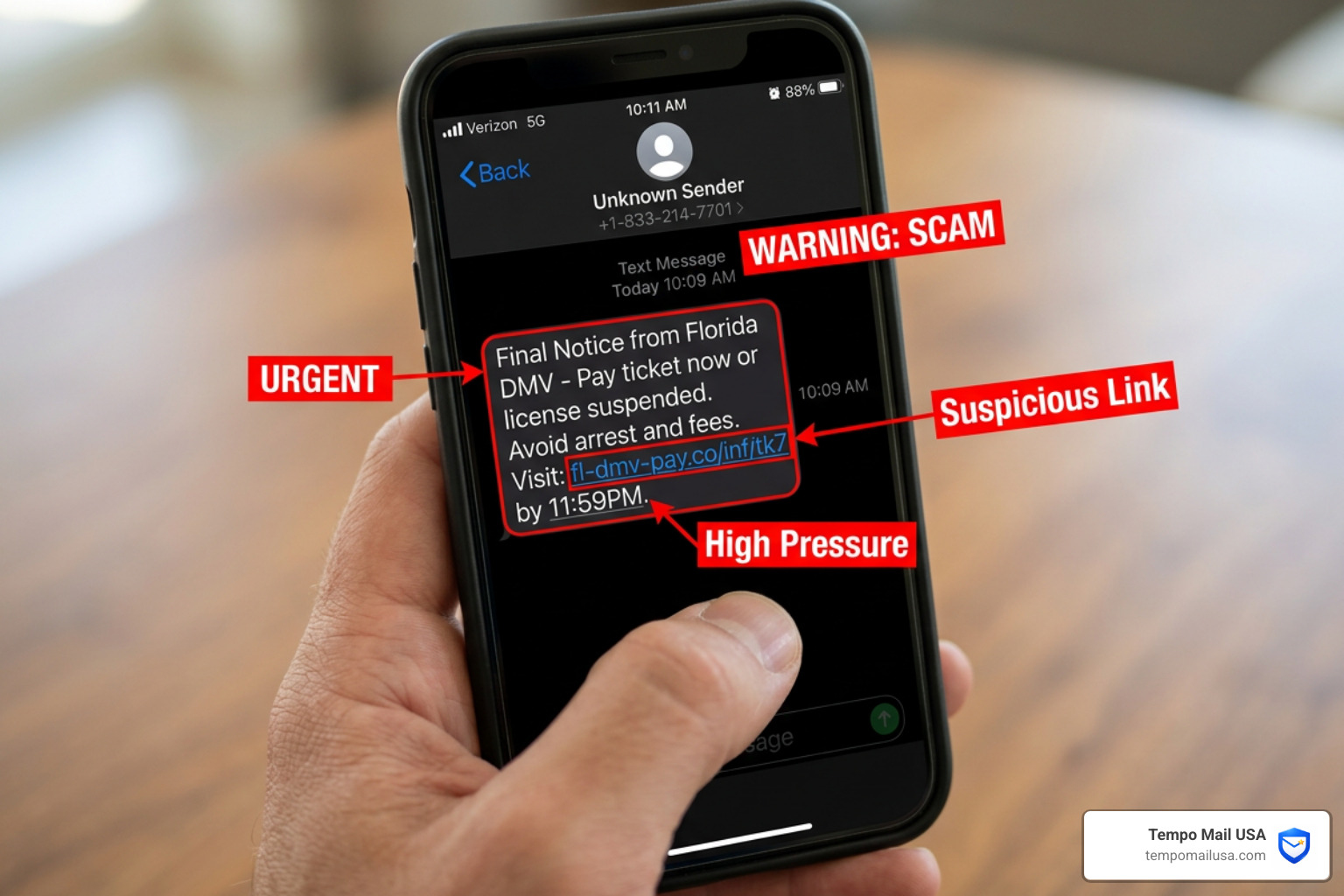
Thousands of Florida drivers have recently received alarming text messages claiming to be a "Final Notice" from the "Florida Department of Motor Vehicles." The message typically threatens that your driving privileges and vehicle registration will be suspended unless you pay an outstanding traffic ticket immediately — via a link in the text.
It looks just official enough to cause a moment of panic.
That panic is exactly what scammers are counting on.
The FLHSMV has officially confirmed these texts are fraudulent and is actively warning residents across the state. Multiple counties — including Clay County and Polk County — have reported receiving them. Some arrive as private messages. Others come as group texts. All of them are fake.
This guide explains how the scam works, how to spot it, what to do if you received one, and how to protect your personal information going forward.
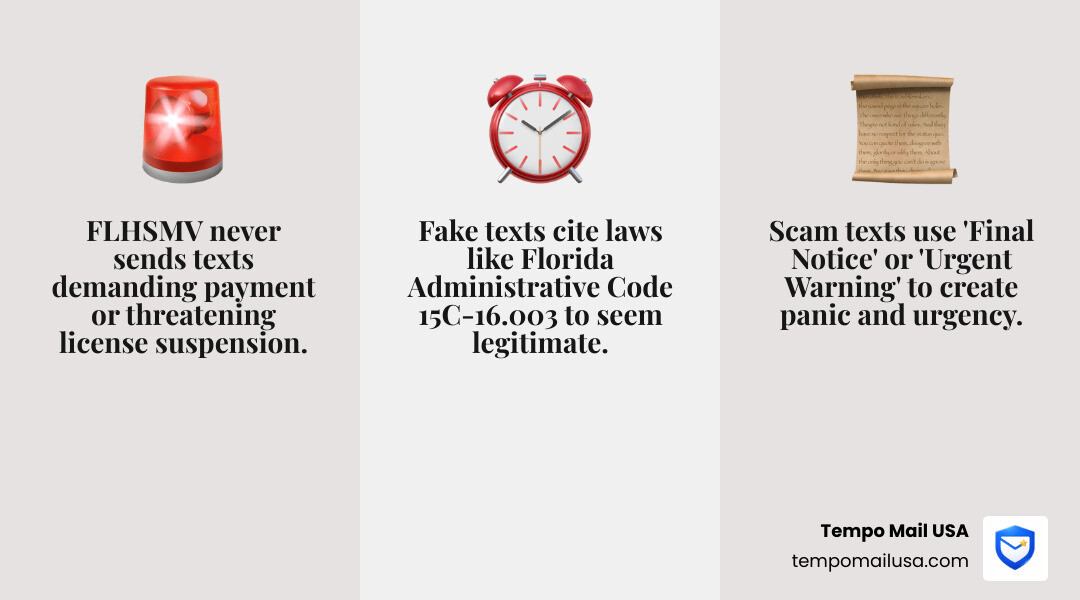
Anatomy of an FLHSMV Scam Text
To the untrained eye, an FLHSMV scam text looks like a legitimate government notification. Scammers use a technique called "smishing" (SMS phishing) to bypass your natural skepticism by creating a high-pressure situation. They know that for most Floridians, the thought of losing a driver's license is a nightmare that could jeopardize their job and daily life.
These messages often start with "Final Notice" or "Urgent Warning" to trigger an immediate emotional response. They claim you have an outstanding traffic ticket and that "Enforcement Penalties" are about to begin. To add a layer of false authority, they often cite specific laws. For example, many of these texts reference "Florida Administrative Code 15C-16.003."
Here is the kicker: that specific code actually exists, but it has absolutely nothing to do with traffic fines. It pertains to the maintenance of records for electronic temporary registrations. Scammers use real-sounding numbers because they know most people won't take the time to look up the legal jargon while they are in a state of panic.
To help you distinguish between a real government notice and a fraud, we’ve put together a comparison of how the state actually communicates versus how these criminals operate.
| Feature | Official FLHSMV Communication | FLHSMV Scam Text |
|---|---|---|
| Primary Method | Official U.S. Mail (Paper) | Unsolicited SMS/Text Message |
| Tone | Formal, procedural, and informative | Urgent, threatening, and aggressive |
| Payment Links | Directs to official .gov portals | Uses shortened or hidden URLs (e.g., .cc) |
| Legal Citations | Relevant to the specific violation | Random or non-existent "codes" |
| Consequences | Indefinite suspension after 30 days | Threats of arrest or 24-hour deadlines |
| Service Fees | Standardized statutory fees | Random "35% service fees" |
Identifying a Fake FLHSMV Scam Text Link
The most dangerous part of the FLHSMV scam text is the link. These links are designed to lead you to a sophisticated phishing site that looks identical to a government portal. However, there are several ways to spot the deception.
First, look at the domain. Official Florida government websites always end in .gov. Scammers frequently use .cc, .com, or .net domains because they are cheap and easy to register. They also use hidden URLs that mask the true destination of the link.
Another advanced tactic is the use of "homoglyphs." These are characters that look like standard letters but are actually from different alphabets. For example, a scammer might use a Cyrillic "о" instead of a standard Latin "o." This allows them to create URLs that look like "floridaticket.com" to the naked eye but actually lead to a malicious server. If you see strange characters or if the font looks slightly "off," it is a major red flag. This is a common tactic we have seen in other schemes, such as the Parkmobile scam text.
Official FLHSMV Communication Policies
We cannot stress this enough: the FLHSMV will never text you to demand payment. According to the Official FLHSMV Scam Alert, the department uses official mail for serious matters like license suspensions or unpaid citations.
If there is a real issue with your license, you will receive a letter in the mail that provides you with a timeframe to resolve the issue before any suspension takes effect. The state does not use random text messages to threaten you with immediate arrest. This policy is consistent across many states, which is why we’ve seen similar scams targeting Georgia drivers as well.
What to Do If You Receive a Suspicious Message
If a message lands in your inbox and your "gut check" says something is wrong, trust that instinct. Here is the immediate protocol we recommend:
- Do Not Click: Even clicking the link to "see what it is" can alert the scammer that your phone number is active and monitored, leading to even more spam.
- Do Not Reply: Replying "STOP" or "Y" often backfires. Scammers use your engagement to confirm they have reached a real person.
- Block the Sender: Use your phone’s built-in features to block the number immediately.
- Forward to 7726: This is the universal "SPAM" reporting number for most wireless carriers. Forwarding the text helps your provider identify and block these numbers across their entire network.
- Report to Authorities: Report the scam to the FTC and the Florida Attorney General’s Office. These reports help law enforcement track the scale of the campaign and shut down fraudulent websites.
We have documented similar "do not click" warnings for residents in other regions, such as the Utah and Louisiana DMV scams, proving that this is a nationwide epidemic of impersonation.
Recovery Steps: If You Clicked the FLHSMV Scam Text Link
If you already clicked the link or, worse, entered your credit card information, do not beat yourself up. These scams are designed by professionals to be convincing. However, you must act quickly to minimize the damage.
The first thing you should do is contact your bank or credit card issuer. Tell them you have been the victim of a fraudulent transaction. They can dispute the credit card charges and issue you a new card with a different number. If you provided your bank account details, ask them about unauthorized bank account transfers and how to secure your funds.
Next, you need to protect your identity. Visit IdentityTheft.gov to create a recovery plan. We strongly recommend placing a credit freeze with the three major bureaus: Equifax, Experian, and TransUnion. This prevents scammers from opening new lines of credit in your name. Finally, change the passwords for any accounts that might have been compromised, especially if you use the same password for your email or banking.
Verifying Your Real Driver Status
If the FLHSMV scam text has left you genuinely worried about a ticket you might have forgotten, there are safe, official ways to check. You should never rely on a link sent to you in a text.
Instead, go directly to the Official MyDMV Portal. This is the only legitimate place to check your driver's license status and vehicle registration online. If you want to check for outstanding traffic citations across any of Florida's 67 counties, the official payment portal is PayFLClerk.com.
If you want a full picture of your history, you can request a complete driving record through the Official FLHSMV Website. This typically costs about $7.00 for an online request or $5.00 by mail. It is a small price to pay for the peace of mind that comes with knowing your record is clean.
Related Threats: SunPass and Toll Scams
The FLHSMV scam text is often part of a broader "transportation" scam ecosystem. Many Florida drivers have reported receiving texts about unpaid tolls, often impersonating SunPass. These messages claim you owe a small amount, like $11.25, and threaten a registration suspension if you don't pay immediately.
Just like the DMV, SunPass does not send unsolicited texts for payment. If you are concerned about tolls, log into your account directly at SunPass.com or check for an official invoice in the mail. The Polk County Tax Collector has issued specific alerts regarding these toll-related phishing attempts, noting that they often arrive as group texts to hundreds of numbers at once.
Frequently Asked Questions about FLHSMV Scams
Does the FLHSMV ever text about unpaid tickets?
No. The FLHSMV does not use text messages to demand money or notify you of citations. All official notifications regarding unpaid tickets that could lead to an indefinite suspension are sent through the U.S. Postal Service. If you receive a text, it is a phishing attempt and should be reported via Federal Trade Commission reporting channels.
Why are Florida drivers being targeted?
Florida is a "target-rich" environment for scammers. With millions of drivers, a complex toll system (SunPass), and a high volume of tourism, there are plenty of people to target. Scammers use fear tactics, such as the threat of a "35% service fee" or immediate license suspension, because they know people will pay a small "fine" of $20 or $50 just to make the problem go away. These reports are often funneled to the Internet Crime Complaint Center (IC3) to help track these international crime rings.
How can I tell if a DMV website is real?
A real government website will always have a .gov domain and use HTTPS (look for the padlock icon in your browser). The state of Florida will never ask you to pay a fine using gift cards, cryptocurrency, or wire transfers. If the site looks unprofessional, has typos, or creates a sense of extreme urgency with a countdown timer, leave the site immediately. You can find more examples of these red flags on the Florida Attorney General Consumer Alerts page.
Conclusion
The rise of the FLHSMV scam text is a reminder that our personal information is constantly under fire. These criminals are professional, persistent, and they rely on the fact that our phone numbers and emails are often publicly accessible or leaked in data breaches.
Staying vigilant is your first line of defense. By knowing the red flags—like the fake "Florida Administrative Code 15C-16.003" or the suspicious .cc links—you can protect your finances and your identity.
At Tempo Mail USA, we believe the best way to stop a scam is to prevent scammers from getting your real information in the first place. By using a temporary email alias or a PII (Personally Identifiable Information) firewall, you can shield your primary identity from the services and databases that scammers often scrape for targets. When you limit the amount of your real data circulating online, you become a much harder target for these smishing attacks.
Stay safe, stay informed, and remember: if the "DMV" texts you, it's not the DMV. For more information on how to protect your digital identity, visit us at https://tempomailusa.com.