

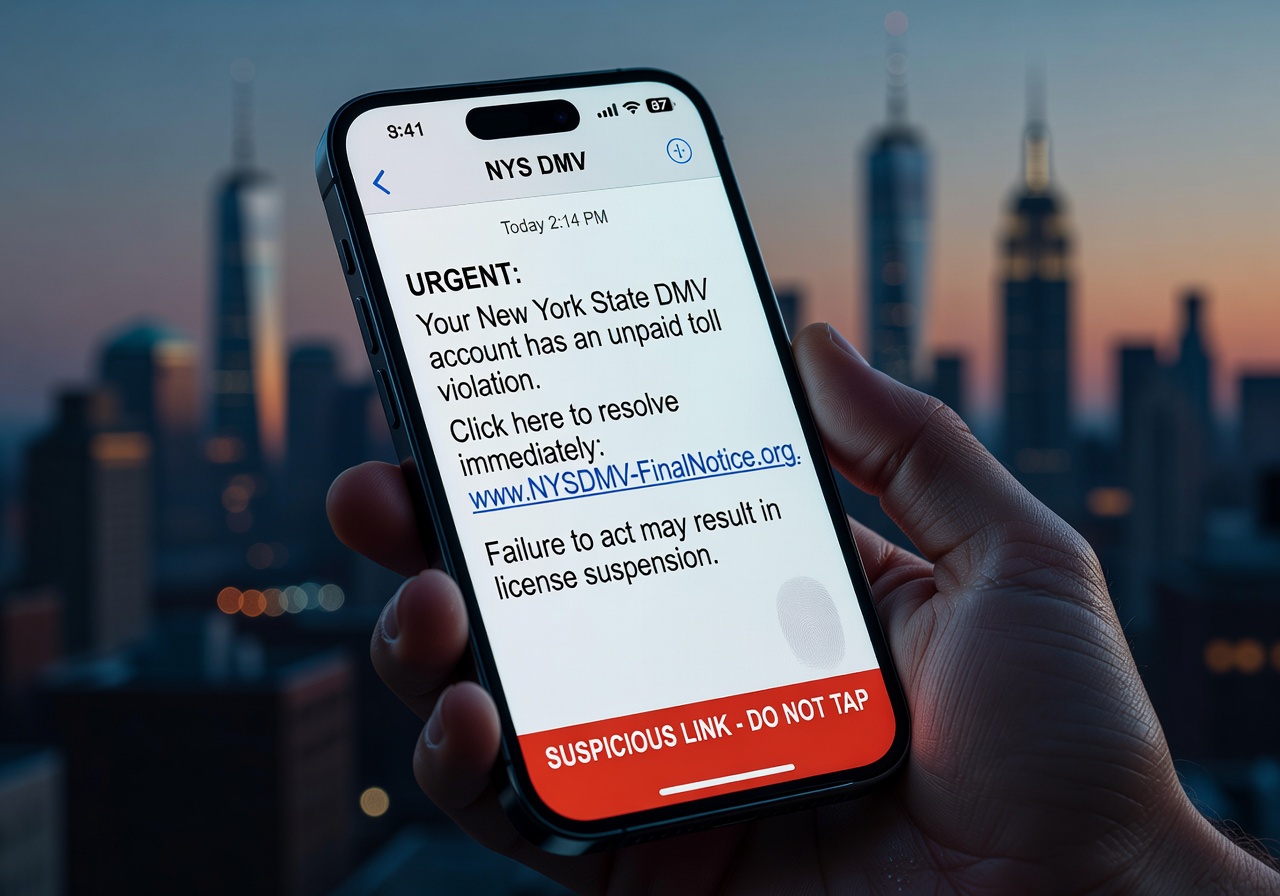

The NYS DMV Scam Text Is Fooling Real New Yorkers — Here's What You Need to Know
NYS DMV scam text messages are fake texts that pretend to be from the New York State Department of Motor Vehicles. They trick people into clicking links or handing over personal information.
Quick answer — what to do right now:
- Do not click any links in the message
- Do not reply or provide any personal information
- Delete the text immediately
- Report it by emailing a screenshot to dmv.sm.phishing@dmv.ny.gov
- Contact your bank if you already clicked a link or made a payment
These scam texts typically claim you have an unpaid traffic ticket, an outstanding DMV fine, or that your driving privileges are about to be suspended. They create urgency — and that urgency is the trap.
The real NYS DMV will never contact you by text to ask for payments or personal information. Full stop.
This is called smishing — SMS phishing — and it's on the rise. Over 170 phishing scams were reported across Rochester, Albany, Buffalo, and Syracuse alone in 2024. Nationally, phishing attacks increased 31% year-over-year, and the FBI recorded over $1.4 billion in losses from phishing scams across the U.S.
One Bronx resident who received one of these texts put it plainly: "I don't have a license, so how do I have a ticket?" — a reminder that scammers send these messages in bulk, hoping someone panics and pays.
If your personal data is already floating around from a previous breach, you're a prime target. Understanding how this scam works is the first step to protecting yourself.
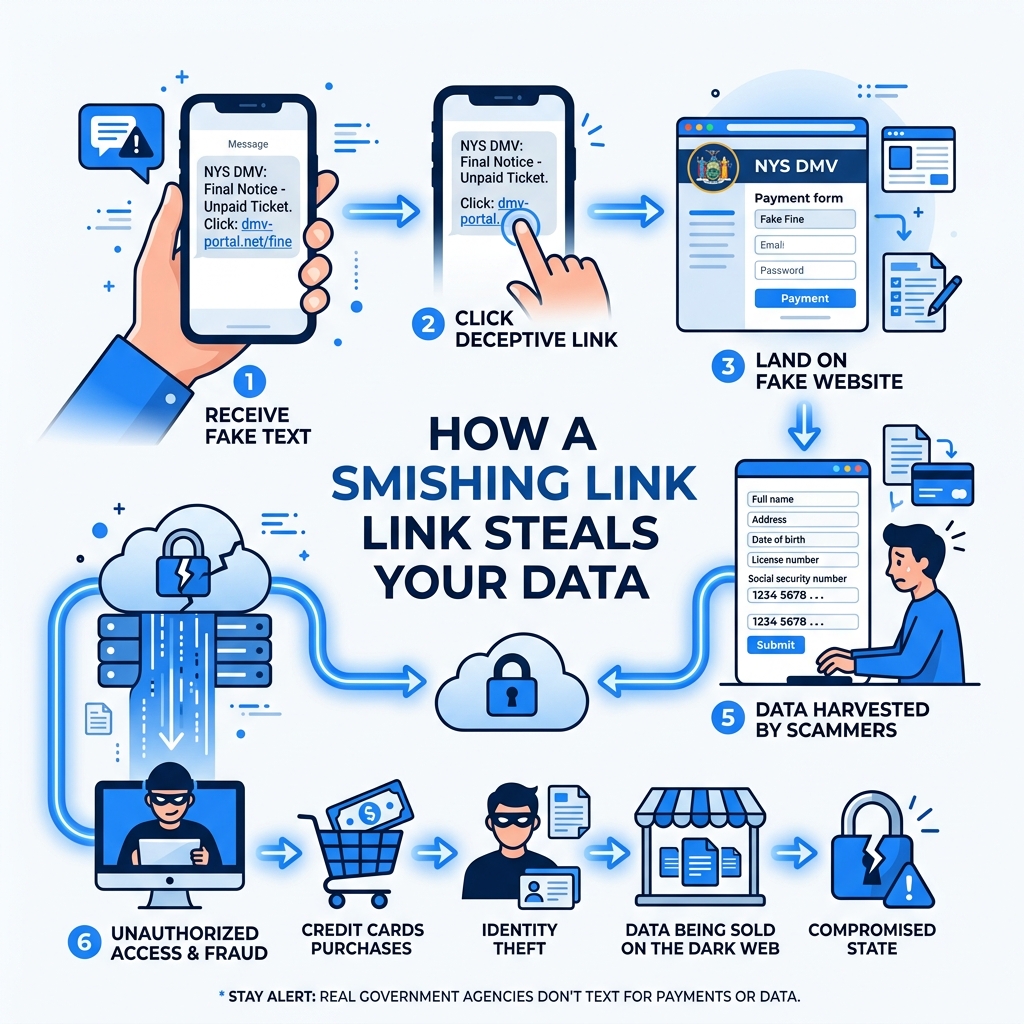
Anatomy of the NYS DMV Scam Text
To the untrained eye, a NYS DMV scam text can look incredibly convincing. Scammers often go to great lengths to copy official logos, branding, and even the specific language used by government agencies. However, once you know what to look for, the cracks begin to show.
The primary weapon in a scammer's arsenal is urgency. They want you to act before you think. Most of these texts are "Final Notices" claiming you owe money for a violation. They might even cite fake laws, like "New York State Administrative code 15c-16.003," to sound authoritative. This is a classic Outstanding Traffic Ticket Scam where the "fine" is actually a trap designed to harvest your credit card details.
According to a Consumer Alert from the NYS DMV, these messages often include a link to a "phony DMV website." These sites are designed to look exactly like the official "MyDMV" portal. Once you enter your driver’s license number, Social Security number, or credit card info, the scammers have everything they need for identity theft.

Common Variations of the NYS DMV Scam Text
The NYS DMV scam text isn't a one-trick pony. It evolves based on what scammers think will trick you. Here are the most common versions currently circulating:
- The Unpaid Toll/E-ZPass Scam: You receive a text claiming you have unpaid tolls and your E-ZPass account is suspended. It threatens a "35% service fee" if you don't pay immediately via the provided link.
- The Fuel Rebate Scam: This one plays on your wallet. It claims the NYS DMV is offering a $1,500 rebate due to high fuel prices. All you have to do is "verify your identity" on a fake webpage.
- The License Update Scam: A message warns that your driver’s license contact information is out of date and must be updated immediately to avoid suspension.
- The Parking Fine Scam: Similar to the ticket scam, this version claims you have a parking violation that has gone unpaid and is now subject to legal action.
Why Scammers Target New Yorkers Specifically
New York is a massive target for several reasons. First, the sheer volume of drivers makes it a numbers game. If a scammer blasts 10,000 texts across the state, they are bound to hit someone who actually does have a pending ticket or a toll they forgot to pay.
Regional targeting is also common. We have seen concentrated waves of these attacks in the Rochester, Albany, Buffalo, and Syracuse regions. By using local context, scammers make the message feel more relevant. It isn't just a New York problem, though; similar tactics are seen in the Michigan SOS Scam, proving that these "DMV" impersonators are a national nuisance.
How to Spot a NYS DMV Scam Text and Protect Your Data
The best defense is a good offense—or in this case, a very skeptical eye. Most NYS DMV scam text attempts have "tells" that give them away.
- Check the URL: Official NYS DMV websites will always end in .gov. If the link in the text is a shortened URL (like bit.ly) or looks like "nysdmv-online-pay.com," it is 100% a scam.
- Look for Typos: While some scammers are getting better, many still make basic spelling and grammar mistakes. Government agencies generally have proofreaders.
- The "Threat" Factor: Does the text threaten to arrest you or suspend your license within 24 hours? The DMV doesn't work that fast, and they certainly don't announce legal action via SMS.
- Mismatched Senders: If the text comes from a random 10-digit phone number or an international area code, it’s fake.
The Verizon Data Breach Investigations Report notes that phishing (which includes smishing) accounts for over 36% of all data breaches. This is because it’s easier to trick a human than it is to hack a server.
Does the DMV Ever Contact You via Text for Payments?
This is the most important takeaway: The NYS DMV will never send you a text message asking for personal information or payments.
Official DMV policy dictates that all sensitive notifications—license renewals, suspension notices, and fine demands—are sent through the U.S. Postal Service. While you might sign up for text alerts for things like "your plates are ready for pickup," those messages will never ask you to click a link to pay a fine or enter your Social Security number.
Risks and Statistics of Modern Phishing Attacks
Falling for a NYS DMV scam text isn't just a minor inconvenience; it can lead to a total financial meltdown. When you click that link, you aren't just "paying a fine." You are often handing over a "PII" (Personally Identifiable Information) starter kit to a criminal.
The risks include:
- Identity Theft: Using your SSN and license number to open fraudulent bank accounts.
- Financial Loss: Draining your credit card or bank account.
- Malware: Some links are designed to install "spyware" on your phone that records your keystrokes (and passwords).
The FBI’s IC3 report highlights that phishing and email scams resulted in over $1.4 billion in losses recently. Furthermore, the APWG Phishing Activity Trends Report shows that these attacks are only getting more frequent.
| Year | Phishing Attack Increase | Reported Losses (US) |
|---|---|---|
| 2022 | 15% | $1.1 Billion |
| 2023 | 24% | $1.25 Billion |
| 2024 | 31% | $1.4 Billion |
What to Do if You Receive a Suspicious Message
If a NYS DMV scam text hits your inbox, don't panic. Take these steps to shut the scammers down:
- Report Junk: Most modern smartphones have a "Report Junk" or "Block and Report" button. Use it.
- Report to the DMV: Take a screenshot and email it to dmv.sm.phishing@dmv.ny.gov. This helps the state track new variations of the scam.
- Report to the FTC: You can provide details to the Federal Trade Commission at reportfraud.ftc.gov.
- Delete and Block: Once reported, delete the message. Do not engage with the scammer—even to "troll" them. It only confirms your number is active.
For a deeper dive into reporting, check out our guide on how to report phishing in the USA.
Immediate Steps After Engaging with a NYS DMV Scam Text
If you’ve already clicked the link or, worse, entered your information, you need to act fast. Every second counts when a scammer has your data.
- Change Your Passwords: If you used a password on the fake site that you use elsewhere (like your email or bank), change it immediately.
- Enable Multi-Factor Authentication (MFA): According to Microsoft security research, MFA can prevent 99.9% of account attacks.
- Contact Your Bank: If you provided payment info, call your bank to cancel the card and dispute any fraudulent charges.
- Freeze Your Credit: This prevents scammers from opening new accounts in your name.
- Report Identity Theft: Visit the FTC's identity theft portal to file an official report.
Frequently Asked Questions about DMV Phishing
Does the NYS DMV send text messages about unpaid tickets?
No. The NYS DMV does not send text messages demanding payment for tickets or fines. All such notices are sent via official mail to the address on file.
How can I tell if a DMV website is legitimate?
Check the URL. Official New York State websites always end in .gov (e.g., dmv.ny.gov). Legitimate sites will also use "https://" and won't have spelling errors or weird domain names like "nys-dmv-records.com."
Who should I contact to report a suspected DMV scam text?
You should email a screenshot of the text to dmv.sm.phishing@dmv.ny.gov. Additionally, you can report the fraud to the FTC at reportfraud.ftc.gov.
Conclusion
The NYS DMV scam text is a reminder that in the digital age, our personal information is constantly under fire. Scammers are banking on our busy lives and our fear of government "penalties" to trick us into making mistakes. But by staying vigilant and knowing the "red flags," we can keep our data safe.
At Tempo Mail USA, we believe the best way to stop a scam is to never give them your real information in the first place. We provide secure email aliases that act as a PII Firewall, shielding your primary identity from the prying eyes of data brokers and hackers. When you use an alias, you compartmentalize your digital life, making it much harder for a single breach to ruin your financial health.
Stay safe, New York. Don't let a "Final Notice" text be the start of a long-term identity theft headache. For more tips on staying secure, visit us at tempomailusa.com.