

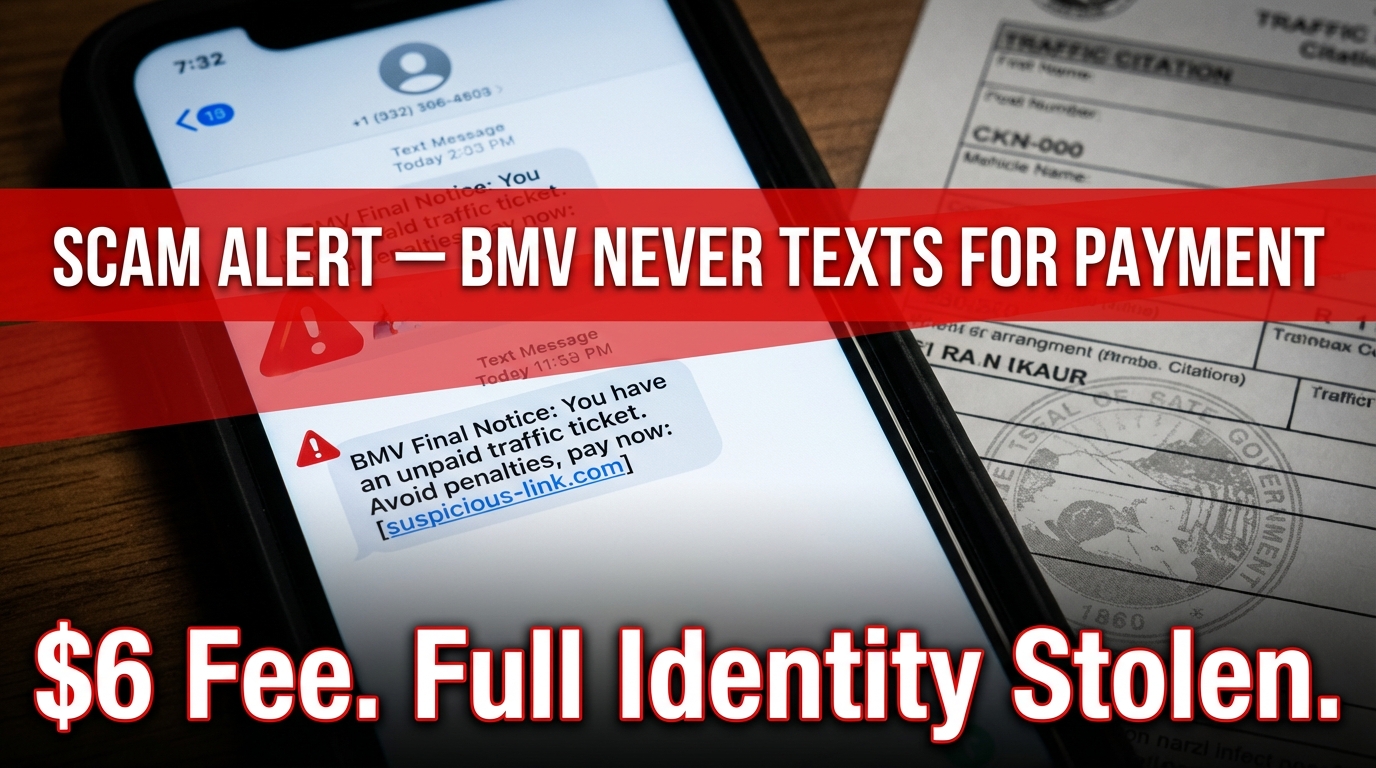

The BMV Unpaid Ticket Scam Text Is Targeting Drivers Nationwide — Here's What You Need to Know
If you've received a bmv unpaid ticket scam text, here's the short answer:
- It is not real. Neither the Ohio BMV, Indiana BMV, nor any other state motor vehicle agency sends text messages demanding payment for unpaid tickets or fines.
- Do not click any links or scan any QR codes in the message.
- Delete the text immediately.
- If you already clicked or entered payment details, contact your bank right away and place a fraud alert on your credit.
These scam texts typically claim you have an outstanding traffic citation or parking ticket, warn of license suspension or legal penalties, and push you to pay a small fee — often something like $6.99 or $12.49 — through a link that leads to a fake website designed to steal your card details and personal information.
The scam has been reported across multiple states, including Ohio, Indiana, West Virginia, Massachusetts, and Texas. Both the Ohio BMV and Indiana BMV have issued official warnings confirming they will never contact residents by text to demand payment.
As Ohio Attorney General Dave Yost put it: "Scammers rely on fear and urgency." That's exactly what these texts are engineered to create.
The danger isn't just losing a few dollars. Clicking the link can expose your name, address, driver's license number, and full credit card details — and in some cases, install malware on your device.
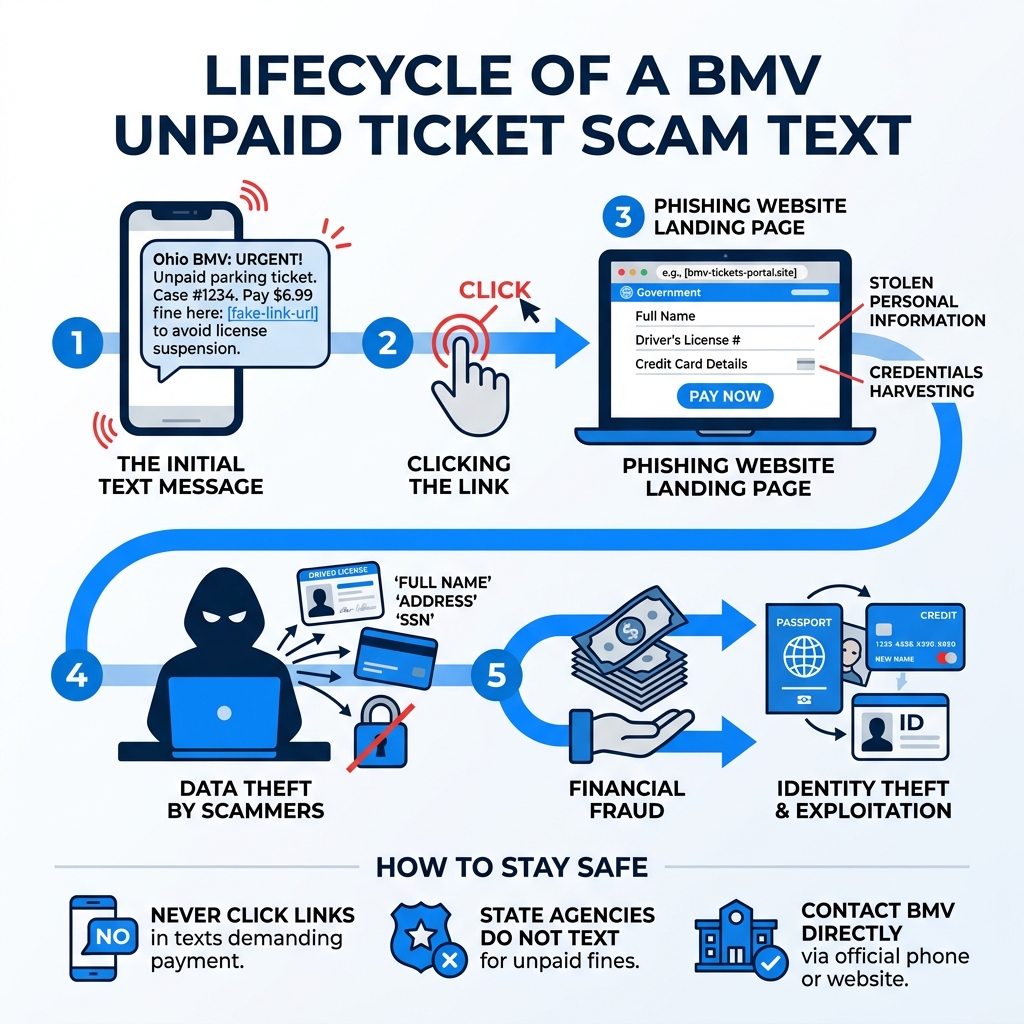
What is the BMV Unpaid Ticket Scam Text?
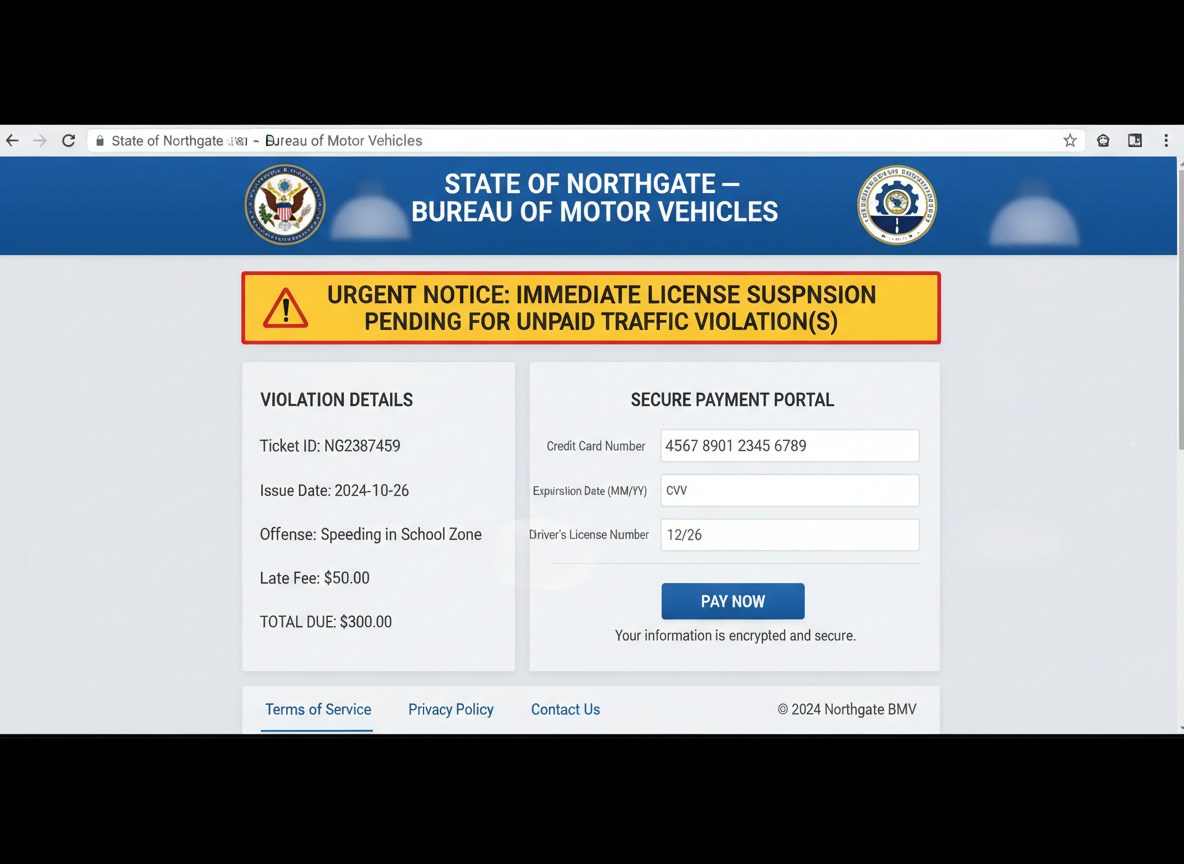
The bmv unpaid ticket scam text is a form of "smishing"—which is essentially phishing via SMS. In this scheme, cybercriminals send out mass text messages pretending to be from a state Bureau of Motor Vehicles (BMV) or Department of Motor Vehicles (DMV). The goal is simple: to trick you into visiting a fraudulent website that looks exactly like an official government portal.
Once you are on that fake site, the scammers use data harvesting techniques to steal your Personally Identifiable Information (PII). This includes your full name, date of birth, driver's license number, and most importantly, your credit or debit card information. They aren't just looking for the $10 "fine" you think you’re paying; they want your card numbers to make much larger, unauthorized purchases or to sell your identity on the dark web.
As noted by the BBB Scam Alert, this is part of a nationwide campaign. Understanding what is a phishing scam is the first step in building your digital defenses.
Common Examples of the bmv unpaid ticket scam text
Scammers are clever, but they often stick to a predictable script. You might see messages like:
- "State BMV Final Notice: You have an outstanding traffic ticket. Pay by [Date] to avoid license suspension."
- "Our records show an unpaid parking violation. Click here to settle your $6.99 fine: [Fake Link]."
- "NOTICE OF CIVIL INFRACTION: Toll or traffic violation detected. Scan this QR code to pay now."
These messages often include a sense of extreme urgency. They might use terms like "Enforcement Penalties" or "Mandatory Penalties" to scare you into acting quickly. You can see more detailed breakdowns of these messages in our guide on why you should not pay this fake DMV message.
Why Scammers Target Drivers with the bmv unpaid ticket scam text
Why do they pick the BMV? It's all about "Authority Bias." Most people have a healthy respect (or fear) of government agencies. When we get a message saying our driver's license might be suspended, our brains go into panic mode. We rely on our cars for work, school, and grocery runs. The threat of losing that mobility is a powerful motivator.
Furthermore, these scams have a massive "hit rate" because almost everyone has a driver's license or has parked in a city at some point. Scammers don't need to know if you actually have a ticket; they just send out thousands of texts knowing that, statistically, some recipients will have a "guilty conscience" or simply want to avoid the hassle of a legal battle. This Texas DMV scam alert highlights how these tactics are adapted state-by-state to maximize fear.
Red Flags: How to Spot a Fake BMV Message
Spotting a bmv unpaid ticket scam text is easier when you know what to look for. Here are the most common red flags:
- The Sender's Number: Official government agencies don't text you from a random 10-digit cell phone number or an out-of-country area code.
- The Link Itself: Look closely at the URL. Does it end in ".gov"? Many scams use ".com," ".net," or even sneaky variations like "state-bmv-gov.com."
- Generic Greetings: Instead of using your name, they might say "Dear Citizen" or "Valued Driver."
- Threatening Language: Real agencies usually send notices via physical mail first. They don't threaten "immediate prosecution" via a text message sent at 2:00 AM.
The Indiana BMV Press Release explicitly states that they never ask for overdue payments over text. If you see a link, do not click it until you've verified it through official channels.
The Psychology of Small Payment Amounts
Have you ever wondered why the "fine" is so small? Amounts like $6.99, $9.99, or $12.49 are a psychological trap. Most people won't think twice about paying $7 to make a problem go away. It feels like a "processing fee" rather than a major penalty. However, once you enter your card details for that $6.99, the scammers have everything they need to drain your account for thousands.
Technical Discrepancies in Scam Links
According to a MalwareTips investigation, these scams use "modular templates." This means the scammers can swap out "Ohio BMV" for "Texas DMV" in seconds. The underlying website remains the same. These sites are often hosted on overseas servers to avoid US law enforcement. They even generate fake "receipts" and "confirmation numbers" to make the transaction feel legitimate.
State-Specific Warnings and Official BMV Policies
Different states have different names for their motor vehicle agencies, and scammers adapt accordingly.
| State | Agency Name | Official Policy on Texting |
|---|---|---|
| Ohio | BMV | Never sends texts demanding payment. |
| Indiana | BMV | Does not send SMS for penalties or fees. |
| Massachusetts | RMV | Never texts for fines or transactions. |
| West Virginia | DMV | Does not send payment demand texts. |
| Texas | DMV | Does not text for unpaid citations. |
In Ohio, reports of thousands being stolen have prompted urgent warnings from state officials.
Ohio and Indiana BMV Alerts
In Indiana, the BMV has noticed a shift. Scammers used to use the term "DMV," but since Indiana uses "BMV," they've updated their texts to be more "accurate." They've even started citing fake Indiana Code sections to sound more official. If you're in the Hoosier state, stay alert for these evolving tactics.
Massachusetts and West Virginia Enforcement Notices
The Massachusetts RMV cautions the public that they will never charge you to check your license status online. If a text asks for money to "verify your records," it's a scam. Similarly, West Virginia officials have warned of texts claiming unpaid tolls—another common variation of the bmv unpaid ticket scam text.
What to Do if You Receive a bmv unpaid ticket scam text
If a suspicious text lands in your inbox, follow these steps:
- Stop: Don't let the "Final Notice" language rush you.
- Don't Click: Links and QR codes are the primary ways they steal your data.
- Delete: Once you've identified it as a scam, get it off your phone.
- Report: Forward the text to 7726 (which spells "SPAM") to alert your carrier.
The WV Division of Motor Vehicles emphasizes that the safest response is to ignore the message entirely.
How to Safely Verify Unpaid Tickets
If you are worried that you actually do have a ticket, verify it the right way:
- Type the URL manually: Go directly to your state's official .gov website (e.g., bmv.ohio.gov).
- Call the Court: If the text mentions a specific city, call that city's clerk of courts using a number found on an official government site.
- Visit in Person: If you're really unsure, a quick trip to a local branch can clear things up. the DMV never texts.
Steps for Victims of BMV Phishing
If you've already clicked the link and entered your information, don't beat yourself up—scammers are professionals. Take these steps immediately:
- Call your bank: Cancel your card and request a new one.
- Monitor your credit: Check for any new accounts opened in your name.
- Place a fraud alert: Contact one of the three major credit bureaus (Equifax, Experian, or TransUnion).
- File a report: Visit reportfraud.ftc.gov to help authorities track the scam. You can find more recovery tips in our guide on staying safe after a toll scam.
Best Practices for Future Phishing Protection
Staying safe in the digital age requires a "layered" defense. Here is how we recommend protecting yourself:
- Use Two-Factor Authentication (2FA): Even if scammers get your password, they won't be able to access your accounts without that second code.
- Report Scam Texts: Always use the 7726 reporting feature.
- Stay Informed: Read PennDOT scam alerts and other state warnings to stay ahead of new tactics.
- Protect Your PII: Be extremely stingy with your personal information. One of the best ways to do this is by using a privacy firewall.
Frequently Asked Questions about BMV Scams
Does the BMV ever text residents for payment?
No. Official BMV and DMV agencies communicate through the U.S. Mail for official notices regarding fines, tickets, or license suspensions. While some states offer text alerts for registration renewal reminders, they will never ask you to pay a fine directly through a link in a text.
What happens if I click the link in a scam text?
Clicking the link usually takes you to a "phishing" site that looks like a real government page. If you enter your credit card or Social Security number, the scammers capture that data instantly. In some cases, simply clicking the link can trigger a malware download that tracks your keystrokes or steals saved passwords from your phone.
How do I report a BMV text scam to the authorities?
You should report the scam to the Federal Trade Commission (FTC) at reportfraud.ftc.gov. You can also report it to the Better Business Bureau (BBB) Scam Tracker. If you have lost money, contact your local police department to file a report.
Conclusion
The bmv unpaid ticket scam text is a sophisticated threat, but it relies on your cooperation to work. By recognizing the red flags—like urgency, small dollar amounts, and non-gov links—you can protect your finances and your identity.
At Tempo Mail USA, we believe that the best way to stop a scam is to prevent scammers from getting your real information in the first place. We provide temporary email aliases that act as a secure proxy for your identity. By using an alias when signing up for services or communicating online, you create a "PII firewall" that keeps your real personal information shielded from data breaches and phishing lists.
Stay vigilant, stay informed, and always verify before you click. For more tips on protecting your digital life, visit https://tempomailusa.com.