

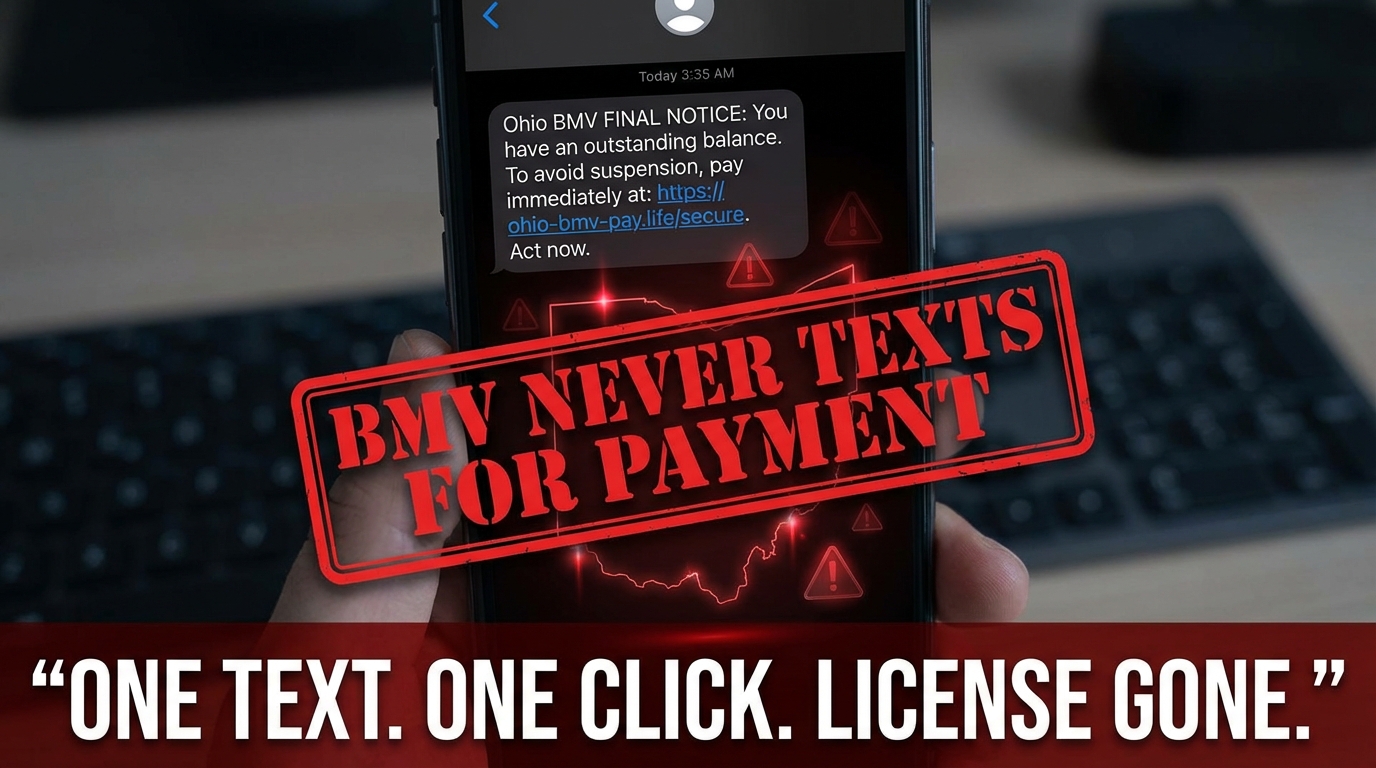

Ohio BMV Scam: What Every Ohio Driver Needs to Know Right Now
The ohio bmv scam is a phishing scheme where fraudsters send fake text messages pretending to be the Ohio Bureau of Motor Vehicles — and it's catching a lot of people off guard.
Quick answer if you received a suspicious BMV text:
- It's a scam. The Ohio BMV will never text you to demand payment or personal information.
- Do not click any links or scan any QR codes in the message.
- Delete the text immediately.
- Report it to the FTC at reportfraud.ftc.gov or the Ohio Attorney General at ohioattorneygeneral.gov.
These scam texts typically claim you have an unpaid traffic ticket or parking violation. They threaten to suspend your driver's license if you don't pay right now. The urgency is deliberate — scammers want you to panic and click before you think.
The Ohio BMV has officially confirmed these reports and issued public warnings. Their Facebook post warning Ohioans about the scam was shared over 580 times, showing just how widely this fraud has spread.
And Ohio isn't alone. This is a nationwide operation. Scammers simply swap the state name in the message to target drivers across the country. The math works in their favor: sending a million texts costs almost nothing, and even a tiny fraction of people responding at $100 each adds up fast.
If you're someone who values your privacy and wants to keep your personal information out of the wrong hands, this guide will walk you through everything you need to know.
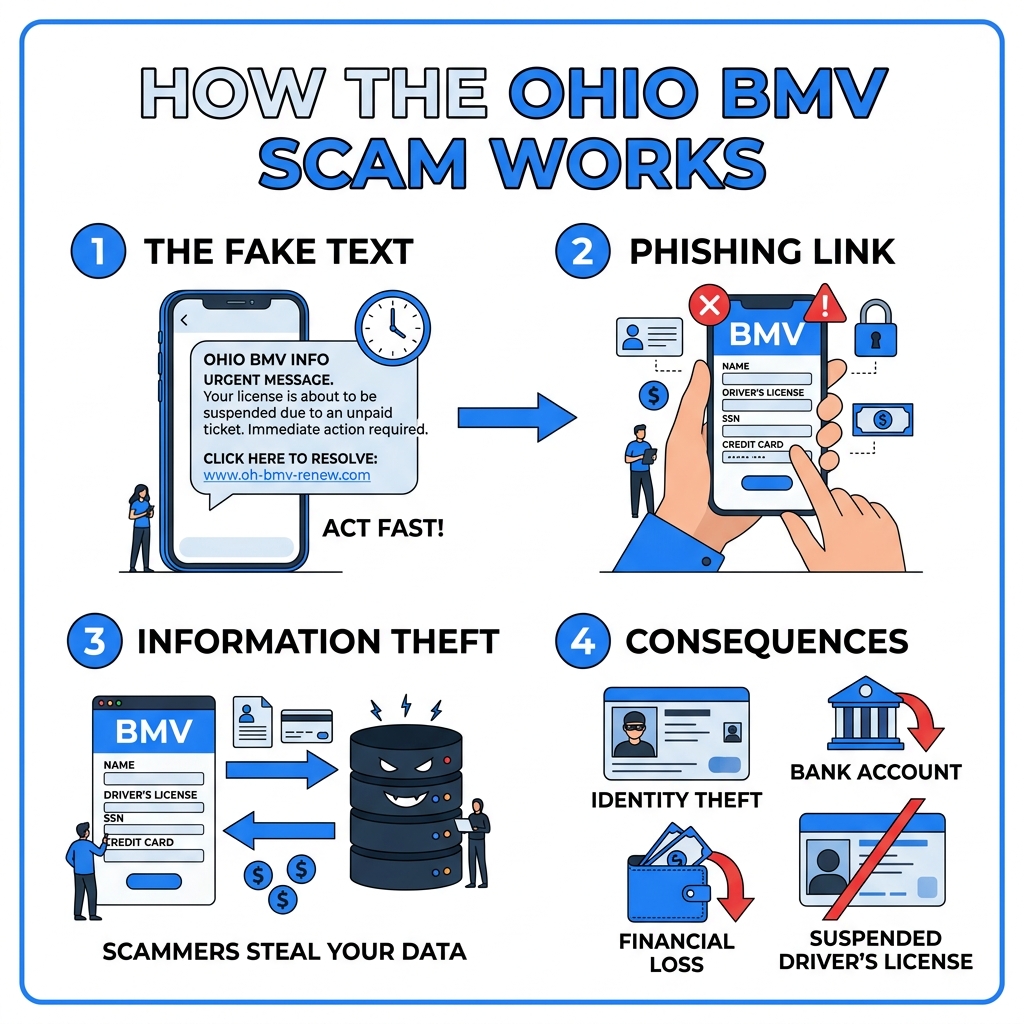
How the Ohio BMV Scam Works
The ohio bmv scam is a classic example of "smishing"—SMS phishing. It starts with a buzz in your pocket. You look down and see a message that looks official, often claiming to be from the "Ohio Department of Motor Vehicles" or the "Ohio BMV."
The content is designed to trigger a "fight or flight" response. It might say you have an outstanding parking ticket or a "final notice" for a traffic violation. To make it even scarier, the message often warns that if you don't pay immediately, your driver's license or vehicle registration will be suspended. Some versions even mention the threat of credit damage or prosecution.
According to reports, Ohio DMV text scam targets drivers by using highly specific language to appear authentic. These messages include links to spoofed websites that look identical to the real BMV portal. Once you click, you are prompted to enter your Social Security number, driver’s license number, and credit card information to "settle the fine." Some scammers have even started including QR codes in the texts, hoping you'll scan them and be whisked away to their fraudulent payment gateway.
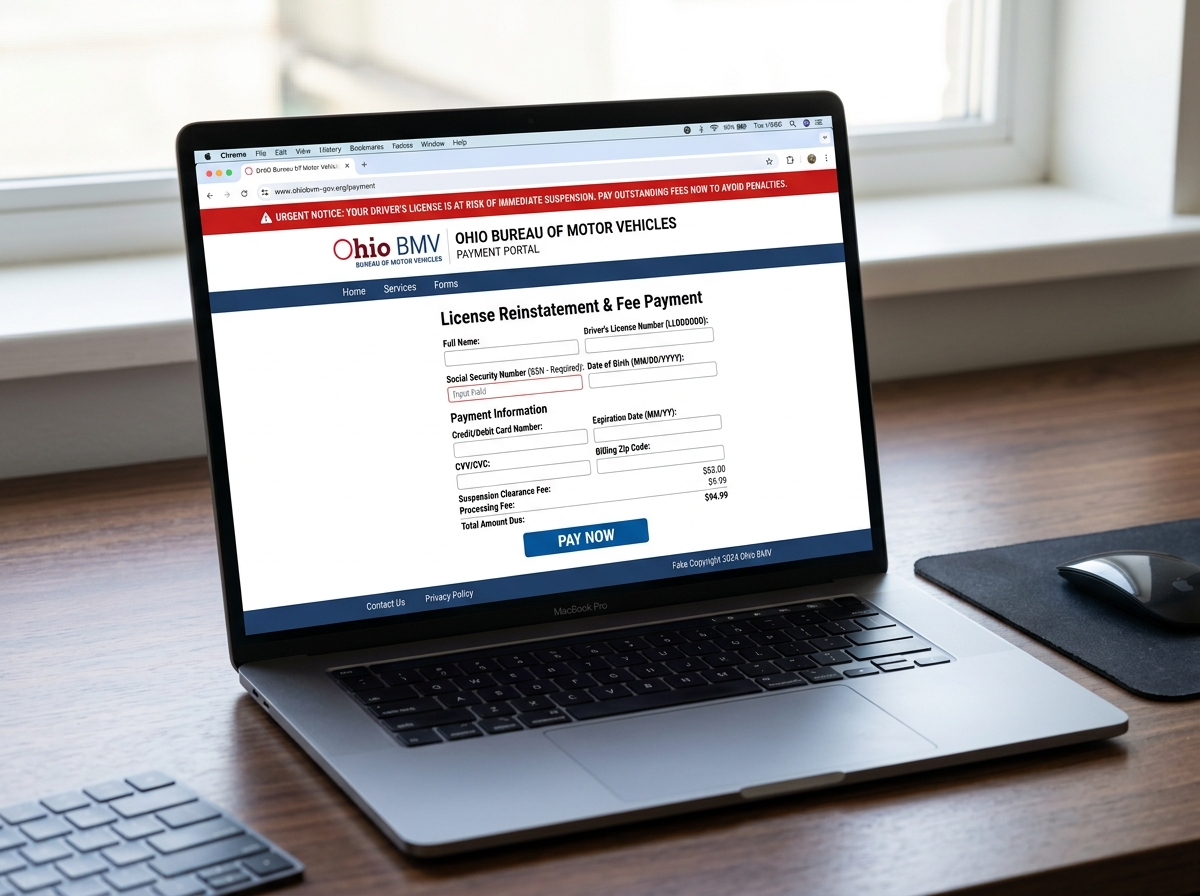
Common Tactics Used in an Ohio BMV Scam
To make the lie more believable, scammers often use "authoritative" details. We've seen reports of texts citing specific (but often fake) legal codes, such as the "Ohio Administrative Code 15C-16.003." By throwing around legal jargon, they hope to bypass your skepticism.
Another tactic involves using the name of a real-sounding clerk or judge. Interestingly, some Reddit users noted receiving texts where the clerk and the judge had the exact same name—a major red flag that the scammers were getting lazy with their templates! This type of high-pressure fraud isn't unique to Ohio; for example, the MVA Scam Text – Maryland: Pay Today or Be Arrested uses very similar "pay or face the consequences" logic.
| Feature | Real Ohio BMV Communication | Ohio BMV Scam Tactic |
|---|---|---|
| Method | Official Mail or In-Person | Unsolicited Text Message |
| Urgency | Standard Due Dates | "Pay Now" or "Immediate Suspension" |
| Link Domain | .gov (e.g., bmv.ohio.gov) | .life, .me, .org, or random strings |
| Payment | Secure Official Portal | Fake phishing links or QR codes |
| Language | Professional and clear | Often contains grammar/spelling errors |
Identifying Red Flags in Fraudulent Messages
The best defense against an ohio bmv scam is a sharp eye. Scammers are good, but they almost always leave "digital fingerprints" that give them away.
The biggest giveaway is the domain name. Official Ohio government websites will always end in .gov. Scammers, however, have to buy domains that look similar but aren't the real deal. In recent Ohio scams, users reported seeing domains ending in .life, .me, or .org-cwsbx.life. If the link in the text doesn't end in ".gov," it is 100% a scam.
As noted in the official bulletin Beware of Scammers Claiming to be Ohio Bureau of Motor Vehicles, the BMV will never contact you out of the blue via text to demand money. If you haven't signed up for specific text alerts, any message claiming you owe a fee is suspicious. Similar issues have been seen in other states, as detailed in the TXDMV Scam Text Alert: Is TXDMV.org Real or Fake? guide, where scammers use ".org" to trick people.
Verifying a Legitimate Ohio BMV Scam Text
If you are ever in doubt, stop and verify. The only legitimate website for the Ohio BMV is bmv.ohio.gov, and their online services portal is bmvonline.dps.ohio.gov.
Ohio BMV Registrar Charlie Norman has been vocal about this: the agency simply does not operate via unsolicited text messages for enforcement actions. If you actually had a traffic ticket, you would receive notice via the U.S. Mail or from a law enforcement officer in person. You can also check your status by manually typing the official BMV address into your browser—never use the link provided in a text. This advice holds true across the country, whether you're looking at an PA DMV Scam Text Alert: Is It Real or Fake? or an Ohio one.
What to Do if You Receive a Suspicious Text
If a text pops up on your phone claiming you owe the BMV money, follow these steps to protect yourself:
- Do Not Click: This is the most important rule. Clicking the link can trigger malware downloads or lead you to a phishing site designed to steal your PII (Personally Identifiable Information).
- Do Not Reply: Replying "STOP" or "Who is this?" tells the scammer that your number is active and monitored by a real person. This makes your number more valuable to them, and they will likely sell it to other scammers.
- Block and Delete: Use your phone's built-in features to block the sender's number. Then, delete the message so you don't accidentally click it later.
- Report the Fraud: You can report these texts to the Federal Trade Commission (FTC) at reportfraud.ftc.gov. This helps authorities track the scale of the scam.
Local news outlets like WTOL11 - YouTube have highlighted how quickly these scams can drain a bank account if a victim falls for the bait. There is no such thing as an Unpaid Traffic Violation Text Scam that is actually real.
Nationwide Context and Similar Fraudulent Schemes
The ohio bmv scam is just one flavor of a much larger problem. Scammers are currently running a "playbook" across the United States. They take a successful template—like a fake traffic ticket or a toll road fee—and simply change the name of the agency to match the victim's area code.
We have seen nearly identical scams targeting drivers in other regions:
- Texas: The Texas DMV Scam Text: Is It Real or Fake? Don’t Click warns of similar registration suspension threats.
- Utah and Louisiana: Similar smishing campaigns have been detected there, as noted in the Utah Louisiana DMV Scam Text: Do Not Click alert.
- South Carolina: Even experts get targeted! A local traffic reporter shared their experience in the SCDMV Scam: A Traffic Reporter Got One report.
- Minnesota: Interestingly, scammers sometimes mess up. Some have sent "Minnesota DMV" texts, even though MN DMV Scam Text: Minnesota Has No DMV points out that Minnesota doesn't even use the term "DMV"!
This nationwide trend includes "Turnpike" or "Toll" scams where you receive a text saying you missed a toll payment. These are almost always fraudulent.
Frequently Asked Questions about Ohio BMV Scams
Does the Ohio BMV ever text residents for payment?
No. The official policy of the Ohio BMV is that they will never send you an unsolicited text message demanding payment or asking for sensitive personal information like your Social Security number.
While the BMV does offer some text services—such as renewal reminders—you must explicitly sign up for these. Even then, a legitimate reminder will never threaten you with immediate arrest or license suspension via text. If you're curious about how other states handle this, the Idaho DMV Text Scam Alert: Fake Messages provides a good comparison of official vs. fraudulent messaging.
What should I do if I already clicked a link in an ohio bmv scam text?
If you realized too late that the text was a scam, don't panic, but act quickly:
- Contact Your Financial Institutions: If you entered credit card or bank info, call your bank immediately to freeze your accounts and dispute any fraudulent charges.
- Change Your Passwords: If the scam site asked you to "log in," change the passwords for your BMV account and any other accounts that use the same credentials.
- Place a Fraud Alert: Contact the major credit bureaus (Equifax, Experian, and TransUnion) to place a fraud alert on your credit report.
- Security Audit: In some cases, clicking a link can install malware. Run a security scan on your phone. For businesses, understanding How Insider Threat Programs Defend Against Security Breaches can provide broader context on data protection.
How can I report these scammers?
Reporting is vital to help stop the ohio bmv scam from claiming more victims. You have several options:
- Federal Trade Commission (FTC): Visit reportfraud.ftc.gov.
- Ohio Attorney General: Use the "Tipster" tool at ohioattorneygeneral.gov.
- Better Business Bureau (BBB): Use the BBB Scam Tracker to alert others in your community.
- Local Police: If you have actually lost money, file a report with your local law enforcement agency.
For more tips on identifying these messages, check out our guide on MVA Text Scam Alert: Fake DMV Messages – How to Avoid Them.
Conclusion
The ohio bmv scam is a reminder that our personal information is constantly under fire. Scammers only need a tiny fraction of a percent of people to fall for their tricks to make a massive profit. By staying informed and recognizing the red flags—like urgency, poor grammar, and non-gov domains—we can keep our data safe.
At Tempo Mail USA, we believe the best way to stop a scam is to prevent scammers from getting your information in the first place. We provide temporary email aliases that act as a secure proxy for your identity. By using an alias when signing up for services or interacting online, you create a "PII firewall" that shields your real personal information from data breaches and scammers.
In an age where a single text message can lead to identity theft, protecting your privacy isn't just a luxury—it's a necessity. Stay vigilant, Ohio!
For more information on how to shield your identity, visit https://tempomailusa.com.