


The MN DMV Scam Text Is Fake — Here's What You Need to Know
If you got an MN DMV scam text, here's the short answer:
It is not real. Delete it. Do not click any links.
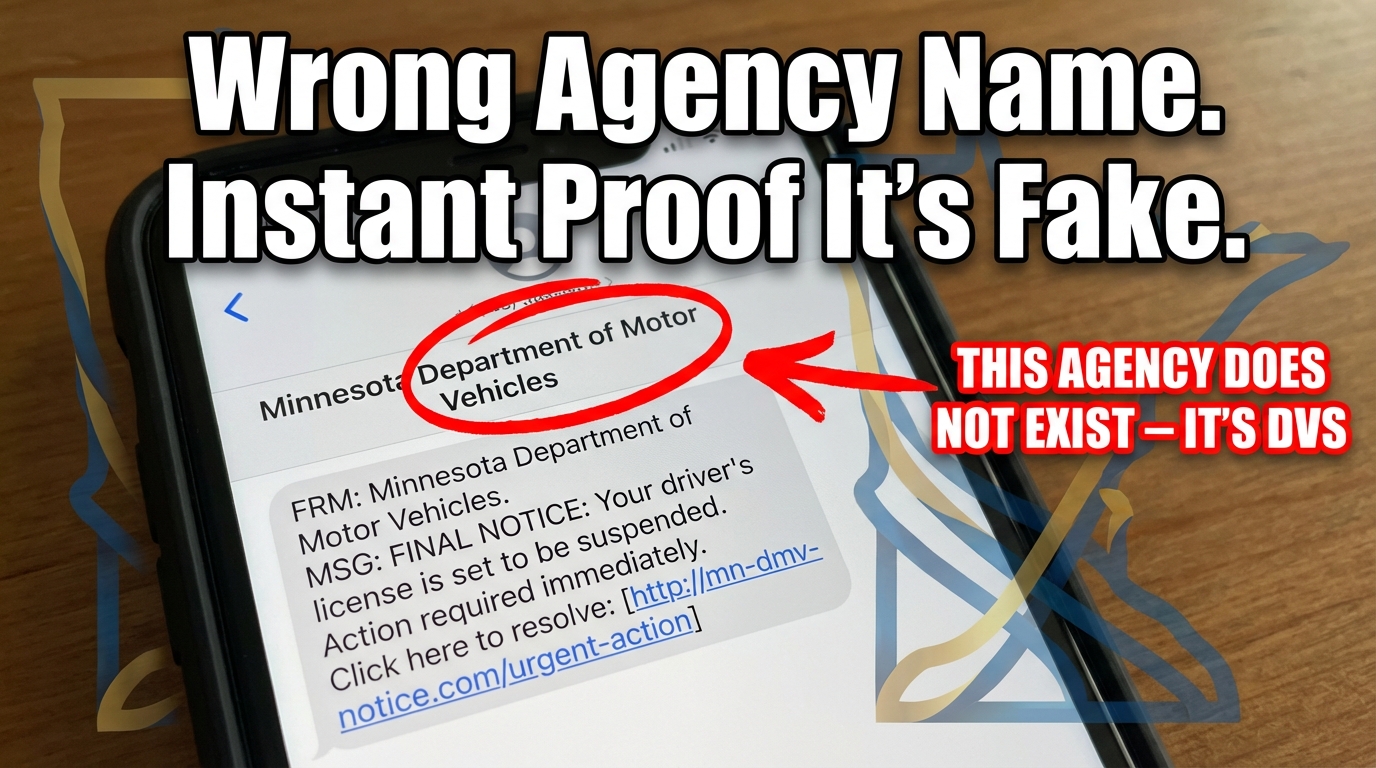
No agency called the "Minnesota Department of Motor Vehicles" exists. Minnesota's real motor vehicle agency is Driver and Vehicle Services (DVS), part of the Department of Public Safety (DPS). DVS and DPS never send texts asking for payment or personal information.
Quick facts to know right now:
- The text is a scam designed to steal your money or personal data
- Fake sender names include "Minnesota Department of Motor Vehicles," "DPSMN," and "Minnesota Department of Vehicle Administration" — none of these agencies exist
- The real DVS website is drive.mn.gov — go there directly if you have questions
- Do not reply, do not click links, and do not pay anything
These scam texts are spreading fast across Minnesota. Local law enforcement agencies and state officials have all issued warnings. Some Minnesotans report getting multiple threatening messages in a row, each one more urgent than the last.
As one Minnesota official put it, "These messages are not only fraudulent — they're frightening."
And the financial stakes are real. Consumers lost $470 million to text scams last year alone — five times more than in 2020. Minnesota ranks 12th in the nation for reported impostor scams, with a median loss of around $800 per victim.
This guide breaks down exactly how this scam works, how to spot it, and what to do if you received one.
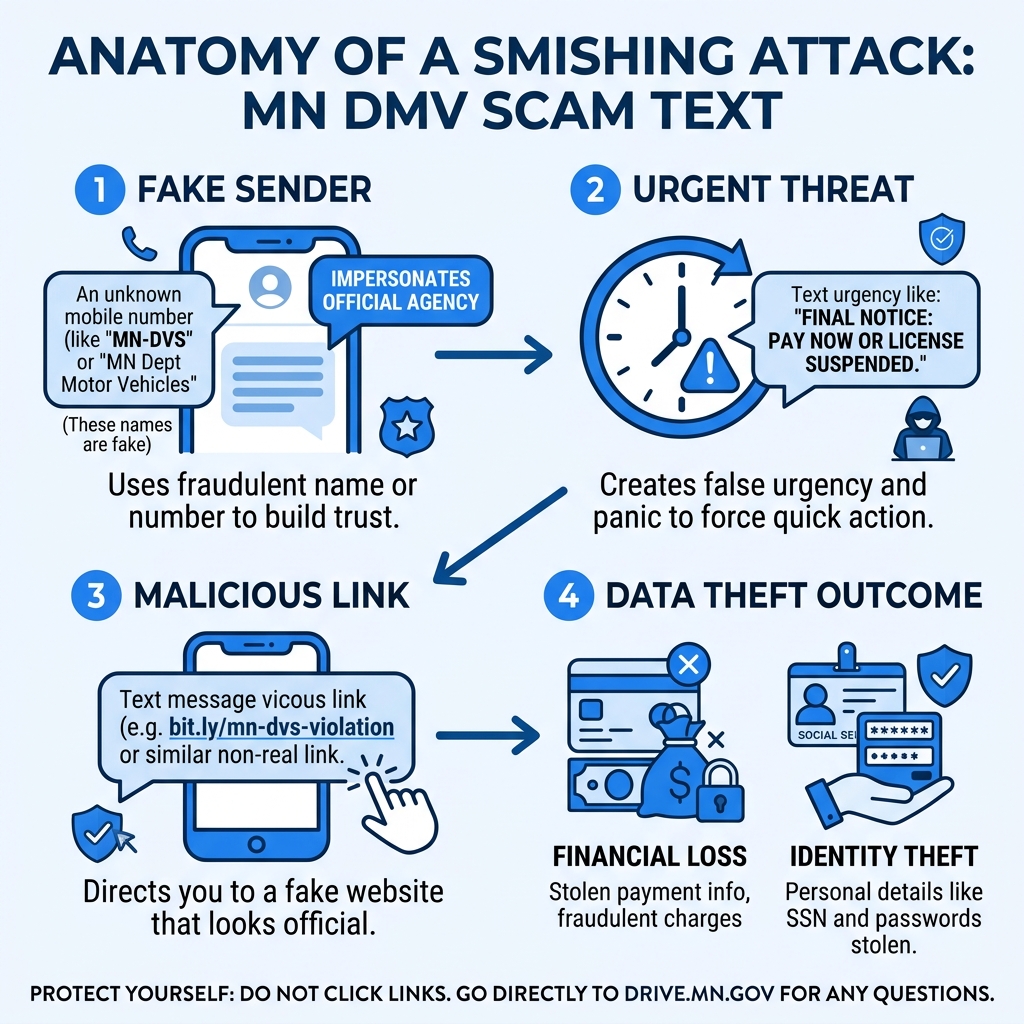
Anatomy of the MN DMV Scam Text
To protect ourselves, we first need to understand what these messages look like. Scammers are essentially "fishing" for your information—a tactic known as smishing (SMS phishing). They use psychological triggers like fear and urgency to make you act before you think.
In the typical MN DMV scam text, the message arrives from an unknown or international number. It often claims to be a "Final Notice" regarding an unpaid traffic ticket or a violation of state law. To make it look official, scammers often cite specific codes, such as "Minnesota State Administrative Code 15C-16.003." Don't let the jargon fool you; this is a common tactic used to build a false sense of authority.

The most glaring red flag is the name of the agency itself. You might see names like:
- "Minnesota Department of Motor Vehicles"
- "DPSMN"
- "Minnesota Department of Vehicle Administration"
In reality, none of these agencies exist. In Minnesota, motor vehicle services are handled exclusively by Driver and Vehicle Services (DVS). If the name on the text doesn't match the official state agency, it’s a guaranteed fraud. For more tips on identifying these types of messages, check out our guide on How to Spot a DMV Text Scam.
Common Phrases in a MN DMV Scam Text
Scammers rely on a specific script to manufacture panic. They want you to believe that if you don't click the link right now, something terrible will happen—like your license being suspended or your credit score being ruined.
Common phrases we see in these fraudulent messages include:
- "Final Notice: Your driver's license will be suspended."
- "Outstanding ticket payment required immediately."
- "Action required: Update your contact information to avoid penalties."
- "Reply Y to confirm or click the link below."
| Feature | Scam Text Language | Official DVS Policy |
|---|---|---|
| Urgency | "Immediate action required" / "Final Notice" | Official notices sent via USPS mail |
| Payment Method | Requests payment via link or gift cards | Never requests payment via text |
| Sender Name | "MN DMV" or "DPSMN" | Does not send unsolicited texts |
| Links | Shortened or suspicious URLs | All services via drive.mn.gov |
How to Verify a MN DMV Scam Text
If you receive a text that makes you nervous, the best thing to do is stop and verify it independently. Never use the contact information or the links provided in the suspicious text. Instead, we recommend going directly to the source.
The official website for Minnesota Driver and Vehicle Services is drive.mn.gov. If you truly had an outstanding issue with your license or registration, it would appear in your official account on that portal. You can also contact DVS directly through their verified channels to ask about your status.
We’ve seen similar tactics used in other areas, such as the Parkmobile Scam Text, where scammers impersonate parking apps to steal credit card info. The rule of thumb remains the same: look for red flags like international area codes, poor grammar, and links that don't end in ".gov". For the most up-to-date information from the state, you can visit the Official DVS Scam Alert.
Why These Messages Are Fraudulent
The fundamental reason these messages are fake is simple: Government agencies do not work this way. The Minnesota Department of Public Safety (DPS) and its Driver and Vehicle Services (DVS) division have explicitly stated they will never request payment, bank information, or Social Security numbers via text message.
In Minnesota, if you have a traffic ticket, that is handled through the court system, not the DMV. Law enforcement officers issue citations, and you receive official documentation through the mail or at the time of the stop. The "DMV" (or DVS) does not "broach" traffic tickets via SMS.
This isn't just a Minnesota problem. We have seen similar campaigns across the country, such as the Georgia DMV Scam Texts, where scammers use almost identical language to target drivers in the South. The Federal Trade Commission (FTC) consistently warns that any unsolicited text from a government agency asking for money is a major red flag.
The Risks of Clicking and How to Report
The danger of the MN DMV scam text isn't just about losing the "fine" the scammer is asking for. Clicking the link can lead to much more severe consequences:
- Malware: The link may download malicious software onto your phone that can track your keystrokes or steal your saved passwords.
- Credential Harvesting: The link often leads to a "spoofed" website that looks exactly like a government portal. When you "log in," the scammers capture your username and password.
- Identity Theft: Once they have your name, address, and license number, they can sell this data on the dark web or open fraudulent accounts in your name.
The statistics are sobering. Losses to text scams were five times greater in 2024 than in 2020, with nearly half a billion dollars lost nationally. In Minnesota, the median loss of $800 shows that these criminals are successfully draining the bank accounts of our neighbors.
If you receive one of these texts, reporting it is a vital step in helping authorities shut down these operations. You can Report to the FTC or file a complaint with the FBI IC3 Reporting center. Additionally, most cell phone carriers allow you to report spam by forwarding the message to 7726 (SPAM). This helps carriers block the numbers and protect other users. We’ve seen this reporting be effective with other scams, like the TXDOT Scam Text, where quick reporting helped identify a single number being used for thousands of fraudulent messages.
Immediate Actions for a MN DMV Scam Text
If a suspicious message lands in your inbox, follow these steps immediately:
- Do Not Click: Even if you’re curious, clicking the link can trigger a malware download.
- Do Not Reply: Replying "STOP" or "Y" confirms to the scammer that your number is active, leading to even more spam.
- Block the Sender: Use your phone’s built-in features to block the number.
- Delete the Message: Once you’ve reported it to your carrier (7726), get it off your phone.
- Verify Official Status: If you are genuinely worried about your vehicle registration, Manage official DVS subscriptions through the official state portal.
Frequently Asked Questions about Minnesota DMV Scams
Does the Minnesota DMV ever text about tickets?
No. Minnesota’s Driver and Vehicle Services (DVS) will never contact you via text to discuss traffic citations or request payment for fines. Traffic tickets are handled by the Minnesota Judicial Branch and local law enforcement. Official communication regarding your driver's license status is almost always handled via the U.S. Postal Service.
What should I do if I already clicked the link?
If you clicked the link and entered any information, you need to act fast:
- Contact your bank: If you provided payment info, freeze your cards immediately.
- Change your passwords: Especially for your email and banking accounts.
- Scan for malware: Use a reputable mobile security app to ensure no "spyware" was installed.
- Place a credit freeze: Contact the major credit bureaus to prevent scammers from opening new accounts in your name.
- Report it: File a report at the FBI Internet Crime Complaint Center.
Why am I being targeted for these scams?
Scammers often get phone numbers through large-scale data breaches or by purchasing lists from the dark web. They also use "autodialers" to send thousands of texts to random numbers within a specific area code (like 612, 651, or 952). If your personal information (PII) has ever been exposed in a corporate data breach, you are more likely to be targeted by these smishing campaigns.
Conclusion
The MN DMV scam text is a reminder that our digital lives are constantly under attack by sophisticated criminals. These scammers rely on the fact that most of us want to be law-abiding citizens and will react quickly to a "Final Notice" from the state. By staying informed and skeptical, we can protect ourselves and our finances.
At Tempo Mail USA, we believe that the best way to stop a scam is to prevent your information from getting into the wrong hands in the first place. We provide temporary email aliases that act as a secure identity proxy—a digital firewall for your privacy. By using a temporary alias when signing up for services or filling out forms online, you protect your real PII (Personally Identifying Information) from being harvested and sold to scammers.
Don't wait until you're a statistic. Take control of your digital footprint and Protect your data at tempomailusa.com. Stay safe, stay private, and always think twice before you click.