

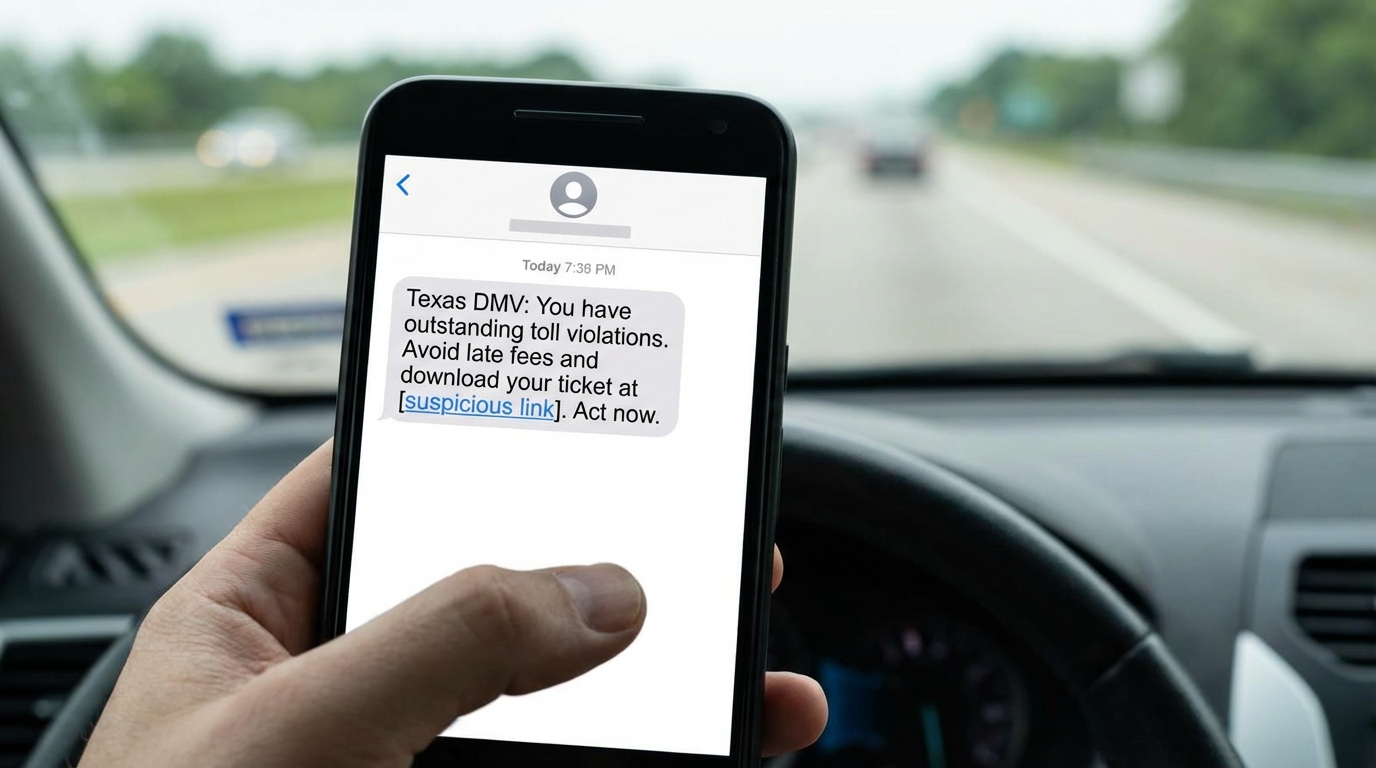

Texas DMV Scam Texts Are Targeting Drivers Right Now
A texas dmv scam text is a fake message designed to trick you into clicking a link or handing over personal information. These texts pretend to be from the Texas Department of Motor Vehicles (TxDMV) and claim you owe money for unpaid tickets, toll violations, or other infractions.
The short answer: It's a scam. Delete it.
Here's what you need to know at a glance:
| Question | Quick Answer |
|---|---|
| Is the text really from TxDMV? | No. TxDMV never sends unsolicited texts about fines or violations. |
| Should I click the link? | No. Never click any link in these messages. |
| Should I pay or share info? | No. Do not send money or personal details. |
| What should I do? | Block the sender, delete the message, and report it. |
| Where do I report it? | FBI IC3 or FTC |
These scams — known as smishing (SMS phishing) — have been hitting Texans hard. Reports have surged across the state, with multiple police departments issuing public warnings. The Texarkana Police Department put it bluntly on social media: "The real DMV isn't sending out threats filled with random big words and weird phrases."
And they're right. The real TxDMV is not a law enforcement agency. It does not issue traffic tickets. It does not collect fines. And it does not send unsolicited texts.
If you're privacy-conscious and worried about your personal data being exposed, this scam is exactly the kind of threat worth understanding — because clicking that link can lead to identity theft, stolen financial information, or malware on your device.
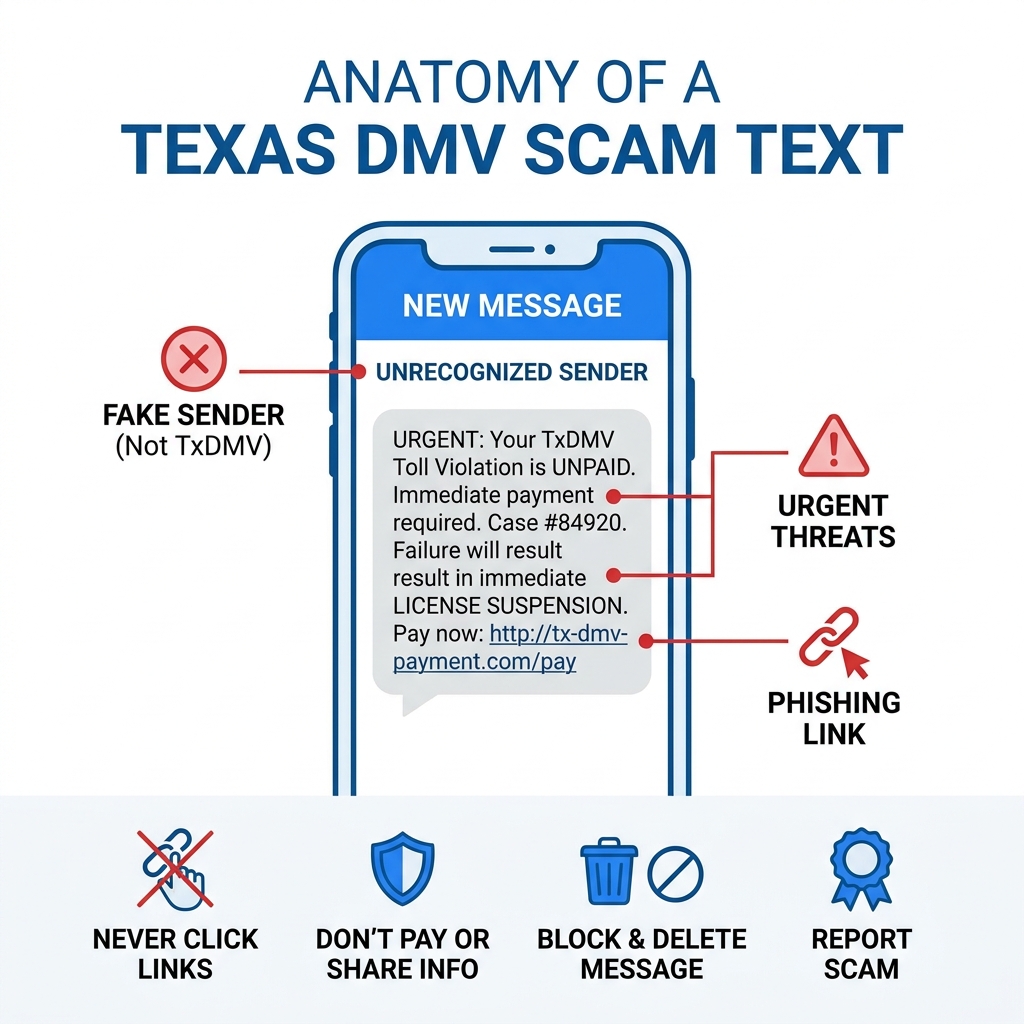
Anatomy of the Texas DMV Smishing Attack
To protect ourselves, we first need to understand how these criminals operate. The texas dmv scam text is a classic example of "smishing." This is a fancy term for phishing that happens over SMS. By using text messages, scammers bypass many of the email filters we’ve grown accustomed to, landing their lies directly in our pockets.
The "Urgent" Toll Violation
One of the most common variations of this scam targets TxTag customers. Since April 2024, there has been a massive spike in texts claiming you have an outstanding toll balance. On February 25, 2025, TxDOT issued an updated warning regarding a significant increase in these reports.
These messages usually look like this: "TxTag: We've noticed an unpaid toll of $12.50 on your account. To avoid a $50.00 late fee and license suspension, pay immediately at [malicious-link]."
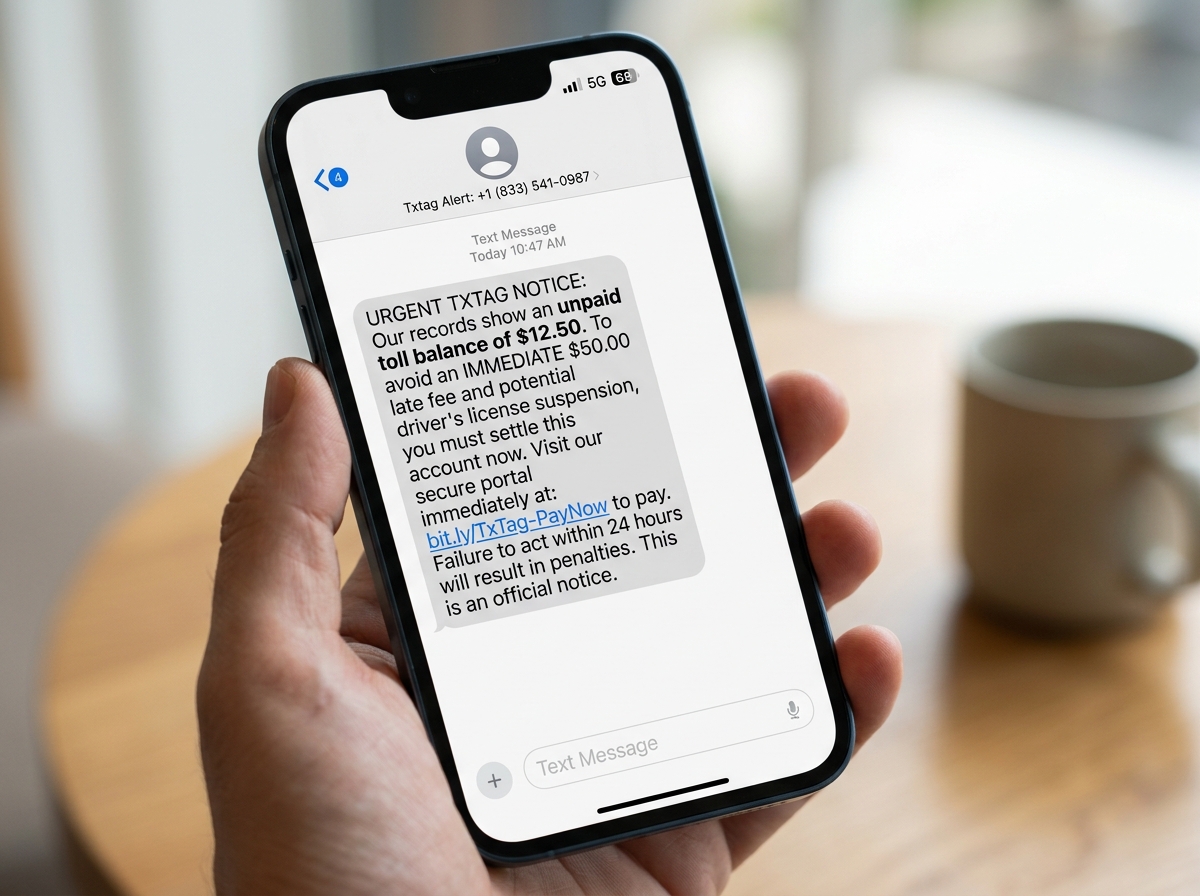
The goal here is simple: fear. By threatening you with a license suspension or a massive late fee, they hope you’ll click the link without thinking. Once you click, you are taken to a website that looks remarkably like the official TxTag or TxDMV site. There, they’ll ask for your credit card info, Social Security number, or driver's license details.
The Fake Traffic Ticket
Another version of the texas dmv scam text claims you have a pending traffic citation. This is particularly sneaky because it plays on the general anxiety we all feel when we see a police cruiser in the rearview mirror.
However, there is a major logical flaw in this scam: the TxDMV doesn't issue tickets. In Texas, traffic citations are handled by local police departments, sheriff’s offices, or the Highway Patrol (DPS). If the DMV is "texting" you about a speeding ticket, you can be 100% certain it’s a fraud.
We see these scams evolving constantly. For more context on how these attacks look across the country, you might want to read about the NYS DMV Scam Text or how Ohio BMV scams have stolen thousands. It's also worth learning how to spot a DMV text scam in general, as the tactics are often recycled from state to state.
The "Card Stealing" Fine
Scammers aren't just looking for a one-time payment of $10. They want your entire wallet. Many of these links lead to "payment portals" designed to harvest your credit card data. We’ve analyzed parking violation scams that use the exact same card-theft technology. Once they have your CVV and card number, they don't just pay your "fine"—they go on a shopping spree.
Red Flags and Verification Steps
How do we know for sure it's a scam? The scammers might be persistent, but they aren't always smart. They often use "word salad" and technical errors that give them away.
1. The "Word Salad" and Weird Phrases
As the Texarkana Police Department noted, these texts are often filled with bizarre language. Have you ever received a text mentioning an "immutable credential endorsement" or "registration voidance"?
The real TxDMV uses plain English. They don't use pseudo-legal jargon to scare you. If the text sounds like it was written by a robot that swallowed a law dictionary, it’s a texas dmv scam text. One hilarious report even mentioned a threat of a "3.0 days" license suspension. Not three days. Not a month. "3.0 days." It’s these tiny, weird details that scream "fraud."
2. Non-U.S. Phone Prefixes
Check the sender's number. Many of these messages originate from international numbers or VoIP (Voice over IP) services. If you see a prefix that isn't +1 (the U.S. country code), or if it's a random 10-digit number from a state you’ve never visited, be suspicious. While some scammers have learned to "spoof" local numbers, many still use international codes like +44 (UK) or +63 (Philippines).
3. The Link is "Off"
Official Texas government websites almost always end in .gov. If the link in your text is txtag-bills-pay.com or texas-dmv-service.net, do not click it. Scammers buy cheap domains that look official but are actually hosted in different countries.
4. High-Pressure Tactics
The real TxDMV or TxTag will never text you out of the blue and tell you that you have 24 hours to pay or you’ll be arrested. Government processes are famously slow; they aren't going to solve a toll violation via a frantic text message at 2:00 AM.
| Feature | Official TxDMV / TxTag | Texas DMV Scam Text |
|---|---|---|
| Communication Method | U.S. Mail, Official Email (if opted in) | Unsolicited SMS / Text |
| Payment Requests | Through secure .gov portals | Links to .com, .net, or shortened URLs |
| Language | Clear, professional, and standard | Threatening, weird jargon, "3.0 days" |
| Sender ID | TxTag uses Shortcode 22498 | Random 10-digit or International numbers |
| Threats | Legal notices via mail | Immediate arrest, "voidance," or suspension |
If you encounter a message that checks these scam boxes, you should report fraud to the Federal Trade Commission immediately.
What to Do if You Receive a Texas DMV Scam Text
If your phone pings and you see a message about a "Texas Department of Motor Vehicles Citation," don't panic. Follow these steps to keep your data safe.
Step 1: Do Not Click
This is the most important rule. Even if you think there’s a 1% chance it’s real, do not click the link. Clicking can trigger a "drive-by download" of malware or confirm to the scammer that your phone number is active and being monitored by a real person.
Step 2: Do Not Reply
Replying "STOP" or "Who is this?" tells the scammer that a human is reading the messages. This will only lead to more scam texts from different numbers.
Step 3: Block and Delete
Use your phone’s built-in features to block the sender.
- On iPhone: Tap the number at the top, tap "info," and select "Block this Caller."
- On Android: Long-press the message and select "Block" or "Report Spam."
Step 4: Verify Through Official Channels
If you are genuinely worried that you might owe money for a toll or a ticket, go to the source.
- For tolls: Visit the official TxTag website directly by typing the address into your browser.
- For registration: Visit www.TxDMV.gov.
- For tickets: Contact your local municipal court or the police department in the city where you were driving.
TXTag only texts from one specific number, which is the shortcode 22498. If the text came from any other number, it’s not TxTag.
Step 5: Report the Scam
Reporting helps authorities track the scale of the attack and shut down the malicious websites.
- FBI IC3: You can report to the FBI’s Internet Crime Complaint Center which tracks nationwide cybercrime trends.
- FTC: Report to the Federal Trade Commission.
- Carrier: Forward the scam message to 7726 (which spells "SPAM"). This alerts your cell phone provider to the malicious sender.
Frequently Asked Questions
Why am I getting a texas dmv scam text?
We often get asked how these scammers got your number in the first place. It’s usually not because the DMV was hacked. Instead, scammers use "autodialers" that cycle through thousands of phone number combinations. They also buy lists of phone numbers from data breaches on other websites.
If your number was part of a leak from a social media site or a retail store years ago, it’s likely on a "sucker list" being sold on the dark web. There has been a massive smishing spike recently, with 8,121 visits to the official TxDMV warning page in a single day during peak scam periods. This indicates a coordinated, nationwide effort.
How to report a texas dmv scam text?
Reporting is a three-pronged approach. First, tell your carrier by forwarding the text to 7726. Second, file a report with the FBI IC3. Third, use the FTC fraud reporting tool. These agencies use this data to work with telecommunications companies to block scam traffic at the source.
If you want to see how other states handle this, you can look at the MVA Scam Text in Maryland or the Michigan MDOT scams. Interestingly, some scammers are so lazy they send DMV texts to people in states like Minnesota, even though Minnesota doesn't even have a "DMV" (it’s called the DVS there!).
Does the TxDMV send unsolicited texts about fines?
No. The official policy of the Texas Department of Motor Vehicles is that they do not send unsolicited texts or emails requesting personal information or payment for violations.
The TxDMV’s primary roles are:
- Registering and titling vehicles.
- Licensing vehicle dealers.
- Credentialing motor carriers.
- Supporting law enforcement through the Motor Vehicle Crime Prevention Authority (MVCPA).
They are not the "toll police" or the "traffic police." If you receive a text claiming otherwise, it is a texas dmv scam text.
Conclusion
The texas dmv scam text is more than just a nuisance; it’s a gateway for identity thieves to access your most sensitive information. By staying vigilant, looking for red flags like weird jargon and non-gov links, and refusing to click on suspicious messages, we can protect ourselves and our finances.
At Tempo Mail USA, we believe that your real identity should be guarded like a fortress. One of the reasons these scammers are so successful is that our real phone numbers and email addresses are scattered all over the internet, making us easy targets.
We provide temporary email aliases that act as a secure identity proxy. Think of it as a privacy firewall. By using a temporary alias when signing up for services, you keep your real PII (Personally Identifiable Information) hidden from data brokers and potential leakers. If a service you signed up for gets hacked, the scammers only get your alias—not your real, permanent inbox.
Be safe, be vigilant, and remember: Don't click it. It’s not a ticket!