

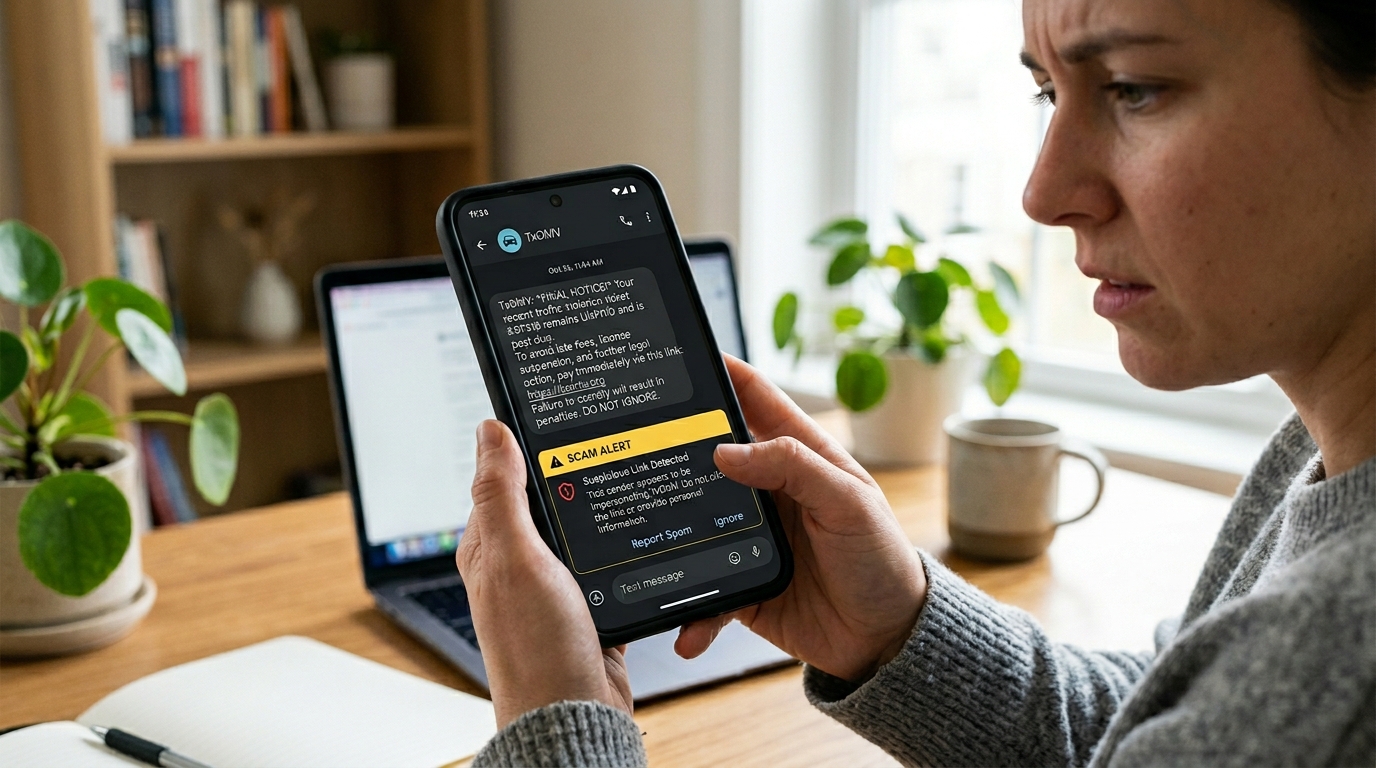

Is That TxDMV Text Real? What You Need to Know Right Now
The txdmv.org scam text is a fake message that criminals send to Texas drivers, pretending to be the Texas Department of Motor Vehicles. The goal is simple: scare you into clicking a link and handing over your personal or financial information.
Quick answer: These texts are not from TxDMV. Delete them. Do not click any links.
Here's what you need to know at a glance:
| Question | Answer |
|---|---|
| Does TxDMV send texts about tickets or fines? | No, never |
| Is TxDMV a law enforcement agency? | No |
| Should you click the link in the text? | Absolutely not |
| What should you do with the message? | Delete it and report it |
| Where do you report it? | ic3.gov or reportfraud.ftc.gov |
These scam messages typically claim you have an unpaid traffic ticket or toll violation. They threaten scary consequences — things like license suspension, prosecution, or registration being canceled — to pressure you into acting fast.
Texas police departments across the state have flagged these texts as fakes. One department noted the messages are packed with bizarre, intimidating phrases that "we're not sure what half of that crap means" — a sign the scammers are just trying to sound official without actually knowing what they're saying.
If you're privacy-conscious and worried about your personal information falling into the wrong hands, this scam is exactly the kind of threat you need to know how to spot and shut down quickly.
Understanding the txdmv.org Scam Text and Smishing Trends
In cybersecurity, we call this "smishing"—a combination of "SMS" and "phishing." It is a deceptive tactic where cybercriminals send text messages to trick you into revealing sensitive data. The txdmv.org scam text is a textbook example of this growing trend. By using a domain that looks official, like "txdmv.org" (which is not the actual state website), scammers attempt to bypass your natural skepticism.
These campaigns are often part of a larger wave of transportation-related fraud. For instance, many Texans have also been targeted by TxTag scam texts that claim you owe money for unpaid tolls. The goal is always the same: to get you to a fake payment portal where you enter your credit card number, Social Security number, or driver's license details.
To help you stay safe, look at how these fake domains compare to the real thing:
| Official Texas DMV URL | Common Scam/Fake Domains |
|---|---|
| www.TxDMV.gov | txdmv.org |
| txdmv.gov/subscribe | texas-dmv-records.com |
| txdmv.gov/contact-us | tx-dmv-fine-pay.net |
Anatomy of a txdmv.org scam text
A typical txdmv.org scam text is designed to hijack your emotions. It usually starts with a "Notice of Violation" or an "Urgent Update." The message will claim that a traffic ticket has gone unpaid and that immediate action is required to avoid "prosecution" or "registration voidance."
The message always includes a link. This link doesn't go to a government server; it goes to a malicious website designed to look exactly like the official TxDMV portal. Once you're there, any information you type is sent directly to the scammers.
Why Texans are being targeted
Why Texas? It’s a numbers game. Texas has millions of registered drivers and a massive network of highways. Because vehicle registration and titling are things almost every adult in the state has to deal with, a scammer sending out 10,000 texts is bound to hit someone who recently moved, renewed their registration, or actually did get a ticket.
The high volume of legitimate DMV transactions makes it easier for a fake message to blend in. Furthermore, since the Texas Department of Motor Vehicles (TxDMV) is a well-known agency, its name carries a level of authority that scammers exploit to create instant panic.
Red Flags: Spotting a txdmv.org Scam Text
Detecting a scam doesn't require a degree in computer science. It just requires a moment of pause. Scammers rely on you being in a hurry. If you slow down, the red flags become obvious.
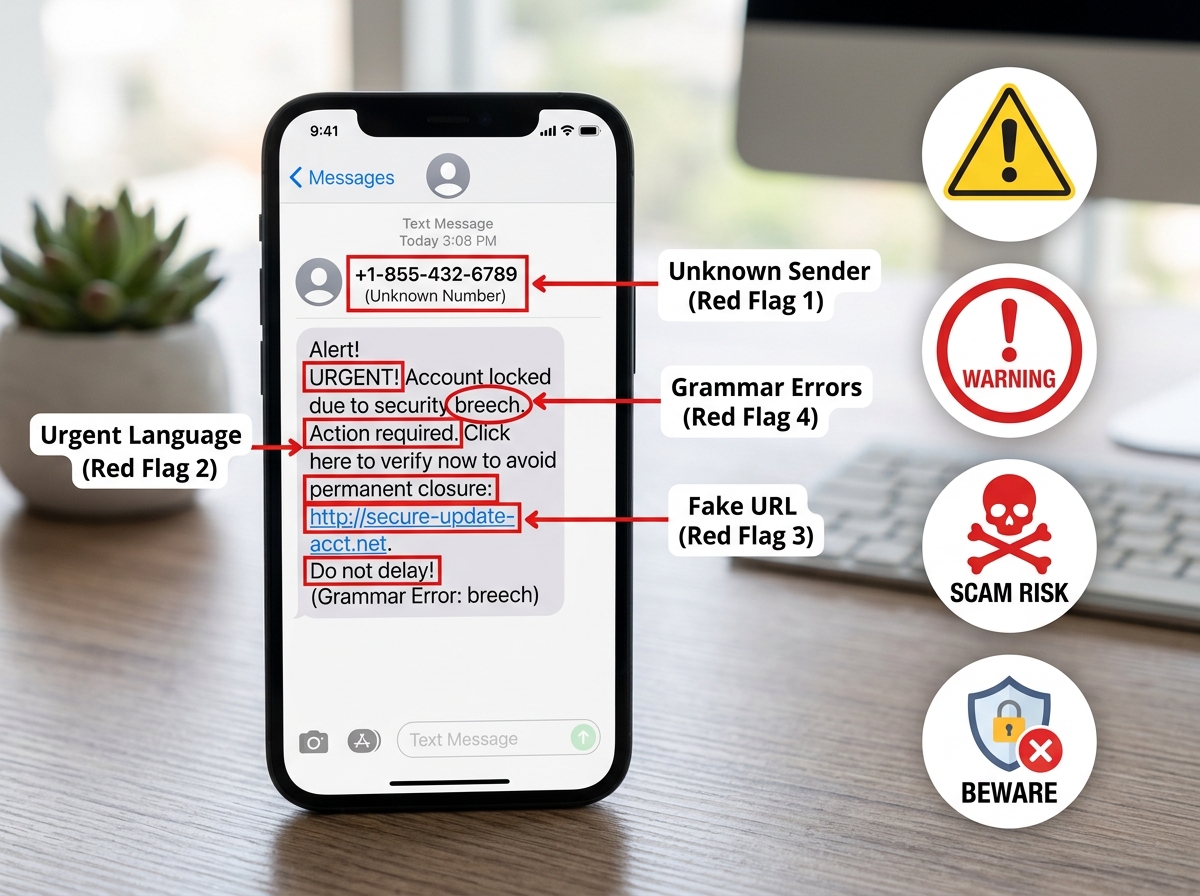
One of the biggest red flags is the origin of the text. Many of these messages come from phone numbers with non-U.S. prefixes or random "short codes" that don't match any official government service. Additionally, the language used is often a "word salad" of legal-sounding terms that don't actually make sense in a Texas legal context.
If you see a message that looks suspicious, you should Report fraud to the Federal Trade Commission immediately to help them track and shut down these operations.
Language used in a txdmv.org scam text
We often see scammers using overly dramatic or "clunky" English. Some of the most common phrases found in the txdmv.org scam text include:
- "Immutable credential endorsement": This is a nonsensical phrase that sounds important but means nothing in vehicle registration.
- "Registration voidance": While your registration can expire or be suspended, "voidance" is not a term the DMV typically uses in unsolicited texts.
- "3.0 days until suspension": The use of decimal points in day counts is a strange quirk often seen in automated scam scripts.
Police departments in cities like Texarkana and Amarillo have pointed out that these messages are often filled with grammatical errors that a professional government agency would never allow in an official notice.
Technical indicators of fraud
Beyond the words, look at the technical details. Scammers often use shortened URLs (like bit.ly or tinyurl links) to hide the final destination of the link. They may also spoof numbers to make it look like the text is coming from a local area code, even if the scammers are operating from another country.
This isn't just a Texas problem, either. You can Learn about similar scams in New York to see how these groups use the same templates across different states, simply swapping out the agency names.
Official TxDMV Communication vs. Smishing Tactics
Understanding what the TxDMV actually does is your best defense. The Texas Department of Motor Vehicles is responsible for titling and registering vehicles, licensing dealers, and credentialing motor carriers.
Crucially, the TxDMV is not a law enforcement agency. They do not pull people over, they do not issue speeding tickets, and they do not collect fines for traffic violations. Those tasks are handled by local police, county sheriffs, or the Texas Department of Public Safety (State Troopers).
Does TxDMV send text messages?
The TxDMV has been very clear: they do not send unsolicited text messages or emails requesting personal information or payment for violations.
While you can sign up for official alerts or news releases via the Official TxDMV Website, these are "opt-in" services. If you haven't specifically asked for text updates, any message you receive claiming to be from them is a fraud. They will never ask you to click a link to pay a fine via text.
How TxDMV actually handles violations
If there is a legitimate issue with your vehicle registration or if you have a complaint filed against you (if you are a dealer), the TxDMV communicates through official channels. This almost always involves:
- United States Postal Service (USPS): Official notices are sent via physical mail to the address on file.
- Official Portals: You would be directed to log into the secure .gov website directly, rather than clicking a link in a message.
- Local Tax Offices: Most registration issues are handled in person at your county tax assessor-collector’s office.
Immediate Steps to Take Against Fraudulent Messages
If a txdmv.org scam text lands in your inbox, don't panic. Taking the right steps immediately can protect your data and help others.
- Block the Sender: Use your phone’s built-in features to block the number immediately.
- Report to your Carrier: Most major carriers allow you to report spam by forwarding the message to 7726 (which spells "SPAM").
- Delete the Message: Once blocked and reported, get it off your phone so you don't accidentally click it later.
- Report to Authorities: You should Report cybercrime to the FBI IC3 at their Internet Crime Complaint Center. This helps federal investigators build cases against the groups running these scams.
What to never do with suspicious texts
The most important rule is: Don't engage.
- Never click the link: Even if you don't enter information, clicking the link can sometimes trigger a malware download or confirm to the scammer that your phone number is "active," leading to even more spam.
- Never reply: Replying "STOP" or "Who is this?" tells the scammer a real person is reading the messages.
- Never share PII: Never provide your Social Security number, credit card info, or driver's license number to a site reached via a text link.
How to verify legitimate Texas tickets
If you are genuinely worried that you might have an unpaid ticket, verify it safely.
- Check with the Local Court: Traffic tickets are handled by the municipal or justice of the peace court in the area where the "violation" occurred.
- Use Official Portals: Visit the official website of your local city or county government.
- Call the Agency: Use a phone number found on an official government website, never a number provided in a suspicious text.
For those curious about how widespread this is, you can find similar Information on Tennessee DMV scams to see the patterns scammers use nationwide.
Frequently Asked Questions about TxDMV Scams
Does the Texas DMV issue traffic tickets?
No. The Texas Department of Motor Vehicles (TxDMV) does not issue traffic tickets or citations. Tickets are issued by law enforcement officers (Police, Sheriffs, or State Troopers) and handled by local courts. If a text says the "DMV" is charging you for a speeding ticket, it is a 100% confirmed scam.
What should I do if I clicked a link in a scam text?
If you clicked the link but didn't enter any info, run a security scan on your phone. If you did enter personal or financial information:
- Contact your bank: Freeze any credit cards you entered.
- Change passwords: Update the passwords for your email and banking accounts.
- Monitor your credit: Check for any unusual activity on your credit report.
- Identity Theft Report: Visit IdentityTheft.gov if you shared your Social Security number.
How can I report a txdmv.org scam text?
You can report it to the FBI at www.ic3.gov or the FTC at www.reportfraud.ftc.gov. You can also contact the TxDMV directly via their official email addresses, such as Media@TxDMV.gov or AskDMV@TxDMV.gov, to make them aware of new variations of the scam.
Conclusion
The txdmv.org scam text is a persistent threat, but it’s one that loses its power the moment you recognize the red flags. By staying informed and remembering that the TxDMV will never text you to demand payment for a ticket, you can keep your personal and financial information safe.
At Tempo Mail USA, we believe that your identity is your most valuable asset. In an age where smishing and phishing are rampant, protecting your real-world data is essential. We provide temporary email aliases that act as a secure identity proxy—a firewall that keeps your real personal information (PII) away from services that might be vulnerable to data breaches or scammers.
Stay vigilant, don't click the link, and always verify through official channels. For more privacy tips and tools to keep your digital life secure, visit us at tempomailusa.com.