

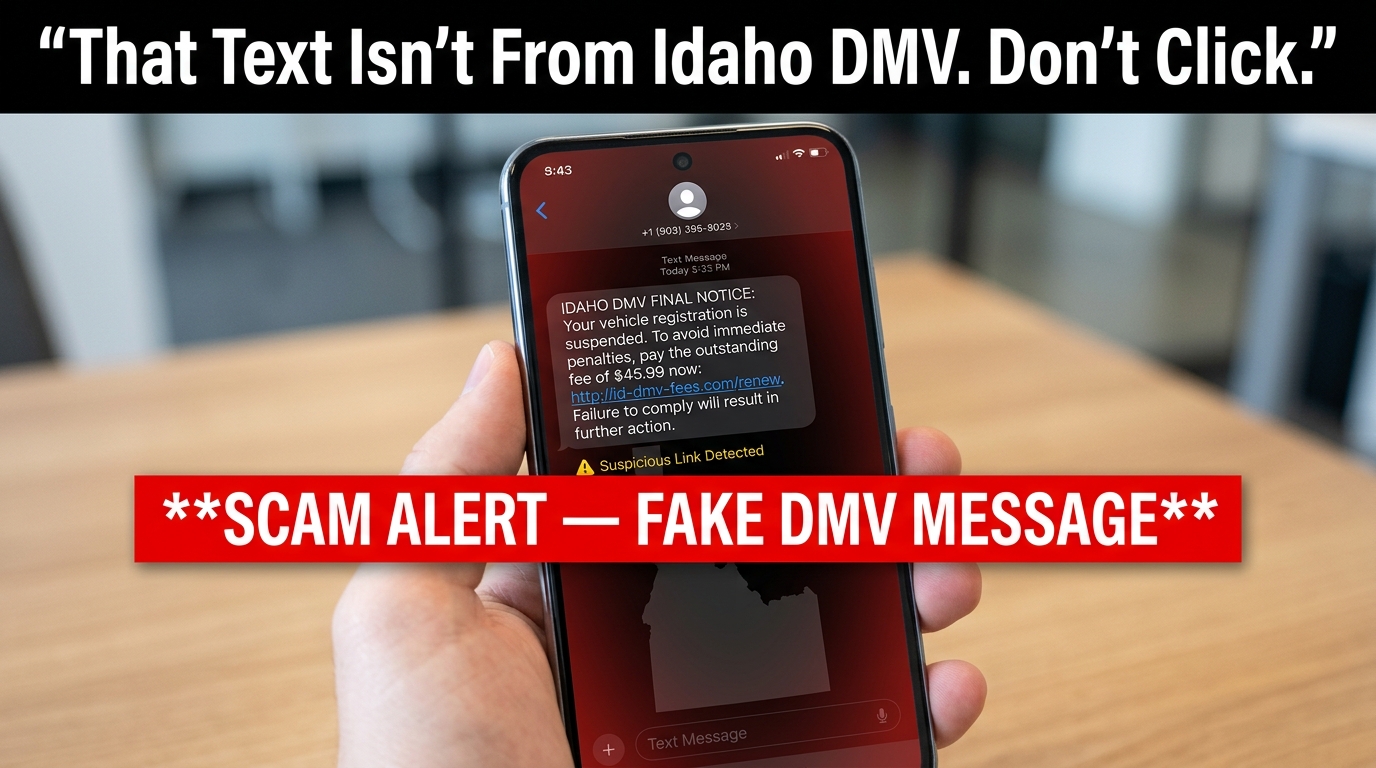

Is That Idaho DMV Text Real? Here's What You Need to Know Right Now
The Idaho DMV text scam is a fraudulent smishing (SMS phishing) scheme where criminals impersonate the Idaho Transportation Department (ITD) to steal your money and personal information.
Quick answer — here's how to know if that DMV text is a scam:
- The link does not end in
.gov→ it's a scam - The text claims you owe an unpaid fine or your registration is overdue → it's a scam
- The message demands immediate payment or threatens license suspension → it's a scam
- The sender is an unknown or foreign number → it's a scam
What to do right now:
- Do not click any links in the message
- Do not provide any personal or payment information
- Report the text to your mobile carrier by forwarding it to 7726 (SPAM)
- Delete the message
- Verify your real DMV status at www.dmv.idaho.gov
The Idaho Transportation Department has issued multiple warnings about repeated waves of these fraudulent texts hitting residents across the state. The scam texts typically claim you have an unpaid traffic citation or an overdue vehicle registration, and they pressure you to click a link and pay immediately.
These messages are not from the ITD or any official Idaho government agency.
One sheriff's office breakdown of a specific scam text found it originated from a Philippine phone number (with a +63 country code) and linked to a fake domain ending in .org instead of .gov — a dead giveaway. Real Idaho government websites always end in .gov.
The scale of this threat matters. ITD processes close to 100,000 DMV transactions online every month, which means scammers have a massive pool of potential targets who are actively thinking about their vehicle registrations and licenses.
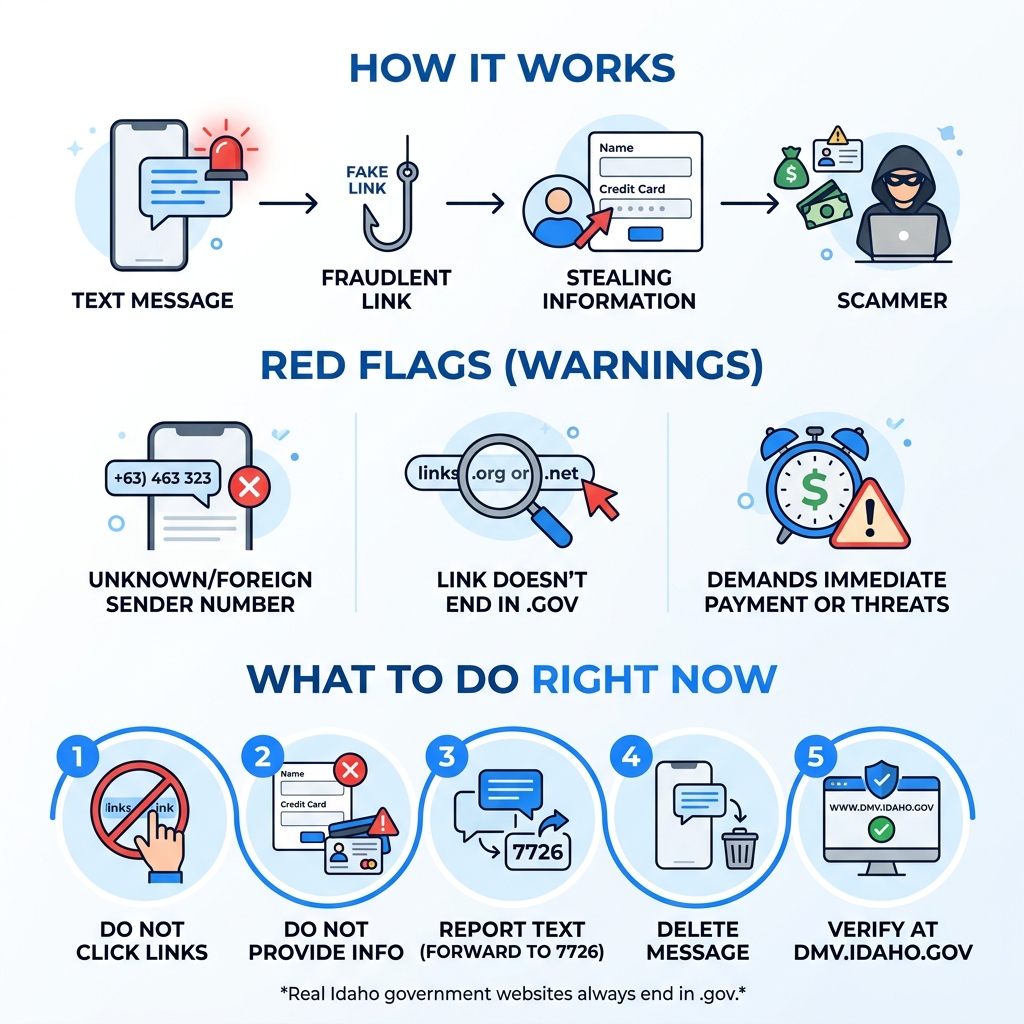
Anatomy of the Idaho DMV Text Scam
To protect ourselves, we first need to understand how these criminals operate. The idaho dmv text scam isn't just a random message; it is a calculated "smishing" attack designed to exploit our sense of urgency. When you receive a text claiming your driver's license is about to be suspended, your natural instinct is to fix the problem immediately. This is exactly what the scammers want.
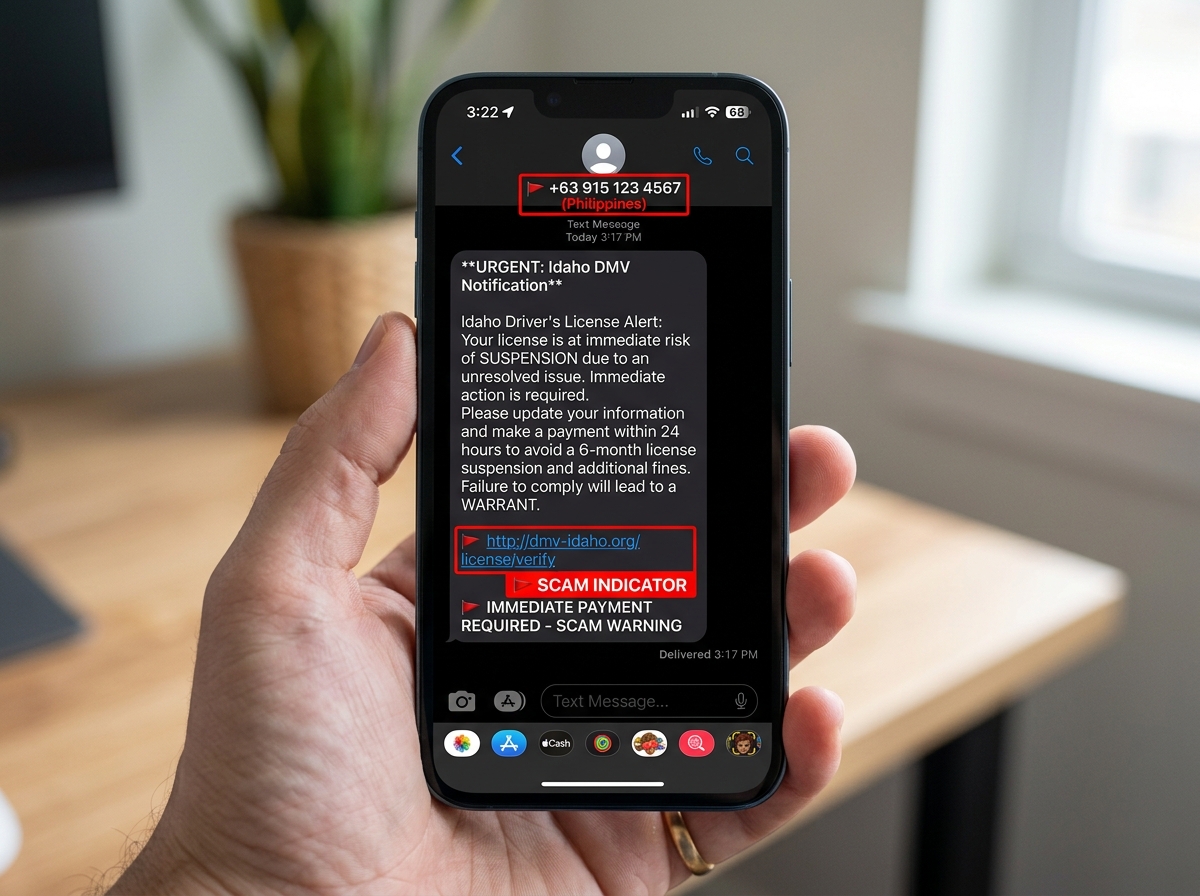
The most common version of this scam involves a text message sent from a number you won't recognize. In many cases, these messages originate from international locations. For instance, the Bonneville County Sheriff’s Office highlighted a wave of texts coming from the +63 prefix, which is the country code for the Philippines. Unless the Idaho DMV moved its headquarters to Manila overnight, that’s a massive red flag.
These texts almost always include a link. These links are designed to look official but often use deceptive domain extensions. You might see addresses ending in .icu, .org, or .com. As we’ve noted, the only legitimate domain for Idaho government services is .gov. If you see anything else, you are looking at an unpaid-traffic-violation-text-scam-dont-pay-this-fake-dmv-message.
Red Flags in an Idaho DMV Text Scam
Beyond the sender's phone number, there are specific technical errors in these messages that give them away. Scammers often try to sound "official" by citing fake regulations. One common example seen in Idaho is a reference to "Regulation 16C-16.003." If you search the Idaho Statutes, you won't find this; it's a fabricated number intended to intimidate you into compliance.
Another major red flag is the demand for immediate payment. Official government agencies rarely, if ever, demand instant payment via a text message link. They certainly won't threaten you with immediate license suspension or legal action within minutes of a first "notice." You can learn more about identifying these deceptive tactics in our guide on txdmv-org-scam-alert-fake-dmv-texts-red-flags.
Common Phrasing in Fraudulent Messages
The language used in an idaho dmv text scam is designed to bypass your critical thinking. Look out for these phrases:
- "Final Notice: Your vehicle registration is overdue."
- "Action Required: Unpaid traffic citation detected."
- "Your driver's license will be suspended unless you act immediately."
These messages often link to a "payment portal" that looks remarkably similar to the real ITD website. However, once you enter your credit card information, you aren't paying a fine—you're handing your financial life over to a criminal. This is a classic parking-violation-scam-text-that-fine-is-stealing-your-card tactic applied to the DMV.
Official Verification: What the ITD Never Does
The Idaho Transportation Department (ITD) and the DMV have very strict protocols for how they communicate with the public. Knowing what they don't do is just as important as knowing what they do.
| Feature | Official ITD Communication | Idaho DMV Text Scam |
|---|---|---|
| Domain Extension | Always ends in .gov | Ends in .com, .org, .icu, .net |
| Payment Requests | Never via unsolicited text | Demands immediate payment via link |
| Urgency | Standard billing cycles/mail notices | Threats of immediate arrest or suspension |
| Sender | Official short codes or verified mail | Random 10-digit or international numbers |
| Traffic Fines | Handed in person by officers | Claimed via text "camera citations" |
The ITD has been very clear: they do not send text messages demanding payment for traffic violations or overdue fees. If you receive a message like this, it is 100% fraudulent. For the most accurate information, you should always refer to the Official Idaho Transportation Department Warning.
Verifying Your Status Without an Idaho DMV Text Scam
If you are genuinely worried about your registration or license status, there are safe ways to check. The ITD is a powerhouse of digital services, processing nearly 100,000 online transactions every month. This includes everything from vehicle registration renewals to driver's license updates.
If you have a Star Card (Idaho’s REAL ID), you are likely already familiar with the official portals. As of 2021, over 490,000 of the 1.25 million licensed drivers in Idaho have a Star Card. To check your status, simply open a fresh browser window and type in dmv.idaho.gov or itd.idaho.gov. Never use the link provided in a text. We highly recommend checking out our dmv-text-scam-2026-do-not-click-that-link-until-you-read-this for more verification tips.
Why Idaho Does Not Text for Fines
One of the funniest—and most effective—ways to spot an idaho dmv text scam is when it claims you owe money for a "camera citation." Here is a piece of expert knowledge for you: Idaho does not use automated camera systems to issue traffic citations.
In the Gem State, traffic tickets must be delivered in person by a law enforcement officer. If a text message says a camera caught you speeding or running a red light, you can laugh and hit delete. The scammers are using a script that works in other states but fails miserably in Idaho. This is a common theme in regional scams, similar to what we've seen in the utah-louisiana-dmv-scam-text-do-not-click reports.
Immediate Steps: What to Do if You Receive a Scam Text
If your phone pings with a suspicious message, don't panic. Panic is the scammer's best friend. Instead, follow these simple steps to protect yourself and your fellow Idahoans.
- Stop and Breathe: Do not click the link. Even clicking the link can sometimes trigger malware downloads or alert the scammer that your number is "active."
- Report to your Carrier: Forward the message to 7726. This is a universal short code for reporting spam to mobile carriers. It helps them block these numbers at the network level.
- Block the Sender: Use your phone's built-in "Block Contact" feature.
- Delete the Evidence: Once reported, delete the text so you don't accidentally click it later.
For a deeper dive into reporting fraud, see our guide on how-to-report-fraud-to-ftc-the-right-way.
Reporting to Federal Authorities
While reporting to your carrier is great for immediate relief, reporting to federal authorities helps catch the people behind the idaho dmv text scam. The FBI Internet Crime Complaint Center (IC3) is the primary hub for this.
When you file an IC3 complaint, you provide the FBI with the fake domain names and phone numbers used by the scammers. This data is used to track "waves" of attacks and can eventually lead to taking down the fraudulent websites. You can also file a complaint with the FTC. If you're unsure of the process, we have a step-by-step breakdown on how-to-report-phishing-email-in-usa-ftc-fbi-gmail-steps.
Securing Your Device After an Idaho DMV Text Scam
If you accidentally clicked the link but didn't enter any info, you're likely okay, but you should still take precautions. Ensure your phone's operating system is fully updated. These updates often include security patches that protect against the latest "smishing" vulnerabilities.
If you did enter personal information, you are at risk of identity theft. You should immediately:
- Contact your bank to freeze your cards.
- Change your passwords for sensitive accounts.
- Monitor your credit report.
The idaho-dmv-scam-text-alert-fake-messages-targeting-drivers post offers a comprehensive checklist for those who may have been compromised.
Protecting Your Digital Identity from Smishing
At Tempo Mail USA, we believe the best way to deal with a scam is to never receive it in the first place. Scammers get your phone number and email address from data breaches, public records, and "free" services that sell your data.
We provide temporary email aliases that act as a secure proxy for your real identity. Think of it as a digital firewall. When you use a temporary alias for online forms or services, your real PII (Personally Identifiable Information) remains hidden. If that service is ever breached, the scammers only get a "temp" address that you can delete, rather than your permanent contact info.
By reducing your digital footprint, you make it much harder for the masterminds behind the idaho dmv text scam to find you. Protecting your privacy is a proactive step, much like our how-to-report-phishing-emails-in-5-easy-steps guide suggests.
Frequently Asked Questions about the Idaho DMV Text Scam
Does the Idaho DMV ever send text messages for payments?
No. The Idaho Transportation Department explicitly states they do not send text messages demanding payment for traffic tickets, fines, or registration fees. They only send texts for "opted-in" notifications, and even then, they will never demand immediate payment through a link.
How can I tell if a DMV link is legitimate?
The "Gold Standard" for legitimacy is the .gov domain extension. Official Idaho sites will be itd.idaho.gov or dmv.idaho.gov. If the link ends in .com, .org, .icu, or anything else, it is a scam. Also, check for "https://" and a padlock icon in your browser, though keep in mind that many modern scam sites now use these to look legitimate.
What should I do if I already clicked the link in a scam text?
If you only clicked the link, close the window immediately and clear your browser cache. If you entered a password, change it on all accounts where you use that same password. If you entered credit card or Social Security information, contact your financial institutions and the credit bureaus immediately to place a fraud alert on your accounts.
Conclusion
The idaho dmv text scam is a persistent threat, but it's one we can defeat with a little bit of knowledge and a lot of caution. The Idaho Transportation Department is here to serve you, not to threaten you via text message.
Always rely on official channels like itd.idaho.gov for your DMV needs. Whether you are renewing your registration or checking on your Star Card status, going directly to the source is the only way to stay safe.
Stay vigilant, Idaho. Don't let a "Final Notice" text ruin your day. For more tips on keeping your digital life private and secure, visit us at https://tempomailusa.com. We are here to help you build a stronger defense against the ever-evolving world of online fraud.