


The Texas DMV Text Scam Is Fooling Thousands of Drivers — Here's What You Need to Know
The texas dmv text scam is a phishing scheme where criminals send fake text messages pretending to be from the Texas Department of Motor Vehicles (TxDMV), threatening license suspension or fines to trick you into clicking a malicious link.
Quick facts:
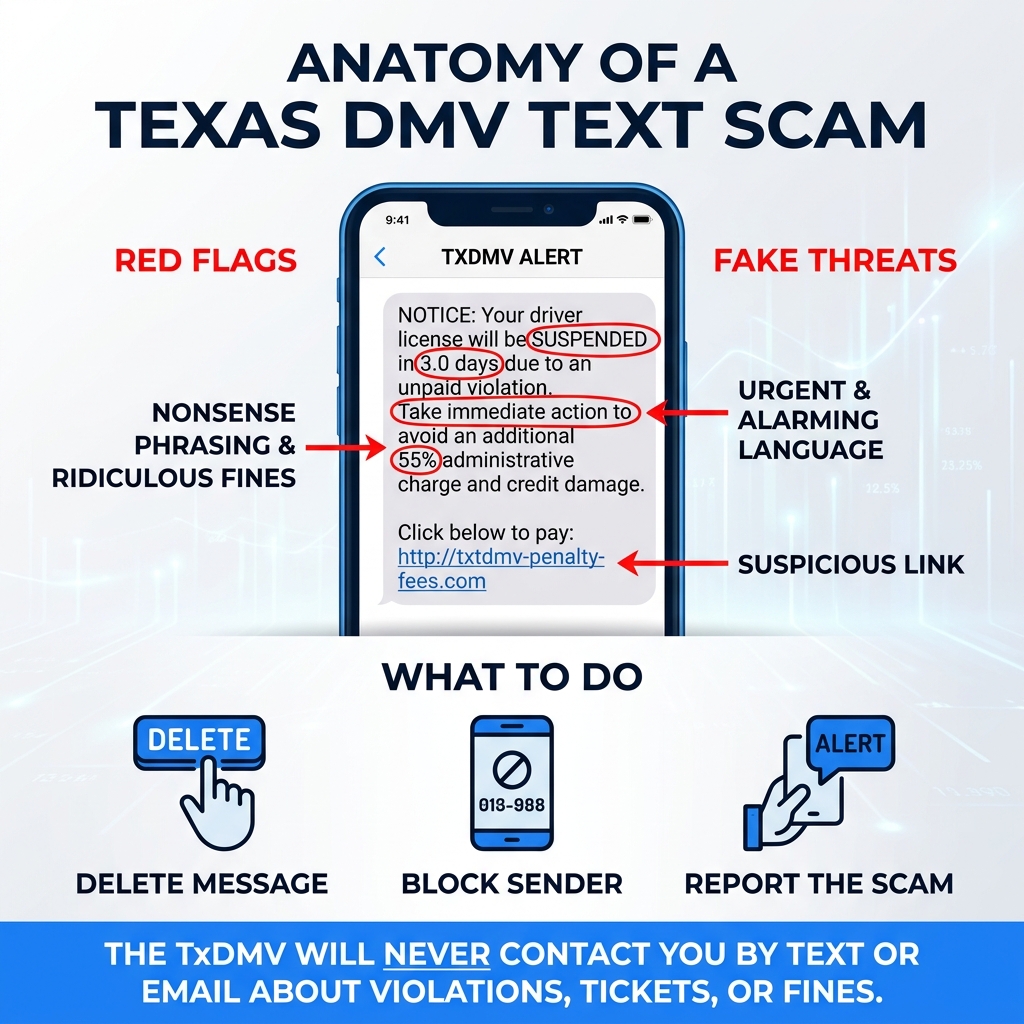
- The TxDMV will never contact you by text or email about violations, tickets, or fines
- The goal of these texts is to steal your personal and financial information
- You should delete the message, block the sender, and report it — never click the link
- This scam has been reported in at least 14 states, not just Texas
- Even people without a driver's license or car have received these texts
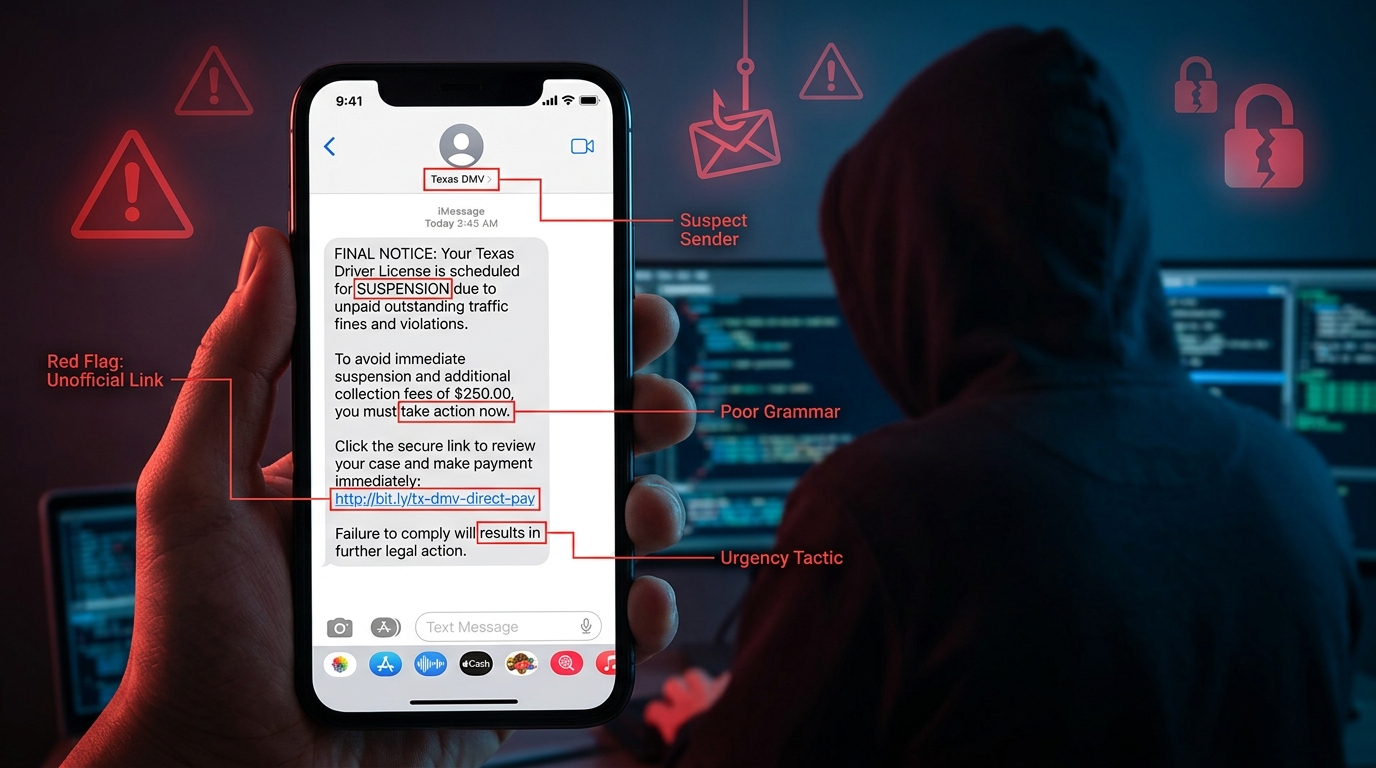
The messages can look alarming at first glance. One example threatened a "3.0 days" license suspension, a 55% administrative charge, credit damage, and vehicle registration suspension — all in one text. As the Texarkana Police Department put it publicly: "We're not sure what half of that crap means — and we're pretty sure whoever wrote it doesn't either."
That mix of intimidating language and nonsense phrasing is a telltale sign. But in a stressful moment, even a poorly written threat can make your stomach drop — which is exactly what scammers are counting on.
What is the Texas DMV Text Scam?
At its core, the texas dmv text scam is a "smishing" (SMS phishing) attack designed to harvest your sensitive data. Scammers send out mass text messages that impersonate official government agencies like the Texas Department of Motor Vehicles (TxDMV) or the Department of Public Safety (DPS). These messages typically claim that you have an unpaid traffic ticket, a toll violation, or a "registration discrepancy" that requires immediate attention.
To create a sense of panic, these texts threatening financial penalties often include extreme threats. We’ve seen reports of texts claiming a "3.0 days" license suspension—a duration that makes zero sense in the real legal world—alongside massive "55% administrative charges." The goal isn't to make sense; it's to make you click.

This isn't a localized issue, either. While it's hitting the Lone Star State hard right now, this is a nationwide epidemic. For instance, the Michigan SOS Scam Text: They Called It the DMV Dead highlights how similar tactics are used to target drivers in the Midwest, proving that these cybercriminals are casting a very wide net.
How the Texas DMV Text Scam Works
The mechanics of the texas dmv text scam rely on psychological manipulation. The scammers use "urgency tactics" to bypass your critical thinking. By threatening "registration voidance" or using high-level (and often made-up) jargon like "immutable credential endorsement," they try to sound official and intimidating.
One of the strangest aspects of this scam is its indiscriminate distribution. We’ve heard stories of 91-year-olds who haven't driven in decades receiving these texts, and even teenagers who don't yet have a permit. This proves the scammers aren't hacking the DMV database to find you; they are simply blasting thousands of random phone numbers at once. If you're interested in how other states handle this, you can read about the Utah Louisiana DMV Scam Text: Do Not Click to see how the "spray and pray" method works across state lines.
Identifying a Texas DMV Text Scam Message
Spotting these fakes is easier than you might think once you know what to look for. The Texarkana Police Department officials have been vocal about the absurdity of these messages, noting that the real DMV doesn't use "random big words" to scare citizens.
Here are the primary red flags:
- Non-U.S. Phone Prefixes: Many of these texts originate from international numbers or strange area codes that have no connection to Texas.
- Poor Grammar and Formatting: Look for oddities like "3.0 days" or "55% admin fee." Professional government agencies generally proofread their communications.
- Suspicious Links: The URL provided will never be a ".gov" site. It might look like "tx-dmv-pay.com" or something equally fishy.
- Strange Email Addresses: If the text asks you to email a Gmail or Yahoo account for "funds verification," it’s 100% a scam.
As we often say in the privacy world, the SC DMV Scam Text: SCDMV Never Texts rule applies here too: if it’s a text from the DMV, it’s almost certainly a fraud.
The Real Role of the Texas DMV vs. Law Enforcement
To protect yourself from the texas dmv text scam, it helps to understand what the TxDMV actually does. Many people confuse the DMV with the police or the courts, but they serve very different functions.
The TxDMV is responsible for vehicle registration, titling, and licensing motor vehicle dealers. They are not a law enforcement agency. They do not pull people over, they do not issue speeding tickets, and they certainly do not collect fines for moving violations.
| Feature | Texas DMV (TxDMV) | Law Enforcement (Police/DPS) |
|---|---|---|
| Primary Duty | Registration & Titling | Public Safety & Traffic Laws |
| Issue Tickets? | No | Yes |
| Collect Fines? | No | No (Courts handle this) |
| Suspend Licenses? | No (DPS handles this) | No (They request it via DPS/Courts) |
| Contact via Text? | Never for violations | Never for violations |
Because the TxDMV doesn't even have the authority to issue a traffic ticket, any text claiming you owe them money for a "violation" is an immediate red flag. This confusion is common across the country, which is why we also warn about the Illinois DOT Text Scam: IDOT Will Never Text You.
Does the TxDMV Ever Contact You Directly?
The TxDMV has stated clearly that they do not contact individuals directly via email or text to request personal information or demand payment for tickets.
While you can opt-in to receive news releases or registration reminders, these are never threatening and will never ask for your credit card info via a text link. For toll-related issues, even specialized agencies have strict rules. For example, the TXDOT Scam Text: TXTAG Only Texts From One Number guide explains that legitimate tolling entities have very specific, verified ways of communicating that don't involve threats of "immutable credential endorsement."
What to Do if You Receive a Scam Text
If your phone pings and you see a message about the texas dmv text scam, the most important thing to do is nothing.
- Do Not Click: The link is designed to install malware or lead you to a "spoofed" website that looks like a government portal but actually steals your login credentials and credit card info.
- Do Not Reply: Responding "STOP" or "Who is this?" actually confirms to the scammers that your number is active, which will lead to even more scam texts in the future.
- Block and Delete: Use your phone’s built-in features to block the sender and delete the thread.
- Report It: You can help others by reporting the scam to the FBI’s Internet Crime Complaint Center or the Federal Trade Commission. You can also forward the message to 7726 (SPAM) to alert your cell carrier.
Steps to Take if You Already Clicked a Link
We know that accidents happen. If you were in a rush and clicked the link or, worse, entered your information, you need to act fast. Phishing sites are incredibly efficient; once they have your data, they may sell it or use it within minutes.
- Freeze Your Credit: This prevents scammers from opening new accounts in your name.
- Monitor Your Bank Accounts: Look for small "test" transactions that often precede a larger theft.
- Change Your Passwords: If the scam site asked for any login info, change that password immediately—and anywhere else you use that same password.
- Contact Law Enforcement: If you actually lost money, file a report with your local police.
The scale of these attacks can be massive. Consider the EZPass Scam Text: 60,000 Reports and Counting—it shows just how quickly these numbers can climb when a scam goes viral.
Verifying a Real Texas DMV Text Scam or Violation
If you’re genuinely worried that you might have an outstanding ticket, don't use the link in the text. Instead, use official channels to verify your status.
- Check with the Court: Traffic tickets are handled by the municipal or justice of the peace court in the county where the citation was issued.
- Contact the DPS: The Texas Department of Public Safety (not the DMV) handles driver's license records. You can check your license eligibility on their official ".gov" website.
- Call the Agency Directly: Use a phone number from an official government website, not a number provided in a suspicious text.
Drivers in other states face similar hurdles. For instance, the NYS DMV Scam Text: 170 Reports in Rochester and the FLHSMV Scam Text: What Florida Drivers Must Know both emphasize that verification should only happen through official portals.
Frequently Asked Questions about the Texas DMV Text Scam
Is this scam limited to Texas or is it nationwide?
It is very much a nationwide problem. While the texas dmv text scam uses the TxDMV name to target Texans, identical scams are circulating using the names of DMVs in Maine, Michigan, Alabama, Rhode Island, and at least 10 other states.
Why did I receive a text if I don't have a driver's license?
Scammers don't have a list of drivers; they have a list of phone numbers. They send these messages to everyone in a specific area code, hoping that a percentage of recipients will be drivers who are easily frightened. If you don't drive, it's just further proof that the message is a total fake.
How can I report these fraudulent messages to authorities?
The best places to report are the FBI’s IC3 website and the FTC’s fraud reporting portal. Additionally, reporting the text as spam to your mobile provider (by forwarding the text to 7726) helps carriers block these numbers at the network level.
Conclusion
The texas dmv text scam is a reminder that our personal information is constantly under fire. While being cautious with your phone number is a great first step, the reality is that our data is often leaked through no fault of our own.
At Tempo Mail USA, we believe in proactive privacy. One of the best ways to keep your real identity safe is to use temporary email aliases and secure proxies whenever you're signing up for services online. By using a "firewall" for your PII (Personally Identifiable Information), you reduce the chances of your real contact details ending up on a scammer's blast list in the first place.
Stay vigilant, keep your software updated, and remember: the DMV will never text you a threat. For more tips on staying safe in the digital age, check out our More info about privacy services. Stay safe out there, Texas!