

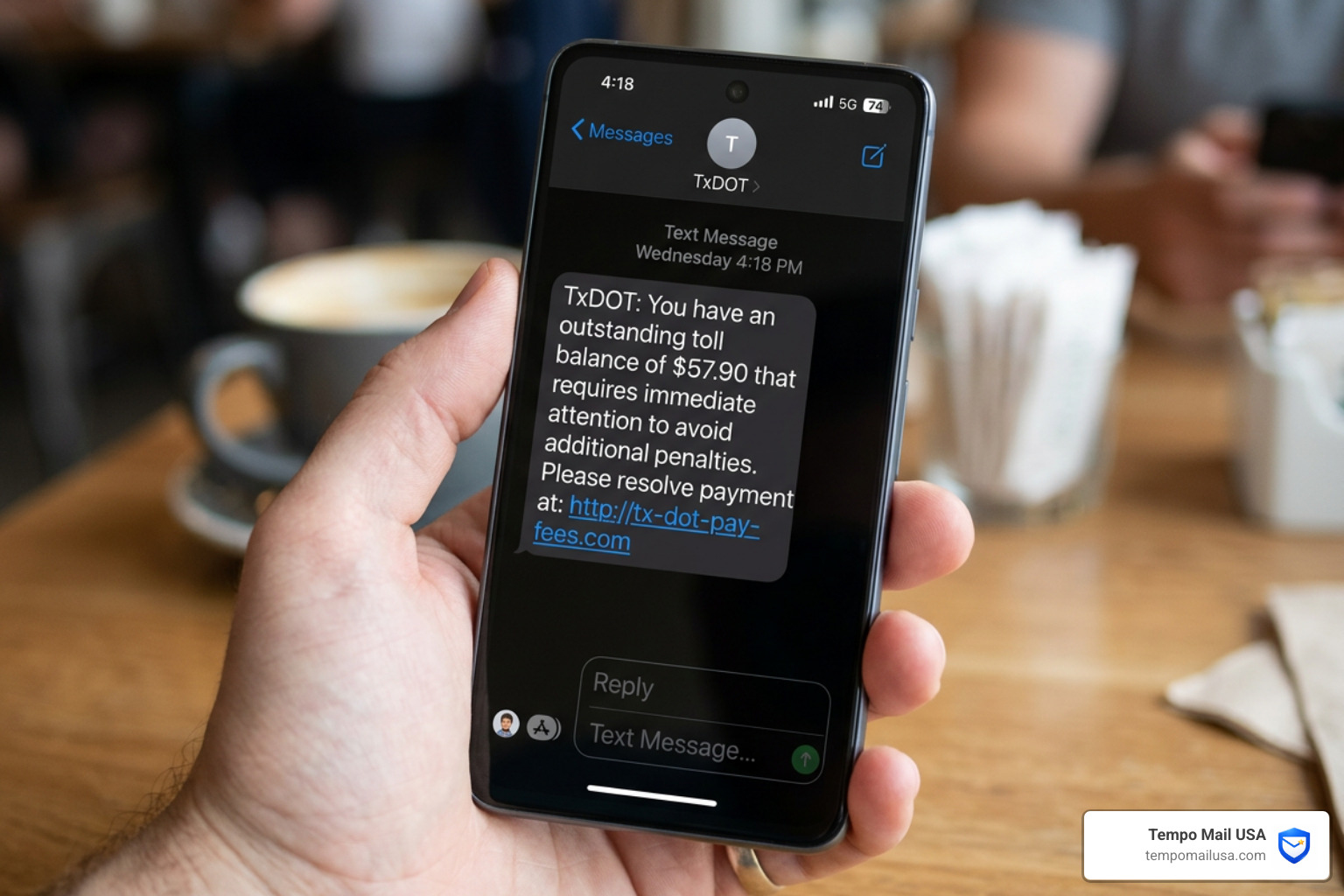

The TxDOT Scam Text: What Every Texan Needs to Know Right Now
TxDOT scam text messages are fake toll notices sent by fraudsters pretending to be TxTag — and they're targeting Texas drivers right now.
Quick answer: Here's what you need to know at a glance:
- It's a scam if the text asks you to click a link to pay an overdue toll balance
- TxTag does NOT send texts about unpaid balances or final payment reminders — ever
- Legitimate TxTag texts only come from the shortcode 22498
- Do not click any links in unsolicited toll payment texts
- Verify your account directly at TxTag.org or call 1-888-468-9824
- Report scams to the FBI's Internet Crime Complaint Center at www.ic3.gov
These smishing attacks — SMS phishing scams — have been hitting Texas toll customers since at least April 2024, with a sharp spike in reports shortly after. The scam texts typically claim you owe a toll balance and pressure you to pay immediately through a fraudulent link. TxDOT has even had to step in to take down fake websites set up by scammers to steal your information.
The timing is no coincidence. The transition of TxTag account management from TxDOT to the Harris County Toll Road Authority (HCTRA) in December 2024 created confusion — and scammers are exploiting it.
If you've received one of these texts, you're not alone. And if you're worried about your personal information, you're right to be.
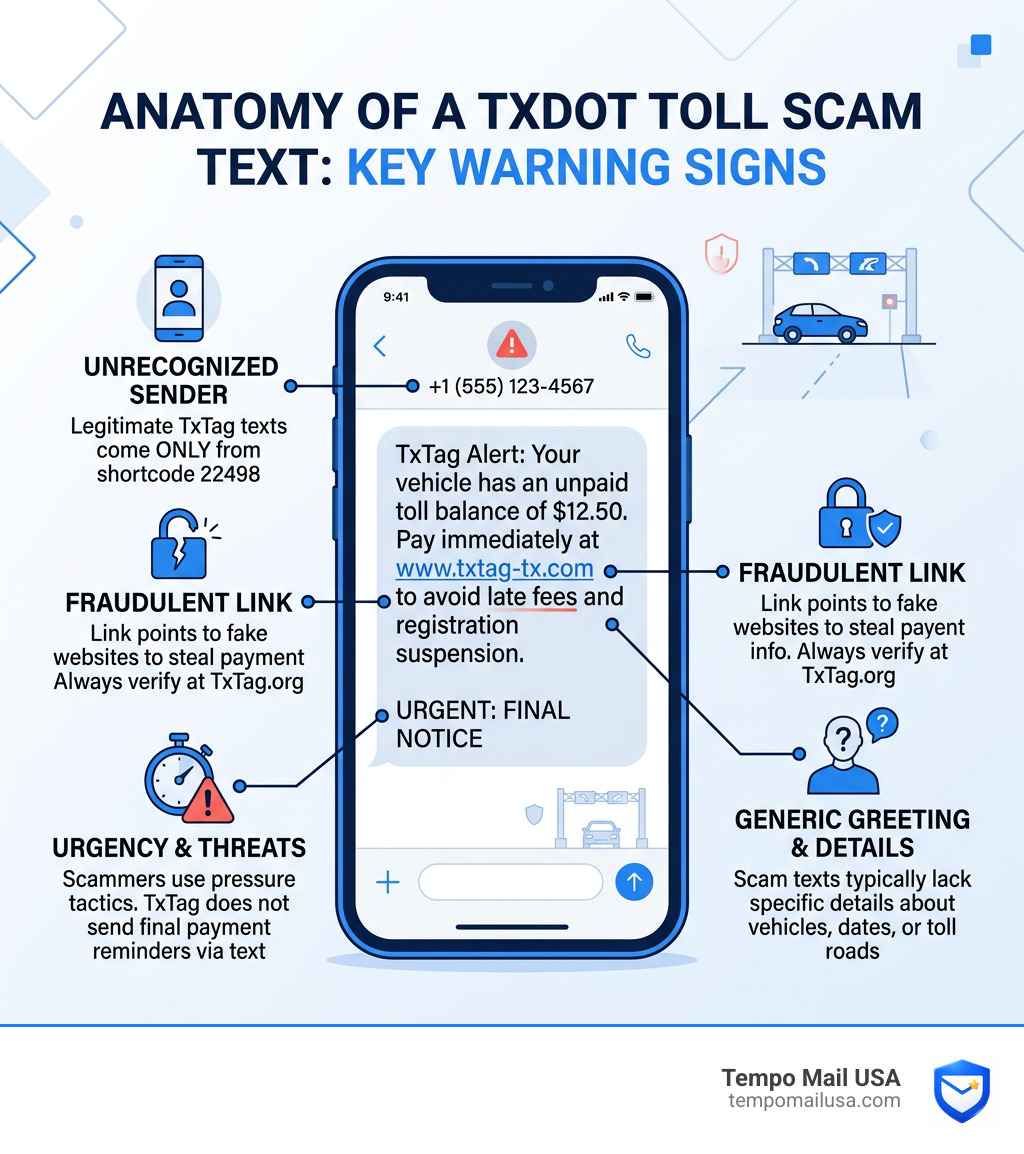
What is the TxDOT Scam Text and How Does it Work?
The TxDOT scam text is a textbook example of "smishing"—a blend of "SMS" and "phishing." We’ve seen these attacks evolve since early 2024, but the core strategy remains the same: psychological manipulation.
Scammers send out mass text messages to thousands of Texas phone numbers. These messages are designed to look like official notifications from TxTag or the Texas Department of Transportation. The hook is almost always financial: you supposedly owe money for a toll violation, and if you don't pay within a very short window (usually 12 to 48 hours), you’ll face mounting late fees or even vehicle registration suspension.
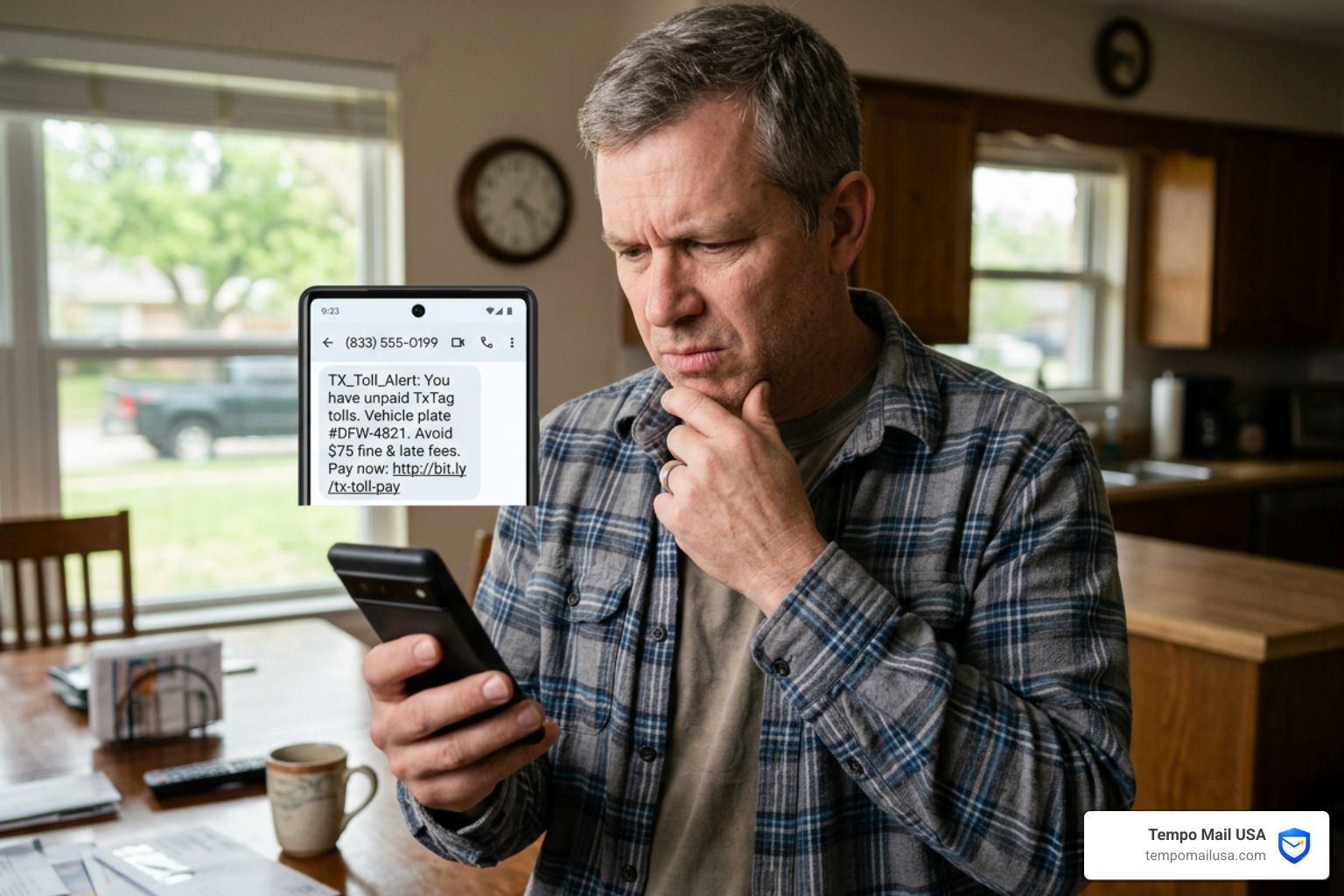
The goal is to trigger a "fight or flight" response. When we see a message claiming we owe money to a government agency, our instinct is to resolve it quickly. Scammers include a link in the text that leads to a sophisticated, fake website that mimics the look and feel of the official TxTag.org portal. Once you enter your credit card details or account credentials on that fake site, the scammers have everything they need to drain your bank account or steal your identity.
According to the FBI’s IC3 report, phishing and smishing are among the most common crimes reported to federal authorities, contributing to over $1.4 billion in losses annually in the United States.
To help you stay safe, we've put together this comparison table to highlight the red flags:
| Feature | Legitimate TxTag Message | TxDOT Scam Text |
|---|---|---|
| Sender Number | Exclusively from 22498 | Random 10-digit numbers or email addresses |
| Urgency | Standard account updates | High pressure (e.g., "Pay within 12 hours") |
| Topic | Opt-in alerts only | Past-due balances or "final notices" |
| Links | Rarely used for payments | Always includes a link to a non-official URL |
| Threats | None in the initial text | Threats of legal action or registration loss |
Identifying a Legitimate TxTag Communication
We know it can be stressful to receive a message about money owed, but there are hard rules that TxTag follows which scammers simply cannot replicate. Knowing these "rules of the road" is your best defense.
First and foremost, TxTag only sends text messages from the shortcode 22498. If you receive a text from a standard 10-digit phone number or an international number claiming to be from TxDOT, it is 100% a fraud. Furthermore, TxTag requires customers to "opt-in" to receive text notifications. If you never signed up for text alerts, any message you receive is highly suspicious.
Even if you have opted in, TxTag's official policy is that they do not send text messages regarding final payment reminders or past-due balances. Legitimate notices regarding unpaid tolls are sent through the U.S. Mail. If the state of Texas wants you to pay a fine, they will send a physical letter to the address associated with your vehicle registration.
If you are ever in doubt, the safest move is to ignore the text entirely and log in to your account manually at TxTag.org. Never use the link provided in a message. For more detailed steps on handling these types of threats, you can check out our guide on how to report phishing attacks and outsmart scammers.
The Risks of Interacting with Fraudulent Messages
Interacting with a TxDOT scam text is like opening the front door to a digital burglar. The risks go far beyond just losing the $20 or $50 "toll fee" the text claims you owe.
When you click a link in a smishing message, you aren't just visiting a website; you might be triggering a background download. Modern phishing sites can install malware on your device the moment the page loads. The Verizon Data Breach Investigations Report notes that phishing accounts for over 36% of all data breaches, and the numbers are climbing.
Malware and Data Theft from a TxDOT Scam Text
The most dangerous aspect of these scams is the potential for credential harvesting. If you enter your username and password into a fake site, scammers can use those same credentials to try and log in to your bank, your primary email, or your social media accounts.
In some cases, the link may install "keyloggers"—malicious software that records every keystroke you make. This allows hackers to capture your PII (Personally Identifiable Information) in real-time. This is why we see a direct link between these toll scams and broader identity theft operations, similar to the traffic compliance department scam that has targeted drivers in other states.
Financial Consequences of the TxDOT Scam Text
The immediate financial risk is credit card fraud. Once you provide your card number to pay the "fake" toll, the scammers often sell that data on the dark web or use it for high-value purchases immediately.
There is also the risk of losing access to your legitimate toll accounts. If a scammer gains access to your TxTag account, they could potentially change your contact information, making it impossible for you to receive real notices from the state. This could lead to actual unpaid balances and legal trouble down the road. We’ve seen similar patterns with the EZPass scam text, where tens of thousands of reports were filed after victims lost significant sums of money.
How to Safely Verify and Report Toll Balances
If you’ve received a suspicious text, don't panic. There are safe, official ways to verify if you actually owe money.
- Use the Official Portal: Go to your browser and type in
TxTag.orgmanually. Do not copy and paste the link from the text. - Call Customer Service: You can reach TxTag directly at 1-888-468-9824. Be prepared to verify your identity, as TxTag takes security seriously and will not provide account details without confirmation.
- Check with HCTRA: Since the management transition in December 2024, many accounts are now handled by the Harris County Toll Road Authority. If your transactions occurred on or after November 9, 2024, you may need to visit hctra.org or call 281-875-EASY (3279).
Reporting the scam is just as important as protecting yourself. By reporting, you help authorities like the FBI track the scammers and shut down their fraudulent websites.
- Report to the FBI: File a complaint at the Internet Crime Complaint Center (IC3) at www.ic3.gov.
- Forward to 7726: Most cell carriers allow you to forward spam texts to 7726 (which spells "SPAM"). This helps carriers block the numbers at the network level.
- Device Security: If you're receiving an influx of these messages, you might want to look into how to stop spam calls and texts on iPhone or Android to filter out the noise.
Frequently Asked Questions about Texas Toll Scams
Does TxTag ever text about unpaid balances?
No. This is the most important thing to remember. While TxTag may send you a text for account updates if you have opted in, they never send SMS messages for final payment reminders or past-due balances. If you owe money, the notification will come via a physical letter in the mail or will be visible when you log in to the official website.
Who manages TxTag accounts now?
As of December 2, 2024, the Harris County Toll Road Authority (HCTRA) has taken over the management of TxTag accounts following a transition from TxDOT. This switch affected millions of drivers. In fact, reports from early 2025 indicated that over 1 million accounts had not yet fully transferred, leaving millions in unpaid balances. This transition period is exactly why the TxDOT scam text has become so prevalent—scammers know people are confused about who they should be paying.
What should I do if I already clicked the link?
If you clicked the link or provided information, you need to act fast:
- Contact your bank: If you entered credit card info, call your bank immediately to freeze the card and dispute any fraudulent charges.
- Reset your passwords: Change the password for your TxTag account and any other accounts (like email or banking) that used the same password.
- Scan for malware: Run a security scan on your phone to ensure no malicious software was installed.
- Monitor your credit: Keep a close eye on your credit report for any unauthorized accounts opened in your name. For more advice, read our guide on reporting phishing attacks.
Conclusion
The TxDOT scam text is a persistent threat, but it's one you can easily defeat with the right knowledge. By remembering that official agencies won't text you for payment and by using only verified channels like TxTag.org, you keep your finances and your identity safe.
At Tempo Mail USA, we believe the best way to stop a scam is to prevent your information from getting into the wrong hands in the first place. Scammers get your phone number and email from data breaches and public records. Our temporary email aliases act as a PII firewall, providing you with a secure identity proxy. By using an alias instead of your primary contact info for non-essential services, you shield your personal data from the brokers and hackers who fuel these smishing campaigns.
Stay vigilant, Texas. Don't let a 160-character text message compromise your digital life. If you want to take the next step in protecting your privacy, visit us at https://tempomailusa.com to learn how an email alias can keep your inbox—and your life—scam-free.