



Why Reporting Fraud Protects Your Personal Information
Report fraud ftc.gov is the Federal Trade Commission's official website where you can report scams, fraud, and bad business practices to help protect yourself and others from identity theft and data breaches.
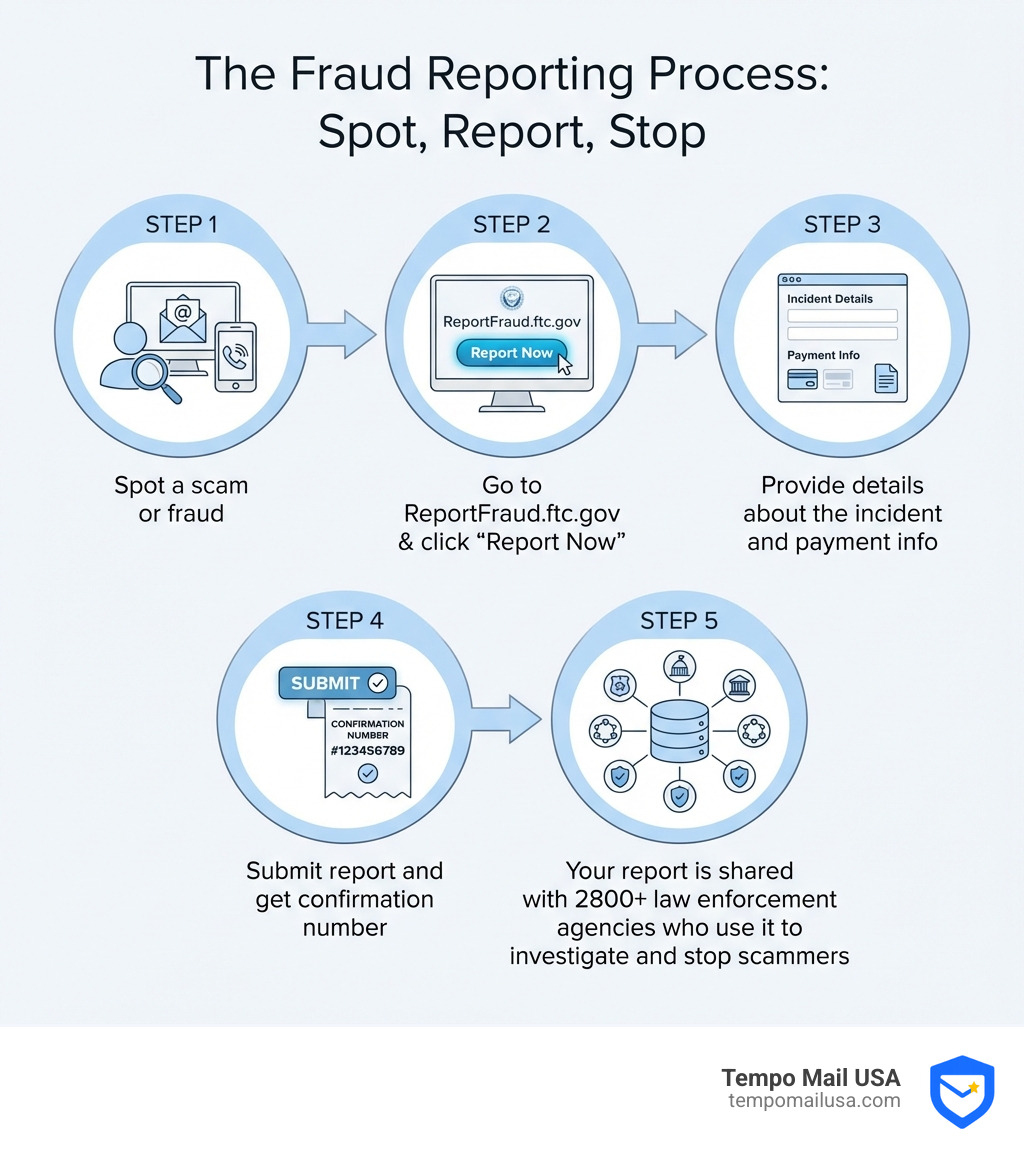
Quick Guide: How to Report Fraud to the FTC
- Go to ReportFraud.ftc.gov
- Click "Report Now"
- Select the type of fraud (scam, unwanted call, or bad business practice)
- Provide details about what happened and any payment information
- Submit your contact information (optional but helpful)
- Receive a report number and next steps
We all see them. The urgent emails claiming your account is compromised. The phone calls threatening legal action. The texts about prizes you never entered to win. Scammers target everyone, trying to steal money and personal information like Social Security numbers, bank account details, and other data that could expose your identity.
Here's what most people don't know: every report you file makes a real difference. Your single report gets shared with more than 2,800 law enforcement agencies. The FTC uses these reports to spot patterns, build cases, and shut down scammers before they can target more victims.
This guide walks you through exactly how to report fraud to the FTC, what information you'll need, and what happens after you submit your report. Whether you've fallen victim to a scam or just spotted something suspicious, reporting it helps protect your community and prevents future data breaches.
What is ReportFraud.ftc.gov and Why Your Report Matters
At its core, ReportFraud.ftc.gov is our nation's digital frontline against deception. It's the Federal Trade Commission's (FTC) dedicated platform designed to empower consumers like us to fight back against the relentless tide of scams, fraud, and bad business practices. The FTC's mission is clear: protecting the public from deceptive or unfair business practices and from unfair methods of competition. This website is a cornerstone of that mission.
When we talk about official government websites, we often look for specific signs of legitimacy. For federal sites in the U.S., that sign is the ".gov" domain. ReportFraud.ftc.gov proudly bears this mark, assuring us that we're interacting with a genuine government resource. Furthermore, the "https://" in the address bar and the little lock icon next to it confirm that our connection is secure, meaning any information we provide is encrypted and transmitted safely. This is crucial when sharing sensitive details about a scam.
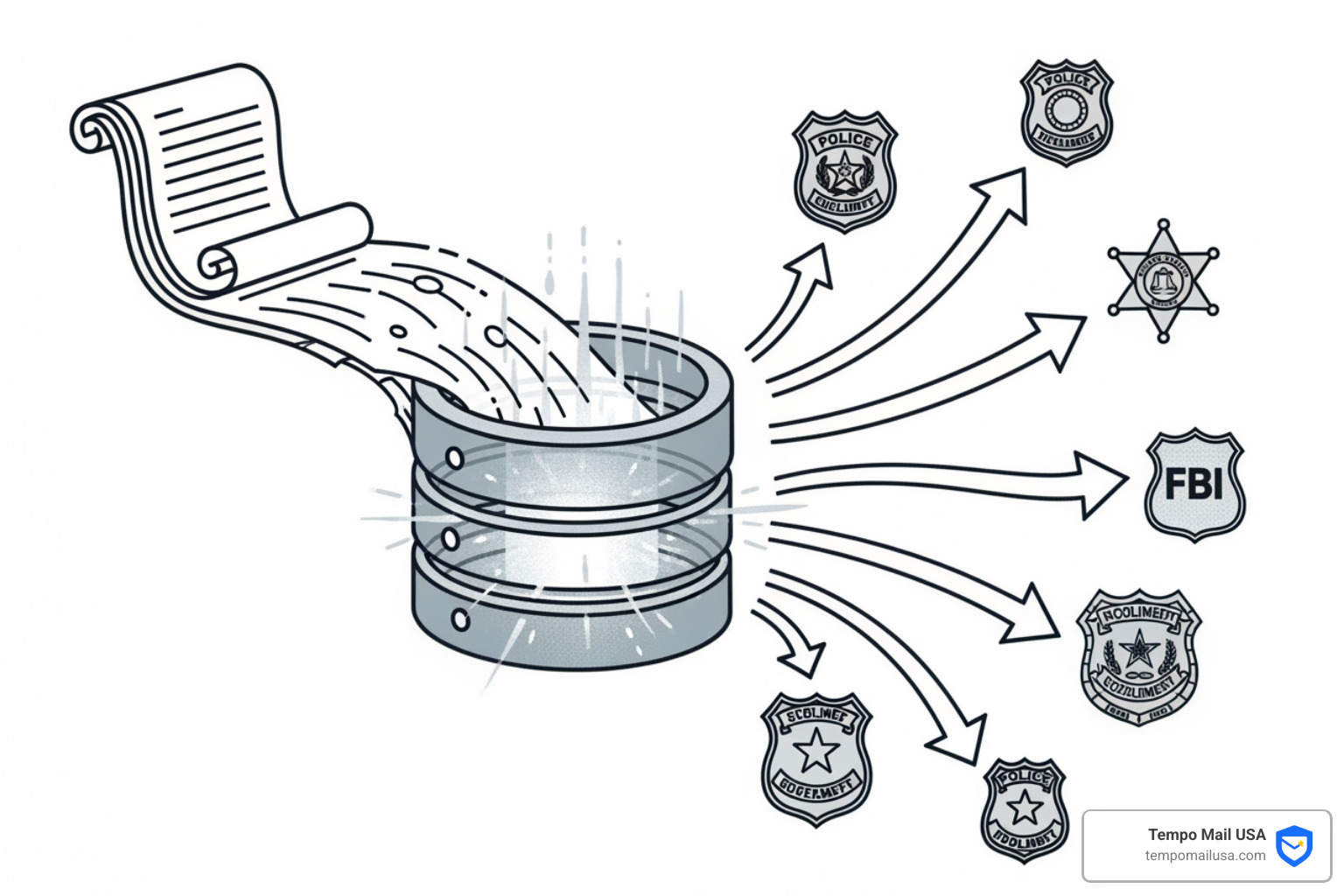
Our reports, once submitted, don't just disappear into a digital black hole. Instead, they are carefully entered into the Consumer Sentinel Network, a secure online database. Think of it as a vast, interconnected web of intelligence, constantly updated with new information from consumers across the country. This database isn't just for the FTC; it's a vital law enforcement tool, accessible by civil and criminal authorities worldwide.
This brings us to a remarkable statistic: your report is shared with more than 2,800 law enforcers. Yes, you read that right – over two thousand law enforcement agencies, from local police departments to federal bureaus, can access and use the information we provide. This broad sharing mechanism transforms individual reports into a powerful collective force, enabling law enforcement to identify trends, connect the dots between seemingly unrelated incidents, and ultimately, bring scammers to justice. It's how our individual act of reporting becomes a powerful step in protecting our communities.
The Power of a Single Report
It's easy to feel like one person's report against a massive, faceless scam operation won't make a difference. But that couldn't be further from the truth. The true power of ReportFraud.ftc.gov lies in the collective impact of millions of individual reports. Each time we report a scam, we're not just sharing our personal experience; we're contributing a crucial piece of a much larger puzzle.
The FTC doesn't just collect these reports; it analyzes them. By aggregating data from countless consumers, the FTC can identify emerging scam patterns, track the methods and targets of fraudsters, and pinpoint the most active scam operations. This intelligence is invaluable for building cases against scammers. It allows investigators to move beyond individual incidents and see the broader criminal enterprise at play.
This is why reporting is so vital. It helps stop future fraud. When the FTC and its law enforcement partners have enough evidence, they can take legal action, leading to investigations, prosecutions, and sometimes even shutting down entire scam networks. Our reports are the foundation upon which these enforcement actions are built, ultimately preventing countless others from falling victim.
Beyond law enforcement, the aggregated data from our reports also serves as a critical resource for public awareness campaigns. The FTC regularly publishes data and alerts about current scam trends, helping us and our communities stay informed and vigilant. Want to see what's happening in your neck of the woods? You can even check out fraud data in your state. Knowing what scams are prevalent in our area can arm us with the knowledge to protect ourselves and our loved ones.
ReportFraud.ftc.gov vs. IdentityTheft.gov
While both ReportFraud.ftc.gov and IdentityTheft.gov are crucial resources provided by the federal government, they serve distinct purposes. Think of them as specialized tools for different kinds of trouble.
ReportFraud.ftc.gov is our go-to for general fraud reporting. This includes a wide array of deceptive practices such as:
- Scams: Everything from imposter scams (where someone pretends to be the government, a business, or even a loved one) to prize scams, tech support scams, and online shopping scams.
- Bad Business Practices: This covers issues like misleading advertising, unfair billing, or problems with products and services that don't quite rise to the level of outright fraud but are still shady.
- Unwanted Calls, Emails, and Texts: If you're bombarded with robocalls, phishing emails, or suspicious text messages, this is the place to report them.
On the other hand, if you've been a victim of identity theft – meaning someone has stolen your personal information (like your Social Security number, bank account details, or medical ID) and used it to open accounts, file taxes, or commit other crimes – then IdentityTheft.gov is the specific resource you need. This site isn't just for reporting; it's a comprehensive, federal government one-stop resource designed to help us recover. It provides step-by-step advice, personalized recovery plans, and helpful resources like easy-to-print checklists and sample letters to guide us through the often-complex process of reclaiming our identity. So, if your personal data has been compromised and misused, head directly to Report Identity Theft at IdentityTheft.gov.
The distinction is simple but vital: general scams and bad business practices go to ReportFraud.ftc.gov, while identity theft has its own specialized recovery hub at IdentityTheft.gov. Knowing which door to knock on ensures our reports get to the right place, maximizing their effectiveness.
A Step-by-Step Guide to Using report fraud ftc.gov
Reporting fraud might sound daunting, but the FTC has designed ReportFraud.ftc.gov to be surprisingly user-friendly. Our goal here is to make the process as straightforward as possible, so you feel confident taking action. Think of this as your personal roadmap to getting that report filed.
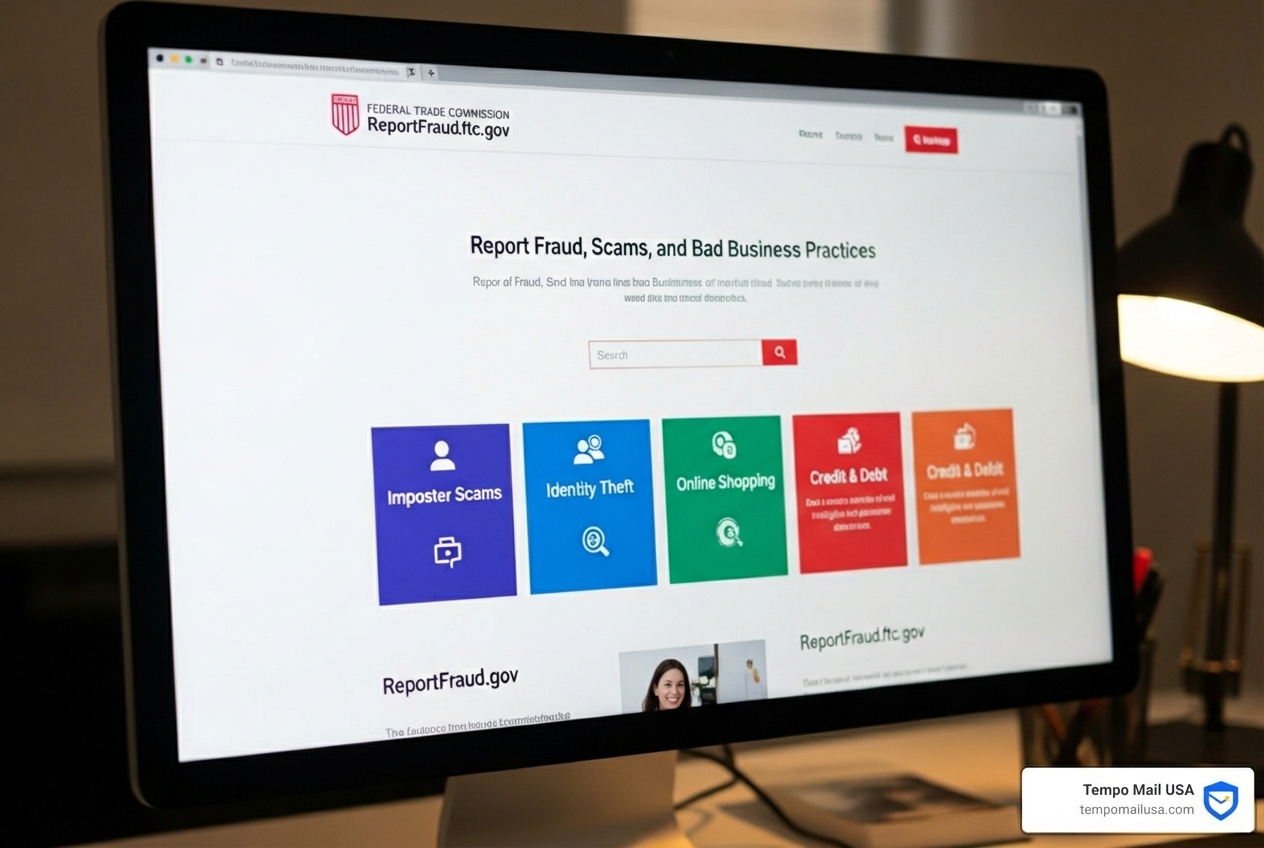
The website itself is built as a how-to guide, breaking down the reporting process into manageable, actionable steps. It's designed for ease of use, even if you're feeling stressed or overwhelmed by a scam. Let's walk through it together.
Step 1: Steer to the Official Site and Begin
First things first: we need to make sure we're on the real ReportFraud.ftc.gov website. Scammers are notoriously good at creating fake websites that look legitimate. So, before you share any sensitive information, always take a moment to verify the site.
Look at the web address in your browser. It should start with "https://" (that "s" stands for secure!), and the domain name should clearly end with ".gov". This is the hallmark of an official federal government website. As the FTC itself advises, "The .gov means it’s official. Federal government websites often end in .gov or .mil. Before sharing sensitive information, make sure you’re on a federal government site." And the "https://" ensures that your connection is encrypted and secure.
Once you've confirmed you're on the right page, you'll see a prominent "Report Now" button. Click it to begin your journey. Don't worry, the site will guide you through each subsequent step. You can always go to the official reporting site directly to start.
Step 2: Describe What Happened
After clicking "Report Now," the website will ask you to identify the type of problem you're reporting. This helps the FTC categorize your information and direct it to the most relevant law enforcement partners. You'll generally choose from options like:
- A Scam
- A Company (for bad business practices)
- An Unwanted Call, Email, or Text
The site will then present a series of questions designed to narrow down the issue. Our research shows that common reportable issues include:
- Impersonator scams: Someone pretending to be from the government (like the IRS or Social Security Administration), a well-known business (like Amazon or Apple), or even a family member or friend.
- Unwanted calls, emails, and texts: Robocalls, phishing attempts, or suspicious messages.
- Online shopping fraud: Problems with purchases made online, like items not delivered or being fake.
- Tech support scams: Someone claiming to be from a major tech company, trying to "fix" a non-existent computer problem and demanding payment or remote access.
- Fake prizes or sweepstakes: Being told you've won something but need to pay a fee to claim it.
- Loan or credit scams: Offers for guaranteed loans or credit cards that require an upfront fee.
You'll be prompted to provide the company's name or the person's name involved, if you have it. Even if you suspect the name is fake or made up, include it. Then, you'll get a chance to describe the incident in your own words. Be as detailed as possible. The more information you can provide, the better. Think of it as telling a story – who, what, when, where, why, and how. Every detail helps paint a clearer picture for investigators.
Step 3: What Information Do I Need to report fraud ftc.gov?
To make your report as effective as possible, it helps to gather some key pieces of information before you start, or as you go through the process. The FTC wants to know the specifics, especially if money was involved. This includes:
- Financial loss details: If you paid money to a scammer, how much was it? Even small amounts are important to report.
- Payment method: How did you send the money? Was it a credit card, debit card, bank transfer, wire transfer (like Western Union or MoneyGram), gift card, cryptocurrency, or cash? Scammers often push for irreversible payment methods like gift cards or wire transfers, so detailing this is crucial.
- Payment date: When did you most recently send or pay the money?
- Contact method: How did the scammer first reach you? Was it by phone call, email, text message, social media, a website, or an ad? Knowing the initial point of contact helps identify common scam vectors.
- Scammer's name or company: If you know it. Again, even if you suspect it's a fake name or a company that doesn't exist, provide what you have.
- Any supporting details: This is where you can describe what happened in detail. Include dates, times, specific phrases used by the scammer, phone numbers, email addresses, websites visited, and any other pertinent information. For example, if it was a tech support scam, what did they claim was wrong with your computer? If it was an online shopping scam, what product did you try to buy?
It’s worth noting that scammers are constantly trying to obtain Personally Identifiable Information (PII) like your Social Security number or account numbers. This is where services like ours at Tempo Mail USA come in handy. By using secure email aliases, we can create a "firewall" around your real PII, making it harder for scammers to access your true identity even if they manage to get a hold of an alias. This proactive step can significantly reduce your risk of becoming a victim, especially in scams that start with phishing emails or suspicious requests for information. Providing as much detail as possible, even about how your PII was requested or compromised, strengthens your report.
Step 4: Submit Your Report and Get Next Steps
Once you've filled out all the relevant details about the scam or bad business practice, the final step is to submit your report. Before you do, the site will typically give you the option to provide your contact information. While this is often optional, we highly recommend including it. Why? Because if FTC investigators need more information to build a stronger case, they might reach out to you. Your willingness to provide further details could be the missing piece that helps them shut down a major scam operation.
After successfully submitting your report, you'll receive a confirmation page. This page is important because it will provide you with a unique report number. Make sure to keep this number for your records. It's your proof that you've done your part and can be useful if you need to reference your report later.
But the help doesn't stop there! The FTC understands that experiencing fraud can be distressing, and you might need guidance on what to do next. The confirmation page will also provide personalized recovery steps and advice custom to the type of fraud you reported. These tips can help you protect yourself further, mitigate any damage, and steer potential next actions. If you provided an email address, you will typically receive a confirmation email with your report number and these valuable next steps, ensuring you have them readily accessible.
What Happens After You File a Report?
It's natural to wonder, "Now what?" after you've taken the time and effort to file a report with ReportFraud.ftc.gov. It's important to set expectations correctly: the FTC generally does not resolve individual consumer complaints. While we wish they could swoop in and solve every personal incident, their primary role is larger-scale consumer protection.
Instead, your report contributes to a massive data aggregation effort. As we mentioned, every report is entered into the Consumer Sentinel Network. This secure, online database is a treasure trove of information, not just for the FTC but for over 2,800 civil and criminal law enforcement authorities worldwide. Think of it as a giant, collaborative puzzle where each report is a piece. Alone, a single piece might not reveal much, but when thousands of pieces come together, a clear picture of fraudulent activity emerges.
This aggregated data is carefully analyzed by the FTC and its partners. They use it to:
- Detect patterns: Spotting emerging trends, common tactics, and specific targets of scammers.
- Identify major players: Pinpointing the individuals or organizations behind widespread fraudulent schemes.
- Build cases: Gathering sufficient evidence to launch investigations and bring legal action against fraudsters.
- Support prosecutions: Providing critical intelligence that helps law enforcement pursue criminal charges.
So, while you might not get a personal call back about your specific case, rest assured that your report is actively being used to investigate and bring cases against fraud, scams, and bad business practices. Your contribution helps the FTC fulfill its mission of protecting consumers on a broad scale, ultimately leading to enforcement actions that can shut down scam operations and protect future victims.
The FTC is also transparent about how our information is handled. They have a clear privacy policy, which states: "How much personal information you provide is up to you. We may share such information with others, including the subject of your report to resolve or investigate it, with other law enforcement authorities or organizations, or in connection with court or administrative proceedings..." You can always read the FTC's Privacy Policy for more details on how they collect and use your information. Your privacy is taken seriously, even as your report serves a greater good.
How to Proactively Protect Yourself From Scams
While reporting fraud is a critical reactive step, being proactive is our best defense. Understanding how scammers operate and taking steps to protect our personal information can significantly reduce our vulnerability. After all, an ounce of prevention is worth a pound of cure, especially when it comes to our hard-earned money and sensitive data.
One of the most effective ways to protect ourselves is by recognizing the red flags that scammers commonly use. They often rely on psychological manipulation to bypass our critical thinking. Look out for:
- Urgency tactics: Scammers love to create a sense of panic or immediacy. They might claim your bank account is about to be closed, you're about to be arrested, or you've won a limited-time prize. They want us to act before we have a chance to think or verify.
- Threats and fear: Impersonating government agencies like the IRS or Social Security Administration, they might threaten legal action, arrest, or the suspension of benefits if we don't comply immediately.
- Unusual payment requests: This is a huge red flag. Legitimate businesses and government agencies will never demand payment via gift cards, wire transfers, cryptocurrency, or asking you to withdraw cash and buy gold. These methods are virtually untraceable and irreversible.
- Promises that are too good to be true: "You've won a lottery you never entered!" or "Guaranteed high returns with no risk!" If it sounds too good to be true, it almost certainly is.
Protecting our Personally Identifiable Information (PII) is paramount. Scammers thrive on getting our names, addresses, phone numbers, email addresses, and especially our Social Security and bank account numbers. One excellent proactive step is to use services that create secure email aliases, like Tempo Mail USA. By using an alias as a "firewall" for your real email address, you can prevent your primary inbox from being flooded with phishing attempts and reduce the risk of your actual PII being exposed in data breaches. It's a simple, yet powerful, layer of protection.
Always verify any contact that seems suspicious. If you get a call or email from a company or government agency, don't use the number or link they provide. Instead, independently look up their official contact information and reach out directly. For instance, if someone calls claiming to be from the FTC, demanding money or threatening you, know this: the FTC will never threaten individuals, demand money transfers to protect it, or ask for cash withdrawals and gold purchases for protection. You can learn how to spot FTC impersonators on their official website. Legitimate organizations will give you time to verify their identity and won't pressure you for immediate action or unusual payment methods. Slow down, talk to someone you trust, and verify before you act.
Frequently Asked Questions about Reporting Fraud
We understand you might have more questions about reporting fraud to the FTC. Here are some of the most common ones we hear, along with clear, concise answers.
What types of scams can I report fraud ftc.gov?
The beauty of ReportFraud.ftc.gov is its broad scope. We can report a vast array of scams and bad business practices. Essentially, if something feels deceptive, unfair, or just plain wrong in the marketplace, it's likely reportable. This includes:
- Impersonator scams: Someone pretending to be from the government (IRS, Social Security, Medicare), a well-known business (like your utility company, Amazon, or a tech giant), a charity, or even a friend or family member in distress.
- Unwanted calls, emails, and texts: This covers annoying robocalls, sophisticated phishing emails designed to steal your login credentials, and suspicious text messages with links to malicious sites. We all see scams. Even if we don't buy into one, we all get the calls, emails, and letters, and reporting them helps.
- Online shopping fraud: Issues with products bought online, such as never receiving items, receiving fake goods, or being charged for things you didn't order.
- Tech support scams: Those pop-up messages or calls claiming your computer has a virus and needs immediate "fixing" by a remote technician.
- Fake prizes, sweepstakes, or lottery scams: Being told you've won a large sum of money but need to pay an upfront fee or taxes to claim it.
- Investment scams: Promises of high returns with little to no risk, often involving cryptocurrency or foreign exchange trading.
- Loan or credit scams: Offers for guaranteed loans or credit cards that require an upfront fee, or debt relief services that charge you but don't deliver.
- Job scams: Fake job offers that ask for personal information or money for training or background checks.
- Bad business practices: This can include misleading advertising, unfair billing practices, or problems with product warranties.
If you're unsure, it's always better to report it. Your report contributes to the collective intelligence that helps the FTC and law enforcement combat these issues.
Will the FTC help me get my money back?
This is a very common and understandable question, especially if you've lost money to a scam. As we've discussed, the FTC does not typically resolve individual complaints or recover money for specific victims directly. Their role is more about systemic change rather than individual restitution.
However, your report is incredibly valuable because it fuels the FTC's larger mission. The FTC uses the reports it receives to investigate and bring cases against fraud, scams, and bad business practices. When the FTC wins a lawsuit against a scammer or a fraudulent company, those legal actions can sometimes result in monetary judgments or settlements. In such cases, the FTC may be able to provide refunds or compensation to victims who were affected by that particular scam. This isn't guaranteed, and the process can take a significant amount of time, but it does happen.
So, while filing a report doesn't guarantee your money back, it's the essential first step that enables the FTC to take action that could eventually lead to refunds for many victims, including potentially yourself.
Is my report to the FTC anonymous?
The level of personal information you provide when reporting to the FTC is largely up to you. The website allows you to choose how much personal information you want to share. You can submit a report with minimal personal details.
However, providing your contact information (name, phone number, email) can be very helpful to the FTC. If investigators need more information about the scam to build a stronger case, they might reach out to you. Your willingness to provide further details could be crucial in connecting the dots and leading to successful enforcement action against a scammer.
Regardless of how much personal information you choose to provide, your report is entered into the Consumer Sentinel Network, a secure database accessible by law enforcement. The FTC operates under strict privacy guidelines, and they are careful with the information they collect. They have a Privacy Act statement that details how they collect and use your information, which we linked to earlier. Rest assured, your decision to report helps protect the broader community, and you have control over your personal data within that process.
Conclusion
We've covered a lot of ground today, from understanding what ReportFraud.ftc.gov is to the detailed steps of filing a report and what happens afterward. The key takeaway is this: our individual actions, when combined, create an unstoppable force against fraud and deception. Every single report we file, no matter how small or seemingly insignificant, contributes to a vast intelligence network that empowers law enforcement to identify patterns, build cases, and ultimately, shut down scammers. This isn't just about protecting ourselves; it's about safeguarding our communities and preventing future victims.
The power of collective action cannot be overstated. By diligently reporting fraud, we're not only helping the FTC in its mission to protect consumers but also actively participating in a shared responsibility to make the digital and physical marketplaces safer for everyone.
Beyond reporting, proactive PII protection is a crucial line of defense. Scammers are always after our sensitive personal information, and services that create secure email aliases offer a vital layer of protection. By keeping our true identity separate from the digital noise, we can significantly reduce our risk exposure.
So, let's commit to being vigilant, informed, and proactive. If you encounter a scam, a bad business practice, or anything suspicious, remember this guide and head straight to ReportFraud.ftc.gov. And for an extra layer of defense against those constantly lurking threats to your personal information, consider bolstering your digital privacy. Protect your identity and register for a secure email alias today. Together, we can make a real difference in the fight against fraud.