

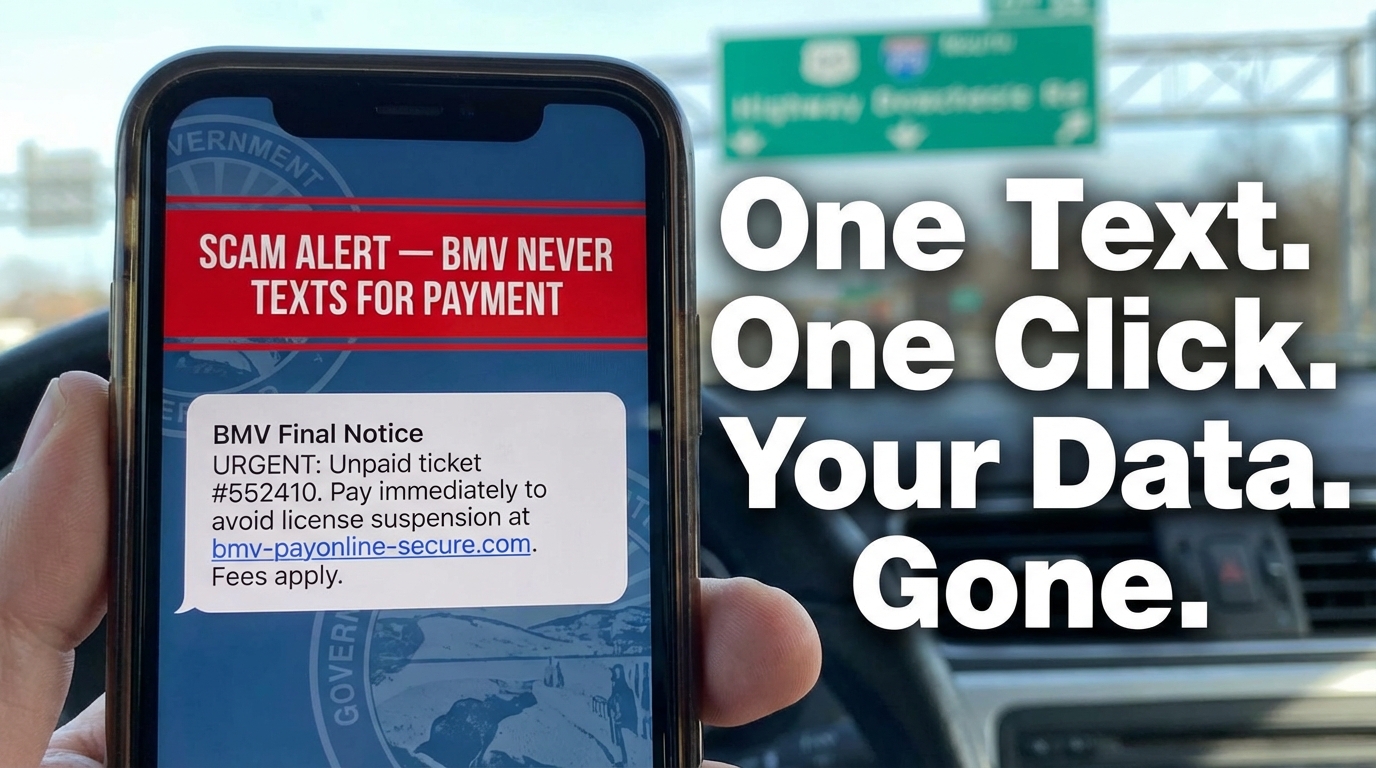

BMV Scam Texts Are Targeting Drivers Right Now — Here's What to Know
BMV scam texts are fake messages sent by criminals pretending to be your state's Bureau of Motor Vehicles. They claim you owe money for unpaid tickets, tolls, or violations — and threaten serious consequences if you don't pay immediately.
Quick answer: How to spot and handle a BMV scam text
- Don't click any links — real BMV agencies never request payments by text
- Check the URL — official sites end in
.gov, not.life,.cfd, or.org - Ignore the urgency — threats of license suspension are a pressure tactic
- Delete the message immediately
- Report it to the FTC at reportfraud.ftc.gov or your state Attorney General
These scams are spreading fast — and getting harder to spot. The Indiana BMV has officially warned that fraudsters have specifically updated their messages to say "BMV" instead of "DMV," making them feel more local and legitimate to Indiana residents. Ohio has seen a similar surge, with fake texts claiming outstanding parking tickets or traffic violations.
The messages often look convincing. They mimic the colors of official BMV websites, drop real-sounding Indiana Code references, and create a tight deadline to pressure you into clicking a phishing link.
Your personal and financial data is the real target.
Understanding how these scams work — and how to verify whether a message is real — can protect you from identity theft, malware, and financial loss.
What Are BMV Scam Texts and How Do They Work?
At their core, bmv scam texts are a form of "smishing"—which is just a fancy way of saying SMS phishing. Scammers send out thousands of text messages at once, hoping a few people will be worried enough to click. These messages are designed to bypass your natural skepticism by using three main ingredients: authority, fear, and urgency.
The messages often claim that you have an outstanding balance or a violation that needs immediate attention. To make the text look official, scammers have started citing specific state laws, such as the Indiana Code, to trick you into thinking a legal process has already begun. According to a Press Release: Updated Text Message Scam References "BMV", these messages are becoming increasingly sophisticated.
When you click the link in one of these texts, you aren't taken to a government website. Instead, you are directed to a fake portal that looks remarkably like the real thing. Scammers use the same logos, fonts, and color schemes as the official Bureau of Motor Vehicles (BMV) mobile site. Once you're there, they’ll ask for your driver’s license number, Social Security number, or credit card information to "settle the debt."

This isn't just happening in one place. As noted in this DMV Scam Text Alert: Fake Messages Spreading Across the US, these tactics are being deployed nationwide, adapted to whichever state agency name fits the local region.
Common Claims in BMV Scam Texts
What exactly do these texts say? They usually focus on things that every driver fears: fines and losing their license. We’ve seen a variety of "hooks" used to get people to click:
- Unpaid Tolls: You might get a message saying you missed a toll payment and owe a small fee (like $6.69) that will balloon into hundreds of dollars if not paid by midnight.
- Parking Tickets: A common tactic in Ohio involves texts claiming you have an outstanding parking ticket that must be paid to avoid a court date.
- License Suspension: This is the big one. The text warns that your driving privileges are at risk of being revoked unless you "verify your information" or pay a penalty immediately.
Drivers in other states face similar issues, as detailed in the Texas DMV Text Scam: Fake Messages & Red Flags and the PA DMV Scam Text Alert: Is It Real or Fake?. The common thread is always a demand for money or sensitive data.
Evolution from DMV to BMV Scam Texts
One of the most interesting (and dangerous) shifts we've seen is how scammers are localizing their language. For a long time, these texts used the generic term "DMV" (Department of Motor Vehicles). However, in states like Indiana and Ohio, the official agency is the BMV (Bureau of Motor Vehicles).
Scammers realized that Hoosiers and Ohioans were getting suspicious of "DMV" texts because that isn't the name of their local office. To counter this, they updated their templates. Now, the bmv scam texts specifically reference the "BMV" to appear more legitimate. This evolution shows that criminals are paying attention to state-specific terminology to increase their success rate. This localized targeting isn't unique to the Midwest; you can see similar patterns in our report on how scammers Beware Georgia DMV Scam Texts Targeting Drivers.
Red Flags: How to Identify a Fraudulent BMV Message
Identifying a scam doesn't require a computer science degree. It just requires a "pause." Scammers rely on you acting quickly before you notice the mistakes. Here are the biggest red flags to watch for:
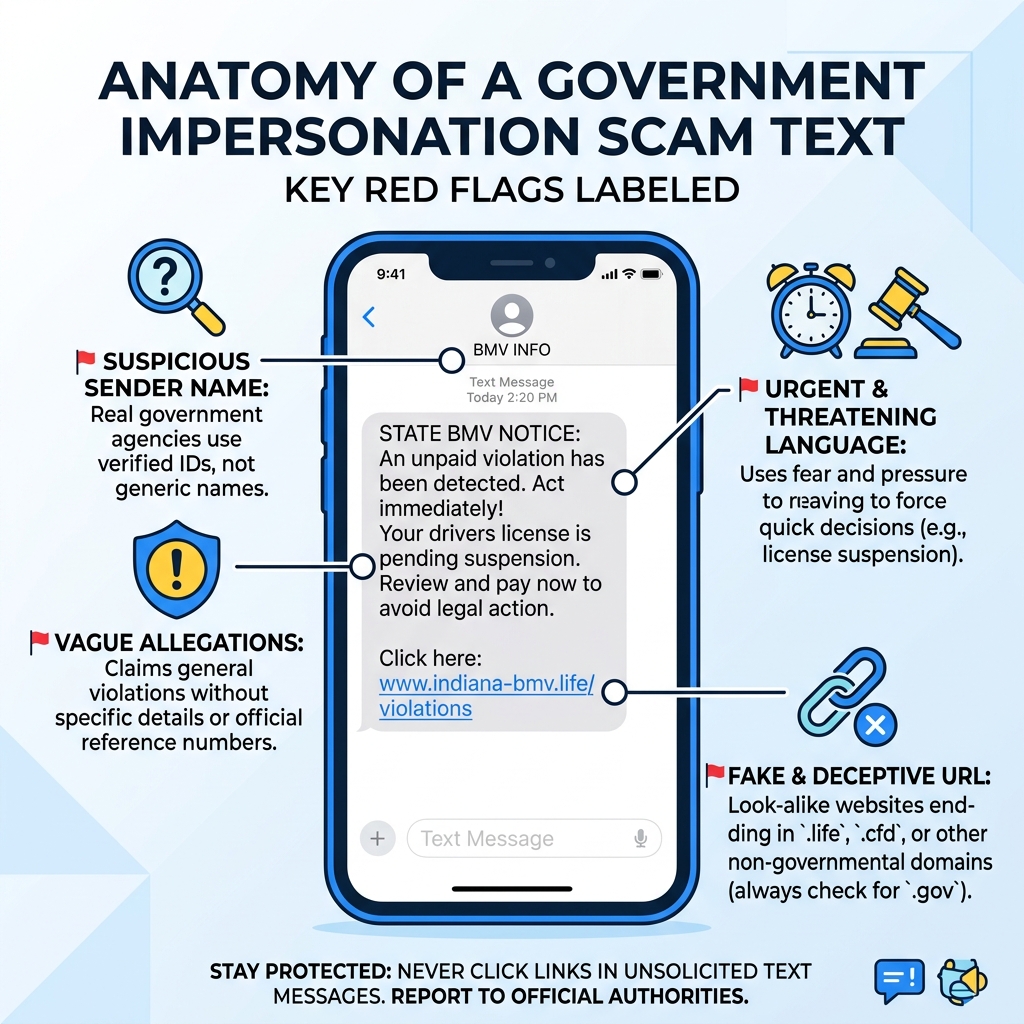
- The Domain Name: This is the single most important check. Official government websites in the United States almost always end in
.gov. If the link in the text ends in.life,.cfd,.org,.com, or some strange string of characters likein-bmv.cfd, it is 100% a scam. - Out-of-State or International Numbers: If you live in Indiana and get a "BMV" text from an area code in Florida or a country code from overseas, it’s fake.
- Urgent and Threatening Language: Phrases like "Final Notice," "Immediate Action Required," or "Avoid Arrest" are classic pressure tactics. Government agencies generally communicate serious legal matters via U.S. Mail, not a casual text.
- Requests for Personal Info via Text: The BMV will never ask you to text back your Social Security number or credit card details.
The Better Business Bureau (BBB) has also highlighted these risks in their BBB Scam Alert: New text message phishing scam impersonates your state’s Department of Motor Vehicles.
To help you distinguish between the two, we've put together this quick reference table:
| Feature | Official BMV Communication | BMV Scam Text |
|---|---|---|
| Primary Method | U.S. Mail (Official Letterhead) | Unsolicited SMS/Text Message |
| Website Link | Ends in .gov (e.g., in.gov) | Ends in .life, .cfd, .xyz, etc. |
| Tone | Formal, informational | Urgent, threatening, or "Final Notice" |
| Payment Request | Through secure official portals | Direct links to "Pay Now" pages |
| Phone Number | Official agency short-code or 1-800 | Random 10-digit or international numbers |
Why the Bureau of Motor Vehicles Won't Text You for Payments
It’s important to understand the internal logic of government agencies. The BMV is a massive bureaucracy, and they have very strict rules about how they handle money.
First and foremost, official policy in states like Indiana and Ohio dictates that the BMV does not send SMS text messages regarding outstanding penalties or fees. If you owe money for a ticket, that usually goes through a local court system, not the BMV's text alerts. If you owe a toll, that is handled by the Turnpike Commission or a specific tolling authority.
The BMV uses U.S. Mail for a reason: it provides a paper trail and is legally recognized for official notices. While some agencies are moving toward digital notifications for things like registration renewal reminders, they will not include a "click here to pay your fine" link in a text message.
As we noted in the MVA Scam Text (Maryland): Pay Today or Be Arrested guide, the threat of immediate arrest via text is a hallmark of fraud. Real legal actions involve paperwork, signatures, and due process—not a 160-character message on your phone.
Step-by-Step Guide to Verifying and Reporting Scams
If you receive a suspicious message, don't panic. Follow these steps to verify your status safely and report the criminals.
Step 1: Do Not Click. Even if you think there’s a chance it’s real, do not click the link in the text. Clicking can trigger malware downloads or alert the scammer that your number is "active," leading to even more spam.
Step 2: Go to the Source. Open your web browser and manually type in the official website address. For Indiana, use myBMV.com. For Ohio, visit the official BMV site. Log in to your account there to see if there are any actual alerts or outstanding fees.
Step 3: Call the Agency Directly. If you’re still worried, find the official customer service number on the back of your driver’s license or the official .gov website. Do not call any number provided in the suspicious text message.
Step 4: Report the Scam. By reporting the scam, you help authorities track the campaign and shut down fake websites.
- Federal Trade Commission (FTC): Report at reportfraud.ftc.gov.
- FBI IC3: File a complaint at ic3.gov.
- State Attorney General: Most states have an online form for reporting consumer scams.
We have seen similar verification steps save drivers in other regions, such as those mentioned in FLHSMV Scam Text: What Florida Drivers Must Know and the Idaho DMV Scam Text Alert: Fake Messages Targeting Drivers.
Protecting Your Data from BMV Scam Texts
The ultimate goal of these scammers is identity theft. If they get your driver’s license number and your credit card, they can open accounts in your name or sell your data on the dark web.
If you have already clicked a link and entered information, you need to act fast:
- Contact your bank: Freeze any cards you entered on the fake site.
- Place a fraud alert: Contact the major credit bureaus (Equifax, Experian, TransUnion) to put a flag on your credit report.
- Scan for malware: If you clicked a link on your phone, run a reputable antivirus scan to ensure no hidden "trackers" were installed.
As we've warned in our guides for Utah and Louisiana and Kentucky, the "Don't Click" rule is your best defense.
Frequently Asked Questions about BMV Scams
Does the BMV send text messages for overdue payments?
No. Official BMV policy states they do not use SMS to collect payments for penalties, tickets, or tolls. Any text message asking for money should be treated as a scam.
What should I do if I clicked a link in a BMV scam text?
If you just clicked the link but didn't enter any info, close the browser tab and clear your browser's cache/history. If you entered personal or financial data, contact your bank immediately and consider a credit freeze.
How can I verify if I actually have an outstanding traffic ticket?
The best way is to check with the local clerk of courts in the county where you think the violation occurred or log in to your state's official BMV portal (ending in .gov). You can also call the BMV's official customer service line to ask about any holds on your registration or license.
Conclusion
The rise of bmv scam texts is a reminder that our personal information is constantly under fire. Scammers are getting smarter, using local names like "BMV" and citing state codes to lower our guard. But by looking for red flags—like non-gov URLs and high-pressure language—we can stay one step ahead.
At Tempo Mail USA, we believe your real identity shouldn't be a sitting duck. One of the best ways to reduce the amount of spam and scam attempts you receive is to limit where you share your primary contact information. We provide temporary email aliases that act as a secure proxy, shielding your personal information from services and potential data breaches. Think of us as your personal PII (Personally Identifiable Information) firewall.
Stay vigilant, don't click the link, and keep your data safe. For more tips on protecting your digital life, visit us at https://tempomailusa.com.