

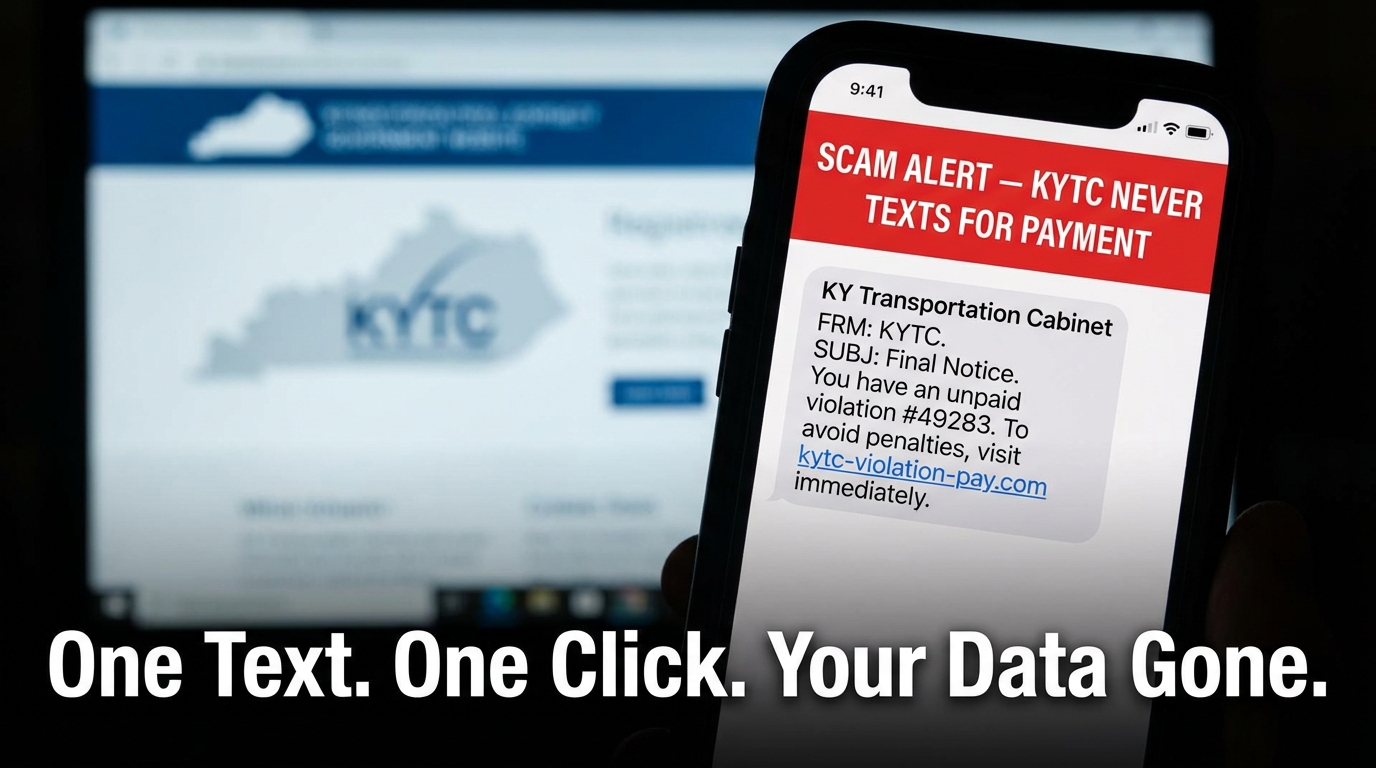

Is the Kentucky Transportation Cabinet Texting You? Here's What You Need to Know
The kentucky transportation cabinet scam is real, it's spreading, and it's designed to steal your money and personal information.
Quick answer: These are fake text messages. KYTC does not send texts about unpaid tickets, toll violations, or payments. If you got one, do not click the link.
Here's what to know at a glance:
| Question | Answer |
|---|---|
| Is the KYTC text message real? | No — it's a phishing scam |
| Does KYTC text about unpaid tickets? | Never |
| Does KYTC collect tolls via text? | No |
| What should you do with the text? | Delete it, don't click any links |
| Where do you report it? | Forward to 7726, report to IC3 or FTC |
| What's the only official driver services site? | drive.ky.gov |
Kentuckians across the state have been receiving unsolicited texts claiming they owe money for traffic violations or unpaid tolls. The messages look official. They include links that closely resemble real Kentucky government websites. And they create a sense of urgency — pay now or face consequences.
But here's the truth: the Kentucky Transportation Cabinet does not send text messages to collect fees, notify drivers of violations, or process toll payments. Full stop.
These texts are a form of smishing — SMS phishing — where scammers impersonate trusted agencies to trick you into clicking a fake link and handing over your personal or banking information.
The scam has evolved over time, starting with fake traffic ticket notices and expanding into toll payment fraud and even AI-powered voice impersonation calls. Multiple warnings have been issued by KYTC itself, local law enforcement, and the FBI's Louisville Field Office.
Anatomy of the Kentucky Transportation Cabinet Scam
To protect ourselves, we first need to understand how these criminals operate. The kentucky transportation cabinet scam isn't just one static message; it is a sophisticated campaign that impersonates various departments within the state government.
Scammers often pose as the KYTC Office of Highway Safety or local driver licensing offices. They send out mass text messages to Kentucky area codes, hoping to catch a few people who might actually have a recent traffic ticket or who frequently travel on toll roads. According to reports from whas11.com, these messages are specifically designed to look like official government correspondence.
The Transportation Cabinet Issues Text Message Scam Alert highlights that these messages often contain a link to a fraudulent website. These sites are "spoofed," meaning they are built to look identical to the official KYTC portal. Once a victim clicks the link, they are prompted to enter sensitive data, such as:
- Full name and date of birth
- Social Security number
- Driver’s license number
- Credit or debit card information
By the time you realize the "payment" didn't go through or the site looks a little "off," the scammers already have everything they need to drain your bank account or sell your identity on the dark web.
Identifying the Kentucky Transportation Cabinet Scam via SMS
The most common version of this scam involves "unpaid infractions." You might receive a text stating that you have an outstanding traffic ticket that must be paid immediately to avoid the suspension of your driving privileges.
This is a classic high-pressure tactic. By threatening your ability to drive, scammers hope you will act out of fear rather than logic. It’s important to remember that similar schemes are happening nationwide, as noted in this DMV Scam Text Alert. In Kentucky, the red flag is the medium: the state will never use a text message as the primary way to notify you of a legal violation or a debt.
Evolution into Toll and AI Impersonation
As people become more aware of the "unpaid ticket" angle, scammers pivot. We have seen a rise in messages regarding "unpaid tolls." These texts claim you missed a toll payment on a Kentucky bridge or highway and owe a small fee (often under $10) plus a large "late penalty."
Interestingly, this mirrors scams in other states, such as the MDOT Scam Text, where scammers target residents even in areas without many toll roads.
Even more alarming is the use of AI. Some Kentuckians have reported receiving phone calls where AI voice cloning is used to impersonate local sheriffs or law enforcement officers. These calls claim there is a warrant for your arrest due to unpaid KYTC fees. They might even use background noises that sound like a busy police station to add "authenticity."
Red Flags: How to Spot a Fake KYTC Message
How do you tell the difference between a legitimate government notice and a criminal's trap? It often comes down to the language used. Scammers are often lazy or based outside of Kentucky, so they use generic terms that don't actually apply to our state.
| Feature | Official KYTC Communication | kentucky transportation cabinet scam |
|---|---|---|
| Agency Name | Kentucky Transportation Cabinet (KYTC) | "KDOT" or "Department of Motor Vehicles (DMV)" |
| Method | Official Mail or drive.ky.gov portal | Unsolicited Text Message or AI Call |
| Payment Method | Secure portal or in-person | Links in texts or wire transfers |
| Urgency | Standard legal timelines | "Pay within 24 hours" or "Immediate arrest" |
| Website URL | Ends in .gov (drive.ky.gov) | Ends in .org, .net, or uses hyphens |
One of the biggest giveaways is the use of "KDOT." While Kansas has a KDOT, Kentucky does not. Similarly, Kentucky uses the term "Circuit Court Clerk" or "KYTC Driver Licensing Regional Offices," not "The DMV." If you see "DMV" in a text about your Kentucky license, it is a scam. For more on these specific red flags, check out this guide on fake DMV texts.
Domain Spoofing and Link Variations
Scammers are masters of the "close-enough" URL. They know that if you are in a hurry, you might not notice a tiny change in a web address. They often use hyphenated versions of real sites or swap out the official .gov extension for something else.
Common fraudulent link patterns include:
- drive-ky-gov.com
- kytc-tickets.org
- ky-gov-pay.net
- drivekygov-portal.com
Official Kentucky government websites will almost always end in .gov. If the link in your text ends in anything else, do not click it. This tactic is explained further in this breakdown of how link spoofing works.
Protecting Yourself from the Kentucky Transportation Cabinet Scam
The best defense against the kentucky transportation cabinet scam is a healthy dose of skepticism. We recommend following a "no-click" policy for any unsolicited text message claiming to be from a government agency.
If you are genuinely worried that you might have an unpaid ticket or toll, go directly to the source. Open your browser and manually type in drive.ky.gov. This is the official secure portal for all Kentucky driver services. If there is a legitimate issue with your license or vehicle registration, it will be listed there.
Other states are facing the same issues. For example, the SCDMV Never Texts and IDOT Will Never Text You campaigns highlight that this is a national trend of government impersonation.
Reporting a Kentucky Transportation Cabinet Scam Incident
If you receive one of these texts, don't just delete it—report it. Reporting helps authorities track the scammers and take down the fraudulent websites they use.
- Forward to 7726: This is a universal "SPAM" reporting number for most cell phone carriers. Forwarding the message to 7726 (which spells SPAM on a keypad) helps your provider block these numbers in the future.
- FBI IC3: File a complaint with the FBI’s Internet Crime Complaint Center (IC3).
- FTC Report: Use the Federal Trade Commission's fraud reporting tool.
- Kentucky Attorney General: You can also report the scam to the Kentucky AG’s office.
For more details on how to handle these messages, see this guide on verifying scam legitimacy.
Recovery Steps for Compromised Information
If you’ve already clicked the link and entered your information, don't panic—but do act quickly. Time is of the essence when it comes to preventing identity theft.
- Contact Your Bank: If you entered credit card or banking details, call your financial institution immediately. They can freeze your accounts and issue new cards.
- Monitor Your Credit: Place a "Fraud Alert" on your credit reports with the three major bureaus (Equifax, Experian, and TransUnion). This prevents scammers from opening new lines of credit in your name.
- Change Passwords: If the scam site asked you to create an account, change the passwords on your real government and financial accounts immediately.
- Follow AG Guidance: The Kentucky Attorney General provides specific identity theft guidance for victims of state impersonation scams.
Falling for a scam is a stressful experience, but you aren't alone. Scammers use advanced psychology to trick even the most tech-savvy people. For a look at how these scams can impact victims, read about the Michigan SOS scam experience.
Frequently Asked Questions about KYTC Fraud
Does KYTC ever text about traffic tickets?
Absolutely not. The Kentucky Transportation Cabinet does not collect fees or notify drivers of traffic violations via text message. All official notifications regarding tickets or license status are sent via the U.S. Postal Service or managed through the official secure portal.
What is the official website for Kentucky driver services?
The only official website is drive.ky.gov. Any website that looks like it but has a different URL—especially those ending in .org or containing hyphens—is a fake designed to steal your data.
How do I report a scam text in Kentucky?
You should forward the text to 7726, then report the incident to the FBI at ic3.gov and the Kentucky Attorney General at ag.ky.gov.
Conclusion
The kentucky transportation cabinet scam is a reminder that our personal information is constantly under threat. These scammers rely on the fact that we use our phones for everything—from paying bills to checking our mail.
At Tempo Mail USA, we believe that the best way to stop a scam is to prevent your information from reaching the scammers in the first place. We provide temporary email aliases that act as a "PII firewall," shielding your real identity from services and potential data breaches. By using a secure alias, you keep your primary inbox clean and your personal data private.
Stay vigilant, Kentuckians. If a text from the "Transportation Cabinet" lands in your inbox, remember: if it's a text, it's a trap. For more tips on protecting your digital life, visit https://tempomailusa.com.