


Michigan Drivers: That Toll Text Is a Scam
MDOT scam text messages are fake toll payment requests sent to Michigan residents by cybercriminals — and they are spreading fast. If you got one, here's what you need to know right away:
- MDOT does not operate toll roads and will never text you asking for payment
- Do not click any link in the message
- Forward the text to 7726 (SPAM) and report it to the FTC at reportfraud.ftc.gov
- Delete the message after reporting it
- If you already clicked and entered payment info, contact your bank immediately
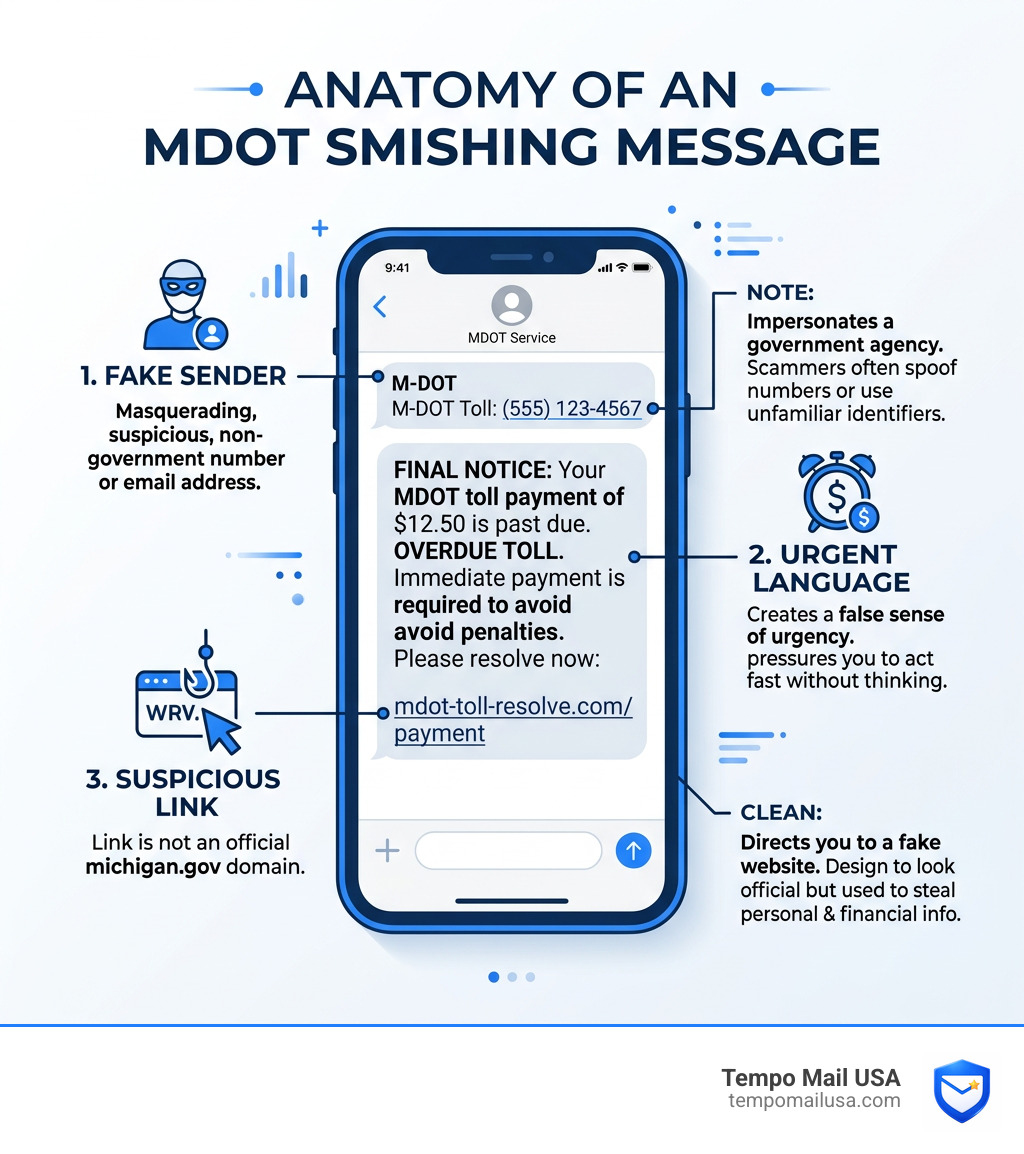
These texts are a form of smishing — SMS phishing — where scammers pretend to be a government agency to steal your personal and financial information. They look urgent, official, and sometimes even include fake Michigan.gov links or copied MDOT logos.
The scale is alarming. The FBI's Internet Crime Complaint Center (IC3) logged 60,000 complaints about toll scams in 2024 alone. And MDOT offices have been flooded with hundreds of calls from confused Michigan residents wondering if they really owe toll fees.
The short answer? They don't. Michigan has no toll roads.
Yet the scam keeps working — because it is designed to make you panic and act fast before you think twice.
Understanding the MDOT Scam Text and How It Operates
At its core, the MDOT scam text is a numbers game. Scammers use automated systems to blast out thousands of text messages to Michigan area codes. This technique, known as "smishing" (SMS phishing), relies on the high open rates of text messages compared to emails. Most of us check our texts within minutes, and a message claiming we owe money to a government agency naturally triggers a "fight or flight" response.
The scam operates through credential harvesting. When a recipient clicks the link in the text, they are directed to a professional-looking website that mimics the official Michigan Department of Transportation (MDOT) or E-ZPass branding. These sites are designed to look identical to the real thing, often featuring the state seal or familiar blue-and-white color schemes. Once there, you are prompted to enter your name, address, social security number, and—most importantly—your credit card information to "settle the debt."
According to FBI reporting on nationwide toll scams, this isn't just a local nuisance; it’s a coordinated national effort. In fact, the EZPass Scam Text: 60,000 Reports and Counting shows that these criminals are successfully siphoning millions of dollars from unsuspecting drivers across the country. By the time the victim realizes Michigan doesn't even have toll roads, the scammers have already processed the payment or sold the credit card data on the dark web.
Why Scammers Target Michigan for Tolls
You might wonder: "If Michigan has no toll roads, why are they sending these texts here?" It seems like a bad business model for a criminal, right? Well, scammers count on three things:
- Travelers: Many Michiganders travel to neighboring states like Ohio, Illinois, or Indiana, where tolls are common. A driver returning from a weekend in Chicago might see an MDOT scam text and assume they missed a toll on the I-94 or the Skyway.
- Confusion with Bridges: Michigan does have tolled bridges (like the Mackinac). Scammers hope you'll confuse a "toll road" with a "toll bridge."
- Mass Spoofing: Scammers don't always filter their lists perfectly. They spoof Michigan.gov links and use names like Bradley Wieferich (the MDOT Director) to add a layer of false authority.
As noted in the MDOT official statement on toll scams, Director Wieferich has been very clear: MDOT does not operate toll roads, and they certainly don't use license plate capture to send you bills via text message.
Red Flags to Spot an MDOT Scam Text
Spotting these fakes requires a bit of "detective work," but once you know what to look for, they stick out like a sore thumb. Here are the most common red flags:
- Suspicious URLs: Look closely at the link. A real government site ends in
.gov. Scammers use "look-alike" domains likemichigan-gov-toll.com,ezpass-pay.vip, orpay-mdot.top. Often, these links are shortened (like Bitly links) to hide the final destination. - International Area Codes: Many of these texts originate from overseas. We’ve seen reports of texts coming from country codes like +63 (the Philippines). Why would the Michigan government text you from Southeast Asia? (Hint: They wouldn't).
- Grammatical Errors: Professional government communications go through multiple rounds of editing. If the text says "Your toll is over due, pay now or loose your license," the typos are a dead giveaway.
- Urgency and Threats: Scammers love to use words like "Immediate Action Required," "Final Notice," or "Late Fee Warning." They want you to panic so you don't stop to verify the facts.
For more tips on identifying these types of messages, check out our guide on How to Spot a DMV Text Scam.
Real Toll Collection Methods in Michigan vs. Fraudulent Claims
To protect yourself, it helps to know how Michigan actually handles money. While the state doesn't have toll roads (highways you pay to drive on), it does have several tolled crossings. However, none of these agencies will ever send you a text message demanding payment via a link.
| Feature | Real Michigan Tolls | MDOT Scam Texts |
|---|---|---|
| Location | Specific Bridges/Tunnels | "Generic" Toll Roads |
| Billing Method | Mail-in invoices or on-site cash/card | SMS/Text Message |
| Payment Site | Official .gov or .org sites | .vip, .top, or .com links |
| Urgency | Standard 30-day billing cycles | "Pay within 24 hours" |
| Threats | Standard late fees via mail | Immediate license suspension |
If you are crossing the Mackinac Bridge, you pay at the booth or via a pre-set MacPass. You won't get a random text three days later. The same applies to the Blue Water Bridge, the International Bridge in Sault Ste. Marie, and the privately owned Ambassador Bridge and Detroit-Windsor Tunnel.
Risks of Engaging with Fraudulent Messages
Clicking a link in an MDOT scam text is like opening the front door of your house to a burglar. The risks go far beyond losing $15 for a fake toll.
- Malware: Simply clicking the link can sometimes trigger a "drive-by download" that installs spyware on your phone. This software can track your keystrokes, stealing passwords for your bank and social media accounts.
- Financial Loss: Once you enter your credit card info, scammers often make a small "test" purchase followed by large, fraudulent transactions.
- Identity Theft: By collecting your name, address, and DOB, scammers can build a profile to open new lines of credit in your name.
- Data Breaches: Your information is often bundled and sold to other criminals, leading to a never-ending cycle of spam calls and phishing attempts.
As we discussed in DMV Text Scam 2026: Do Not Click That Link Until You Read This, these attacks are becoming more sophisticated every year, making it harder for the average user to distinguish between fact and fiction.
Official Warnings and State Responses
Michigan officials are not taking this lying down. Attorney General Dana Nessel has issued multiple alerts, especially during high-travel seasons. During the Memorial Day holiday, when 1.3 million Michiganders hit the road, MDOT took the unusual step of using its highway infrastructure to fight back.
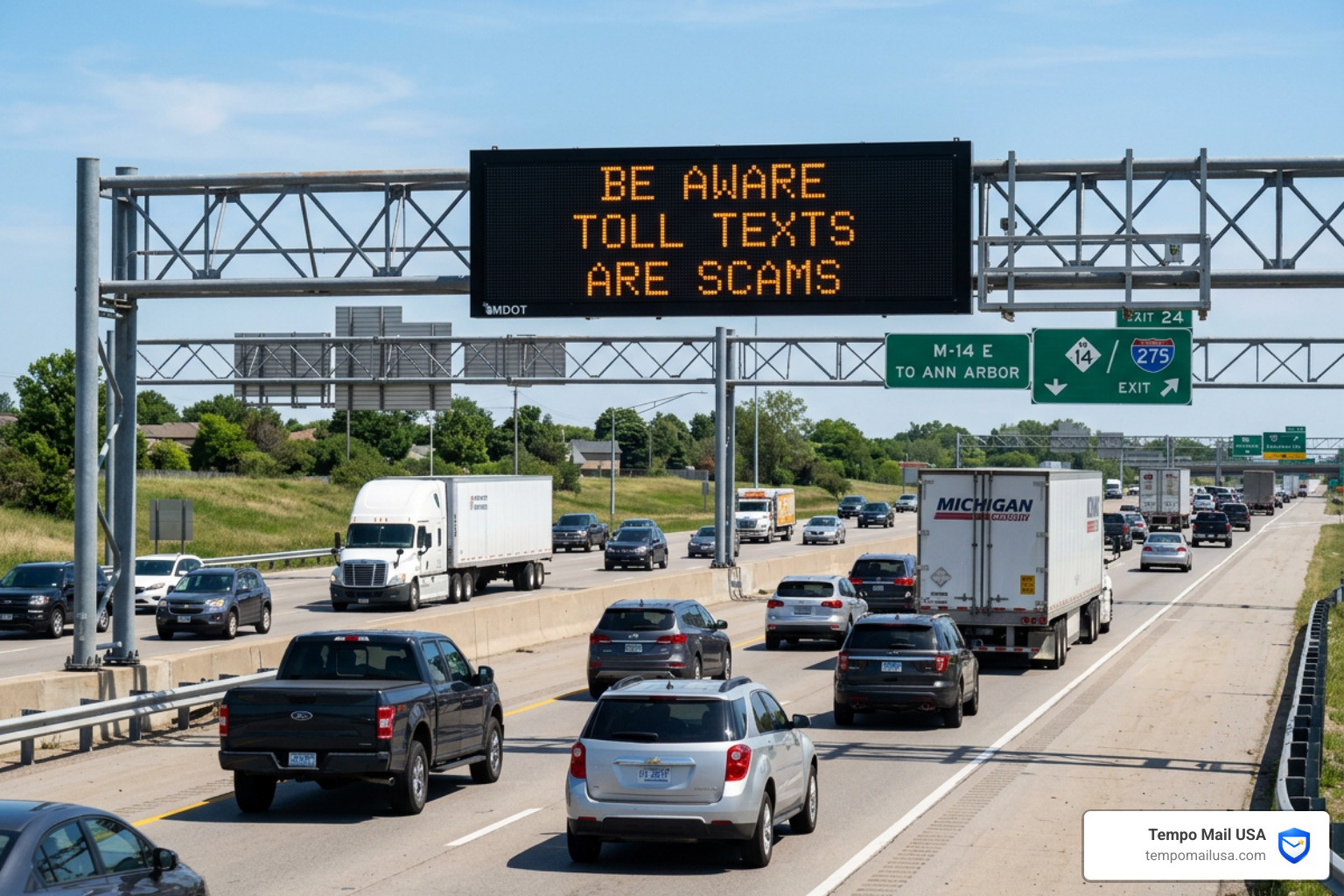
MDOT utilized 278 Dynamic Message Signs (DMS) across the state to broadcast a simple warning: "BE AWARE TOLL TEXTS ARE SCAMS." This was a direct response to the hundreds of phone calls MDOT offices received from worried residents. When the state starts using its "traffic jam" signs to warn you about texts, you know the situation is serious!
How to Report a Toll Scam
If you receive a suspicious text, don't just delete it—report it. Reporting helps federal agencies track the origin of these scams and shut down the fraudulent websites.
- 7726 (SPAM): This is a universal "report spam" number for almost all cell phone carriers. Copy the scam text and forward it to 7726. It’s free and helps your carrier block the sender.
- FTC: You can file an official report at reportfraud.ftc.gov. The Federal Trade Commission uses this data to build cases against scam rings.
- IC3: The FBI’s Internet Crime Complaint Center is the best place to report if you have actually lost money. Visit www.ic3.gov to file a complaint.
For more information on how these scams are affecting other regions, read our post on how to Beware Georgia DMV Scam Texts Targeting Drivers.
Frequently Asked Questions about MDOT Toll Scams
Does MDOT ever send toll bills via text or email?
Absolutely not. MDOT and other Michigan state agencies communicate regarding debts or official business through the U.S. Postal Service. They will send a paper letter to the address associated with your vehicle registration. They will never demand payment via text, email, or social media message. Furthermore, the government will never ask for payment via "untraceable" methods like prepaid gift cards, cryptocurrency, or apps like Venmo or CashApp.
For a deeper dive, the FCC guide on identifying toll scams provides a comprehensive look at how legitimate agencies handle billing.
What to Do if You Clicked an MDOT Scam Text Link
If you clicked the link and—worse—entered your information, don't panic, but do act quickly.
- Contact Your Bank: If you entered credit card info, call your bank's fraud department immediately to cancel the card and dispute any charges.
- Freeze Your Credit: Contact the three major credit bureaus (Experian, TransUnion, and Equifax) to place a security freeze on your credit report. This prevents scammers from opening new accounts in your name.
- Update Passwords: If the site asked you to "log in," change the passwords for your email and any accounts that use that same password.
- Scan for Malware: Run a security scan on your phone using a reputable mobile antivirus app.
For more recovery steps, see our advice on FLHSMV Scam Text: What Florida Drivers Must Know.
Is the toll scam happening in other states?
Yes, this is a nationwide epidemic. Scammers simply swap out the "MDOT" branding for whatever is local to the recipient. In California, they impersonate FasTrak. In Illinois, it’s I-PASS. In Florida, they use SunPass, and in the Northeast, E-ZPass is the primary target. The FBI IC3 complaint data shows that while the names change, the tactics remain identical.
Conclusion and Preventive Measures
The MDOT scam text is a reminder that our personal information is constantly under fire. While reporting and blocking are great reactive steps, the best defense is a proactive "PII firewall."
At Tempo Mail USA, we believe your real identity shouldn't be a sitting duck. One of the best ways to prevent your phone number and email from ending up on these "scam lists" is to use temporary email aliases and identity masking. When you sign up for new services, apps, or websites, don't give them your primary "life" email. Use an alias that proxies your identity. If that alias starts receiving spam or phishing attempts, you can simply delete it without ever affecting your real inbox.
By compartmentalizing your digital life, you stop scammers before they even get your number. Stay vigilant, Michigan! Remember: if a text says you owe money for a road that doesn't exist, it's definitely a scam.
For more ways to keep your phone quiet and secure, check out our guide on the Best way to stop spam calls. Stay safe out there on the (toll-free) roads!