


The Iowa DOT Scam Is Targeting Iowans Right Now — Here's What You Need to Know
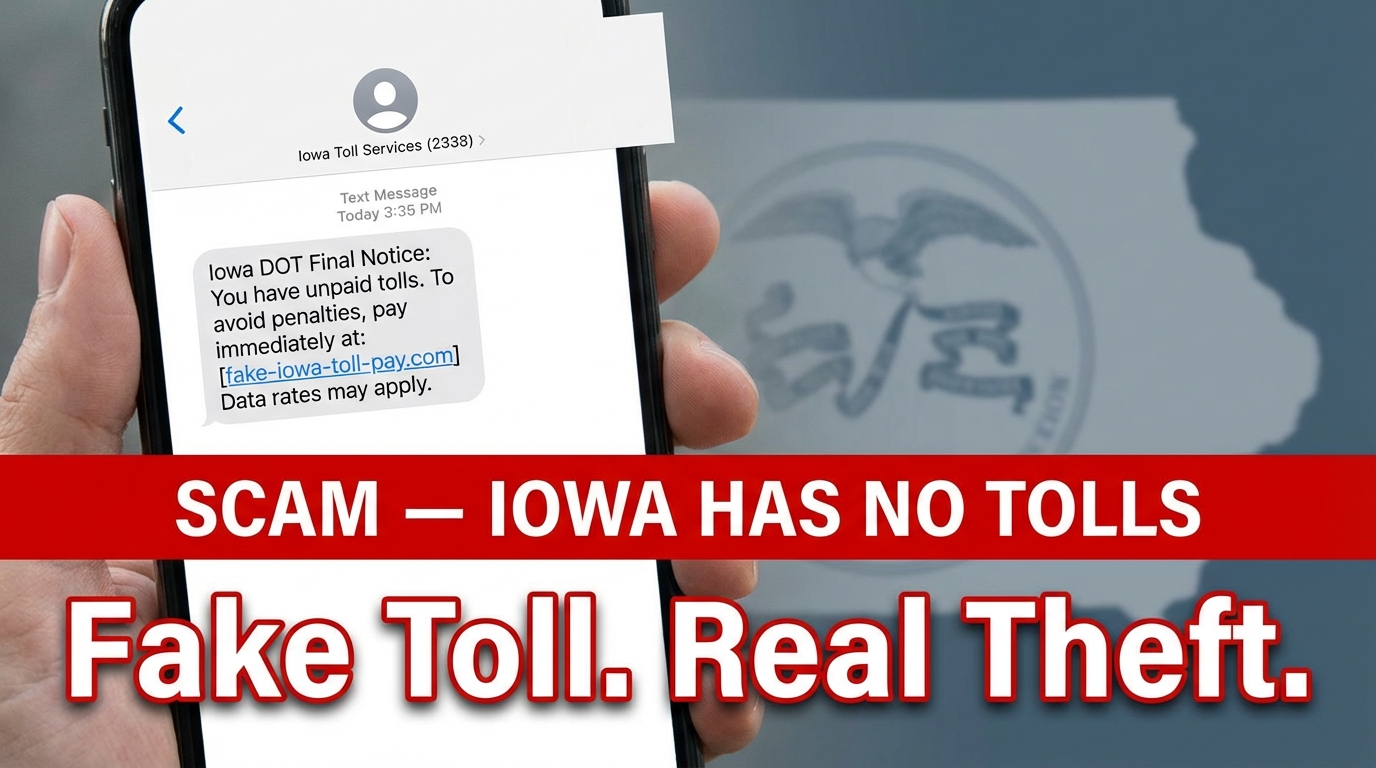
The iowa dot scam is a text message phishing scheme where criminals impersonate the Iowa Department of Transportation (DOT) to steal your personal and financial information.
Quick answers:
- What is it? Fake texts claiming you owe unpaid tolls, traffic fines, or registration fees — sent by scammers pretending to be the Iowa DOT or "DMV"
- Is it real? No. The Iowa DOT does not send fee reminders by text, does not collect tolls, and Iowa has no "DMV"
- What should you do? Do not click any links. Report the text, block the number, and delete the message
- Were you scammed? Contact local law enforcement, report to the FTC and FBI's IC3, and check your credit report immediately
Polk County Sheriff's Office has issued a direct warning to residents about these fraudulent texts. The messages look official. They use government-sounding language and link to fake websites designed to mimic real Iowa DOT pages.
The goal is simple: get you to hand over your credit card number, Social Security number, or other personal data.
This isn't just an Iowa problem. Transportation departments across the country are seeing the exact same scam, just wearing a different state's name. Iowa is simply the latest target.
If you got one of these texts, you're not alone — and you're in the right place.
How the Iowa DOT Scam Works
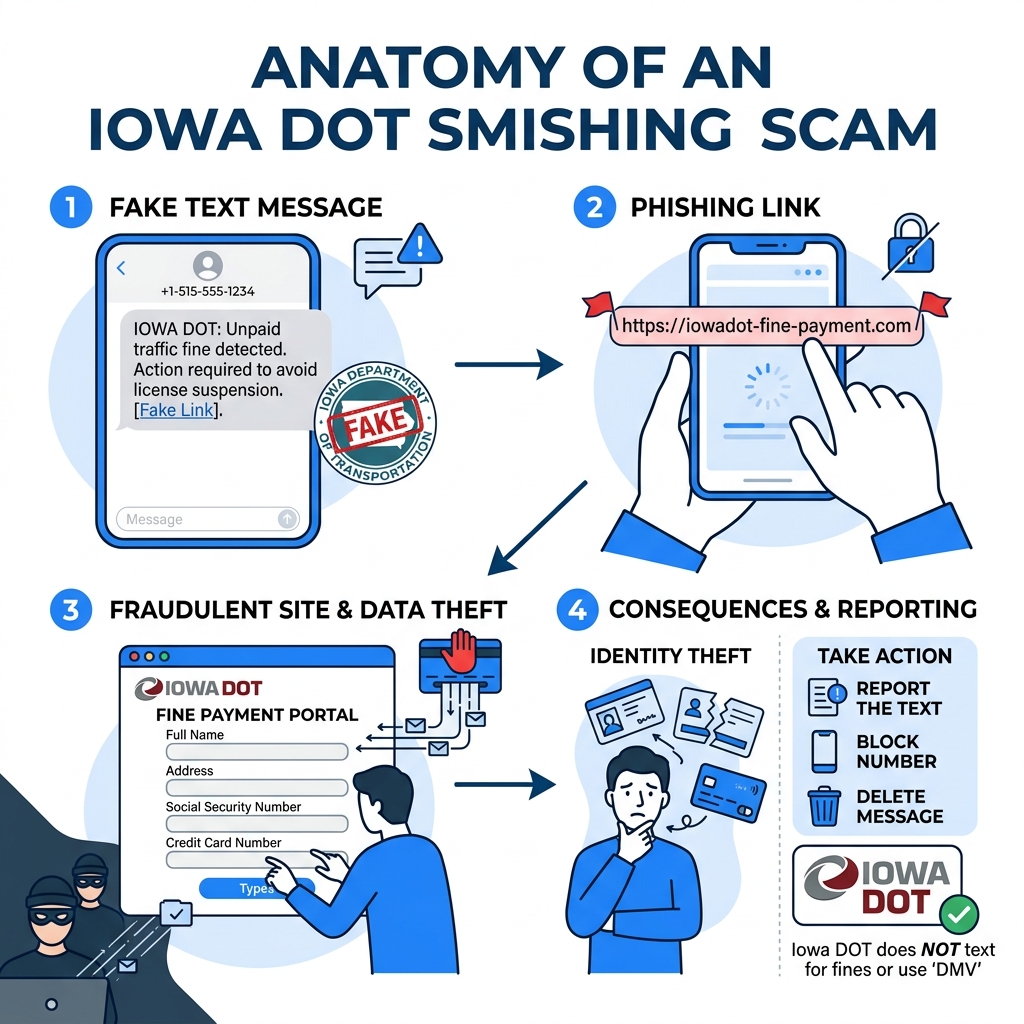
The iowa dot scam is a classic example of "smishing"—a portmanteau of SMS and phishing. It relies on psychological triggers to bypass your natural skepticism. By the time you realize the message is a fake, the scammers may already have what they need to drain your bank account or sell your identity on the dark web.
The process usually begins with an unsolicited text message. These messages are sent out in massive batches using automated systems. The scammers don't necessarily know you live in Iowa; they just cast a wide net and wait for a "bite."
The content of these messages typically falls into three categories:
- Unpaid Tolls: This is the most common variation. The text claims you have an outstanding balance for a toll road and warns that late fees will be applied if you don't pay immediately.
- Traffic Violations: These texts claim you were caught speeding or running a red light by a camera, and you must pay a fine to avoid legal action or license suspension.
- Registration Fees: Some versions claim your vehicle registration has expired or there is a problem with your title that requires an "update fee."
Regardless of the claim, the message always includes a link. This link is the "hook." When you click it, you are taken to a website that looks remarkably like the official Iowa DOT website. It might use the same logos, colors, and fonts. On this fake site, you'll find a form asking for your name, address, driver's license number, and—most importantly—your credit card information to "settle the debt."
For a deeper look at how these fraudulent messages are spreading across the country, you can read more about how dmv-scam-text-alert-fake-messages-spreading-across-the-us is affecting various states.
According to official news from the Fraudulent Text Messages Target Recipients With False Claims of Unpaid Tolls or Traffic Violations alert, these scammers are highly sophisticated, often creating URLs that look very similar to legitimate government domains to trick even tech-savvy users.
Identifying the Iowa DOT Scam Red Flags
We want you to be able to spot these fakes in a heartbeat. While the scammers are good, they aren't perfect. There are several glaring red flags that prove a message is an iowa dot scam.
- The "DMV" Reference: This is the biggest giveaway. Iowa does not have a "Department of Motor Vehicles" or "DMV." In our state, these services are handled by the Iowa Department of Transportation (DOT) or the Motor Vehicle Division. If a text mentions the "Iowa DMV," it is 100% a scam.
- The Toll Claim: We’ll let you in on a little secret: The Iowa DOT does not collect tolls on any roads or bridges in the state. If you receive a text about an "Iowa toll," it's a lie because those tolls don't exist.
- Urgent and Threatening Language: Scammers want you to panic. They use words like "Urgent," "Final Notice," or "Immediate Action Required" to stop you from thinking clearly. Legitimate government agencies usually communicate via physical mail for serious matters.
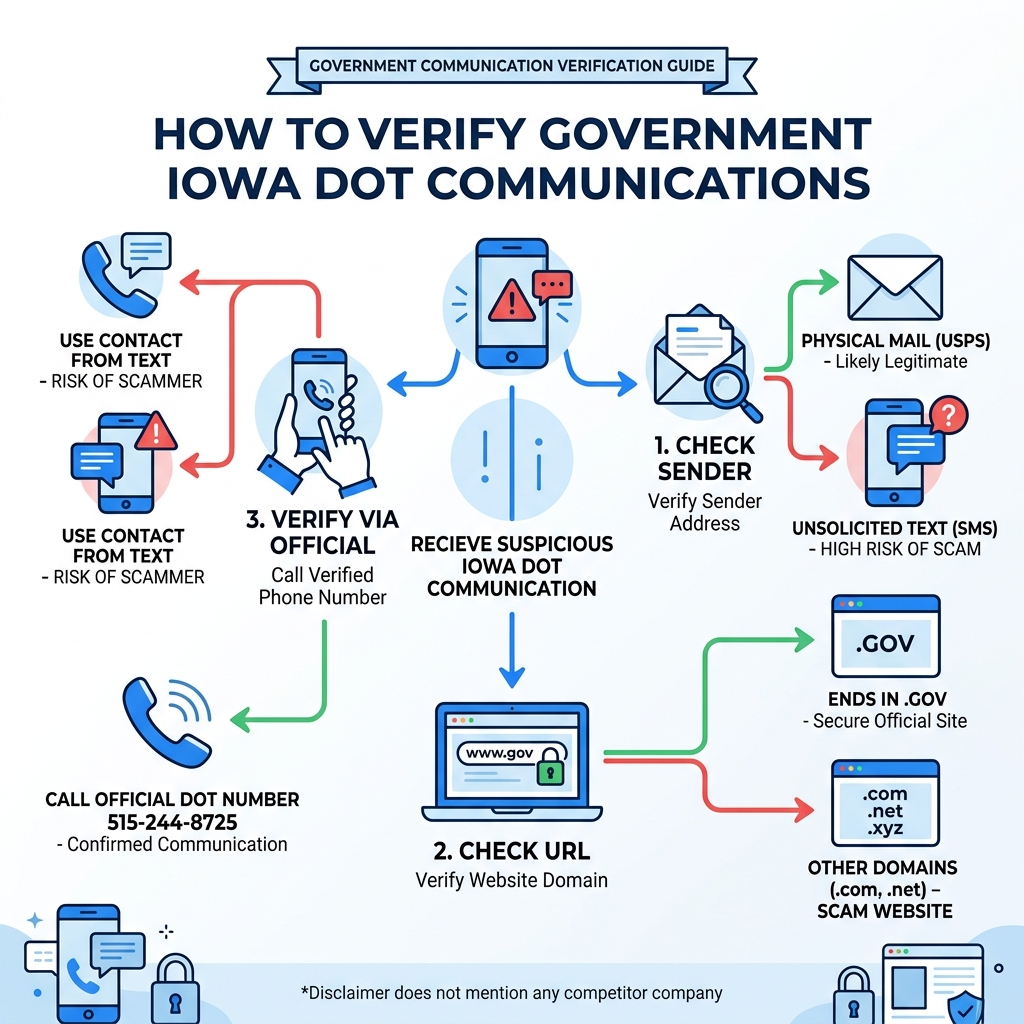
- Suspicious URLs: Look closely at the link. Official Iowa government websites always end in .gov. If the link ends in .com, .net, .org, or some strange string of characters like "iowa-dot-fees-online.xyz," do not click it.
- Requests for Private Info: The DOT will never ask you for your Social Security number or credit card details via a text message.
For more tips on spotting these signs, check out our guide on tx-dmv-scam-text-explained-how-it-works-red-flags, which covers similar tactics used in other regions.
Nationwide Context of Smishing Attacks
It is important to understand that the iowa dot scam isn't happening in a vacuum. It is part of a massive, nationwide campaign targeting residents in almost every state. Cybersecurity experts have noted that these groups often use the same templates, simply swapping out the state name and logo.
We have seen nearly identical reports in Pennsylvania, where residents were targeted by the penndot-text-scam-alert-fake-messages. The goal remains the same: impersonate a trusted state agency to steal PII (Personally Identifiable Information). By recognizing that this is a broad trend, we can better protect ourselves by remaining skeptical of any government communication that arrives via SMS.
Official Communication vs. Fraudulent Messages
To help you distinguish between a real notice and a scam, we’ve put together a comparison of how the Iowa DOT actually operates versus how scammers try to trick you.
| Feature | Official Iowa DOT | Scammers (iowa dot scam) |
|---|---|---|
| Primary Contact Method | Physical mail (USPS) or in-person | Unsolicited Text Message (SMS) |
| Website Domain | Always ends in .gov | Ends in .com, .net, .org, .xyz, etc. |
| Payment Requests | Customer-initiated via official portal | Demanded via a link in a text |
| Toll Collection | None (Iowa has no state toll roads) | Claims you owe money for tolls |
| Language Tone | Formal and informative | Urgent, threatening, or alarmist |
| Information Requested | Verified through secure login | Asks for CC# and SSN directly on a form |
As noted by the Iowa DOT warns people of ongoing fraudulent toll scam report, the department simply does not use text messaging for fee collection or reminders. If you see a text demanding money, you can be certain it didn't come from a legitimate state office.
How the Iowa DOT Scam Differs from Official Contact
The Iowa DOT is very clear about its communication policies. They do not send out fee collection reminders via text. If you owe money for a registration renewal or a legitimate fine, you will receive a letter in your physical mailbox.
Furthermore, the Iowa DOT will never ask for your private or financial information via text. Legitimate online transactions are always initiated by you, the customer. For example, if you go to the official website to renew your tags, you are the one starting that process. The DOT won't text you out of the blue to ask for your credit card.
This policy is consistent with other states as well. For instance, the sc-dmv-scam-text-scdmv-never-texts alert highlights that South Carolina's agency also avoids texting for these purposes. Understanding this "no-text" rule is your best defense.
Verifying Legitimate Iowa DOT Records
If you are genuinely worried that you might owe a fee or have a problem with your license, don't use the link in a text. Instead, go directly to the source.
You can verify your records by contacting the Iowa Motor Vehicle Division directly. You can reach them at 515-244-8725 or email driver.services@iowadot.us. By initiating the contact yourself using a verified phone number or email, you ensure that you are speaking with a real government representative.
Avoid using "official" looking agencies that aren't actually part of the government. This is a common tactic in other states, such as the georgia-dmv-scam-text-the-fake-agency situation, where scammers created an entirely fake agency name to sound more authoritative.
What to Do if You Receive a Suspicious Text
If your phone pings and you see a message that looks like the iowa dot scam, don't panic. Follow these steps to stay safe:
- Do Not Click: This is the most important rule. Clicking the link can lead to malware being installed on your phone or take you to a phishing site.
- Report Junk: Most modern smartphones have a "Report Junk" or "Report Spam" feature. Use it! This helps your carrier and Apple/Google identify and block the scammer's number for everyone.
- Forward to 7726: You can forward any spam text to "SPAM" (7726). This is a free service used by major wireless carriers to track and stop scam campaigns.
- Block the Number: Once you've reported it, block the sender so they can't bother you again.
- Delete the Message: Get it off your phone so you don't accidentally click it later.
We've seen similar advice given for the Texas DMV scams. You can verify if a site is real by checking our analysis on txdmv-scam-text-alert-is-txdmv-org-real-or-fake. The same logic applies here: if the URL looks "off," it probably is.
Steps for Victims of the Iowa DOT Phishing Attack
If you've already clicked the link and entered your information, don't beat yourself up. These scammers are professionals. However, you need to act quickly to minimize the damage.
- Contact Your Bank: If you provided credit card or banking information, call your financial institution immediately. They can freeze your account, cancel your cards, and help you dispute any fraudulent charges.
- File a Police Report: Contact your local law enforcement agency. While they might not be able to catch the scammer immediately, having a police report is often necessary for identity theft recovery.
- Report to the FBI and FTC: File a report online at the FBI's Internet Crime Complaint Center (IC3) at ic3.gov and with the Federal Trade Commission (FTC) at reportfraud.ftc.gov.
- AARP Fraud Watch: The AARP Fraud Watch Helpline (877-908-3360) is a great resource for people of all ages to get guidance on what to do after being targeted by a scam.
- Monitor Your Credit: Go to annualcreditreport.com to get a free copy of your credit report. Check for any accounts or inquiries you don't recognize. You may also want to place a "fraud alert" or "credit freeze" on your files with Equifax, Experian, and TransUnion.
The Iowa DOT warns consumers of text phishing scam official page emphasizes that reporting is crucial for helping authorities track the scale of the attack. For comparison, you can see how Texas handles these reports at txdot-scam-text-txtag-only-texts-from-one-number, noting that official agencies often only text from a single, verified short-code.
Frequently Asked Questions about Iowa DOT Scams
Does Iowa have a DMV?
No. While many people use the term "DMV" as a shorthand for motor vehicle services, Iowa does not have a "Department of Motor Vehicles." Our services are managed by the Iowa Department of Transportation (DOT). If you receive a message from the "Iowa DMV," you know immediately that it is part of the iowa dot scam.
Does the Iowa DOT collect tolls via text?
Absolutely not. In fact, the Iowa DOT does not collect tolls on any of the roads or bridges it maintains. There are no state-run toll roads in Iowa. Any text claiming you owe a "toll fee" in Iowa is a complete fabrication. Official payments are only handled through physical mail, in-person at a service center, or through a secure, customer-initiated transaction on a .gov website.
How can I report a fake Iowa DOT website?
If you encounter a website that is impersonating the Iowa DOT, you should report it to the Iowa DOT Bureau of Investigation and Identity. You can contact investigator Ryan Ridout at 515-237-3260 or email ryan.ridout@iowadot.us. Reporting these sites helps the DOT work with internet service providers to take the fraudulent pages offline.
Conclusion
The iowa dot scam is a reminder that our personal information is always under threat from digital predators. While the Iowa DOT and local law enforcement are working hard to warn the public, the ultimate responsibility for our data privacy lies with us. By staying informed, recognizing red flags, and following official communication protocols, we can keep our finances and identities safe.
At Tempo Mail USA, we believe that the best way to stop a scammer is to never give them your real information in the first place. We provide temporary email aliases that act as a secure proxy for your identity. By using an alias when signing up for services or communicating online, you create a "PII firewall" that shields your personal details from data breaches and phishing lists.
In an age where your phone number and email are the keys to your digital life, protecting them is more important than ever. Stay vigilant, stay skeptical of unsolicited texts, and consider using tools that keep your real identity under wraps.