

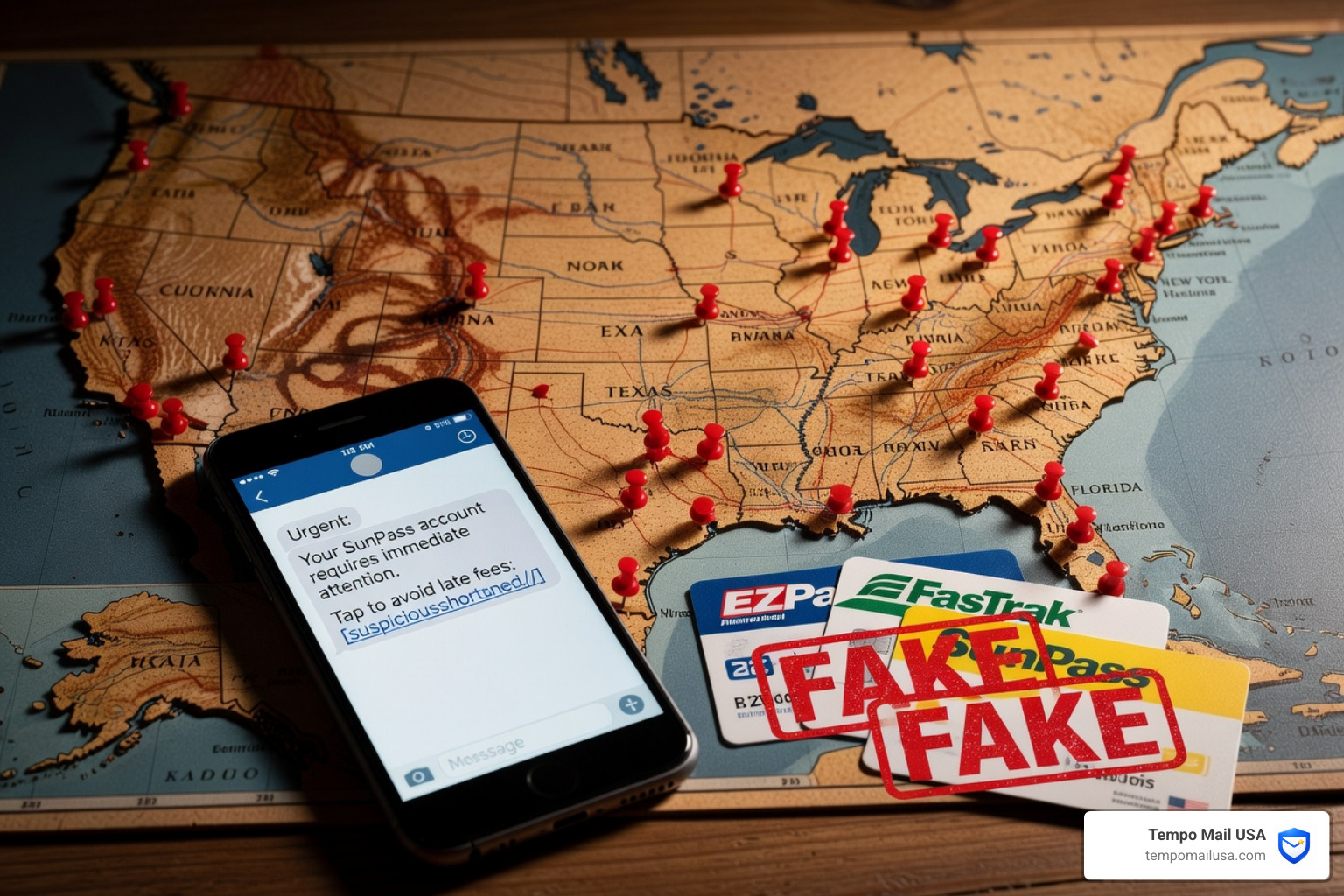

Toll Scam Texts Are Everywhere — Here's What You Need to Know
A toll scam text is a fake SMS message that pretends to be from a toll agency, claiming you owe an unpaid balance and pressuring you to click a link and pay immediately. That link leads to a phishing site designed to steal your credit card details, personal information, or both.
Quick answer — what to do if you get a suspicious toll text:
- Do not click any links in the message
- Do not reply or call any number listed in the text
- Verify directly by visiting your toll agency's official website
- Report it by forwarding to 7726 (SPAM) or filing a complaint at ic3.gov
- Delete the message after reporting
These scams are surging. The FTC reported that consumers lost $470 million to text scams in 2024. The FBI’s Internet Crime Complaint Center received roughly 60,000 complaints about toll scams alone in a single year. And according to McAfee, fake unpaid toll texts nearly quadrupled between January and late February of the same period.
The unsettling part? You don't even need to have driven through a toll recently. Scammers send these texts in bulk, targeting random phone numbers across every state — including states that don't even have toll roads.
Whether you just received one of these texts or want to stay protected, this guide covers everything: how the scam works, how to spot it, what to do if you clicked, and how to keep your personal information safe.
What is the Toll Scam Text and Why is it Surging?
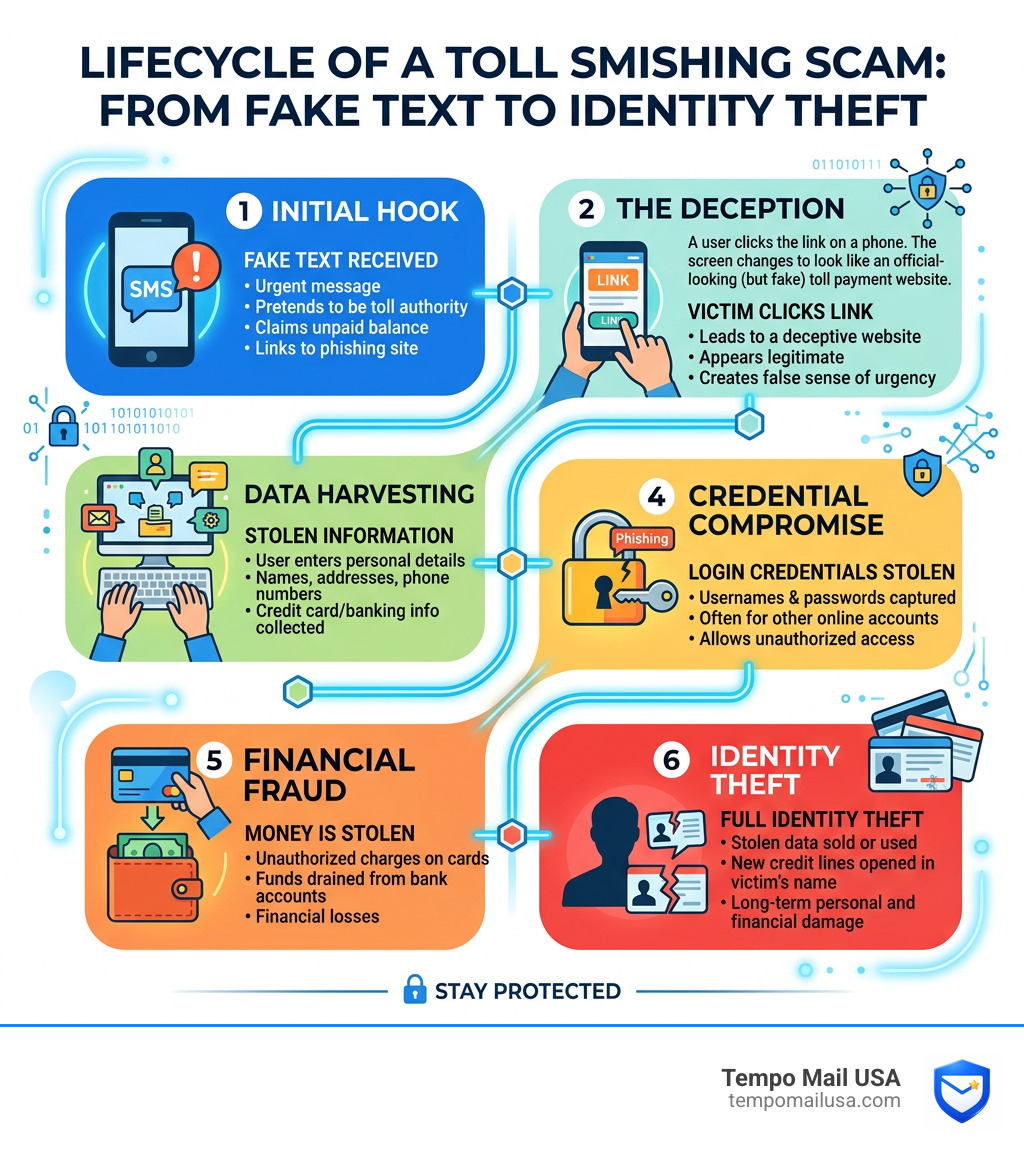
At its core, a Toll scam text is a form of "smishing"—a portmanteau of SMS and phishing. It is a digital trap designed to exploit our sense of urgency and our desire to avoid late fees. We’ve all been there: you’re busy, your phone pings, and suddenly you’re told you owe $12.51 for a bridge you crossed three weeks ago. If you don't pay now, the text warns, you'll face a $50 fine.
Why are we seeing so many of these lately? There are a few key reasons for this massive surge:
- The Rise of Cash-Free Lanes: As more highways move toward "all-electronic tolling," drivers are used to receiving digital notifications. Scammers exploit this new "normal" to blend in with legitimate services.
- AI Automation: Modern criminals use generative AI to scale their campaigns. They can register thousands of fake domains and send millions of texts in seconds, all with perfectly polished (though often still slightly "off") language.
- Massive Financial Success: According to Federal Trade Commission data on 2024 text scam losses, consumers lost nearly half a billion dollars to these schemes. Because it works, scammers keep doing it.
- Spoofing and Local Targeting: Scammers can "spoof" phone numbers to make them look like they are coming from a local area code or even a legitimate agency name. They often use generic greetings like "Dear Customer" to cast the widest net possible.
If you want to dive deeper into how specific agencies are being impersonated, check out our more info about the E-ZPass text scam, which has already affected tens of thousands of drivers.
How to Identify a Fraudulent Toll Scam Text
Spotting a Toll scam text is easier once you know the "tell-tale" signs of a criminal. Legitimate toll agencies like E-ZPass or SunPass have very strict protocols for how they communicate with you. They almost never send a random text message out of the blue demanding immediate payment via a clickable link.
Warning Signs of a Toll Scam Text
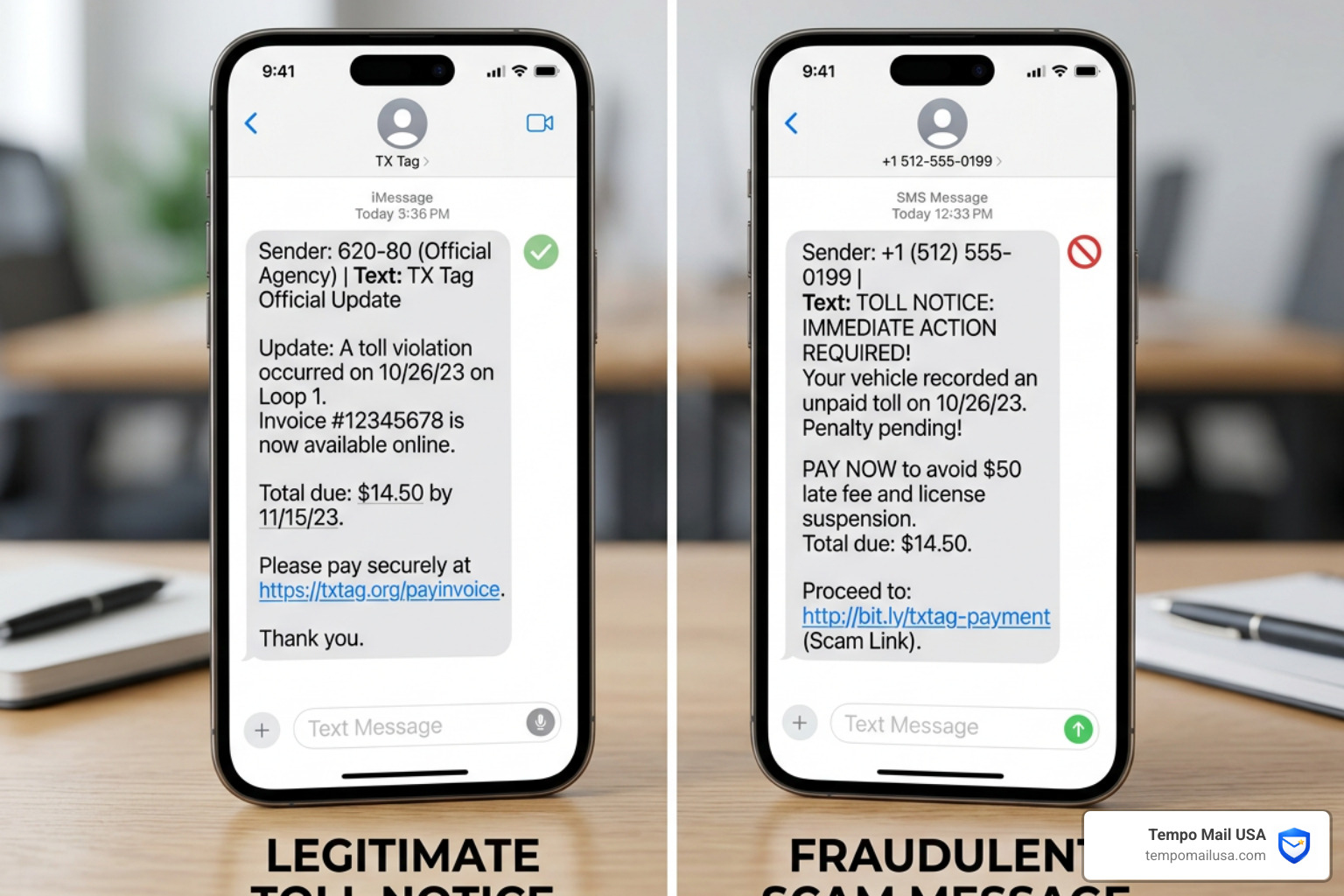
When you look at a suspicious message, keep an eye out for these specific red flags:
- The "Hook" Amount: Scammers often use small, believable numbers like $11.69 or $12.51. They know you're more likely to pay a small amount quickly just to make the problem go away.
- Shortcodes and International Numbers: If the text comes from a 10-digit number you don't recognize, or worse, a number with a Canadian area code (like 902) or an international prefix, it’s a scam.
- Generic Greetings: Legitimate agencies usually have your name on file. If the text starts with "Dear Customer" or "Toll User," be on high alert.
- Suspicious Links: Look closely at the URL. Does it say
ezpass-service.comortoll-payments-online.net? Real agencies use their official government domains (usually ending in .gov or .org). As the AAA warning on suspicious toll links points out, these links are designed to harvest your data. - Urgent or Threatening Language: Phrases like "Action Required," "Final Notice," or "Immediate Payment Needed to Avoid Suspension" are classic social engineering tactics designed to make you panic.
| Feature | Legitimate Agency | Scammer Tactic |
|---|---|---|
| Notification Method | Primarily via Snail Mail or Official App | Unsolicited SMS/Text Message |
| Greeting | Personalized (Your Name) | Generic ("Dear Customer") |
| Link Destination | Official .gov or .org site | Random, misspelled, or shortened URLs |
| Payment Request | Secure portal with login | Direct link to enter credit card/SSN |
| Tone | Formal and Informational | Urgent and Threatening |
State-Specific Warnings and Targeted Agencies
Scammers aren't picky; they will impersonate any agency that people recognize. However, certain high-traffic systems are targeted more frequently. We’ve seen a massive spike in reports involving:
- E-ZPass: Covering the Mid-Atlantic and Northeast, this is perhaps the most impersonated brand. Even the New York Governor's warning on E-ZPass scams emphasized that E-ZPass will never ask for your Social Security number or credit card via text.
- FasTrak: California drivers are frequently targeted with texts claiming account suspensions.
- I-PASS: Illinois residents have reported thousands of fraudulent messages claiming "past due" balances.
- SunPass / FLHSMV: Florida's high volume of tourists makes it a goldmine for scammers. For more details, see our more info about the Florida FLHSMV scam.
Verifying a Toll Scam Text with Local Authorities
If you get a text and you’re genuinely worried you might owe money, do not use the contact information in the text. Instead:
- Independent Lookup: Open your browser and search for the official agency (e.g., "Texas DOT official website" or "California DMV").
- Log In Directly: Use the official app or the secure portal on their website to check your balance.
- Call Customer Service: Use the phone number listed on the back of your physical toll transponder or your last paper statement.
Agencies like the Illinois DOT or TxDOT have been working overtime to take down fraudulent websites, but new ones pop up every day. If you live in the South, you might want to read our more info about the Georgia DMV scam to see how they operate there.
What to Do if You Receive or Click a Suspicious Link
If you receive a Toll scam text, the best thing you can do is... nothing. Don't click, don't reply "STOP" (which just confirms your number is active), and don't call the number.
However, we are human, and sometimes we click before we think. If you have engaged with a link, here is how to handle it:
- Reporting: Forward the message to 7726 (which spells SPAM). This alerts your carrier to the fraudulent number.
- Official Complaints: File a report with the FBI IC3 reporting portal. This helps law enforcement track the scale of the attack.
- FTC Notification: Use the how to report fraud to the FTC guide to ensure your experience is logged in the national database.
Recovery Steps After Engaging with a Toll Scam Text
If you’ve already entered your information into a fake website, you need to act fast. Scammers can use your driver's license number, credit card, and SSN to wreak havoc on your life.
- Contact Your Bank: Immediately call your credit card issuer or bank to report the fraud and cancel your cards.
- Change Passwords: If you used the same password for the fake toll site as you do for other accounts, change them all immediately. Enable Multi-Factor Authentication (MFA) everywhere.
- Freeze Your Credit: Contact Equifax, Experian, and TransUnion to place a freeze on your credit reports. This prevents scammers from opening new accounts in your name.
- Monitor IdentityTheft.gov: This is the official government resource for creating a recovery plan if your SSN has been compromised.
- Report Phishing: For a step-by-step on handling the aftermath, see our more info about reporting phishing emails.
New Protections and Preventive Measures for Drivers
The good news is that technology is starting to catch up. Google is rolling out new protections for Android users within Google Messages. This update uses on-device AI to analyze texts for red flags—like suspicious links or urgent language—and flags them as a "likely scam" before you even open them. Because the detection happens on your phone, your private messages aren't sent to Google's servers.
Beyond built-in phone features, you can take these preventive steps:
- Use a PII Firewall: Services like Tempo Mail USA allow you to use temporary email aliases when signing up for services. This keeps your real data out of the hands of companies that might eventually suffer a data breach, which is often where scammers get your phone number and email in the first place.
- Stay Skeptical: Treat every unsolicited text that asks for money as a scam until proven otherwise.
- Check the FCC guide on avoiding toll scams: They provide updated samples of what the latest scams look like.
- Watch for "Crossover" Scams: Scammers who succeed with toll texts often move on to package delivery scams (USPS/FedEx) or fake job offers. The tactics are the same: urgency + a link = danger.
Frequently Asked Questions about Toll Scams
Do toll agencies ever text for payment?
Generally, no. Most agencies like E-ZPass, FasTrak, and I-PASS explicitly state they will never request credit card information or Social Security numbers via text or email. Legitimate notifications usually arrive via snail mail or appear in your secure account dashboard after you log in manually.
What happens if I accidentally clicked the link?
Clicking the link itself is risky because it could potentially trigger a malware download or "fingerprint" your device (telling the scammer what kind of phone and browser you use). If you clicked, clear your browser cache and run a security scan on your device. The real danger, however, is entering any data into the form on the page that follows.
Are there other similar text scams to watch for?
Yes, smishing is a broad field. We see frequent "package delivery" scams claiming you have a parcel at the post office with an "incomplete address." We also see fake Netflix "account on hold" alerts and more info about the Coinbase text scam targeting crypto users.
Conclusion
The Toll scam text is a sophisticated, evolving threat, but it relies on one thing: your reaction. By slowing down, recognizing the red flags, and verifying information through official channels, you can render these scams powerless.
At Tempo Mail USA, we believe that the best way to stop a scam is to prevent your data from reaching the scammers in the first place. By using a secure alias as a "PII firewall," you shield your personal information from the data breaches that fuel these criminal campaigns. Protecting your identity doesn't have to be complicated—it just requires the right tools and a healthy dose of vigilance.
Stay safe on the road, and even safer on your phone. Protect your identity with Tempo Mail USA and keep your private life private.