



Why Everyone's Asking If AI Will Replace Cybersecurity
Will cybersecurity be replaced by AI?
No, AI will not replace cybersecurity—it will fundamentally transform it. AI is a powerful tool that augments human capabilities, not eliminates them. Here's what's happening:
- Augmentation, not replacement: AI automates routine tasks while humans focus on strategy, critical thinking, and complex decision-making
- Changing roles: Cybersecurity jobs are evolving, not disappearing—new specializations are emerging
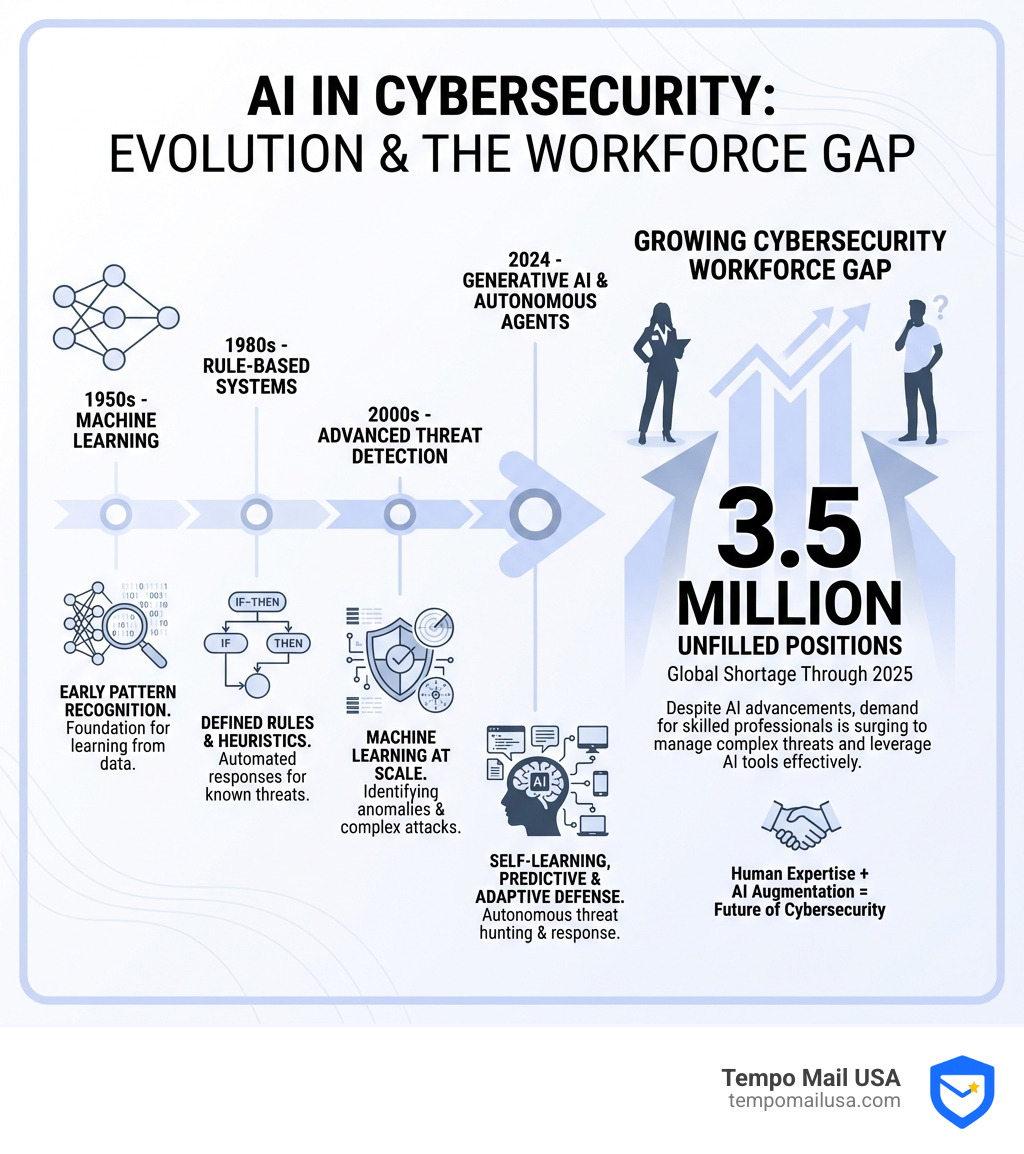
- Growing demand: Despite AI advances, there will be 3.5 million unfilled cybersecurity jobs through 2025
- Rising stakes: The cost of cybercrime is expected to reach $10.5 trillion by 2025, increasing the need for both AI tools and human expertise
The cybersecurity landscape is undergoing a massive shift. AI agents are now hacking computers at unprecedented speeds and getting better at all phases of cyberattacks faster than most of us expected. In July 2024, Ukraine's CERT finded Russian malware that used a large language model to automate cyberattack processes in real-time, generating both reconnaissance and data theft commands autonomously.
This isn't a story about machines taking over. It's about the cybersecurity profession evolving to become more strategic and impactful.
The global AI in cybersecurity market was valued at $17.4 billion in 2022. Projections suggest it could reach $102.78 billion by 2032, growing at nearly 20% per year. That's not the sound of an industry dying—it's the sound of change.
Think of it like the transition from horses to cars: transportation jobs didn't disappear, they evolved into roles like mechanics and engineers. The same is happening with AI and cybersecurity. The work is changing, but the need for skilled professionals who can think critically, solve complex problems, and make ethical decisions is only growing.
Will Cybersecurity Be Replaced by AI? The Augmentation vs. Obsolescence Debate
The question of will cybersecurity be replaced by AI is common, but the consensus is a firm "no." Instead of replacement, we're seeing a shift toward human-AI synergy. AI is here to augment our capabilities, making our roles more strategic and impactful.
The numbers support this. The global AI in cybersecurity market, valued at $17.4 billion in 2022, is projected to reach $102.78 billion by 2032, growing at a CAGR of 19.43%. This signals profound technological evolution, not a dying industry. Top organizations are already adopting AI and automation in their defense strategies, as noted by The 2023 EY Global Cybersecurity Leadership Insights Study.
Will AI completely replace human cybersecurity professionals?
AI will not completely replace human cybersecurity professionals; the future is augmentation, not obsolescence. While powerful at processing data, AI is not ready to fully replace human intervention. Humans provide critical thinking, intuition, and ethical judgment. AI lacks the ability to fully understand context, struggling with the broader implications or ethical dilemmas of its findings.
Roles will shift from repetitive tasks to strategy and oversight, with professionals becoming architects of AI-powered security systems. This human-AI collaboration will create a more robust security posture than either could achieve alone.
What specific cybersecurity tasks will AI automate?
AI's superpower is processing vast amounts of data at best speeds, making it ideal for automating routine cybersecurity tasks. We anticipate AI will increasingly take over:
- Threat Detection: Machine learning algorithms can analyze network traffic for anomalies, identifying potential threats in real-time, including zero-day attacks.
- Log Analysis: AI can tirelessly analyze vast amounts of logs and event data, flagging suspicious activity to reduce the burden on human analysts.
- Vulnerability Assessments: AI can rapidly scan systems for known vulnerabilities and misconfigurations, providing a continuous assessment of an organization's attack surface.
- Data Aggregation and Correlation: AI can collect and correlate data from disparate security tools, presenting a unified view of the threat landscape to help understand complex attack chains.
- Repetitive Tasks: Alert triaging, initial incident response steps, and other repetitive data processing can be automated, freeing up human experts.
For example, real-world automating threat detection case studies show how AI can streamline operations, drastically reducing the time required to identify and respond to threats.
Which tasks will remain human-centric?
While AI handles data processing, certain critical tasks will remain firmly in the human domain, where our cognitive abilities and strategic thinking are indispensable:
- Strategic Planning and Decision-Making: Setting cybersecurity strategy, aligning it with business goals, and making high-stakes decisions requires human judgment.
- Creative Problem-Solving: Human creativity and adaptability are crucial for novel attacks, where AI's pattern-based approach falls short.
- Ethical Decision-Making: As AI becomes more prevalent, ethical considerations are paramount. Human oversight is essential to ensure AI systems are used responsibly.
- Intent Modeling: Understanding the "why" behind an attack—the motivations of threat actors—requires a level of contextual and psychological insight that AI lacks.
- Complex Incident Response: Managing a major incident—communicating with stakeholders, making decisions under pressure, and coordinating recovery—requires human leadership.
- Hypothesis-Driven Threat Hunting: This proactive approach requires human curiosity and investigative skills to form hypotheses about potential threats and actively search for them.
AI will handle the "what" and "how quickly," while humans focus on the "why," "what next," and "what's right."
The Evolving Cyber Workforce: Skills, Gaps, and New Opportunities
The cybersecurity workforce is evolving rapidly. A persistent skills gap coexists with AI-driven changes that demand new skills and create new roles. This is an evolution, not a crisis, where adaptation is key to thriving. The information security analyst job outlook continues to show strong growth, confirming the demand for human expertise.
How will the skills required for cybersecurity jobs change in the age of AI?
To stay relevant, professionals must accept continuous learning and develop new capabilities:
- AI Literacy: Understanding AI/ML fundamentals, including how systems work and fail, is critical. LinkedIn’s report on rising skills confirms AI literacy is a top skill companies are hiring for.
- Data Science Skills: Professionals will need to understand data analysis and how to interpret AI outputs, including identifying potential biases.
- Human-AI Collaboration: Effectively working with, managing, and leveraging AI tools, including configuration and troubleshooting, will be paramount.
- Strategic Thinking and Problem-Solving: Focusing on high-level strategy and complex problem-solving as AI handles routine tasks.
- Soft Skills: Communication, adaptability, ethical reasoning, and teamwork will become even more important as these are skills AI cannot replicate.
As Solutions Review notes, "If professionals want to keep their jobs...they must equip themselves with AI-centric skills as soon as possible."

Can AI help address the cybersecurity skills gap?
Yes, AI is a force multiplier that can help address the skills gap. With 3.5 million unfilled jobs projected through 2025, AI helps by:
- Automating Entry-Level Tasks: Automating repetitive tasks frees junior analysts to tackle complex issues, accelerating their learning.
- Democratizing Tools: Simplifying complex operations, making advanced tools more accessible to organizations with limited staff.
- Upskilling Professionals: Acting as an assistant, providing real-time insights and suggesting solutions to help professionals learn on the job.
The ISC2 Cybersecurity Workforce Study on the workforce gap shows the gap between supply and demand continues to widen. AI can help bridge this by making our existing workforce more effective.
Will AI create new cybersecurity job roles, and what might they entail?
Yes, AI is creating new roles that blend cybersecurity with AI and data science expertise:
- AI Security Specialist: Secures AI systems, protects models from adversarial attacks, and ensures data integrity.
- AI Ethics Officer: Establishes and enforces ethical guidelines for AI use, ensuring fairness, transparency, and accountability.
- Cybersecurity Data Scientist: Uses data science to build and refine AI models for threat detection and response.
- AI Red Teamer: Specializes in finding vulnerabilities in AI systems by simulating sophisticated AI-powered attacks.
- ML Security Engineer: Designs and maintains machine learning models for security applications like malware detection.
- AI-Augmented Security Engineer: Optimizes and integrates AI-powered security tools into security operations.
These roles represent a shift towards more specialized positions. The Computer and Information Research Scientist roles are a good example of how AI research is driving demand for specialized expertise.
The AI Arms Race: A Double-Edged Sword for Attackers and Defenders
AI in cybersecurity is not a one-sided affair. As defenders adopt AI, so do adversaries, creating an "AI arms race." This makes the landscape more dynamic and challenging, as AI is a double-edged sword with immense benefits and significant risks.
How are cybercriminals leveraging AI to improve their attacks?
Cybercriminals are using AI to make attacks more sophisticated, scalable, and harder to detect. We're seeing AI used for:
- AI-Powered Phishing: Generative AI (LLMs) enables attackers to craft convincing, personalized phishing emails at scale, making them harder to spot. Social engineering incidents have surged by 135% since the rise of tools like ChatGPT. As Forbes warned, we must "prepare for the AI phishing onslaught."
- Deepfakes: AI generates realistic deepfakes (audio, video, images) for impersonation, disinformation, and fraud. The infamous deepfake CFO scam that stole $25 million is a stark example.
- Automated Hacking and Vulnerability Exploitation: AI agents can perform reconnaissance, identify vulnerabilities, and launch attacks at machine speed.
- Ransomware Creation: AI can help generate advanced ransomware with sophisticated evasion and anti-recovery techniques.
- Improved Social Engineering: Beyond phishing, AI helps criminals create believable personas and automate conversations for targeted campaigns.
What are the significant risks and challenges associated with using AI?
While powerful, AI integration introduces significant risks that must be addressed:
- Adversarial Attacks: Attackers can manipulate AI model inputs to cause misclassifications, like labeling malware as benign.
- Model Bias: Models trained on biased data can lead to unfair or inaccurate security decisions, potentially missing certain attacks.
- Overreliance on AI: Over-dependence on AI without sufficient human oversight can lead to complacency and leave systems vulnerable if the AI fails.
- Data Poisoning: Attackers can inject malicious data into training datasets, corrupting the AI's learning process.
- Prompt Injection: With LLMs, attackers can craft malicious prompts to bypass safety filters or trick the AI into performing unintended actions.
These risks are not theoretical. A staggering 93% of cybersecurity professionals expect AI-enabled threats to impact their organizations. The analysis of "Autonomous AI Hacking" highlights how these capabilities are changing the game.
How does the balance of power shift with the advent of AI in cybersecurity?
Historically, the advantage has often been with attackers. With AI, this dynamic is shifting profoundly.
In the short term, AI threatens to tip the scales in favor of attackers by dramatically reducing the skill, cost, and time needed to exploit flaws. This democratization of attacks means even average criminals can wield sophisticated tools. As Computerworld noted, "The AI-powered cyberattack era is here."
However, defenders are also innovating. Concepts like Continuous Find/Continuous Repair (CD/CR) point to a future of self-healing networks where AI automatically finds and patches vulnerabilities. The race is on, and defensive AI innovation is striving to catch up.
AI in Practice: Technologies, Strategies, and Ethical Guardrails
It's crucial to understand how AI is applied in practice, the strategies used, and the necessary ethical guardrails. AI's role in defense is becoming central, as outlined by Fortinet's insights.
What are the emerging AI-powered cybersecurity tools and technologies?
The market is full of innovative AI-powered tools that leverage ML, deep learning, and NLP to improve security:
- Security Automation Platforms: Integrate AI to automate tasks, orchestrate responses, and streamline workflows for greater efficiency.
- Threat Intelligence Solutions: Analyze global threat data to identify emerging attack patterns, indicators of compromise (IOCs), and TTPs at scale.
- User and Entity Behavior Analytics (UEBA): Establish baselines of normal user and device behavior, then flag deviations as potential threats to detect insider threats or compromised accounts.
- AI-Driven Anomaly Detection: Continuously monitor networks, logs, and application behavior to identify unusual activities that could indicate an attack.
- Automated Vulnerability Management: Rapidly scan code and systems for vulnerabilities, prioritize them by risk, and suggest remediation steps.
- Next-Generation Endpoint Detection and Response (EDR): Improve EDR with advanced threat hunting, behavioral analysis, and automated response on endpoints.
These technologies are changing security operations centers (SOCs) from reactive units into proactive, intelligence-driven hubs.
What is the impact of AI on data privacy and security?
AI has a dual impact on data privacy and security, offering powerful tools while also introducing new privacy risks.
For data security, AI can bolster defenses by:
- Enhancing PII protection: Improves PII protection by identifying and classifying sensitive data across vast datasets for proper governance.
- Implementing Zero-Trust Principles: Continuously verifies user and device identities and enforces least privilege access, which is crucial for a zero-trust architecture.
- Improving Data Governance: Helps automate compliance checks and enforce data handling policies in complex regulatory environments.
However, AI also presents privacy risks:
- Training Data Risks: Training data for AI models can contain sensitive PII, which could be exposed if not properly secured.
- Adversarial Machine Learning: Attackers can exploit AI models to extract sensitive information from training data or cause misclassifications, leading to privacy breaches.
- Identity Proxying Challenges: Verifying identity is harder with AI-generated deepfakes and social engineering. This is where services like TempoMail USA become critical. We provide secure email aliases that act as a 'firewall' for your PII, hiding your real email and personal data from AI-powered phishing, spam, and data harvesting. This approach helps maintain your privacy in an age of convincing AI-generated content.
As AI models become more sophisticated, even generating text like our LLM text generator can do, the line between authentic and fabricated content blurs, making robust identity protection vital.
What ethical considerations arise from the increasing use of AI in cybersecurity?
The use of AI in cybersecurity raises critical ethical considerations that must be addressed:
- Algorithmic Bias: Models trained on biased data can lead to discriminatory security decisions, eroding trust and providing unequal protection.
- Autonomous Weapons and Actions: Fully autonomous AI actions raise accountability concerns, especially regarding unintended consequences and determining responsibility for errors.
- Accountability: Determining legal and ethical accountability for actions taken by AI systems is complex. Clear frameworks are needed.
- Transparency and Explainability: Many AI models are "black boxes," making it hard to understand their decisions. This lack of transparency hinders auditing and trust.
- Overreliance on AI: Over-dependence can degrade critical human skills, leaving us vulnerable when AI systems fail.
- Data Poisoning and Integrity: Deliberate manipulation of training data can corrupt AI models, leading to erroneous and unethical security decisions.
Addressing these concerns requires robust governance and continuous dialogue. The CISA's Roadmap for AI is one example of efforts to guide the responsible deployment of AI in critical sectors.
Frequently Asked Questions about AI Replacing Cybersecurity
What's the final verdict on will cybersecurity be replaced by AI?
The final verdict is that AI will not replace cybersecurity professionals but will transform their roles. AI is a powerful partner, not a replacement, enabling work at unprecedented scale and speed. Human oversight, strategy, ethics, and creative problem-solving remain critical. The focus shifts from manual tasks to managing AI systems and tackling novel threats that require human ingenuity. Professionals will become strategists who leverage AI as a key ally.
As a professional, how can I prepare for an AI-driven future?
To prepare, focus on embracing opportunity rather than fearing displacement. Key strategies include:
- Accept Continuous Learning: Stay updated on the latest AI advancements and their security applications.
- Develop AI Literacy and Data Science Skills: Understand the basics of how AI and machine learning work and how to interpret their results.
- Focus on Uniquely Human Strengths: Cultivate skills AI cannot replicate, such as critical thinking, creativity, ethical reasoning, and communication.
- Learn Human-AI Collaboration: Become proficient in working with and managing AI-powered systems.
- Specialize: Consider specializing in areas like AI security, AI ethics, or advanced threat hunting.
As emphasized in our research, "Professionals must equip themselves with AI-centric skills" to thrive in this new era.
Is AI more of a threat or a tool for cybersecurity?
AI is both a threat and a tool. This dual nature defines the current landscape.
As a threat, it fuels an arms race, allowing criminals to create more sophisticated attacks at scale. We face more intelligent and persistent adversaries.
As a tool, AI empowers defenders with faster, smarter, and more proactive defenses. It's a force multiplier for processing data, detecting anomalies, and automating responses.
The key is ensuring defensive innovation outpaces malicious use through continuous adaptation, investment in AI defenses, and robust human oversight.
Conclusion
The answer to will cybersecurity be replaced by AI is clear: AI is not a harbinger of job displacement but a catalyst for change. We are witnessing an evolution towards human-AI synergy, where technology augments our capabilities, freeing us to focus on strategy and ethics.
This collaborative future promises a more resilient security posture. While AI automates tasks and improves response times, human ingenuity and critical judgment remain irreplaceable. New roles are emerging, and the demand for skilled professionals who can steer this AI-driven landscape is growing.
As the AI arms race intensifies, our collective challenge is to ensure that defensive innovation leads, building robust systems and ethical frameworks to harness AI's potential while mitigating its risks. The future of cybersecurity is not about AI replacing us; it's about us evolving alongside AI to create a safer digital world.
In this rapidly changing environment, protecting your digital identity is more crucial than ever. Our services at TempoMail USA offer a vital layer of defense, providing secure email aliases that act as a "firewall" for your PII, safeguarding you against the sophisticated, AI-powered threats of today and tomorrow.
Protect your digital identity in the age of AI. Register for a secure alias today.