

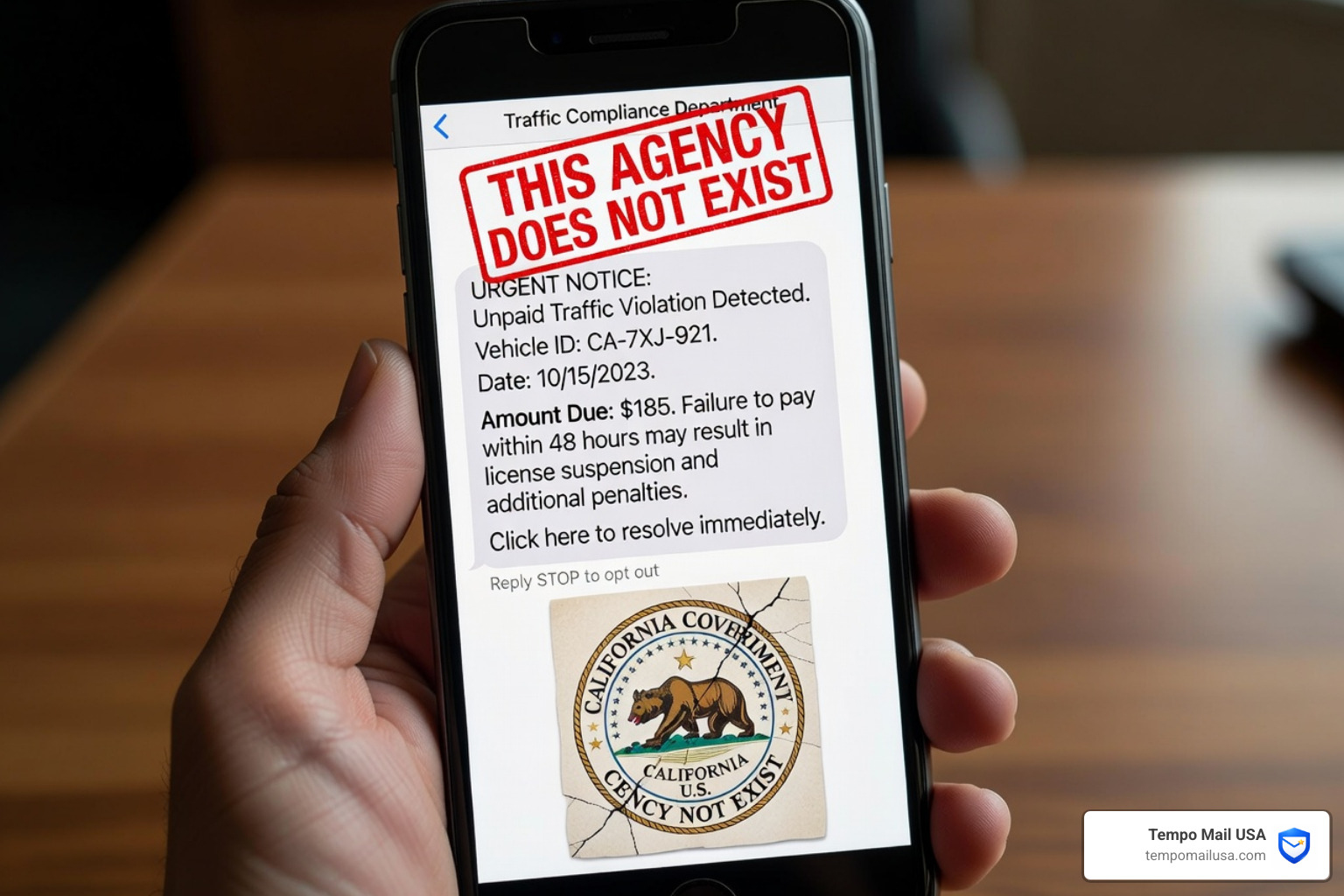

The Unpaid Traffic Violation Text Scam Is Spreading Fast — Here's What You Need to Know
The unpaid traffic violation text scam is a phishing scheme where criminals send fake text messages pretending to be your state's Department of Motor Vehicles (DMV), claiming you owe money on an unpaid traffic ticket.
Quick answer: These texts are scams. No state DMV will contact you by unsolicited text to demand payment for a traffic violation. Delete the message and do not click any links.
Here's a fast summary of what you need to know:
- What it is: A fake text (also called "smishing") impersonating your state DMV
- What it claims: You have an unpaid traffic citation and must pay immediately
- What it threatens: License suspension, registration holds, extra fees, and even prosecution
- What it really wants: Your credit card details and personal information
- What you should do: Delete it, do not click the link, and verify directly with your real DMV
These scam texts have already triggered official warnings from DMVs and government agencies in New Jersey, Idaho, Hawaii, Georgia, Connecticut, New Hampshire, Florida, and Arizona — and the list keeps growing. The Federal Trade Commission (FTC) has also issued a national consumer alert about the trend.
The scam works because it hits a nerve. Most people have driven through an intersection camera or forgotten a minor ticket. That small seed of doubt is exactly what scammers are counting on.
As the FTC put it, scammers have been running unpaid toll text scams for a while — and now they've expanded the playbook to impersonate DMV agencies across the country.
Understanding the Unpaid Traffic Violation Text Scam
To protect ourselves, we first need to understand the mechanics of the "smishing" (SMS phishing) attack. This isn't just a random annoying text; it is a calculated psychological operation designed to bypass your natural skepticism. By impersonating a government authority like the DMV or a state court, scammers exploit our instinct to comply with the law and avoid penalties.
When you receive an unpaid traffic violation text scam, the message usually arrives from a standard 10-digit phone number or a short code. It uses official-sounding language to create a "fear-based urgency loop." You are told that a violation exists, a deadline is looming, and severe consequences are imminent if you don't act now.
The goal is to get you to click a link that leads to a fake payment portal. These portals are often carbon copies of legitimate government websites, featuring state seals, professional layouts, and even "secure" SSL certificates to trick you into lowering your guard. Understanding What is a Phishing Scam? Protect Yourself is the first step in recognizing that these digital traps are everywhere.
According to the FTC, That text about an overdue traffic ticket is probably a scam. They've noted that scammers are moving beyond simple toll road scams and are now targeting specific state DMV identities to make their lures more convincing.
Common Wording Used in an Unpaid Traffic Violation Text Scam
Scammers use a specific vocabulary to trigger panic. If you see these phrases in a text message, your "scam radar" should be ringing at full volume:
- "Final Notice:" Even if you've never received a first notice, they use this to make you feel like you're out of time.
- "License Suspension:" A terrifying threat for anyone who relies on their car for work or family.
- "35% service fee:" Scammers often claim that if you don't pay the "small" fine now, a massive collection fee will be added.
- "Registration hold:" They threaten to prevent you from renewing your tags, making your vehicle illegal to drive.
- "Action required by [Date]:" Setting a hard deadline (usually within 24 to 48 hours) forces you to make a snap decision without verifying the facts.
How to Spot an Unpaid Traffic Violation Text Scam Red Flag
Even the most sophisticated scams have "tells." We’ve identified several red flags that can help you debunk a fraudulent message in seconds:
- Non-.gov URLs: Official state websites almost always end in
.gov. If the link in the text is something likedmv-payment-notice.comorstate-citations.org, it’s a fake. - Generic Case Numbers: Real citations have specific, verifiable numbers. Scam texts often use generic strings or no case number at all until you click the link.
- QR Codes: Some newer versions of this scam include a QR code. Government agencies rarely, if ever, send unsolicited QR codes via text for debt collection.
- Urgent Deadlines: Legitimate legal processes move slowly. If a text demands payment "within the hour" to avoid arrest or suspension, it's likely a scam.
Learning How to Protect Yourself: How to Avoid Phishing involves looking at the sender's details. If the area code doesn't match your state, or if the language is riddled with slight grammatical errors, treat it as hostile.
How the Phishing Scheme Works Step-by-Step
Scammers don't just target you; they target everyone. They use "bulk SMS" tools to send out thousands of messages simultaneously. They don't know if you actually have a car or a license; they just play the numbers game.
| Feature | Official DMV Communication | Unpaid Traffic Violation Text Scam |
|---|---|---|
| Primary Method | U.S. Postal Mail | Unsolicited Text Message |
| Link Type | Official .gov portals | Shortened or unofficial URLs |
| Payment Method | Secure portal, check, or in-person | Credit card on site, often via link |
| Urgency | Standard legal timelines | Immediate (24-48 hours) |
| Threats | Outlined by state law | Extreme (Immediate arrest/suspension) |
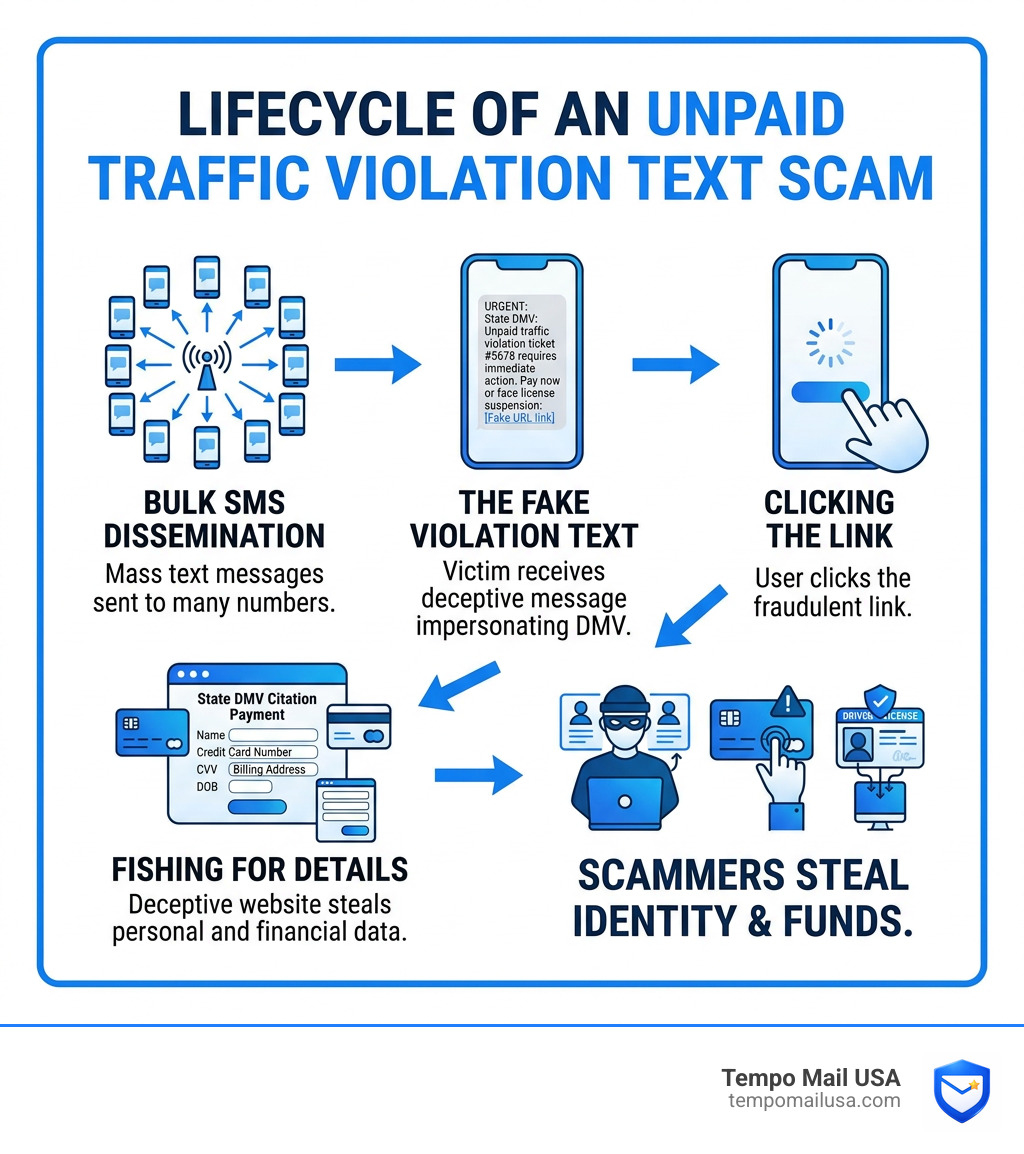
The lifecycle of the scam typically follows these steps:
- Step 1: You receive the text.
- Step 2: The "urgency" prompts you to click the link.
- Step 3: You land on a high-quality fake website.
- Step 4: You are asked to "verify" your identity by entering your name, DOB, and SSN.
- Step 5: You are presented with a "fine" (often a small amount).
- Step 6: You enter your credit card details to "settle" the matter.
The Small Payment Trap
One of the most devious parts of the unpaid traffic violation text scam is the amount they ask for. Instead of demanding $500, they might ask for $6.99, $9.99, or $19.95.
Why so low?
- Low-risk rationalization: You think, "It's only ten bucks, I'll just pay it to make the problem go away."
- The real prize: The scammers don't actually care about your $10. They want the credit card number, CVV, and expiration date you just typed into their form. Once they have that, they can sell your data on the dark web or sign you up for expensive recurring monthly "memberships" that are hard to cancel.
Post-Click Consequences
Clicking the link is dangerous, but entering data is disastrous. If you fall for the trap, the consequences go far beyond a small fraudulent charge:
- PII Collection: By providing your name and address, you've helped them build a profile for identity theft.
- Identity Fraud: If you provided a Social Security Number or Driver's License number, they can open lines of credit in your name.
- Secondary Scams: Once scammers know you are "responsive" to texts, they will target you with even more aggressive scams (like fake bank alerts or "unclaimed package" texts).
- Malware Risks: Sometimes, simply clicking the link can trigger a "drive-by download" that installs tracking software on your phone.
We highly recommend reading DMV Text Scam 2026: Do Not Click That Link Until You Read This for a deeper look at the technical risks involved.
State-Specific Targets and Official Warnings
This scam is currently a national epidemic. In early 2026, several states issued urgent alerts as their residents were bombarded with these messages.
- Idaho: The Idaho Transportation Department (ITD) warned that messages regarding citations and registrations were circulating statewide and were not connected to official services.
- New Jersey: The NJ MVC had to post a customer advisory after residents reported receiving texts citing specific state statutes (N.J.S.A. Title 39) to sound more legitimate.
- Hawaii: The Hawaiʻi State Judiciary clarified that they only use U.S. Mail for citation notices.
- Georgia: The Department of Driver Services (DDS) identified texts claiming license suspensions due to unpaid tickets and urged drivers to use their official online portal instead.
- New Hampshire: Residents received texts on March 7, 2026, that even included "dmv-nh" in the fake URL to trick local drivers.
Regional Variations of the Scam
While the core of the unpaid traffic violation text scam remains the same, scammers often "localize" the bait. For example:
- In Florida, the texts often mention "registration holds," a common pain point for Sunshine State drivers. See FLHSMV Scam Text: What Florida Drivers Must Know.
- In Georgia, the focus is often on immediate "license suspension." Check out Beware of Georgia DMV Scam Texts Targeting Drivers.
- Other variations have been spotted in Utah Louisiana DMV Scam Text: Do Not Click.
How to Safely Verify and Report Fraudulent Citations
If you receive a text and you're genuinely worried you might have a ticket, do not use the link in the message. Instead, use these "safe" verification methods:
- Official Portals: Manually type the address of your state's DMV or court system into your browser. Look for the
.govextension. - eCourt Kokua (Hawaii): Residents can search by name or license plate on the official judiciary site to find real citations.
- DDS Online Services (Georgia): Drivers can log into their secure accounts to check their driving history and any pending violations.
- Check the Mail: Real tickets for camera violations or unpaid fines are sent via the U.S. Postal Service, not SMS.
If you know it's a scam, report it immediately to ReportFraud.ftc.gov. This helps the government track the infrastructure scammers are using and shut down their fake websites.
Immediate Steps for Victims
If you've already entered your information or paid the "fine," don't panic—act quickly:
- Contact your card issuer: Call the number on the back of your card. Tell them you entered your details on a fraudulent site. They will likely cancel your card and issue a new one.
- Dispute charges: If you see any unauthorized transactions (even small ones), dispute them immediately.
- Fraud alerts: Place a fraud alert on your credit reports with Equifax, Experian, and TransUnion.
- Credit freeze: Consider a full credit freeze to prevent scammers from opening new accounts in your name.
- IdentityTheft.gov: If you shared your SSN, file an official report at IdentityTheft.gov.
Reporting to Authorities and Carriers
Reporting the unpaid traffic violation text scam helps protect others in your community.
- Forward to 7726: This is the universal "SPAM" reporting number for most major cell carriers. Forward the scam message to this number.
- Report Junk: Most modern smartphones have a "Report Junk" or "Block and Report" option directly in the messaging app. Use it!
- Local Police: If you actually lost money, file a non-emergency report with your local police department.
Frequently Asked Questions about DMV Text Scams
Why do government agencies never contact you via unsolicited text for payments?
Government agencies prioritize security and a "paper trail." Texting is considered an insecure channel for sensitive financial transactions. Furthermore, state agencies must follow strict notification laws, which almost always require a physical letter sent to your registered address. While some DMVs may send appointment reminders via text, they will never ask for payment or personal info through an unsolicited SMS.
What should I do if I clicked the link but did not provide any information?
If you only clicked the link but closed the page before entering data, you are likely safe from identity theft. However, the scammers now know your phone number is "active." You should:
- Clear your browser's cache and cookies.
- Scan your phone for malware using a reputable security app.
- Be extra vigilant, as you will likely receive more scam texts in the future.
How can I verify a real traffic ticket without using the link in a text?
The best way is to go directly to the source. Call your local clerk of courts or visit the official DMV website by typing the URL yourself (e.g., www.nj.gov/mvc or dds.ga.gov). Most states have a "Search for Citations" feature where you can enter your driver's license number or license plate to see any outstanding issues.
Conclusion
The unpaid traffic violation text scam is a reminder of how aggressive digital criminals have become. They rely on the fact that our phones are always in our hands and that a "DMV notice" carries enough weight to make us act before we think.
At Tempo Mail USA, we believe the best defense is a strong privacy firewall. By using temporary email aliases and being cautious with your personal data, you can significantly reduce your "digital footprint" and make it harder for scammers to find you in the first place. Protecting your PII (Personally Identifiable Information) is no longer optional—it's a necessity in 2026.
Stay safe, stay skeptical, and remember: if the DMV wants your money, they'll send you a letter, not a text. For more tips on keeping your digital life clean, check out our guide on the Best way to stop spam calls.