


The SCLA Honor Society Scam Question Every Student Is Asking
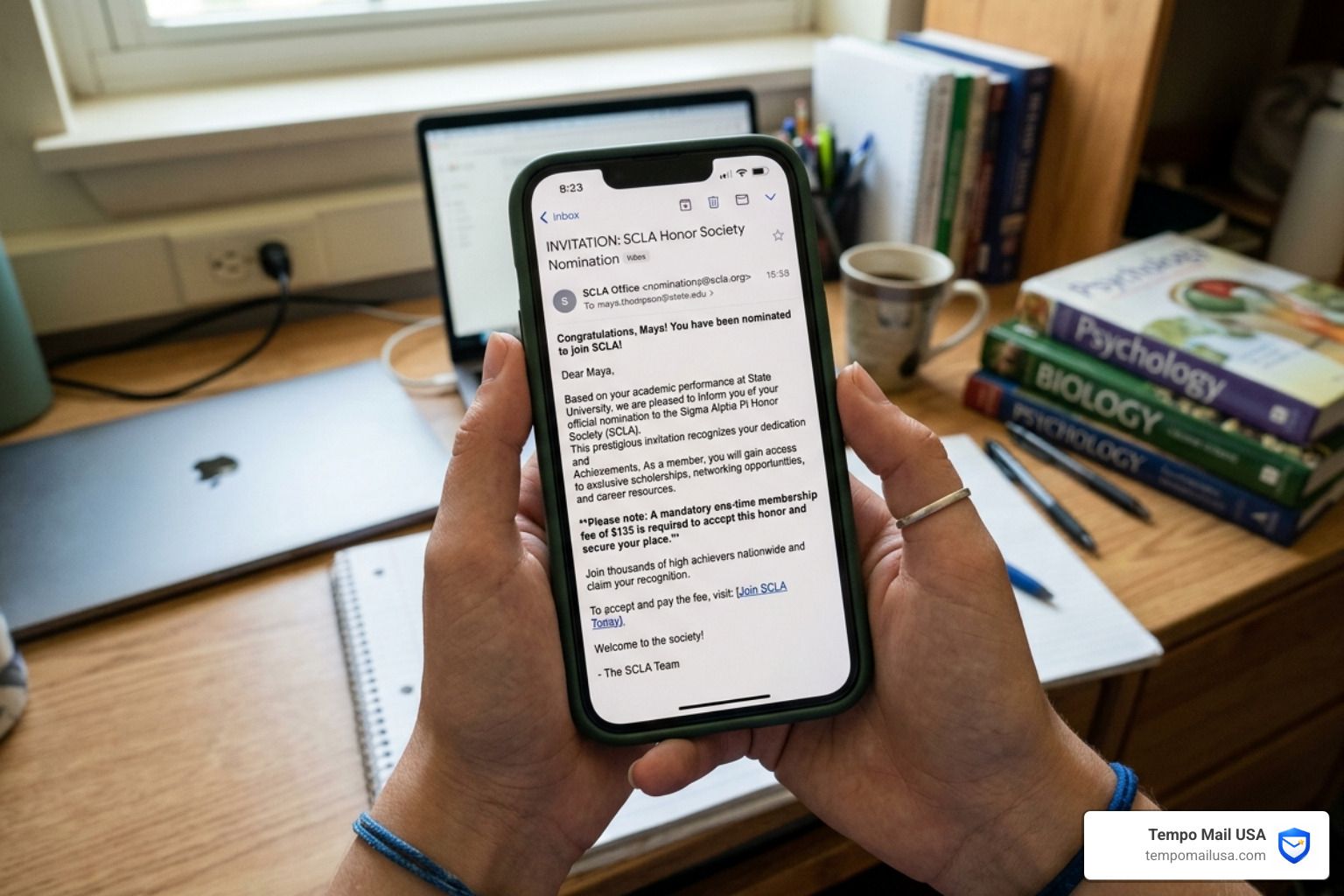
The scla honor society scam debate is one of the most searched topics among college students who suddenly receive a "nomination" email from an organization they've never heard of — asking for $95 within 72 hours.
Here's the short answer:
SCLA is a legally registered business — but it is NOT accredited by the Association of College Honor Societies (ACHS), uses high-pressure marketing tactics, and has generated multiple complaints about unfulfilled promises and refund difficulties.
Quick verdict at a glance:
| Question | Answer |
|---|---|
| Is SCLA a real organization? | Yes, legally registered in Tysons, VA |
| Is SCLA accredited by ACHS? | No |
| Is the $95 fee required? | Yes, one-time lifetime fee |
| Are invitations merit-based? | Not always — students with low GPAs report receiving them |
| Is it worth it? | Debated — many members report poor value |
| Is it an outright scam? | Not legally, but practices raise serious red flags |
So if you got an unsolicited email with a ticking deadline, you were right to be suspicious.
And if you used your real email address to open that link — your personal information may already be exposed.
Beyond the honor society debate, the SCLA invitation model is a textbook example of how your student email ends up on targeted marketing lists. In 2026, with data privacy concerns at an all-time high, knowing how organizations obtain your contact details is just as important as knowing whether the organization itself is legitimate.
This guide breaks down everything: what SCLA actually is, what you get for $95, what real members say, and how to protect your inbox and personal data from similar solicitations.
Is the SCLA Honor Society Scam Real? Legitimacy vs. Prestige
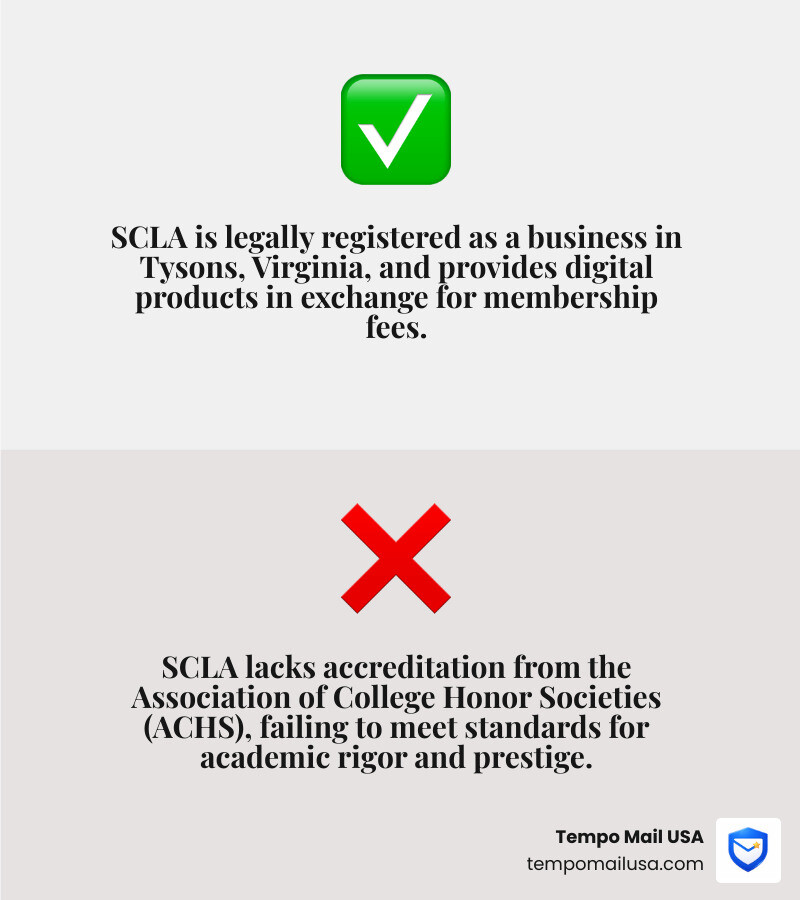
When we talk about whether something is a "scam," we have to look at the legal definition versus the academic reality. In the eyes of the law, the Society for Collegiate Leadership & Achievement (SCLA) is a legitimate business. They are registered in Tysons, Virginia, and they do provide digital products in exchange for your money. However, in the academic world, "legitimate" is often synonymous with "prestigious" and "accredited." This is where the scla honor society scam concerns begin to take root.
The gold standard for honor societies is the Association of College Honor Societies (ACHS). This body sets strict standards for governance, financial transparency, and, most importantly, academic rigor. SCLA is notably not accredited by the ACHS. While SCLA claims to have over 100,000 members across 850+ campuses, many academics view it as a "pay-to-play" model.
In a pay-to-play model, the primary barrier to entry isn't necessarily your 4.0 GPA; it’s your ability to pay the $95 membership fee. While they state they require a 3.0 GPA for undergraduates and 3.4 for graduate students, students across the country have reported receiving invitations despite having much lower grades. This suggests that the "selection process" might be more of a wide-net marketing strategy than a merit-based honor.
To help you understand the difference, we’ve put together a comparison of what a 2026 student should expect from a truly prestigious society versus the SCLA model.
| Feature | ACHS-Accredited Societies (e.g., Phi Beta Kappa) | SCLA Honor Society |
|---|---|---|
| Accreditation | Certified by ACHS | None |
| Campus Presence | Mandatory local chapters & faculty advisors | Often online-only; many campuses disavow them |
| Selection Rigor | Top 10% of class; strictly vetted | Broad marketing; frequent "nominations" |
| Primary Goal | Academic recognition and service | Career tools and digital certifications |
| Marketing | Formal invitation via university registrar | Unsolicited emails with high-pressure deadlines |
If you're wondering Is The Society For Collegiate Leadership & Achievement Legitimate or Just a Scam?, the answer depends on what you value. If you want a line on your resume that academics respect, SCLA may fall short. If you want access to a digital job board and don't mind the $95 entry fee, you might see it differently—but the "honor" part of the title remains a point of heavy contention.

Red Flags and Marketing Tactics
The most common way students encounter the scla honor society scam is through their inbox. You’re sitting in the library, probably stressed about finals, and suddenly a "Nomination Notice" pops up. It looks official. It uses your university’s name. But if you look closer, the red flags start waving.
The biggest red flag is how they got your information. SCLA often uses "student directory information" to harvest emails. Under the Family Educational Rights and Privacy Act (FERPA), schools can share "directory information" (like your name and email) unless you specifically opt out. SCLA takes advantage of this to send thousands of unsolicited emails.
This type of data harvesting is exactly why we recommend using a "PII firewall." When you give your real, primary email to every campus club or "opportunity" that asks, you increase your risk of your data being sold or leaked. If you're worried about your digital footprint, you should check Is My Email On The Dark Web Check For Free to see if your student data has already been compromised.
Furthermore, these emails often look suspiciously like phishing attempts. While SCLA is a real company, their tactics mirror those of bad actors. You can learn more about identifying these risks in our guide on What Is A Phishing Scam Protect Yourself.
High-Pressure Tactics and the SCLA Honor Society Scam
One of the most criticized aspects of SCLA is their use of a 72-hour signup deadline. This is a classic "scarcity" tactic used in high-pressure sales. Legitimate academic honors don't expire in three days. If you were truly nominated for your lifetime of hard work, that honor wouldn't vanish because you didn't check your email on a Tuesday.
This specific tactic led to a major controversy at Calhoun Community College. The college president, Dr. Jim Klauber, was so concerned by the emails his students were receiving that he issued a public warning. He noted that he knew of "no legitimate honors society that gives a 72-hour deadline." He even went as far as to refer the matter to the U.S. Attorney’s office for review of potential federal consumer law violations. You can read more about this incident in the report on Honor society offer sparks concern at Calhoun Community College.
By forcing students to make a quick decision, SCLA prevents them from doing exactly what you are doing right now: researching the organization's value. This is a significant part of the scla honor society scam narrative. Using a temporary email alias for these types of "offers" is the Best Way To Protect Against Identity Theft, as it keeps your real identity shielded while you investigate the claims.
Lack of Campus Affiliation and Recognition
Another major red flag is the lack of a physical presence on campus. Most legitimate honor societies have an office, a faculty advisor, and regular meetings. SCLA is primarily an online organization.
Many universities have had to issue statements clarifying that they are not affiliated with SCLA. Because SCLA uses the university's name in the email (e.g., "The University of [State] Chapter"), students assume it’s an official school endorsement. In reality, SCLA is often an "independent organization" with no formal ties to the university administration.
Before you pay any fee, we always suggest visiting your University Registrar or the Office of Student Affairs. Ask them directly: "Is this society recognized by the school?" If the answer is no, that $95 is likely better spent on textbooks—or pizza. If you feel you've been misled by these affiliation claims, you should know How To Report Identity Theft To The Ftc or report the organization for deceptive marketing.
Membership Fees and Promised Benefits
SCLA charges a one-time lifetime membership fee of $95. In their SCLA FAQ | Membership, Benefits & How to Join, they justify this cost by promising a suite of "exclusive" benefits. But in 2026, many of these benefits are things you can actually get for free elsewhere.
The primary benefits promised include:
- A Scholarship Database: They claim access to over 28,000 opportunities.
- Career Readiness Course: A 3-credit accredited course (though you should check if your specific school actually accepts these credits).
- AI Career Hub: Tools for resume building and networking.
- Certifications: Credentials from partners like Microsoft and Google.
- Honor Cords: The ability to buy (yes, buy) cords for graduation.
While these sound great on paper, the scla honor society scam complaints often center on the actual quality of these tools. For example, many of the "28,000 scholarships" are public scholarships that anyone can find with a simple Google search. You don't need to pay $95 to access a list of scholarships that are already public.
When it comes to protecting your finances and identity while navigating these "membership" sites, it’s worth looking into the Best Identity Theft Protection Usa Top Services Compared to ensure your payment info doesn't end up in the wrong hands.
The Reality of SCLA Career Tools and Scholarships
Let’s look at the "Career Hub." In 2026, AI-powered networking is everywhere. SCLA promises a platform that connects you with hiring managers. However, multiple reviews on the Better Business Bureau (BBB) and other sites suggest that the job boards are often outdated or simply aggregate listings from free sites like LinkedIn or Indeed.
One reviewer noted, "I was scammed into thinking that I would receive opportunities in job postings, but it was nothing helpful and outdated." This is a common sentiment. While they do offer a letter of recommendation upon completion of their program, a letter from an automated system or a corporate office in Virginia rarely carries the same weight as a letter from a professor who actually knows your work.
If you are considering joining for the academic credentials, read the SCLA Rating, Review and Requirements. Is it worth it? carefully. You might find that the "accredited" certifications are the same ones available through Coursera or LinkedIn Learning, often at a lower cost or even free through your university’s library.
Resume Value and Member Feedback
Does SCLA look good on a resume? This is the $95 question. Some proponents argue that it shows "initiative" and a "commitment to leadership." They claim it provides a "finished" look to a resume.
However, many career experts disagree. Because SCLA is known as a pay-to-play organization, savvy recruiters may see it as a sign that a student is easily swayed by marketing rather than a sign of true academic excellence. In contrast, seeing "Phi Beta Kappa" or a discipline-specific society (like Tau Beta Pi for engineering) tells a recruiter exactly where you stood in your class.
The SCLA – Accredited Collegiate Leadership Honor Society - 164 Reviews page shows a 4.5-star rating, but you have to look at the content of the reviews. Many of the 5-star reviews are brief and generic, while the 1-star reviews are detailed accounts of students trying to get their money back.
Member Reviews and the SCLA Honor Society Scam Reality
The most damning evidence in the scla honor society scam discussion is the pattern of complaints regarding refunds. SCLA has multiple BBB complaints from students who realized there was no active chapter on their campus and tried to get their money back, only to be met with silence or "no-refund" policies.
If you find yourself in a position where you feel a company has used deceptive tactics to take your money, you should follow the How To Report Phishing Email In Usa Ftc Fbi Gmail Steps to alert the proper authorities. Reporting these incidents helps protect other students from falling for the same high-pressure deadlines.
We’ve analyzed the feedback, and here are the most common themes:
- Confusion over affiliation: Students thought the school was "nominating" them.
- Difficulty with refunds: Once the $95 is gone, it’s very hard to get back.
- Lack of local activity: Many students join expecting meetings and networking, only to find a stagnant online portal.
- Low utility: The "exclusive" jobs and scholarships didn't provide any value beyond what was already free online.
Frequently Asked Questions about SCLA
Can I get a refund from SCLA if I am dissatisfied?
Technically, SCLA has a refund policy, but executing it is notoriously difficult. Many students report that their emails go unanswered once the payment has been processed. If you are unhappy, we recommend contacting your bank immediately to dispute the charge as "services not as described," especially if you were led to believe the organization was officially affiliated with your university.
Why did I receive an invitation if my GPA is below 3.0?
This is one of the biggest "gotchas" of the scla honor society scam. SCLA often uses broad marketing lists. If your GPA is below their stated minimum and you still got a "nomination," it’s a clear sign that the invitation was part of a mass-marketing campaign, not a merit-based selection. They likely bought your email address from a third-party data broker or harvested it from a public directory.
Is SCLA membership worth the $95 fee for my career?
For most students in 2026, the answer is likely no. The $95 is essentially a fee for access to a digital platform of tools that are largely available for free elsewhere. Your GPA, your internships, and your actual campus leadership roles will carry far more weight with employers than a membership you bought online.
Conclusion
So, is it the scla honor society scam or just a savvy business with aggressive marketing? The truth lies somewhere in the middle. While SCLA isn't a "scam" in the sense that they will steal your credit card number and disappear, they do use deceptive, high-pressure tactics to sell a product of questionable academic value.
In the modern academic landscape, your "Digital Hygiene" is your best defense. These invitations thrive because students use their primary email addresses for everything, making them easy targets for data harvesters. By the time you realize an offer is "pay-to-play," your PII (Personally Identifiable Information) is already in their database.
The best way to handle an SCLA "nomination" is with a healthy dose of skepticism. Do your due diligence:
- Check with your university’s student affairs office.
- Search for an ACHS accreditation.
- Ignore "deadlines" that feel like a sales pitch.
- Use a PII firewall to keep your real identity safe.
At Tempo Mail USA, we believe you should be in control of who has your data. Using a temporary email alias for initial signups and inquiries ensures that if an organization turns out to be a gimmick, your real inbox remains clean and your identity stays protected.
Protect your identity from spam and scams by using a secure alias today. Don't let a "72-hour deadline" pressure you into a $95 mistake. Your hard-earned academic success deserves a real honor, not a paid subscription.