



Why the Best Way to Protect Against Identity Theft Starts Before You Become a Victim
The best way to protect against identity theft is to use a layered defense — combining email aliases, credit freezes, strong passwords, multi-factor authentication, and regular account monitoring — before a thief ever gets a chance to act.
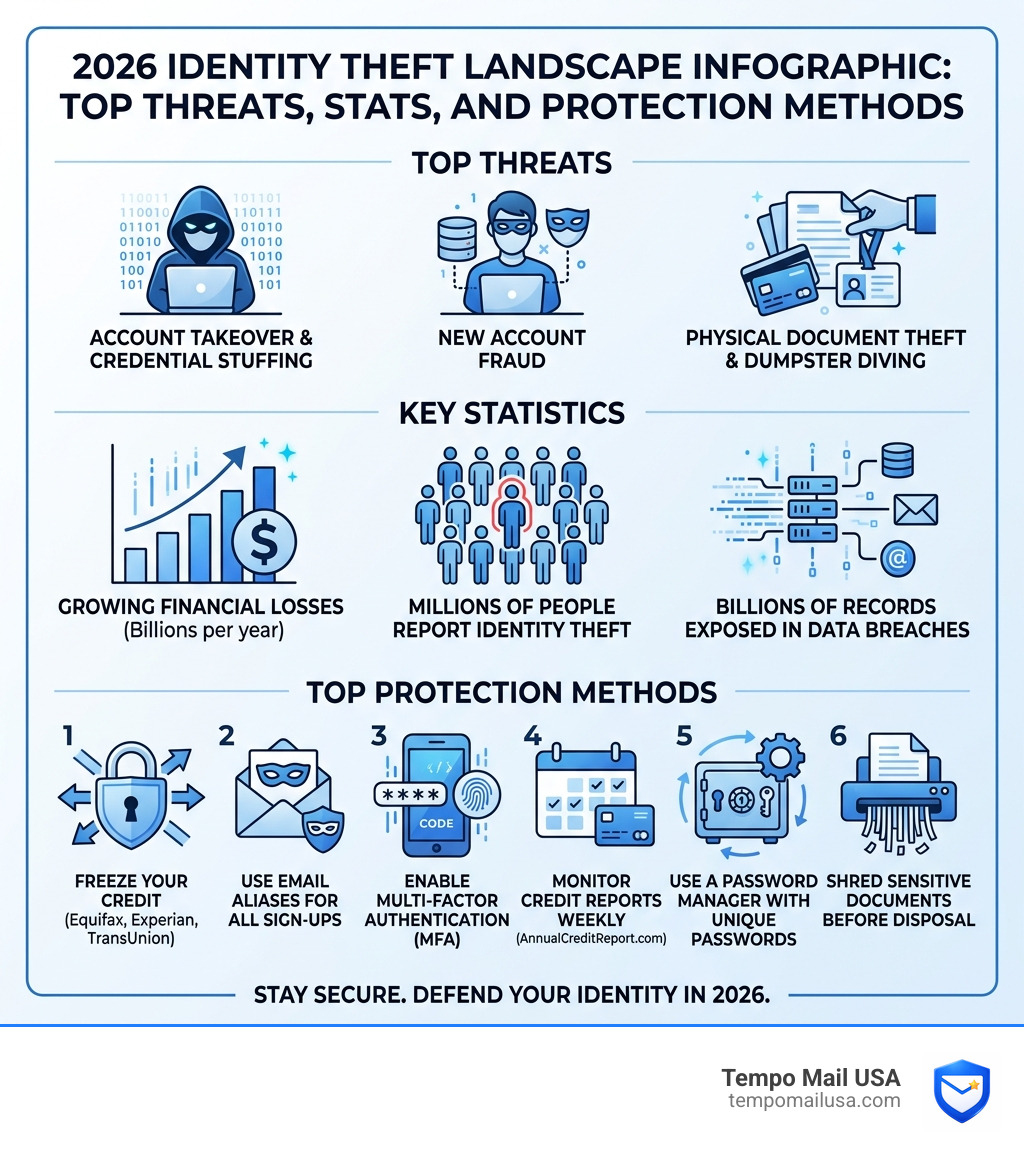
Quick answer: Top identity protection methods ranked:
- Freeze your credit at all three bureaus (Equifax, Experian, TransUnion) — blocks new accounts from being opened in your name
- Use email aliases for every online sign-up — keeps your real email off breach lists
- Enable multi-factor authentication on all accounts — stops 99% of unauthorized logins
- Monitor credit reports weekly at AnnualCreditReport.com — catches fraud early
- Use a password manager with unique passwords per site — eliminates credential stuffing risk
- Shred sensitive documents before disposal — closes the physical theft loop
- Place a fraud alert when you suspect compromise — forces creditors to verify identity
Here's the uncomfortable truth: identity theft isn't a distant risk. Last year, more than one million people reported identity theft to the FTC. And that's just those who reported it.
The real scale is larger. In 2024 alone, over 3,000 data breaches exposed billions of records. Your email address was almost certainly in some of them. Once it's out there, it gets used — for phishing, credential stuffing, account takeovers, and fraud that can drain your bank account, wreck your credit, and block your access to health benefits or tax refunds.
The damage isn't just financial. Victims describe spending months — sometimes years — fighting to reclaim their identity. One FTC account describes a victim who suffered a heart attack from the stress of fighting fraud across banks, credit cards, and government agencies simultaneously.
The good news? Most identity theft is preventable. Not with one magic tool, but with a set of smart, layered habits that make you a much harder target.
This guide walks through the best identity protection services and strategies available in April 2026 — so you can build that defense before you need it.
The State of Identity Fraud in April 2026
As we navigate through April 2026, the landscape of digital crime has become increasingly sophisticated. According to recent FTC reports, identity theft remains a top concern for millions of households. The sheer volume of data circulating on the dark web is staggering; Google dark web report essential findings you must know reveals that billions of records are currently available for purchase by bad actors.
The financial impact is equally sobering. Americans lost $43 billion to identity theft in the most recent reporting period, highlighting that this isn't just a "tech problem"—it's a massive drain on personal wealth. Furthermore, the average data breach now costs organizations roughly $4.88 million. These costs are often passed down to us as consumers, but the personal cost of having your credentials stolen is far more direct. Over 80% of breaches involve stolen credentials, and in nearly every case, an email address is the first piece of data exposed. For more official insights, you can visit Identity Theft and Online Security | Consumer Advice .
Common Warning Signs of Compromise
Detecting identity theft early is the difference between a minor headache and a multi-year financial disaster. We recommend watching for these "red flags" as outlined by Identity Theft: Protect Yourself | consumer.gov :
- Unrecognized Bills: Receiving a bill for a credit card, medical service, or utility you never signed up for.
- Credit Denial: Being denied credit or a loan despite having a historically strong credit score.
- Collection Notices: Getting calls or letters from debt collectors regarding debts you don't recognize.
- Account Anomalies: Seeing small "test" charges on your bank statement (thieves often do this to see if a card is active before making a large purchase).
- Missing Mail: If your regular bills or bank statements stop arriving, a thief may have filed a fraudulent change-of-address form.
The Best Way to Protect Against Identity Theft: A Multi-Layered Defense
We believe the best way to protect against identity theft is to build a "PII Firewall" around your life. PII stands for Personally Identifiable Information—things like your SSN, birth date, and home address. Once this data is out there, it’s nearly impossible to "un-ring" the bell.
A proactive defense starts with physical habits. Even in 2026, "dumpster diving" remains a viable tactic for low-tech thieves. Always use a cross-cut shredder for any documents containing account numbers or your name. To take it a step further, you should learn how to remove personal info from the internet to reduce the "attack surface" available to digital scammers.
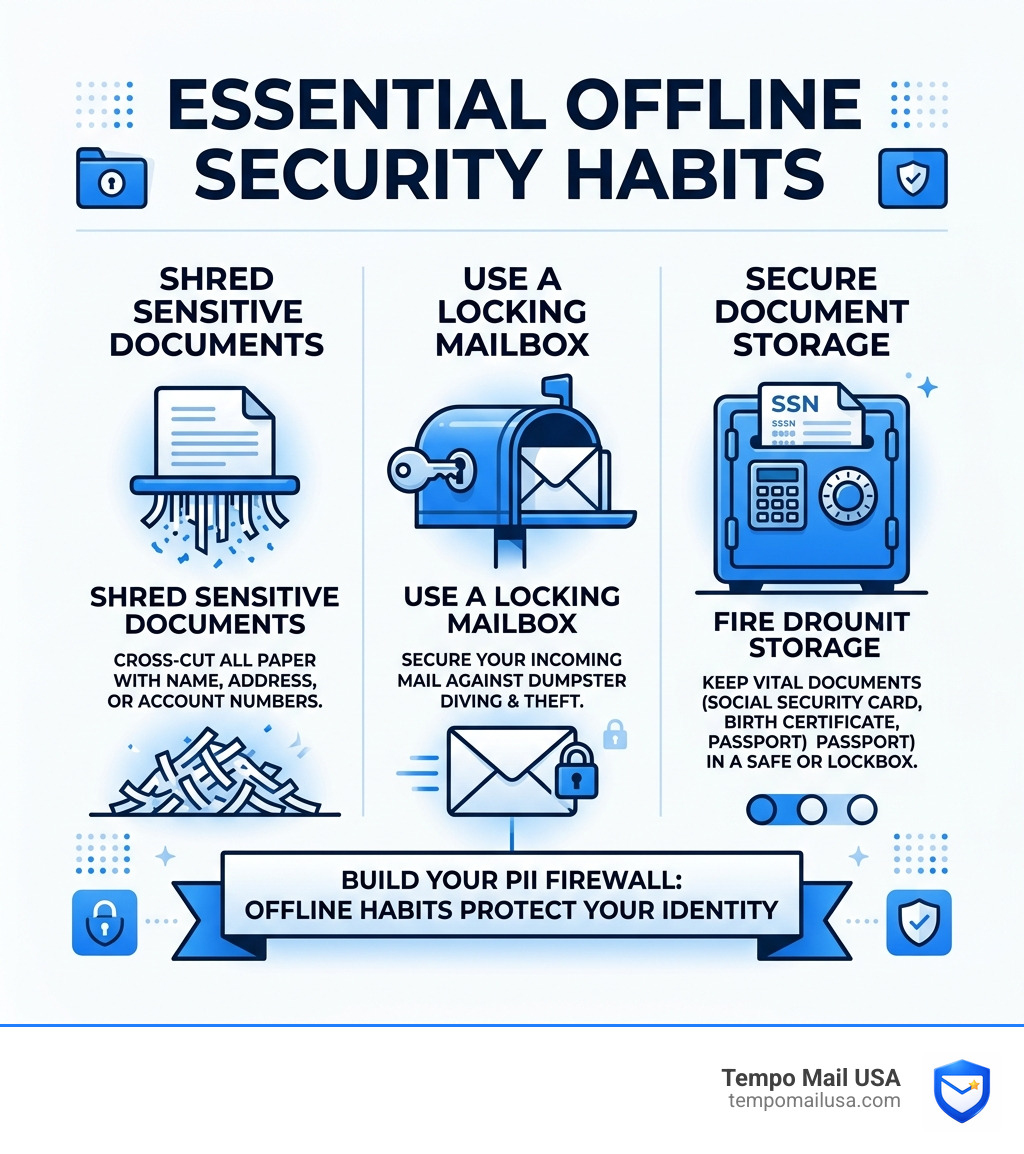
Beyond physical security, we must protect personal information online by questioning every request for our data. Before giving out your Social Security Number, ask: Why do you need it? How will you protect it? What happens if I don't provide it? Often, providing the last four digits or an alternative ID is sufficient.
Why Email Aliases are the Best Way to Protect Against Identity Theft
At Tempo Mail USA, we advocate for "credential masking" as a primary defense. When you use your real email address to sign up for every newsletter, shop, or forum, you are creating thousands of points of failure. If just one of those companies is breached, your real email is now linked to your password and other personal details on the dark web.
By using free private email services to create aliases, you create a "firewall." Each service gets a unique, temporary address. If "Service A" gets hacked, you simply delete that alias. The thief never gets your real email address, and they can't use that credential to try and log into your bank or primary accounts. This "breach isolation" is arguably the most effective way to stop phishing and credential stuffing before they start.
Safeguarding Vulnerable Groups: Children and Seniors
Identity theft doesn't just target those with high credit limits. Children and seniors are often preferred targets because their credit is rarely monitored. Foster youth are at particularly high risk due to frequent moves and multiple people having access to their records.
For children, identity theft might go undetected for a decade until they apply for their first student loan or apartment. We recommend checking if your child has a credit report; if they do (and they shouldn't), it's a sign of fraud. For seniors, medical identity theft is a growing concern where thieves use stolen Medicare numbers to receive treatments or file fraudulent insurance claims. You can find specific resources for these groups at Identity Theft | Consumer Advice .
Digital Fortification: Advanced Malware Protection and Secure VPNs
Your devices are the gateways to your identity. If a hacker gains access to your smartphone or laptop, they have the "keys to the kingdom." Following 10 proven security tips to protect identity online is essential.
One of the biggest risks remains public Wi-Fi. Whether you are at a coffee shop or an airport, these networks are often unencrypted, allowing "man-in-the-middle" attacks where hackers intercept your data. To stay safe, we strongly recommend using secure VPNs. A VPN creates an encrypted tunnel for your traffic, making it unreadable to anyone else on the network.
Additionally, ensure all your devices have automatic updates enabled. These updates often contain critical security patches that close "zero-day" exploits used by hackers. For more on device security, see the FTC's guide on how to Protect Your Personal Information From Hackers and Scammers | Consumer Advice .
Multi-Factor Authentication: The Best Way to Protect Against Identity Theft in 2026
If you aren't using Multi-Factor Authentication (MFA), you are leaving the door unlocked. Microsoft research indicates that MFA can prevent over 99.9% of account compromise attacks. Even if a thief steals your password through a data breach, they cannot get into your account without that second factor.
In 2026, we suggest moving beyond SMS-based codes, as "SIM swapping" allows thieves to intercept these texts. Instead, use:
- Authenticator Apps: (like Google or Microsoft Authenticator) which generate time-based codes.
- Security Keys: Physical USB or NFC devices (like YubiKey) that provide the strongest hardware-based protection.
- Passphrases: Use long, 15+ character phrases instead of simple passwords.
- Biometrics: Using your fingerprint or face ID adds another layer that is difficult to replicate.
Financial Guardrails: Credit Monitoring Software and Fraud Resolution
While prevention is the goal, monitoring is your safety net. Many people confuse credit freezes, alerts, and locks. Here is a quick breakdown to help you choose the right tool:
| Feature | Credit Freeze | Fraud Alert | Credit Lock |
|---|---|---|---|
| Cost | Free (Federal Law) | Free | Often requires a paid subscription |
| Function | Blocks all access to your credit report | Requires lenders to verify your ID | Blocks access via a mobile app |
| Duration | Permanent until you lift it | 1 Year (Renewable) | Depends on subscription |
| Best For | Maximum security for everyone | Those who suspect recent fraud | Convenience and quick "toggling" |
For a deeper dive, check out our guide on how to freeze your credit after identity theft. If you are looking for automated help, we have reviewed the best identity theft protection services that offer 24/7 monitoring and insurance. You can also get the basics directly from the source at Annual Credit Report.com.
Strategic Monitoring of Financial Accounts
Don't wait for your monthly statement to check your balance. We recommend:
- Weekly Credit Checks: You are entitled to free weekly credit reports from Equifax, Experian, and TransUnion via AnnualCreditReport.com.
- IRS IP PIN: This is a 6-digit number assigned to eligible taxpayers to help prevent the misuse of their SSN on fraudulent federal income tax returns.
- Social Security Monitoring: Create a "my Social Security" account to ensure no one is using your SSN for unauthorized employment or benefits.
Strategic Recovery: Navigating the Aftermath of a Data Breach
If you discover you've been compromised, don't panic—but do act fast. The first step is to check if your data was breached to understand exactly what was exposed.
The gold standard for recovery is IdentityTheft.gov. This FTC site will help you create a personalized recovery plan, pre-fill forms, and track your progress. It is far more effective than trying to navigate the bureaucracy on your own. You can find more details on how to recover from identity theft.
In some cases, you should also report the crime to local law enforcement, especially if you know the thief or if the theft occurred during a physical crime like a mugging or home robbery. A police report is often required by banks to dispute large fraudulent transactions.
Specialized Recovery: Tax and Medical Identity Theft
Standard credit monitoring won't always catch tax or medical fraud.
- Tax Identity Theft: If you receive an IRS notice that more than one tax return was filed in your name, you must file IRS Form 14039, the Identity Theft Affidavit.
- Medical Identity Theft: If you see unrecognized treatments on your "Explanation of Benefits" (EOB) form, contact your insurance provider immediately. This type of theft is dangerous because it can result in incorrect blood types or allergies being added to your medical records.
- Employment Theft: If your Social Security statement shows earnings from an employer you never worked for, a thief is likely using your SSN to get a job.
Frequently Asked Questions about Identity Protection
What is the single best way to protect against identity theft?
While there is no "silver bullet," the most effective combination is freezing your credit across the three major bureaus and using multi-factor authentication (MFA) on your primary email and financial accounts. This stops the two most common vectors: new account fraud and account takeovers.
How often should I check my credit reports in 2026?
In the current high-threat environment, we recommend checking your credit reports once a week. Federal law currently allows for free weekly reports from Equifax, Experian, and TransUnion via AnnualCreditReport.com. Frequent checks allow you to spot and dispute unauthorized accounts before they cause significant damage.
Is a credit freeze better than a fraud alert?
Yes, for most people, a credit freeze is superior. A freeze provides the strongest protection by completely blocking lenders from seeing your credit report, which prevents new accounts from being opened. A fraud alert only requires lenders to take "reasonable steps" to verify your identity, which can sometimes be bypassed by sophisticated scammers.
Conclusion
The best way to protect against identity theft in 2026 is to accept that your data is already a target and build your defenses accordingly. By implementing a PII firewall—using tools like Tempo Mail USA for email aliases, freezing your credit, and enabling robust MFA—you move from being a "low-hanging fruit" for hackers to a hardened target.
Identity protection isn't a one-time setup; it's a lifestyle of digital hygiene. Stay vigilant, monitor your accounts weekly, and never share your personal information unless it is absolutely necessary. Your future financial health depends on the steps you take today.