

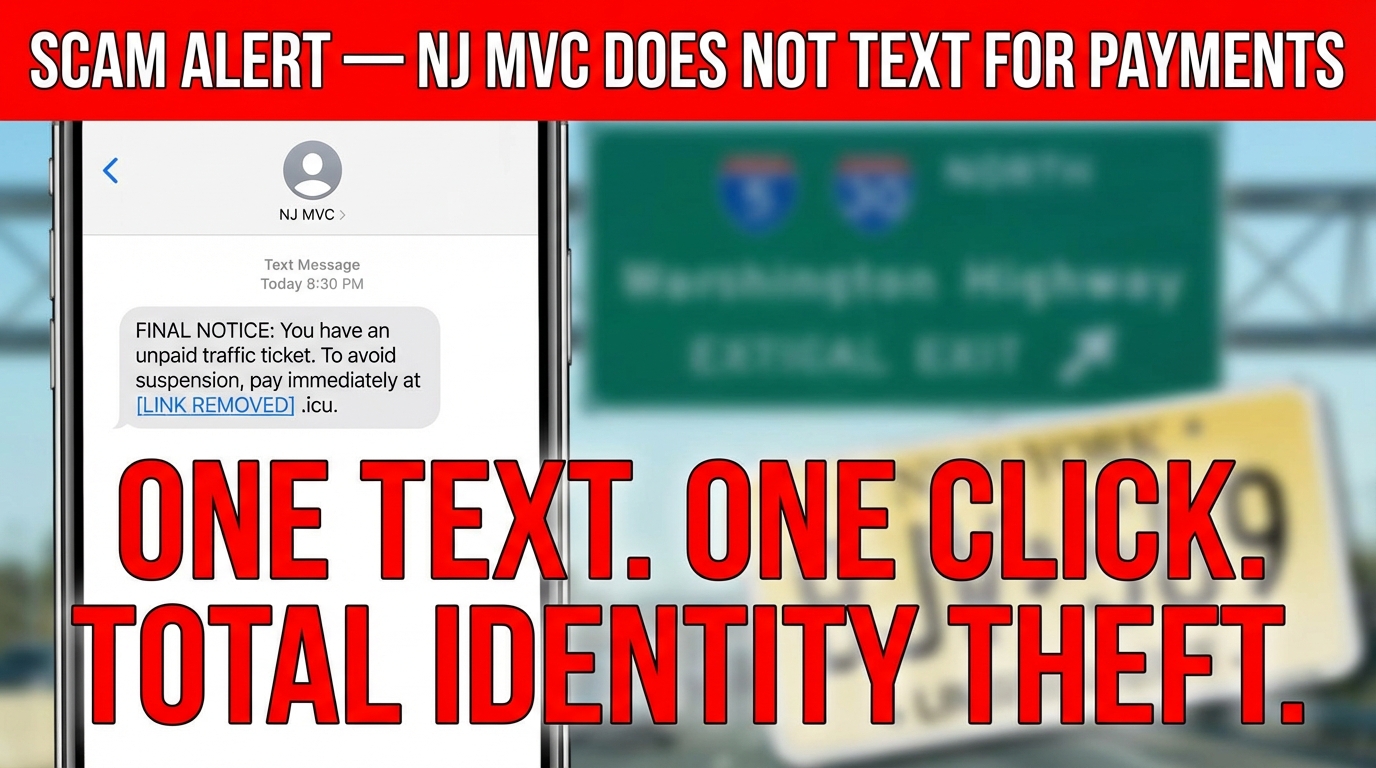

The NJ MVC Scam Text Is Fooling New Jersey Drivers Right Now
If you just got an NJ MVC scam text, here's what you need to know right away:
Quick answers:
- It's a scam. The NJ Motor Vehicle Commission does not send texts about unpaid tickets, fines, or license suspensions.
- Do not click any links in the message.
- Delete the text or report it as junk on your phone.
- Forward it to 7726 (SPAM) to report it to your carrier.
- If you already clicked, change your passwords and monitor your accounts immediately.
These texts are spreading fast across New Jersey. They typically claim you have an unpaid traffic ticket and threaten to suspend your license or add fees if you don't pay right away. The links look convincing — sometimes including words like "ezpassnj" or ".gov" — but they lead to fake sites designed to steal your personal and financial information.
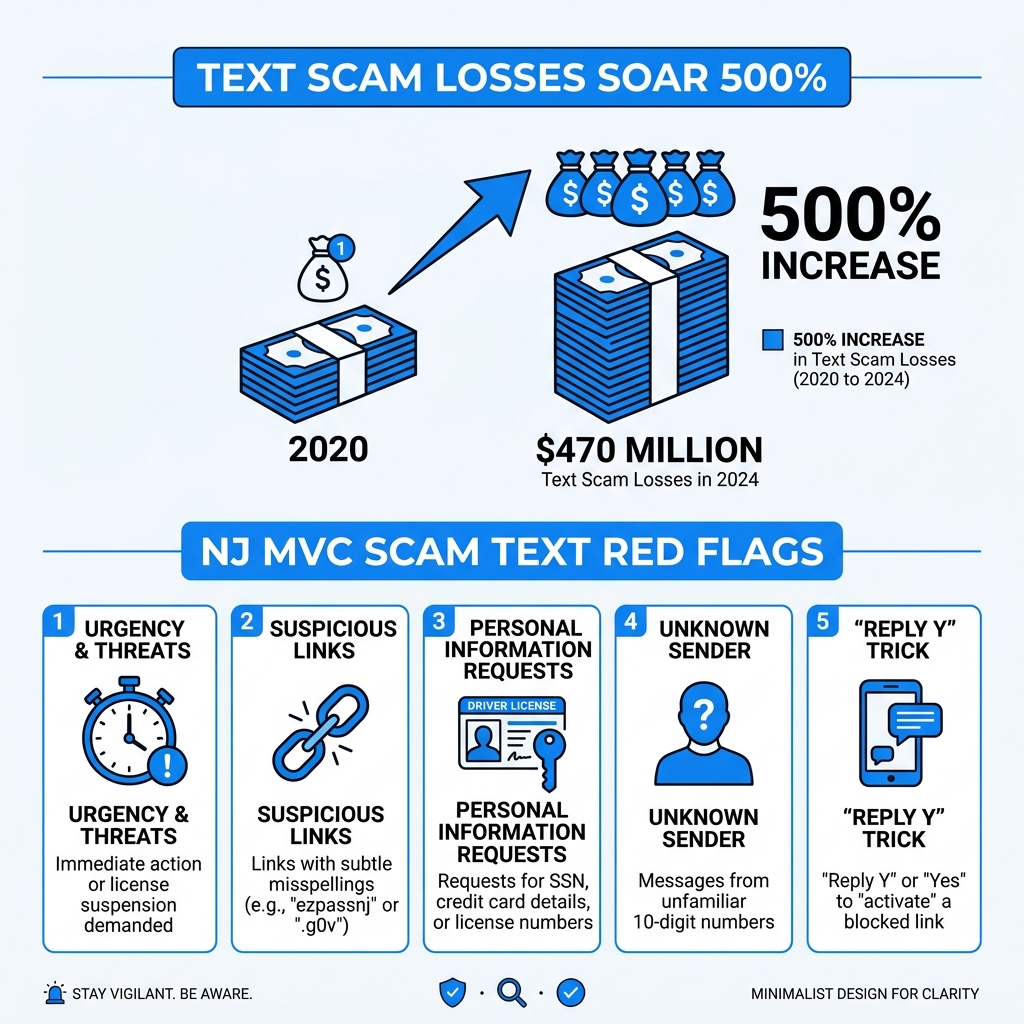
The New Jersey Cybersecurity and Communications Integration Cell (NJCCIC) has flagged over 20,000 domains linked to these SMS scams. And the problem isn't small. In 2024, Americans lost $470 million to text scams — five times more than in 2020.
One radio host described the moment perfectly: getting the text felt like a stomach-drop before the brain kicked in. That split-second of fear is exactly what scammers are counting on.
Anatomy of an NJ MVC Scam Text
To the untrained eye, an nj mvc scam text can look terrifyingly legitimate. These messages are a form of "SMiShing" (SMS Phishing), where cybercriminals use the trust we have in our mobile devices to bypass our common sense.
One of the most clever tactics used by these groups is the "Reply Y" trick. You might receive a text where the link isn't clickable at first. The message instructs you to reply with "Y" or "Yes" to "activate" the link or "reopen" the message. In reality, this is a technical workaround to bypass your phone's built-in spam filters that often disable links from unknown senders. Once you reply, the malicious link becomes active, and you're one tap away from a fraudulent website.
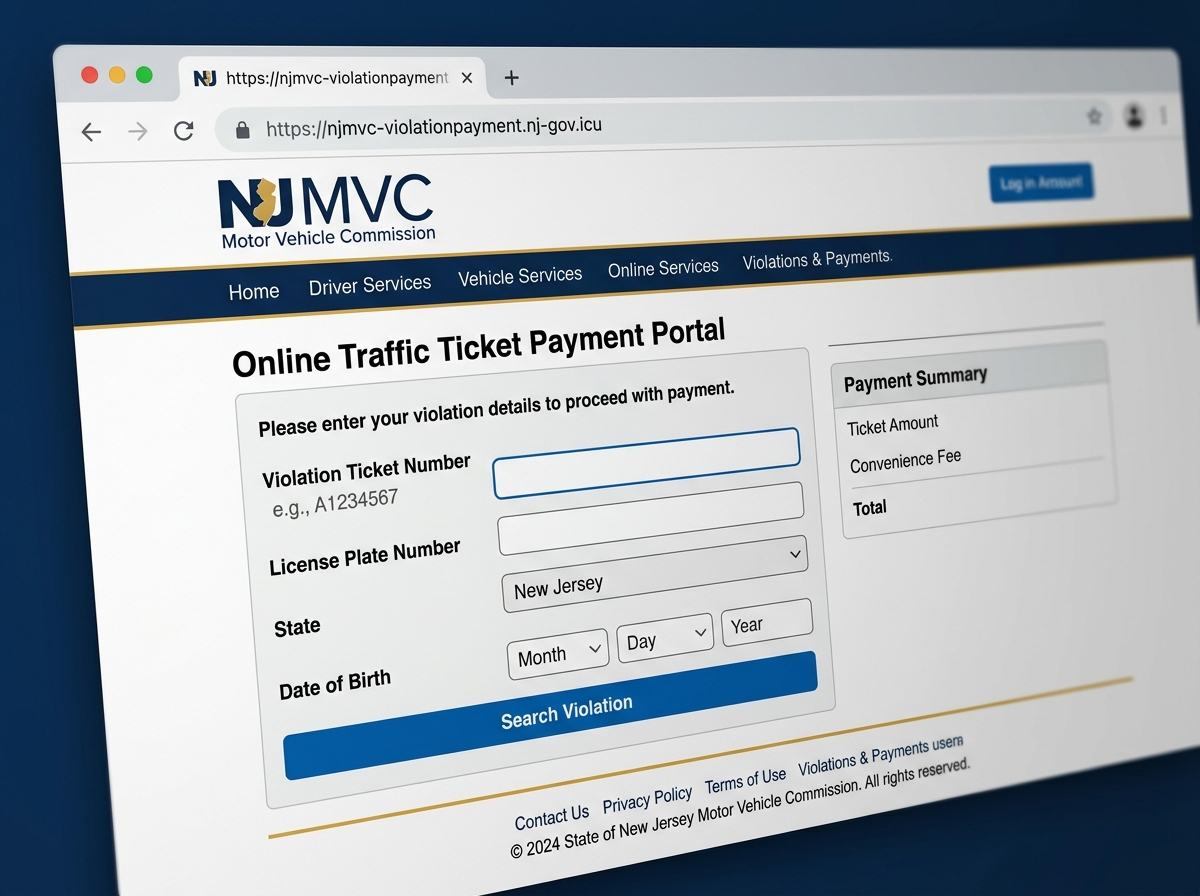
These fake websites are masterpieces of deception. They often feature the official NJ MVC logo, professional-looking fonts, and even "secure" padlocks in the browser bar. However, if you look closely at the URL, the facade crumbles. Instead of ending in .gov or .nj.gov, these sites often use cheap, obscure Top-Level Domains (TLDs) like .icu, .vip, or .top.
Research from the NJCCIC shows that a massive 82 percent of fraudulent domains used in these toll and vehicle violation campaigns were registered through a single provider, Dominet (HK) Limited, based in Hong Kong. These cybercriminals are part of organized groups, sometimes referred to as the "Smishing Triad," who use automated kits like "Lighthouse" or "Darcula" to send out thousands of messages at once. This isn't just one person in a basement; it's a phishing scam targeting NJ drivers with fake MVC traffic ticket texts on a massive, industrial scale. We've seen similar patterns in other states, such as the EZPass Scam Text: 60,000 Reports and Counting, which uses almost identical infrastructure.
Common Claims in an NJ MVC Scam Text
What exactly does an nj mvc scam text say to get you to click? They rely on "fear-ware" — language designed to make you panic and act without thinking. Common claims include:
- The "Final Notice": Claiming you have an outstanding traffic violation that must be paid by a specific (and very near) deadline.
- The Suspension Threat: Warning that your driver's license will be suspended for at least 30 days if you don't resolve the "debt" immediately.
- The Collection Fee: Threatening that the case will be handed over to a collections agency, which will add a 35% service fee to your fine.
- The Credit Score Hit: Claiming that your failure to pay will be reported to credit bureaus, damaging your financial future.
Some of these texts even cite fake laws, like "New Jersey Code 15C-16.003," which doesn't actually exist. Real New Jersey traffic laws fall under Title 39. If you receive a text with a deadline years in the future, like the DMV Text Scam 2026, that is another immediate red flag that the message is a total fabrication.
Identifying a Fake NJ MVC Scam Text URL
The URL is the biggest "tell" in any SMiShing attempt. Scammers try to hide their tracks by including keywords like "ezpassnj," "njmvc," or "nj-gov" inside the link. For example, you might see something like njmvc-gov.icu or ezpassnj.vip.
As we mentioned, the NJCCIC has identified over 20,000 second-level domains linked to these scams. They are registered in bulk to stay ahead of blocklists. Official New Jersey government websites will always end in .gov or .nj.gov. If the link ends in anything else, it is a fraud. For more details on these technical red flags, you can read the warning about text messages impersonating the New Jersey Motor Vehicle Commission (NJMVC).
Red Flags and Official NJ MVC Policies
To protect ourselves, we need to understand how the real NJ MVC operates. The most important thing to remember is that the state of New Jersey does not use the term "DMV." While many of us say it out of habit, the official name is the New Jersey Motor Vehicle Commission (NJMVC). Any text using "NJ DMV" is almost certainly a scam.
Here is a quick breakdown to help you distinguish between a real communication and a fraud:
| Feature | Official NJ MVC Communication | NJ MVC Scam Text |
|---|---|---|
| Method | U.S. Mail (for tickets and suspensions) | SMS Text Message |
| Texting Policy | Only for appointment reminders | Demands for payment or PII |
| Terminology | New Jersey Motor Vehicle Commission | "NJ DMV" or "Department of Motor Vehicles" |
| Payment Link | NJMCdirect.com (for court fines) | .icu, .vip, .top, or .xin domains |
| Legal Citations | Title 39 | Fake codes like "15C-16.003" |
| Urgency | Standard legal timelines via mail | High-pressure, immediate threats |
The NJ MVC only sends texts if you have specifically signed up for an appointment reminder. They will never text you to tell you your license is suspended or that you owe money for a speeding ticket. In fact, traffic tickets in New Jersey are handled by the NJ Courts and municipal courts, not the MVC directly. For a broader look at how these agencies handle communication, see our MVA Text Scam Alert.
The Risks of Clicking: PII Theft and Malware
You might wonder, "What's the harm in just looking at the site?" The danger is real and immediate. Clicking a link in an nj mvc scam text can lead to several disastrous outcomes:
- Identity Theft (PII Theft): These sites are designed to harvest your Personally Identifiable Information (PII). They will ask for your name, address, Date of Birth, Driver’s License number, and Social Security number. Once they have this, they can open credit lines in your name or sell your data on the dark web.
- Financial Fraud: The "payment" portal will ask for your credit or debit card information. Instead of paying a $10 fine, you are handing over your card details to a criminal group.
- Malware and Viruses: Some of these links are designed to trigger a background download of malicious software. This malware can track your keystrokes (capturing bank passwords) or give hackers remote access to your device.
- Device Compromise: In some cases, the site might prompt you to download a "security update" or an app to view your ticket. This is a classic trick to get you to install a virus.
As the Illinois DOT Text Scam reminds us, state agencies will never reach out via text for these sensitive matters because the risk to the consumer is too high.
What to Do If You Receive a Suspicious Message
If an nj mvc scam text lands in your inbox, don't panic. Follow these steps to protect yourself and your fellow New Jerseyans:
- Stop and Breathe: Scammers rely on urgency. If a text says you have "one hour to pay," it’s a scam. Government agencies don't work that fast!
- Do Not Click: Don't tap the link, and certainly don't reply "Y" or "Yes."
- Report to 7726: This is a universal "spam" reporting number for major cell carriers. Forward the scam message to 7726 (which spells SPAM on your keypad). This helps carriers block the sender's number for everyone.
- Report to the NJCCIC: You can report the incident directly to the New Jersey Cybersecurity and Communications Integration Cell at cyber.nj.gov.
- Report to the IC3: The FBI's Internet Crime Complaint Center (IC3) tracks these nationwide campaigns. You can file a report at ic3.gov.
- Block and Delete: Once you've reported it, block the number and delete the thread.
- Verify Safely: If you are genuinely worried about a ticket, go to the official NJMCdirect website or call your local municipal court. Never use a phone number provided in a text message. Even experienced professionals can get targeted, as seen in the SCDMV Scam where a traffic reporter received one.
Frequently Asked Questions about NJ MVC Scam Texts
Does the NJ MVC ever text about unpaid tickets?
No. The official policy of the NJ MVC is that they do not communicate regarding driver’s licenses, vehicle registrations, or traffic violations via text. All official notifications regarding these matters are sent through the U.S. Mail. If you have an unpaid ticket, you will receive a paper notice from the municipal court where the violation occurred. If you ignore those mailings, the court may eventually issue a warrant or a suspension notice, but again, that will arrive in your physical mailbox. Falling for these texts can lead to devastating results, as noted in the Ohio BMV Scam where thousands were stolen.
How can I tell if an E-ZPass text is legitimate?
This is a tricky one because E-ZPass does sometimes use a third-party service for collections. However, the rule of thumb is: E-ZPass NJ does not send unsolicited text messages to collect payments.
If your account is in serious arrears and has been sent to collections, you might receive a text from Credit Collection Services (CCS). A legitimate CCS text will always include:
- A specific file number.
- A callback phone number.
- A link to the official payment site:
www.ccspayment.com.
If the text asks you to go to "ezpassnj-gov.top" or any other variation, it is a scam. When in doubt, log into your account directly at the official ezpassnj.com website.
What should I do if I already clicked the link?
If you've already interacted with an nj mvc scam text, take these steps immediately:
- Disconnect: Close the browser tab and, if possible, turn off your Wi-Fi/Data for a moment to stop any active data transfers.
- Scan for Malware: Use a reputable mobile security app to scan your phone for any malicious files that may have been downloaded.
- Change Passwords: If you entered any passwords (like your email or bank login), change them immediately from a different device.
- Enable MFA: Turn on Multi-Factor Authentication (MFA) on all your sensitive accounts.
- Monitor Your Credit: Keep a close eye on your bank statements and credit reports. You may want to place a "fraud alert" or a "credit freeze" on your files with Equifax, Experian, and TransUnion.
- Contact Authorities: If you provided financial info, call your bank to cancel your cards.
For more recovery tips, check out our guide on the Texas DMV Scam Text.
Conclusion
The nj mvc scam text is a reminder that our personal information is constantly under fire. These scammers are sophisticated, using localized area codes (like 609 or 909) and convincing websites to trick even the most tech-savvy drivers.
At Tempo Mail USA, we believe the best way to stop a scam is to prevent your data from reaching the scammers in the first place. Every time you use your real email address or phone number to sign up for a service, you risk that data being leaked or sold to the very "Smishing Triads" sending these texts.
Our service provides a secure PII (Personally Identifiable Information) firewall. By using temporary email aliases, you can shield your true identity from the "wild west" of the internet. When you keep your real contact details private, you significantly reduce the chances of your number ending up on a scammer's hit list.
Stay vigilant, Jersey drivers. Remember: the MVC will never text you for money. If you want to take the next step in protecting your digital life, Protect your identity with Tempo Mail USA. Together, we can make sure these scammers have nowhere to hide.