

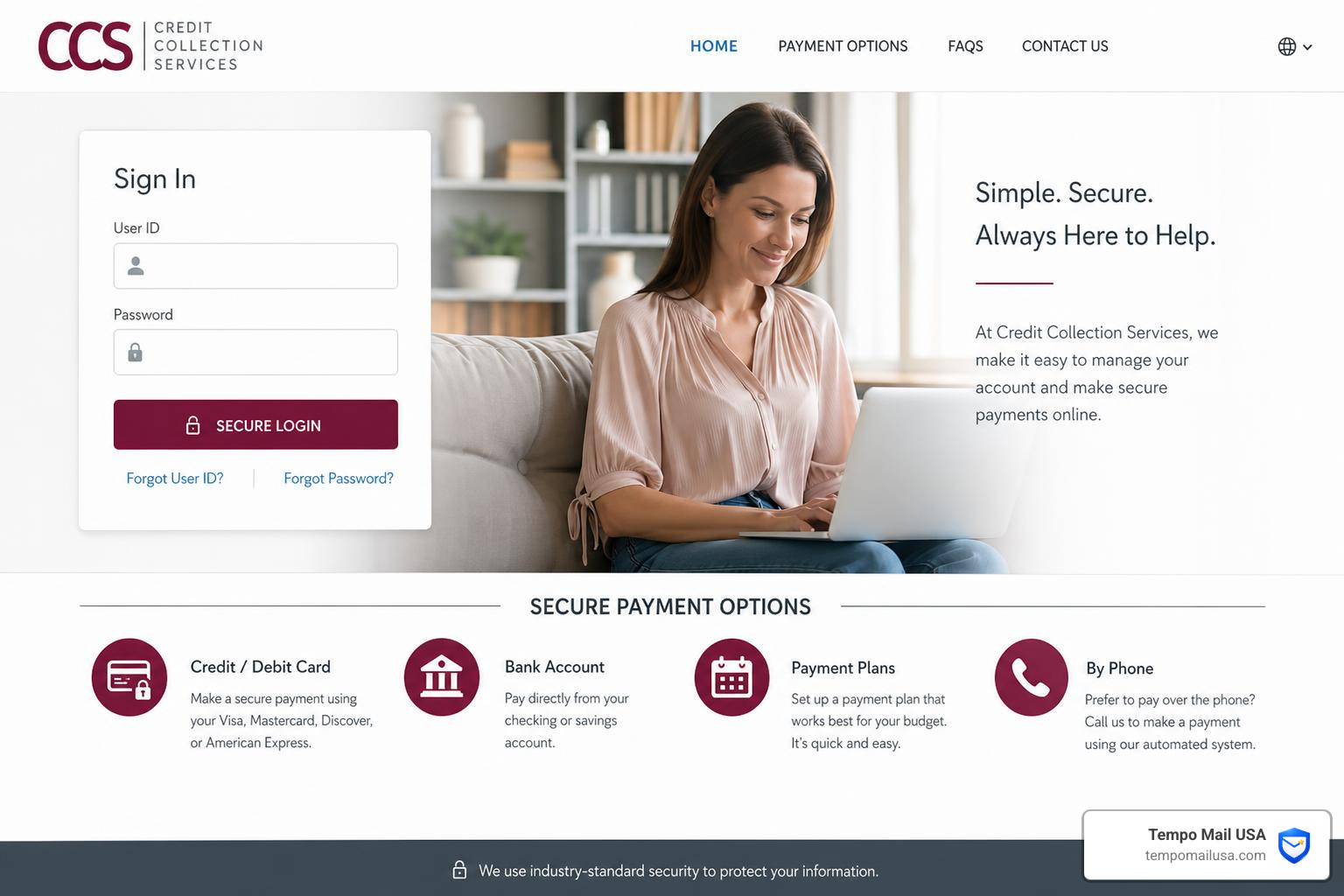

Is the CCSPayment Scam Real? Here's What You Need to Know First
The ccspayment scam is a real and growing threat — but the situation is more nuanced than a simple yes or no.
Here's the quick answer:
- CCSPayment is a legitimate payment portal operated by Credit Collection Services (CCS), a real debt collection agency founded in 1966 in Norwood, Massachusetts
- However, scammers actively impersonate CCSPayment to trick people into paying fake debts or handing over personal information
- If you received a notice, it could be either a real debt collection attempt or a fraudulent impersonation — you need to verify before doing anything
Quick verdict by scenario:
| Situation | What It Likely Means |
|---|---|
| Received a letter with full debt details and creditor name | Possibly legitimate — verify before paying |
| Got a text or email demanding urgent payment via gift card or wire transfer | Almost certainly a scam |
| Threatened with arrest for unpaid debt | Scam — debt collectors cannot legally threaten arrest |
| Asked to pay through an unfamiliar link or odd domain | Scam — check the URL carefully |
| Notice arrived with no debt details or validation offer | Red flag — could be a scam |
An unexpected message from a debt collector is stressful. Scammers know that. They count on panic making you act fast without thinking.
The FTC received over 200,000 debt collection scam reports in 2024 alone — and CCSPayment's name is frequently used by fraudsters precisely because it sounds official and hard to dismiss.
Before you pay a single dollar or share any personal information, take five minutes to verify. This guide walks you through exactly how.
Understanding the CCSPayment Scam and Legitimacy
To understand the ccspayment scam, we first have to look at the legitimate company being impersonated. Credit Collection Services (CCS) is a massive debt collection agency headquartered at 725 Canton Street, Norwood, Massachusetts. They have been around since 1966, handling unpaid bills for hospitals, utility companies, banks, and even toll agencies.
The confusion often stems from their name rebranding. While the company is officially CCS, they use the online portal "ccspayment.com" for their consumer division. Because the brand has a relatively low online profile and a high volume of consumer complaints, it creates a perfect "smoke screen" for scammers.
As noted in CCSPayment Scam Concerns: Is It Real or a Misunderstanding?, many people assume any contact from CCS is a scam because they don't recognize the debt. In reality, CCS often collects on "forgotten" debts like an old medical co-pay or a missed toll from a road trip three years ago.
Common Tactics Used in a CCSPayment Scam
Scammers are clever. They don't just send a random email; they use social engineering to make you doubt your own memory. Here are the most common ways the ccspayment scam manifests:
- Phishing Emails: You receive an email with the CCS logo, claiming you owe money for a "recent transaction." The email includes a link to a site like "ccspayments-online.com" (notice the extra 's') designed to steal your credit card data.
- Urgent Threats: Scammers use high-pressure language, claiming that if you don't pay within 24 hours, your credit score will be ruined or a "legal file" will be sent to your local police.
- Fake Job Offers: Some scammers post "Remote Administrative Assistant" jobs. Once you "apply," they claim you must pay a "registration fee" or "equipment deposit" via a CCS-branded portal.
- Withdrawal Paralysis: As explored in Is ccspayment.com a Scam?, victims are sometimes told they have received a payment (like a freelance fee), but they must pay an "international transfer fee" to unlock the funds. Once the fee is paid, the scammer vanishes.
Red Flags of a Fake Debt Notice
Spotting a ccspayment scam is much easier when you know what a legitimate debt collector is forbidden from doing. Scammers rely on your lack of knowledge regarding debt collection laws.
| Feature | Legitimate CCS Notice | Scam Message |
|---|---|---|
| Payment Method | Credit card, check, or ACH via official portal | Gift cards, Cryptocurrency, Wire transfers |
| Language | Professional, factual, and dry | Urgent, threatening, or full of typos |
| Contact Time | 8 AM to 9 PM local time | Middle of the night or constant badgering |
| Debt Details | Lists original creditor and account number | Vague "unpaid balance" or "legal fee" |
| Verification | Must provide a validation letter upon request | Refuses to provide written proof |
If you receive a text message about a fine or debt, be extremely wary. Much like the Parking Violation Scam Text That Fine Is Stealing Your Card, these messages often include a shortened URL that leads to a phishing site.
Another major red flag is the demand for untraceable payments. No legitimate collection agency in April 2026—or ever—will ask you to pay a medical bill with a Target gift card or Bitcoin. According to CCSPayment Scam: Warning Signs, How It Works & Staying Safe, any request for payment via wire transfer should be treated as an immediate confirmation of fraud.
How to Verify a CCSPayment Debt Collection Notice
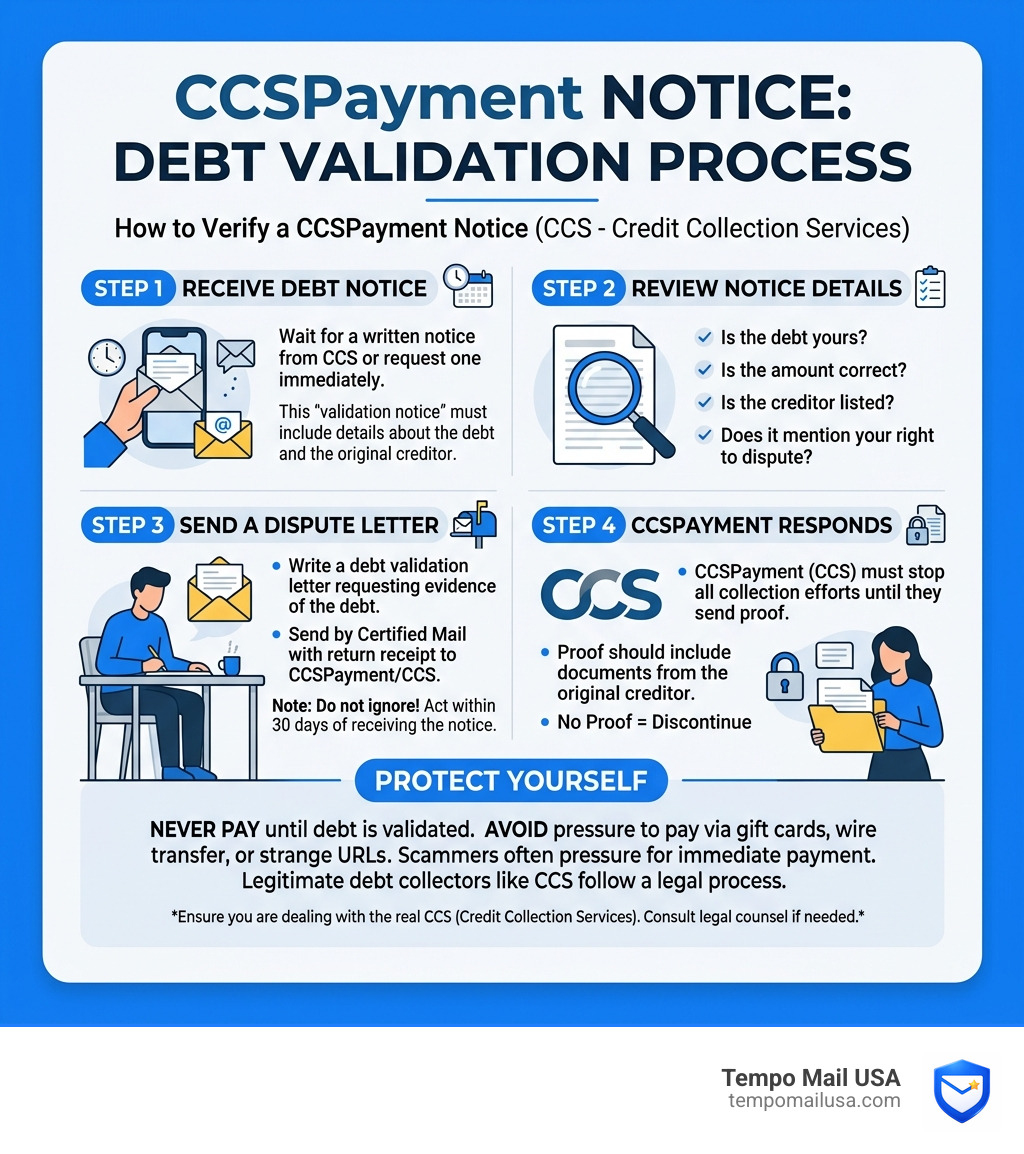
If you receive a notice and you're not sure if it's the real CCS or a ccspayment scam, do not click any links. Instead, follow these verification steps:
- Request a Debt Validation Letter: Under federal law, debt collectors must send you a written notice within five days of their first contact. This letter must include the amount owed and the name of the original creditor. If they refuse to send this, hang up.
- Contact the Original Creditor: Did the notice say you owe money to a specific hospital or utility company? Call that company directly using a number from their official website. Ask them if your account was actually sent to CCS for collections.
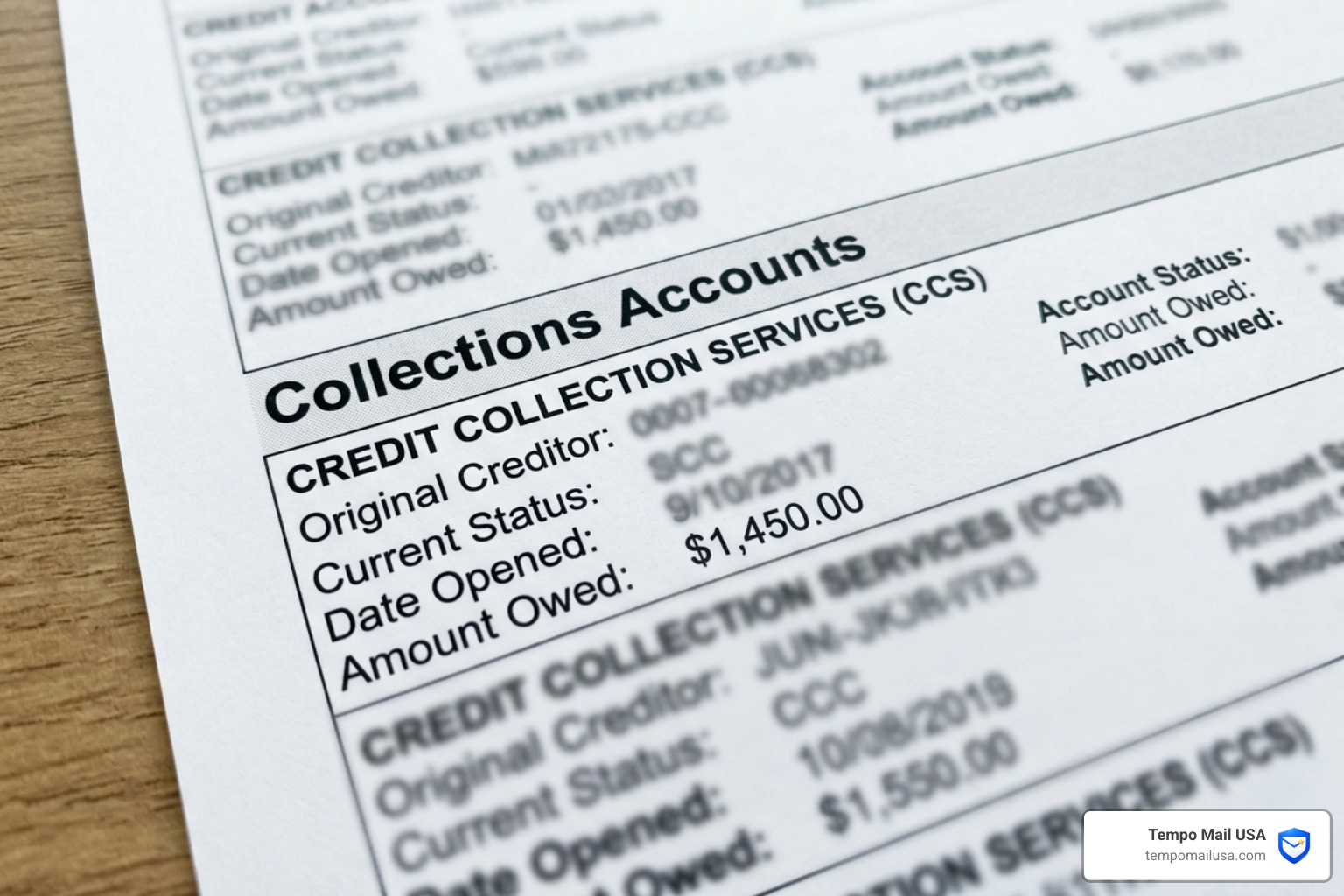
- Check Your Credit Report: Real collection accounts usually show up on your credit report. You can get a free report at AnnualCreditReport.com. If CCS isn't listed, the "debt" might be a total fabrication.
- Verify the URL: The only legitimate payment site is
www.ccspayment.com. Scammers use "look-alike" domains likeccspayments.netorccs-payment-portal.com.
For more on protecting your data during this process, see our guide on Identity Theft Steps To Protect Yourself. As CCSPayment scams: How to recognize fake CCS notices - Norton points out, verifying the source is the single most important step in avoiding financial loss.
Verifying the CCSPayment Scam via Official Channels
If you're still on the fence, check the reputation of the agency. CCS has a significant history, which means there is a lot of public data available:
- BBB and CFPB: Credit Collection Services has over 400 complaints with the Better Business Bureau and roughly 270 complaints filed with the Consumer Financial Protection Bureau (CFPB). While many of these are about aggressive tactics or reporting errors, they prove the company is a real entity.
- Short Codes: Legitimate CCS text messages often come from the short code 30601. If you get a text from a standard 10-digit mobile number claiming to be a corporate collection office, it’s likely a scam.
- Official Phone Numbers: CCS operates Monday-Friday, 8 AM to 8 PM ET. If you're getting calls on a Sunday morning, it's not the real CCS.
Always be skeptical of "official" sounding texts. We've seen similar patterns in the Txdmv Scam Text Alert Is Txdmv Org Real Or Fake reports, where scammers use government or agency names to bypass your natural defenses.
Your Rights and Protection Under the FDCPA
The Fair Debt Collection Practices Act (FDCPA) is your best friend when dealing with any debt collector, real or fake. This federal law dictates what collectors can and cannot do.
- No Harassment: They cannot use profane language, threaten violence, or call you repeatedly to annoy you.
- Time Restrictions: They can only call between 8 AM and 9 PM your local time.
- Right to Silence: You can send a written letter telling them to stop contacting you. Once they receive it, they can only contact you to confirm they are stopping or to notify you of a specific legal action (like a lawsuit).
- No Lies: They cannot misrepresent the amount you owe or claim to be an attorney or government representative if they are not.
As explained in Is CCSPayment a scam? How to identify real vs. fake debt collectors, one of the biggest lies scammers tell is that you will go to jail. In the United States, you cannot be arrested for an unpaid consumer debt.
We see these same fear tactics used in the Afterpay Text Scam That 3000 Credit Is Stealing Your Bank alerts. Scammers rely on the "shock factor" to prevent you from exercising your legal rights.
Steps to Take if You’ve Been Targeted
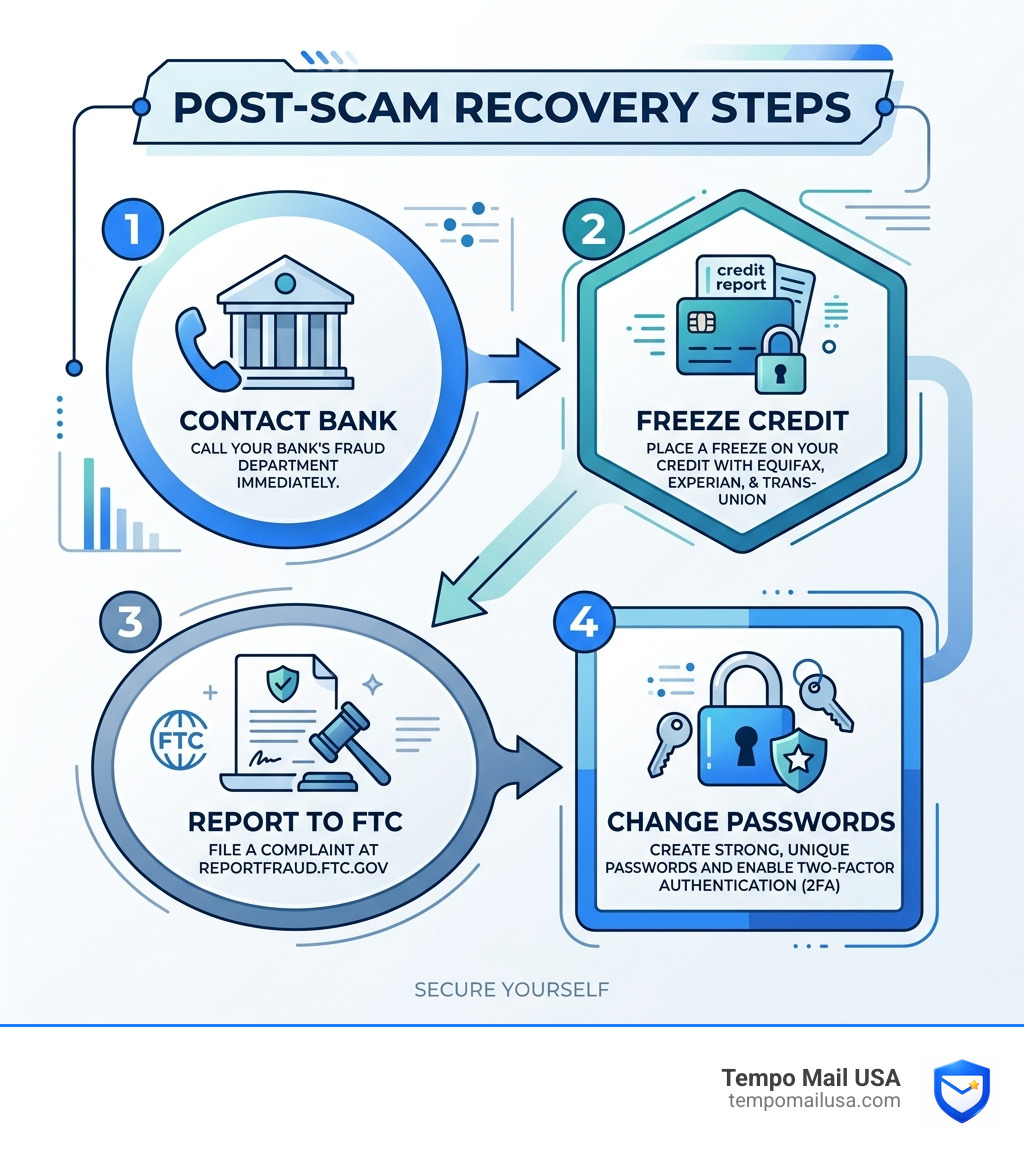
If you realize you've engaged with a ccspayment scam, don't beat yourself up. These frauds are designed to be convincing. Instead, move into "damage control" mode immediately.
- Report to the FTC: Go to
reportfraud.ftc.gov. This helps the government track scam patterns and potentially shut down fraudulent domains. - Freeze Your Credit: Contact Equifax, Experian, and TransUnion to place a freeze on your credit. This prevents scammers from opening new accounts in your name using the info they stole.
- Contact Your Bank: If you provided payment info or authorized a transfer, call your bank's fraud department immediately. If it's within 72 hours, there is a roughly 60% chance of a wire recall being successful.
- Update Your Security: Change your banking passwords and enable Two-Factor Authentication (2FA).
If you've encountered other similar threats, like those mentioned in our Tax Abatement Office Scam Warning, you'll notice the recovery steps are almost identical. Speed is the most important factor.
How to Report a CCSPayment Scam
Beyond the FTC, there are several other places where your report can make a difference:
- IC3 Portal: The FBI’s Internet Crime Complaint Center (IC3) handles cyber-based scams.
- IdentityTheft.gov: If you gave them your Social Security number or other PII, this site provides a personalized recovery plan.
- Local Law Enforcement: While they may not be able to track a scammer in another country, a police report is often required by banks to reverse fraudulent charges.
Learning How To Spot A Dmv Text Scam or other impersonation frauds can help you develop a "scammer radar" that protects you across all platforms.
Frequently Asked Questions about CCSPayment
Is CCSPayment a legitimate company?
Yes, CCSPayment is the official payment portal for Credit Collection Services (CCS), a legitimate debt collection agency founded in 1966. However, because it is a real company, scammers frequently use its name and logo to create fake "debt" notices that look authentic.
Can I go to jail for an unpaid CCS debt?
No. Under the Fair Debt Collection Practices Act (FDCPA), it is illegal for a debt collector to threaten you with arrest or jail time for a consumer debt. If someone claiming to be from CCS tells you the police are on their way, you are 100% dealing with a scammer.
How does a CCSPayment collection affect my credit score?
A legitimate collection account from CCS can stay on your credit report for seven years, even if you pay it off. This can significantly lower your credit score. However, many people find that CCS accounts appear due to administrative errors (like a doctor's office failing to bill insurance). In these cases, you can dispute the entry with the credit bureaus to have it removed.
Conclusion
Navigating debt collection is like walking through a minefield. On one side, you have legitimate agencies like CCS that can be aggressive and prone to reporting errors. On the other, you have the ccspayment scam—fraudsters who want to steal your identity and your hard-earned money.
The best way to stay safe is to limit the amount of personal identifiable information (PII) you have floating around the web. This is where we come in. At Tempo Mail USA, we provide a digital firewall for your identity. By using our secure email alias generation, you can proxy your identity and shield your real contact details from services.
If a service is breached or a scammer gets a hold of an email address, they only get a "temp" alias that we can shut down instantly, leaving your real inbox—and your real identity—untouched. When scammers are constantly trying to piece together your digital profile, acting as your own "identity firewall" is the smartest move you can make.