

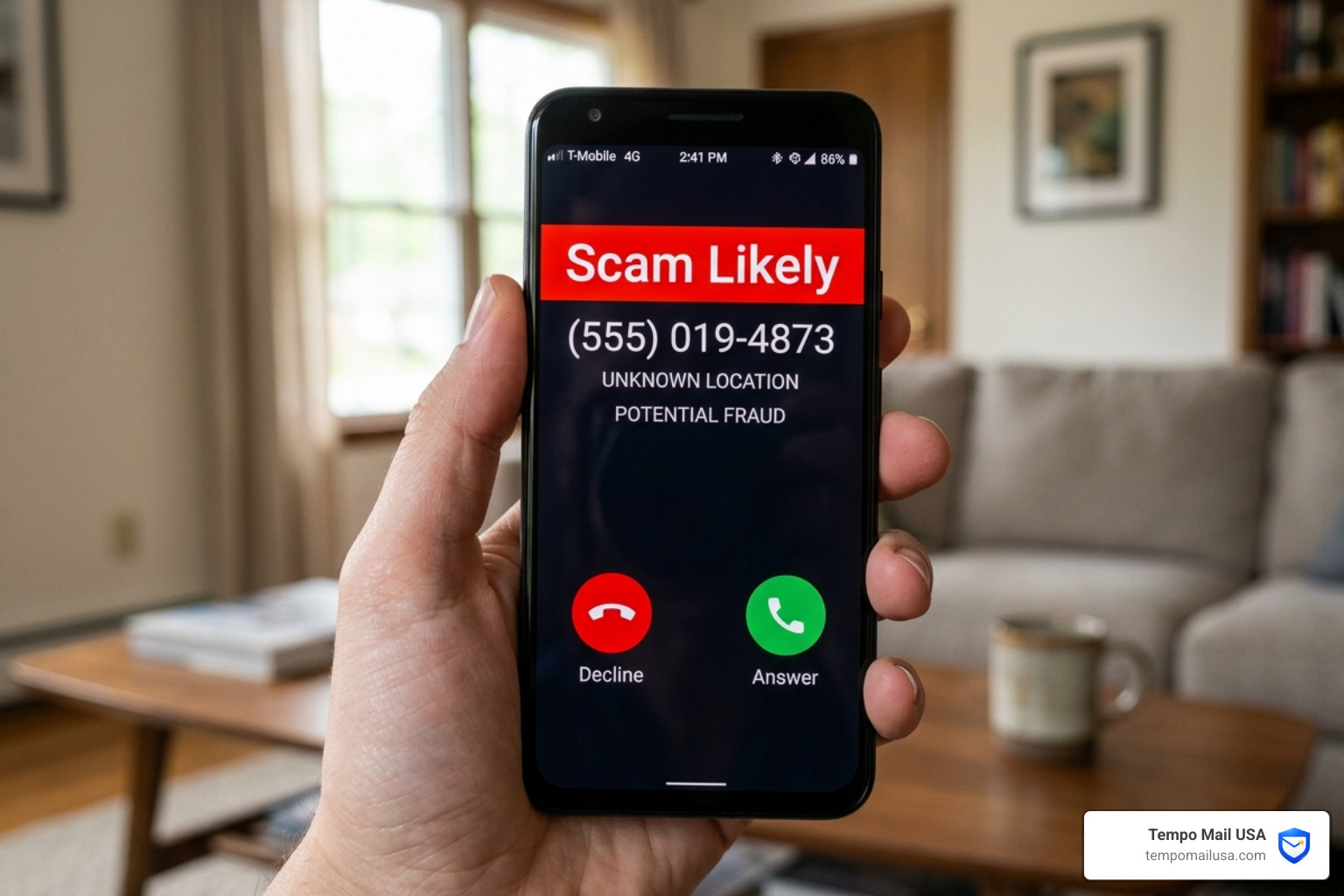

Is That Call From a "Tax Abatement Office" Real? (Almost Certainly Not)
The tax abatement office scam is a fraudulent scheme where criminals impersonate fake government tax agencies — by phone or voicemail — to steal your money or personal information.
Quick answer: No government agency called a "Tax Abatement Office," "Tax Resolution Team," or "Priority Account Review Office" exists. These are invented names designed to sound official. If you received a call or voicemail from one, it is a scam.
Key facts at a glance:
- The IRS never initiates contact by phone — only by U.S. mail
- Scam calls often use names like "Hannah Whitford" or "Laura Christie" with urgent scripts about "flagged accounts"
- Known scam numbers include 877-593-1091, 202-649-2801, and 771-222-3150
- Scammers want your Social Security number, bank details, or upfront fees
- You should hang up immediately and never call back
It is tax season 2026, and these scam calls are spiking fast. One consumer reported receiving 10 to 12 calls per day from fake tax relief robocallers. Security researchers have detected a measurable surge in robocalls impersonating tax resolution firms during tax filing season.
The calls sound polished. A calm, professional voice leaves a voicemail referencing your "flagged account," a "final stage review," or a "limited-time abatement program." It feels like it could be real — especially if you have any anxiety about your taxes.
That feeling of uncertainty is exactly what scammers are counting on.
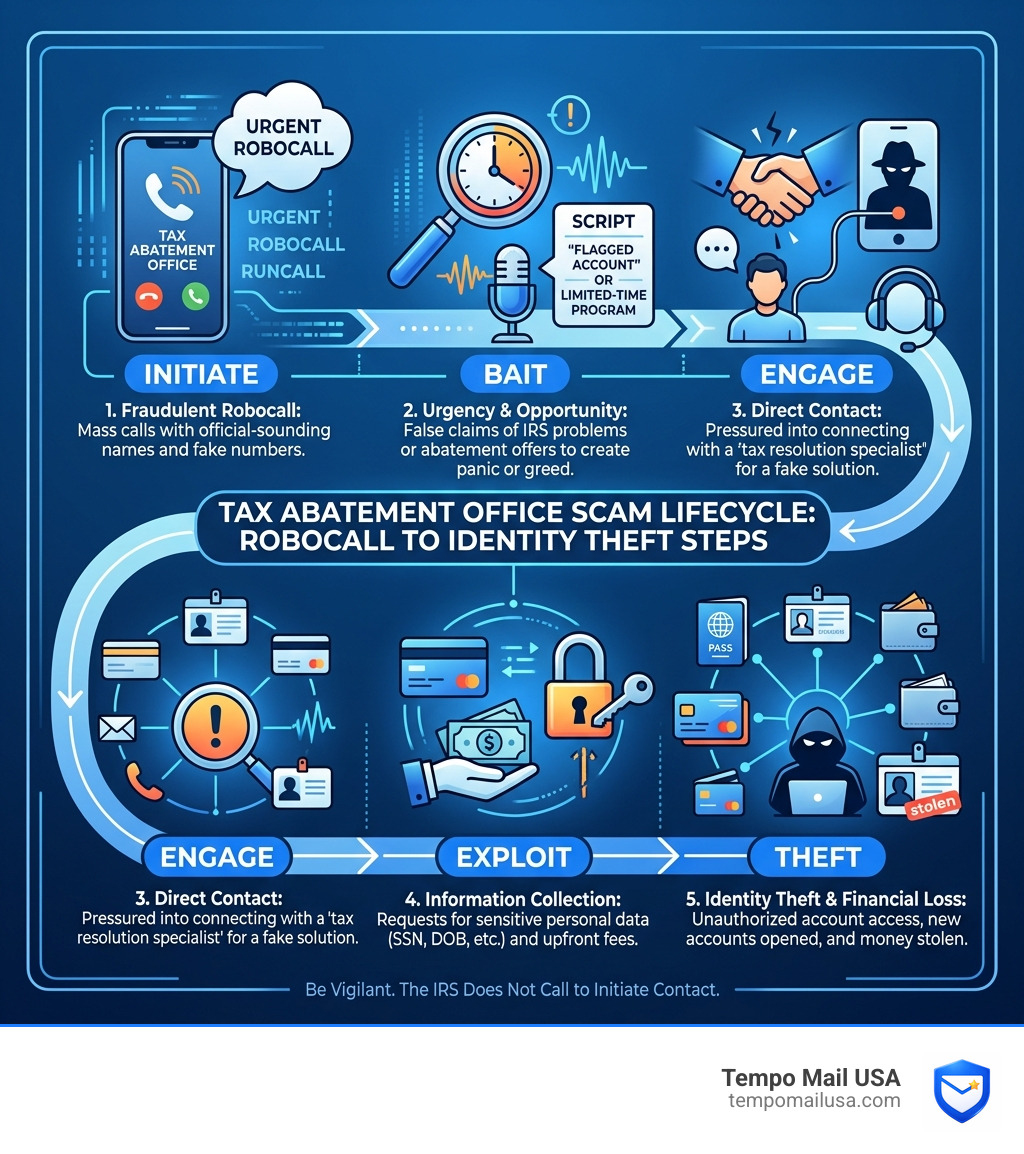
What is the Tax Abatement Office Scam?
At its core, the tax abatement office scam is a sophisticated phishing operation. Criminals set up "boiler room" call centers—often overseas—and use robocall technology to blast thousands of Americans with a singular message: you owe the government money, or you are missing out on a way to erase your debt.
These groups use a "word salad" of official-sounding terms to invent fake agencies. You might hear names like the "Tax Resolution Team," the "Priority Account Review Office," or the "Tax Mediation and Resolution Agency." In Pennsylvania, scammers have even gone as far as sending deceptive letters under names like "Tax Assessment Procedures" or the "Domestic Judgment Registry."
None of these offices are real. They are phantoms created to lend a sense of authority to a lie. According to research on the Tax Abatement and Relief Office Scam, the ultimate goal is to pressure you into paying "settlement fees" or to harvest your Social Security number (SSN) for identity theft. We’ve seen a massive wave of these reports lately, as detailed in our Tax Abatement And Relief Office Scam Warning.
Common Scripts Used by the Tax Abatement Office Scam
Scammers love a good script. It allows them to sound consistent and professional, even if the person on the other end is a criminal in a basement. You might receive a voicemail from a "Hannah Whitford" or "Laura Christie." These names are frequently rotated to keep the scam fresh.
One common script used by the 202-649-2801 Tax Abatement and Resolution Office Scam sounds like this:
"This is Laura Christie from the review desk with the tax abatement and resolution office. My records show your account has been flagged for a final stage review regarding back taxes or missed filings. We have new resolution programs available for a limited time that could significantly reduce what you owe. Call me back now at 202-649-2801."
Notice the key elements: a specific name, a "flagged" account, and a "limited time" offer. It’s designed to make you feel like you’ve missed something important and that only a quick phone call can fix it.
Psychological Tactics and Urgency
Why do people fall for this? Because scammers are excellent psychologists. They exploit what we call "unverifiable uncertainty." Most people aren't 100% sure about every single tax form they’ve ever filed. When a "Tax Resolution Team" calls, that tiny seed of doubt grows into a full-blown panic.
The scammers use phrases like "This is our only attempt to reach you" or "Your file is being transferred to the enforcement division." This creates a fight-or-flight response. When you are in a state of fear, you are less likely to pause, research the number, or realize that the IRS doesn't work like a flash sale. Our Tax Abatement Scam Calls Warning highlights how these threats of arrest or property seizure are used to bypass your logical thinking.
Red Flags of a Tax Abatement Office Scam Call
Identifying a scam is easier when you know what the "red flags" look like. If you get a call that makes your heart race, take a deep breath and look for these signs:
- Unsolicited Contact: The IRS does not call you out of the blue.
- Vague Agency Names: Names like "Taxpayer Assistance Center" (without a specific location) or "National Tax Debt Relief."
- Robotic Tones: Many of these calls use AI-generated voices or pre-recorded scripts that don't quite sound human.
- Demand for Immediate Payment: Scammers often demand payment via wire transfer, cryptocurrency, or—most commonly—gift cards.
- Aggressive Threats: Real tax officials do not threaten you with immediate arrest, deportation, or driver's license revocation over the phone.
The Internal Revenue Service (IRS) explicitly states that they will never demand a specific payment method or threaten to bring in local police to have you arrested for not paying.
How the IRS Actually Contacts Taxpayers
We cannot stress this enough: The IRS's first contact with you will always come by mail, delivered by the U.S. Postal Service.
If you truly owe back taxes, you will receive a series of official letters (notices) long before any other action is taken. These letters will explain your rights, how much you owe, and how to appeal the decision. As the FTC warns, you should hang up on unexpected calls saying you owe back taxes because they are simply not how the government operates.
Identifying Fraudulent Phone Numbers
Scammers use "spoofing" technology to make their calls appear as if they are coming from Washington D.C. (area code 202 or 771) or from a toll-free number. However, reports from thousands of consumers have linked specific numbers to the tax abatement office scam.
Commonly reported scam numbers include:
- 877-593-1091
- 202-649-2801
- 771-222-3150
- 833-820-4216
If you see these numbers on your caller ID, do not answer. If you have already received a voicemail from them, do not call them back. Calling back often connects you directly to a scammer's "sales floor," where they will try even harder to manipulate you. For more on these specific numbers, see our Tax Abatement Scam Calls Irs Phone Scam Warning.
What to Do if You Are Targeted
If you receive a suspicious call, the best thing you can do is nothing.

- Hang up immediately: Don't try to "mess" with the scammer or press buttons to "opt out." Pressing buttons often just confirms to the scammer that your number is active, leading to more calls.
- Do not engage: Do not provide your name, address, or any part of your SSN.
- Block the number: Use your phone’s built-in blocking features to prevent them from calling again.
Scammers often pivot. If a phone scam doesn't work, they might try an Irs Audit Phishing Email Scam to catch you off guard. Always stay vigilant across all communication channels.
Reporting the Tax Abatement Office Scam to Authorities
Reporting these calls helps federal agencies track and shut down scam operations. Here is where you should send your information:
- TIGTA: The Treasury Inspector General for Tax Administration handles IRS impersonation. Report at tigta.gov or call 1-800-366-4484.
- FTC: Report the scam at ReportFraud.ftc.gov.
- IRS: Forward any phishing emails or details of phone scams to phishing@irs.gov with the subject line "IRS Phone Scam."
Detailed investigations, such as the one by Malwaretips on the Tax Abatement Adjustment Office Scam, show that these reports are vital for mapping out criminal networks.
Steps for Victims of Information Theft
If you’ve already spoken to a scammer and shared personal information, don't panic. You need to act quickly to protect your identity:
- Place a Credit Freeze: Contact Equifax, Experian, and TransUnion to freeze your credit. This prevents scammers from opening new accounts in your name.
- Notify Your Bank: If you shared card details or bank info, call your financial institution's fraud department immediately.
- Run a Security Scan: If you clicked any links or downloaded "tax forms" from a scammer, run a full malware scan on your computer.
- Monitor Your Accounts: Keep a close eye on your bank statements and your IRS online account for any unauthorized activity.
- Get an IP PIN: You can request an Identity Protection PIN from the IRS to prevent someone else from filing a tax return in your name.
Legitimate Tax Relief vs. Fraudulent Offers
It is important to know that legitimate tax relief does exist, but it never starts with a robocall. The IRS offers several programs for taxpayers facing genuine financial hardship.
| Feature | Legitimate IRS Protocol | Tax Abatement Office Scam |
|---|---|---|
| Initial Contact | Official letter via U.S. Mail | Unsolicited phone call or text |
| Payment Method | IRS.gov, official checks, or authorized payment processors | Gift cards, wire transfers, or crypto |
| Urgency | Provides time to appeal and explain rights | Demands immediate action or "file closure" |
| Fees | No upfront fees for government programs | Demands $500–$5,000 "review fees" |
| Verification | You can verify status via IRS.gov | Uses fake names and untraceable numbers |
Vetting Third-Party Tax Resolution Firms
There are private companies that help people negotiate with the IRS. However, many are "scam-adjacent." To vet a company, ask these questions:
- Are they BBB accredited with a high rating?
- Do they charge massive upfront fees before even looking at your case?
- Do they offer a money-back guarantee?
- Are their practitioners Enrolled Agents (EAs) or CPAs?
Steer clear of any company that promises they can settle your debt for "pennies on the dollar" before they have even seen your financial records.
The Danger of OIC Mills
An "Offer in Compromise" (OIC) is a real IRS program that allows you to settle your tax debt for less than the full amount. However, most people do not qualify for it. "OIC Mills" are companies that use aggressive marketing to make you believe everyone qualifies. They charge you thousands in fees to file paperwork they know will be rejected.
Before paying a company, use the IRS Offer in Compromise Pre-Qualifier tool on the official IRS website. It’s free and will tell you if you are actually a candidate for the program.
Frequently Asked Questions about Tax Scams
Can a private collection agency call me about tax debt?
Yes, but only under very specific circumstances. The IRS uses a few private agencies to collect overdue taxes. However, you will receive multiple letters from the IRS first, followed by a letter from the collection agency. Both letters will contain a unique taxpayer authentication number. These agencies will never ask for gift cards and will always direct you to pay via IRS.gov/payments.
What should I do if I already shared my Social Security number?
Immediately visit IdentityTheft.gov to create a recovery plan. You should also contact the IRS at 1-800-908-4490 to report that your SSN has been compromised so they can flag your account for fraudulent returns.
How can I verify my tax status safely?
The safest way is to create and log into your IRS Online Account at IRS.gov. There, you can see exactly what you owe, your payment history, and any digital copies of notices sent to you. You can also call the official IRS hotline at 1-800-829-1040.
Conclusion
The tax abatement office scam thrives on the complexity of the tax code and the natural anxiety we all feel during tax season. By understanding that the IRS will never call you out of the blue and by recognizing the scripts used by fake "resolution teams," you can protect your finances and your peace of mind.
At Tempo Mail USA, we believe that the best defense against these scams is a strong "PII Firewall." Scammers get your phone number and email address from data breaches and public records. By using our secure email alias generation, you can shield your real identity from services, ensuring that if a database is leaked, your primary contact information remains hidden.
Digital hygiene is no longer optional in 2026—it’s a necessity. Stay safe, stay skeptical, and always verify before you act. For more information on how to protect your privacy, visit tempomailusa.com.