



The US Claim Registry Scam Is Targeting Creators, Business Owners, and Everyday People Right Now
The us claim registry scam is a type of fraud where criminals impersonate official US government agencies — like the USPTO, the IRS, or state unclaimed property offices — to trick you into sending money or handing over personal information.
Here is what you need to know right away:
- It is not a real government program. There is no single federal agency called the "US Claim Registry."
- Scammers send fake urgent notices about trademark conflicts, copyright violations, unclaimed funds, or overdue fees.
- They demand payment via gift cards, wire transfers, or payment apps — methods no real government agency uses.
- They use your real public information (like USPTO filings or business registration data) to make the scam look convincing.
- You can verify any legitimate claim for free at official
.govwebsites — no payment required.
These scams hit a wide range of people. A musician might get a call saying their copyright registration failed. A small business owner might receive an "urgent" letter threatening trademark loss unless they pay within 48 hours. Someone else might get a text claiming thousands of dollars in unclaimed property are waiting — but only if they click a link and provide their details first.
The BBB Scam Tracker has logged over 900 reports tied to fake "relief check" and unclaimed funds schemes alone. And with billions of dollars in real unclaimed property held by US states, scammers have a very convincing hook to use.
The fraud works because it looks real. Scammers spoof official phone numbers, copy government logos, and reference your actual business or trademark data pulled from public databases.
This guide breaks down exactly how these scams work, how to spot them, and what to do if you receive a suspicious notice.
Anatomy of Government Impersonation and Fraudulent Registries
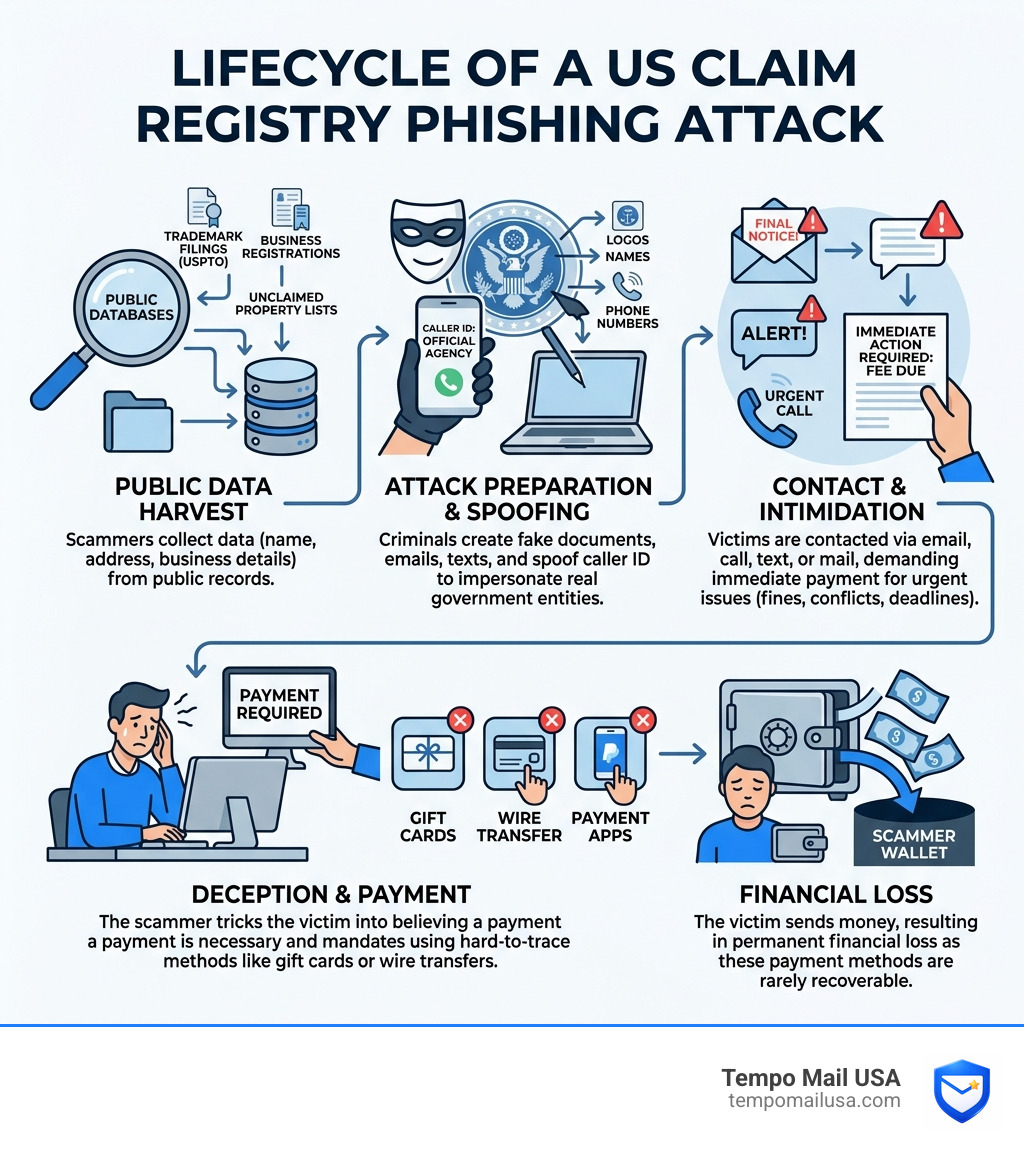
The us claim registry scam isn't just one static trick; it is a sophisticated ecosystem of impersonation. We have seen scammers successfully mimic the United States Patent and Trademark Office (USPTO), the U.S. Copyright Office, and even the IRS. These criminals use advanced social engineering to make you believe you are dealing with a federal authority.
For instance, Scammers are impersonating the United States Patent and Trademark Office by spoofing phone numbers so your caller ID actually displays "USPTO." They might use the names of real employees found on LinkedIn or official directories to build rapport. Once they have you on the line, they claim there is a "problem" with your filing that requires an immediate "processing fee."
Beyond the USPTO, we see similar tactics in the realm of asset recovery. Scammers often set up "private registries" that sound official. You might receive a letter from a group with a name like "U.S. Trademark Compliance Service" or "National Claim Registry." These are not government entities. They are private companies—or outright fraudsters—trying to charge you for services that are either unnecessary or free through official channels. To understand how deep these "recovery" schemes can go, look at our Detailed Guide to Payne Richards Associates Scam Status for a breakdown of how private firms operate in this grey area.
How the US Claim Registry Scam Exploits Public Records
One reason the us claim registry scam is so effective is that it relies on "the truth." Most government filings are public record. When you register a trademark, your name, address, email, and the specifics of your brand are published in the Trademark Status and Document Retrieval (TSDR) database.
Scammers use automated scripts (data scraping) to harvest this information. They know exactly when you filed, what your serial number is, and when your renewal is due. When they contact you, they cite these specific details. This makes the "urgent notice" feel legitimate. They aren't guessing; they are reading your own public file back to you. This is why identity theft protection services and data privacy compliance are so critical for modern business owners.
Identifying a US Claim Registry Scam in Unclaimed Property Notices
Another massive wing of this fraud involves "unclaimed property." Every state has a treasurer's office that holds onto forgotten utility deposits, uncashed paychecks, or old bank accounts. Scammers exploit this by sending texts or making calls claiming you have a "relief check" or "unclaimed fund" waiting.
They might say, "You have $5,286 waiting to be claimed!" This specificity is a bait tactic. How to handle unexpected calls about unclaimed funds usually involves a simple rule: if they ask for money to "release" the funds, it’s a scam. Real state programs never charge a fee to return your money. We’ve also seen a rise in SMS-based fraud in this sector; check out our report on the Unifin Text Scam Exposed - What You Need to Know to see how text-based phishing works.
The US Claim Registry Scam: Red Flags and Verification Steps

To protect your finances, you must become an expert at spotting the "tell." Scammers rely on fear and haste. If a notice says you have "48 hours to respond or lose your rights," your internal alarm should go off.
Common Red Flags Include:
- Unusual Payment Methods: If they ask for gift cards, wire transfers (Western Union/Moneygram), or cryptocurrency, it is 100% a scam. No government agency accepts "Apple Gift Cards" for trademark fees.
- Non-Government Domains: Official emails come from
.govdomains. If you get an email fromuspto-registry@gmail.comorcompliance@usptogov.co, it’s fake. - Threats of Legal Action: The U.S. Copyright Office and USPTO do not threaten to sue you or "arrest" you over filing fees.
| Feature | Official Government Communication | US Claim Registry Scam |
|---|---|---|
| Email Domain | Always ends in .gov | Ends in .com, .net, or .org |
| Payment Method | Official portals (Pay.gov) | Gift cards, Wire, Payment Apps |
| Urgency | Standard legal deadlines | "Act now or lose everything" |
| Contact Method | Physical mail or official portal | Unsolicited texts and "spoofed" calls |
If you encounter someone claiming you owe money for a debt you don't recognize, read our guide on Fake Debt Collector Scam - Warning Signs & How to Protect Yourself to stay safe.
Verification Protocols for Trademark and Copyright Owners
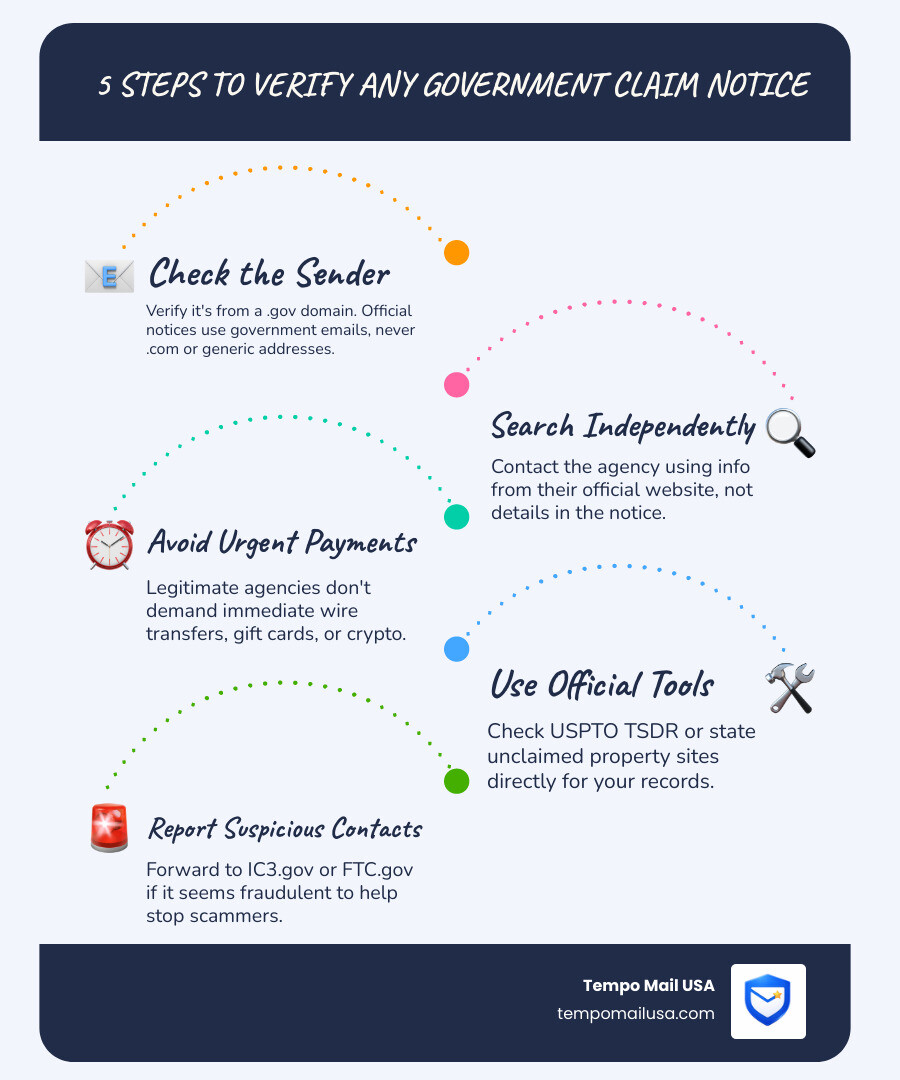
If you receive a suspicious notice, do not click any links. Instead, follow these verification steps:
- Check the TSDR: Go directly to
tsdr.uspto.govand enter your serial number. If there is a real issue, it will be listed in the "Documents" tab. - Verify the Sender: Look at the return address. If it’s a P.O. Box in a state where the agency doesn't reside, be wary.
- Call the Official Number: Don't use the number provided in the suspicious email. Find the agency's number on their official
.govwebsite and call them directly.
Scammers often pretend to be "agents" or "collectors." For more on this, see our article on the Phantom Debt Collection Scam - Fake Collectors.
Immediate Actions for Victims of Financial Fraud
If you have already sent money or shared your SSN, you must act fast.
- Contact Your Bank: Tell them you were a victim of a "government impersonation scam." They may be able to freeze the transaction.
- Freeze Your Credit: Contact Equifax, Experian, and TransUnion to prevent scammers from opening new accounts in your name.
- Report It: You need to document the crime. Learn How to Report Fraud to FTC - The Right Way to ensure the authorities have the data they need to track these criminals.
Preventing Phishing with Disposable Email Infrastructure
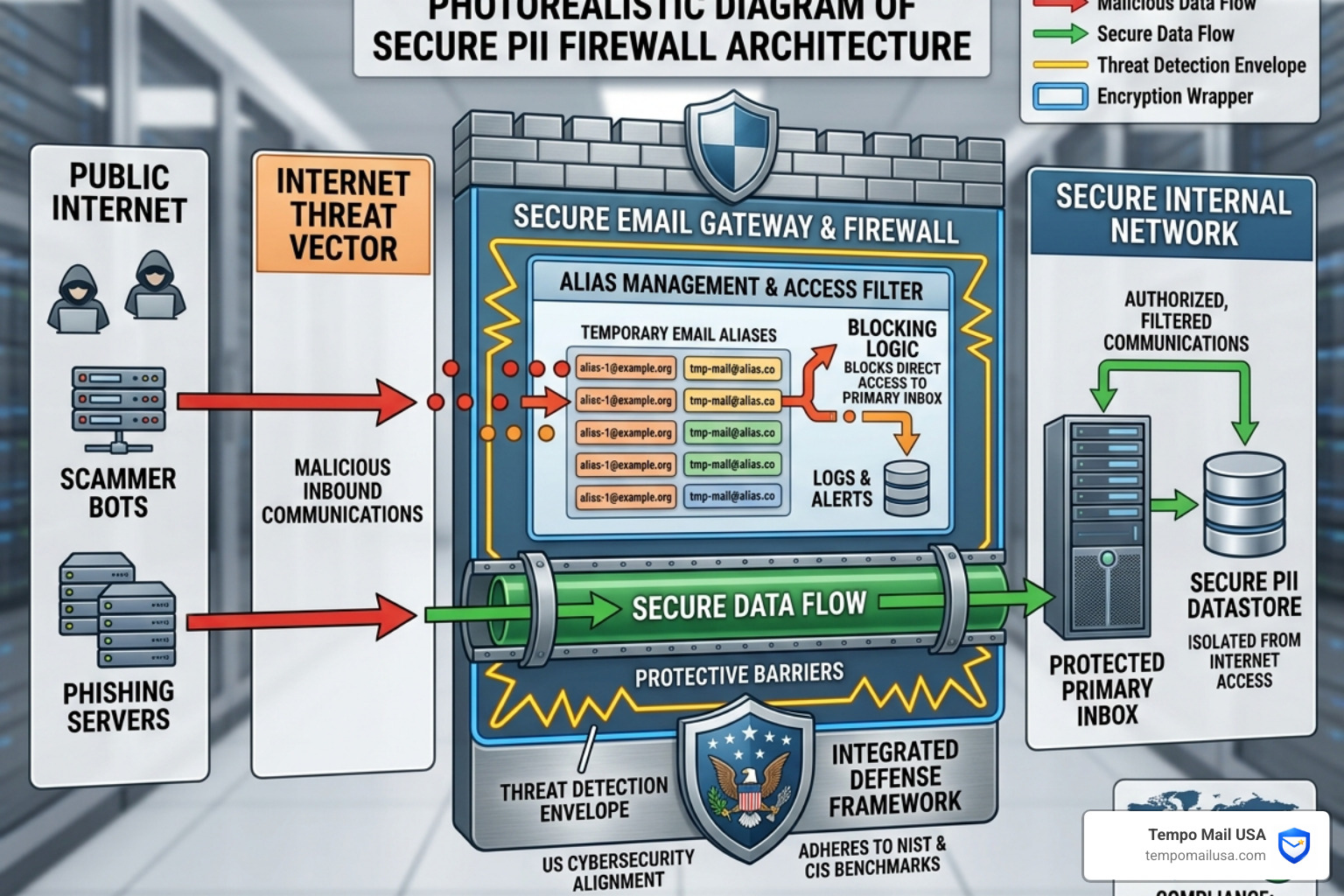
The root cause of the us claim registry scam is the exposure of your Personally Identifiable Information (PII). When you use your real, primary email address for business registrations, domain signups, or public filings, you are essentially handing scammers a direct line to your inbox.
This is where Tempo Mail USA becomes your most powerful defensive tool. By using a "PII Firewall," you can protect your primary identity from being harvested by the bots that fuel these scams.
Why You Need a Temporary Email Alias
Using disposable email infrastructure isn't just for avoiding spam; it's a core component of data privacy compliance and advanced malware protection.
- Anonymity in Public Filings: When a database is scraped, the scammers get your "proxy" email, not your real one.
- Instant Kill Switch: If a specific alias starts receiving us claim registry scam emails, you can simply delete that alias. The "link" to your real life is severed instantly.
- Advanced Malware Protection: Tempo Mail USA filters out malicious attachments and tracking pixels before they ever reach your local device.
- Secure Identity Proxying: We act as a middleman, ensuring that your real service providers can reach you, but the "bad guys" only see a temporary wall.
For any business owner or creator, using a temporary email for public-facing registrations is the digital equivalent of using a secure PII firewall. You wouldn't leave your office door unlocked at night; don't leave your primary email address in a public government database. Secure your identity now by adopting a proactive privacy posture.
Enterprise Cybersecurity and Identity Theft Protection Services
For larger organizations, the us claim registry scam can be a precursor to a larger corporate takeover or data breach. Protecting a business requires more than just a strong password; it requires an integrated stack of enterprise cybersecurity tools.
The Essential Security Stack for Businesses:
- Identity Theft Protection Services: These services monitor the dark web for your company's EIN, your executives' SSNs, and leaked credentials.
- Enterprise VPN Solutions: Ensure that all employee connections are encrypted, preventing "man-in-the-middle" attacks where scammers might intercept sensitive filing data.
- Secure Cloud Storage for Business: Store your intellectual property documents (patents, trademark certificates) in encrypted vaults rather than standard email folders.
- Credit Monitoring Software: Set up alerts for your business credit profile. Scammers often try to take out loans using the "legitimacy" of your hijacked trademark.
- Cybersecurity Insurance: If the worst happens and you lose significant funds to a wire fraud scam, insurance can be the difference between staying open and filing for bankruptcy.
If you find yourself entangled with a fraudulent financial entity, we have developed a specific framework for recovery: How to Resolve First Financial Scam - 5 Guaranteed Methods.
Frequently Asked Questions about US Claim Registry Scams
What is the US Claim Registry scam?
It is a fraudulent scheme where scammers impersonate government agencies (like the USPTO or IRS) or create fake "registries" to demand money for trademark renewals, copyright fees, or to "release" unclaimed property. They use public data to make their claims look real.
How can I tell if a notice about unclaimed money is legitimate?
Real unclaimed money is managed by state governments and is always free to claim. If a notice asks for a "processing fee," a "tax," or payment via gift cards, it is a scam. Always verify by visiting unclaimed.org or your state's official .gov website.
Why do scammers target trademark and patent owners specifically?
Trademark and patent filings are public records. Scammers can easily see your name, address, and filing dates. They target owners because IP is valuable, and owners are often willing to pay quickly to avoid losing their legal protections.
What is the best way to protect my PII from being used in these scams?
The best defense is to use identity theft protection services and a secure email proxy like Tempo Mail USA. By using temporary email aliases for public filings, you ensure that your real PII is never scraped by scammers' bots.
Conclusion
The us claim registry scam thrives on the intersection of public data and private fear. By understanding that no legitimate government agency will ever demand payment via wire transfer or gift card, you have already won half the battle.
However, passive awareness isn't enough in an era of automated data scraping. You must adopt a proactive cybersecurity insurance mindset. This means using enterprise VPN solutions, monitoring your credit, and most importantly, shielding your PII.
Using a service like Tempo Mail USA allows you to interact with the digital world through a secure PII firewall. It’s time to stop giving scammers the keys to your inbox. By utilizing temporary email infrastructure and staying vigilant, you can protect your business, your creations, and your financial future. Protect your business today and turn the tide against digital fraud.