



Resolve First Financial Scam: What You Need to Know Right Now
If you've been targeted by the resolve first financial scam, here's what to do immediately:
- Do not call back any number left in the voicemail
- Do not share any personal or financial information
- Block the number and let future calls go to voicemail
- Check your credit report at AnnualCreditReport.com to see if any real debts exist
- Report the call to the FTC at ReportFraud.ftc.gov
Calls and voicemails from Resolve First Financial have been showing up on phones across the country in 2025 — and they follow a very familiar pattern.
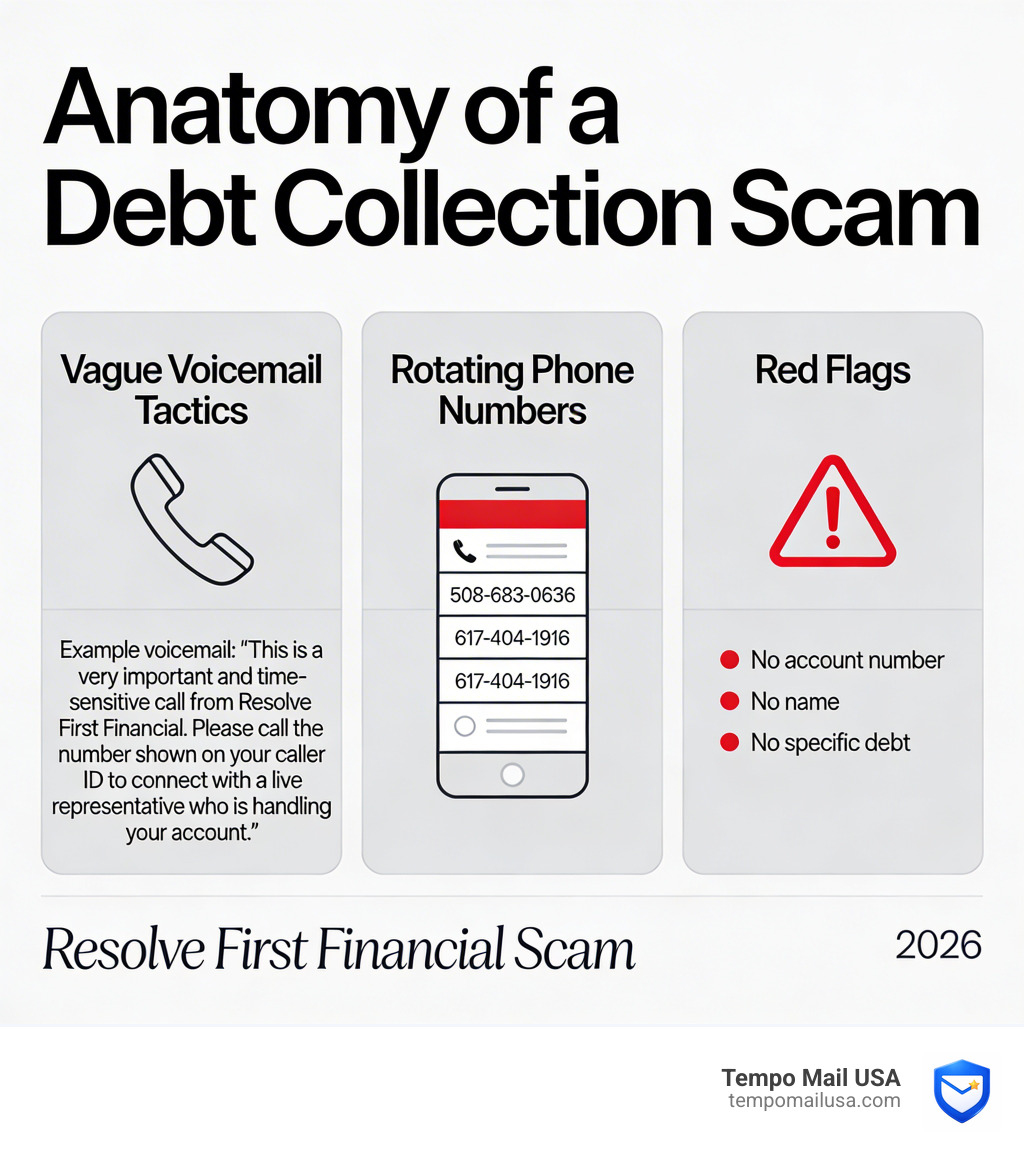
The message is vague. No account number. No name. No specific debt. Just something like:
"This is a very important and time-sensitive call from Resolve First Financial. Please call the number shown on your caller ID to connect with a live representative who is handling your account."
That's it. No real details.
One consumer described receiving multiple calls from different phone numbers — including 508-683-0636 and 617-404-1916 — none of which matched the official number listed on the company's website. That same person had previously lost $1,800 to a similar scam targeting accounts that had been paid off for over 20 years.
These calls are designed to make you panic and call back. The moment you do, scammers fish for your personal information — your name, address, Social Security number, or payment details.
This is a textbook debt collection scam, and the BBB Scam Tracker officially flagged it as a Credit Repair/Debt Relief scam as recently as November 25, 2025.
Here's the good news: you have clear legal rights, and there are specific steps you can take to protect yourself — starting right now.
Identifying the Resolve First Financial Scam
When we look at the reports flooding into the BBB Scam Tracker, a clear picture of the resolve first financial scam emerges. This isn't your standard debt collection agency; it is a highly coordinated robocall operation designed to exploit financial anxiety.
The primary weapon in their arsenal is the vague voicemail. Unlike legitimate agencies that must identify themselves and the nature of the debt clearly, these calls use "blind" scripts. They mention a "time-sensitive matter" or "handling your account" without ever mentioning your name or an account number. This is a classic phishing attempt. If they don't know who you are, they are simply casting a wide net to see who bites.
Spotting the Resolve First Financial Scam Red Flags
We’ve identified several glaring red flags that should tell you immediately to hang up:
- Rotating Area Codes: You might get a call from (571) 302-8632 one hour and a completely different area code the next. This is called "neighbor spoofing" or using VOIP numbers to bypass your blocks.
- Mismatched Phone Numbers: Often, the number on your caller ID doesn't match the number they tell you to call back. If you research the company online, you'll find their "official" numbers don't match the ones calling you.
- Lack of Specifics: Legitimate collectors have your data. Scammers ask you to provide it. If they ask for your Social Security number to "verify your identity" before telling you what the debt is, it’s a scam.
- Urgent and Threatening Tone: They want you to act before you think. Using words like "judgment," "legal action," or "last chance" is a psychological trick to bypass your logic.
For more insights into how these types of operations stay under the radar, you can read our look at whether Boardsi is a scam.
How to Stop a Resolve First Financial Scam Robocall
Stopping these calls requires a multi-layered defense. First, we recommend utilizing your smartphone’s built-in "Silence Unknown Callers" feature. If a number isn't in your contacts, it goes straight to voicemail. Since the resolve first financial scam relies on you picking up to "verify" your info, denying them a live person is your best first step.
Second, ensure you are on the National Do-Not-Call Registry. While scammers often ignore this, it gives you more legal leverage when reporting them. If the harassment persists, check out our guide to Payne Richards Associates for more tips on dealing with aggressive outreach.

5 Guaranteed Methods to Resolve Fraudulent Debt Claims
If you’ve already been contacted, don't panic. We have developed five proven methods to handle these fraudulent claims and get the scammers off your back for good.
| Feature | Legitimate Debt Collector | Resolve First Financial Scam |
|---|---|---|
| Identification | Provides full name and company address | Vague, anonymous, or uses common names |
| Debt Info | Knows the exact amount and original creditor | Asks you to "verify" or "confirm" details |
| Paperwork | Sends a written validation notice within 5 days | Refuses to send mail; insists on phone payment |
| Payment | Accepts checks, credit cards, or bank transfers | Demands gift cards, wire transfers, or crypto |
| Threats | Follows FDCPA (no threats of jail) | Uses intimidation and legal threats |
Method 1: Verify the Debt via Official Credit Bureaus
The absolute first thing we recommend is checking the facts. If you truly owed money, it would likely appear on your credit report. You can get your free annual credit report here.
Check the reports from the "Big Three": Equifax, Experian, and TransUnion. If the debt claimed by Resolve First Financial isn't there, or if it's a "phantom account" you don't recognize, you are likely dealing with a scam. Also, look for "time-barred" debts—debts so old that the legal window for collection has expired. Scammers love to buy these "zombie" debts for pennies and try to scare you into paying them.
Method 2: Demand a Written Validation Notice
Under the Fair Debt Collection Practices Act (FDCPA), any legitimate collector must send you a written validation notice within five days of their first contact. This notice must include the amount of debt and the name of the creditor.
If they refuse to send this via physical mail, or if they claim they "already sent it" but can't provide a tracking number, stop talking. You can use our checklist for Finelo to see how other companies handle transparency. Never agree to a debt over the phone without seeing it in writing first.
Method 3: Cease and Desist Communication
You have the legal right to tell a debt collector to stop contacting you. We recommend sending a "Cease and Desist" letter via certified mail with a return receipt requested. Once they receive this, they are legally prohibited from contacting you except to confirm they will stop or to notify you of a specific legal action (like a lawsuit, which scammers almost never actually file).
Keeping a detailed call log is essential here. Note the time, date, and phone number of every call. If they continue to call after receiving your letter, they are violating federal law. For more on verifying if a company is operating within legal boundaries, see our Shepherd Outsourcing review.
Method 4: Report to Federal and State Authorities
Scammers thrive in the shadows. To resolve the resolve first financial scam, you need to shine a light on them. Report the activity to:
- The FTC: Use ReportFraud.ftc.gov to help the government build a case.
- State Attorney General: Especially if you are in Texas, where the AG has been vocal about debt threats, filing a state-level complaint is vital.
- IC3: If the scam involved any internet communication, file a report at the Internet Crime Complaint Center.
- econsumer.gov: If the calls seem to originate from outside the US, report them at econsumer.gov.
Method 5: Secure Your Personal Information
If you’ve spoken to them at all, you must assume your data is at risk. Scammers often share "sucker lists" with other fraudsters. We suggest visiting IdentityTheft.gov to set up a recovery plan. Change your passwords, especially for your email and banking apps.
If you gave them access to your computer, run a full security scan immediately. For those who might have interacted with other suspicious sites, our guide on whether Temu is a scam offers broader advice on digital safety.
Your Legal Rights Under the Telemarketing Sales Rule
Many people don't realize that the resolve first financial scam often violates the Telemarketing Sales Rule (TSR). Amended in 2010, this rule specifically prohibits debt relief services from charging upfront fees. If a company asks for money before they have settled or reduced your debt, they are breaking the law.
Furthermore, the TSR requires clear disclosures. They cannot misrepresent the consequences of their service or fail to tell you how long it will take to see results. If they threaten you with jail time, they are moving from "unethical" into "criminal" territory. Debt is a civil matter, not a criminal one. You cannot be arrested for owing a credit card balance.
We’ve seen similar tactics used in other industries, such as the AI.com scam patterns, where urgency is used to mask a lack of legal compliance.
What to Do if You Already Paid a Scammer
If you’ve already sent money, every second counts. Here is our step-by-step recovery guide:
- Bank Chargebacks: If you paid by credit or debit card, call your bank immediately. Tell them the charge was fraudulent and request a chargeback.
- Wire Transfers: If you used Western Union or MoneyGram, call their fraud departments instantly. If the money hasn't been picked up yet, they can sometimes stop it.
- Gift Cards: Contact the company that issued the card (e.g., Apple, Google, Target). If the funds are still on the card, they may be able to freeze them and issue a refund.
- Mail Intercept: If you sent cash or a check via USPS, use the USPS Package Intercept service to stop the delivery.
- Watch for "Recovery Scams": This is critical. Scammers often sell your name to "recovery" firms that claim they can get your money back for a fee. This is just the same scammer wearing a different hat. For more on this cycle, see our Burnslim legitimacy guide.
Frequently Asked Questions about Resolve First Financial
Is Resolve First Financial a legitimate company?
Based on current BBB reports and consumer data from 2025, the entities calling from numbers like (571) 302-8632 are not operating as a legitimate, transparent business. While there may be companies with similar names, the specific "Resolve First Financial" robocall campaign is widely flagged as a scam due to its lack of transparency, use of spoofed numbers, and failure to provide debt validation.
Can a debt collector threaten me with arrest?
No. Under the FDCPA, it is illegal for a debt collector to threaten you with arrest or jail time. They also cannot impersonate law enforcement or government officials. If a caller says the "police are on their way" because of an unpaid debt, they are a scammer. Hang up and report them to the FTC.
How do scammers get my phone number?
Scammers obtain numbers through various channels, including data breaches, public records, and social media. They also buy "lead lists" from shady brokers. Companies like Firstunityreserve have warned that fraudsters often impersonate executives to gain trust before launching these campaigns.
Conclusion
The resolve first financial scam is a reminder of how vulnerable our personal information can be in the digital age. These scammers rely on the fact that your real phone number and email address are often linked to your most sensitive financial data.
At Tempo Mail USA, we believe the best way to resolve a scam is to prevent it from ever reaching you. By using our secure email alias generation, you can shield your real identity from services and lead generators. We act as a firewall between you and "sucker lists" and data brokers. When you use an alias, you cut off the scammers' primary way of finding you.
If you've been targeted, take a deep breath and follow the steps we've outlined. Knowledge is your best defense. For a deeper dive into the reporting process, check out our guide on how to report fraud to the FTC the right way. Stay safe, stay private, and don't let the robocalls win.