

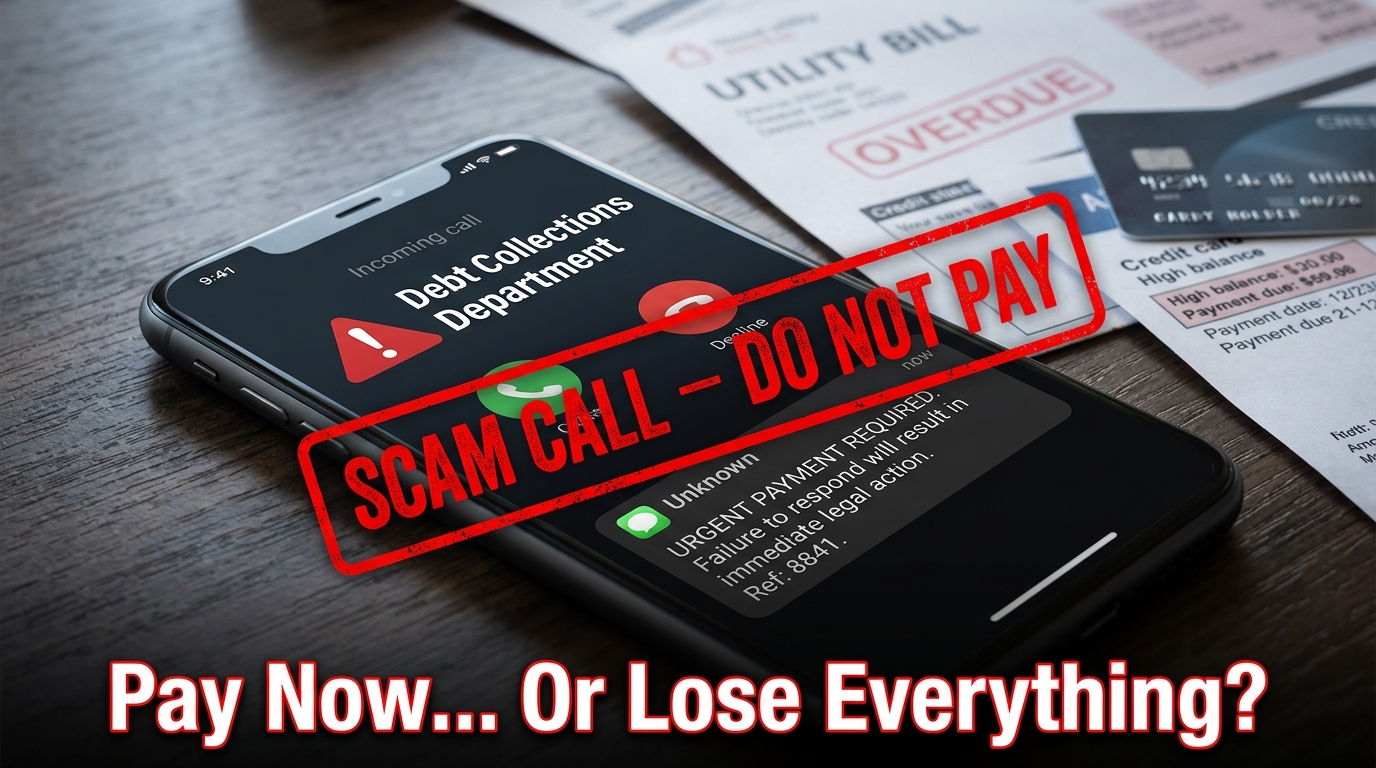

The Fake Debt Collector Scam Is More Common Than You Think
A fake debt collector scam happens when someone pretends to be a debt collector to frighten you into paying money you may not owe. Here's what you need to know right away:
Quick answers:
- What it is: Scammers impersonate debt collectors and demand payment for debts that are fake, already paid, or unenforceable
- Biggest red flags: Threats of arrest, demands for gift cards or wire transfers, refusal to provide written verification
- What to do: Do not pay. Request written debt validation. Hang up and report to the FTC at ReportFraud.ftc.gov
- Your key right: Under the Fair Debt Collection Practices Act (FDCPA), any collector must send you written debt details within 5 days of first contact
These scams are not rare. The FTC recorded 124,450 reports of debt collection fraud in a single year. The Consumer Financial Protection Bureau (CFPB) ranked debt collection as the second-most complained-about consumer issue in 2023.
And the problem is getting worse. High consumer debt levels have made more people vulnerable — scammers know this and are exploiting it aggressively, now targeting victims through calls, texts, and emails alike.
The scary part? These scammers often have fragments of your real personal information — like the last four digits of your Social Security number — which makes them sound disturbingly legitimate.
This guide covers exactly how these scams work, how to spot them, and how to protect yourself.
How the Fake Debt Collector Scam Works
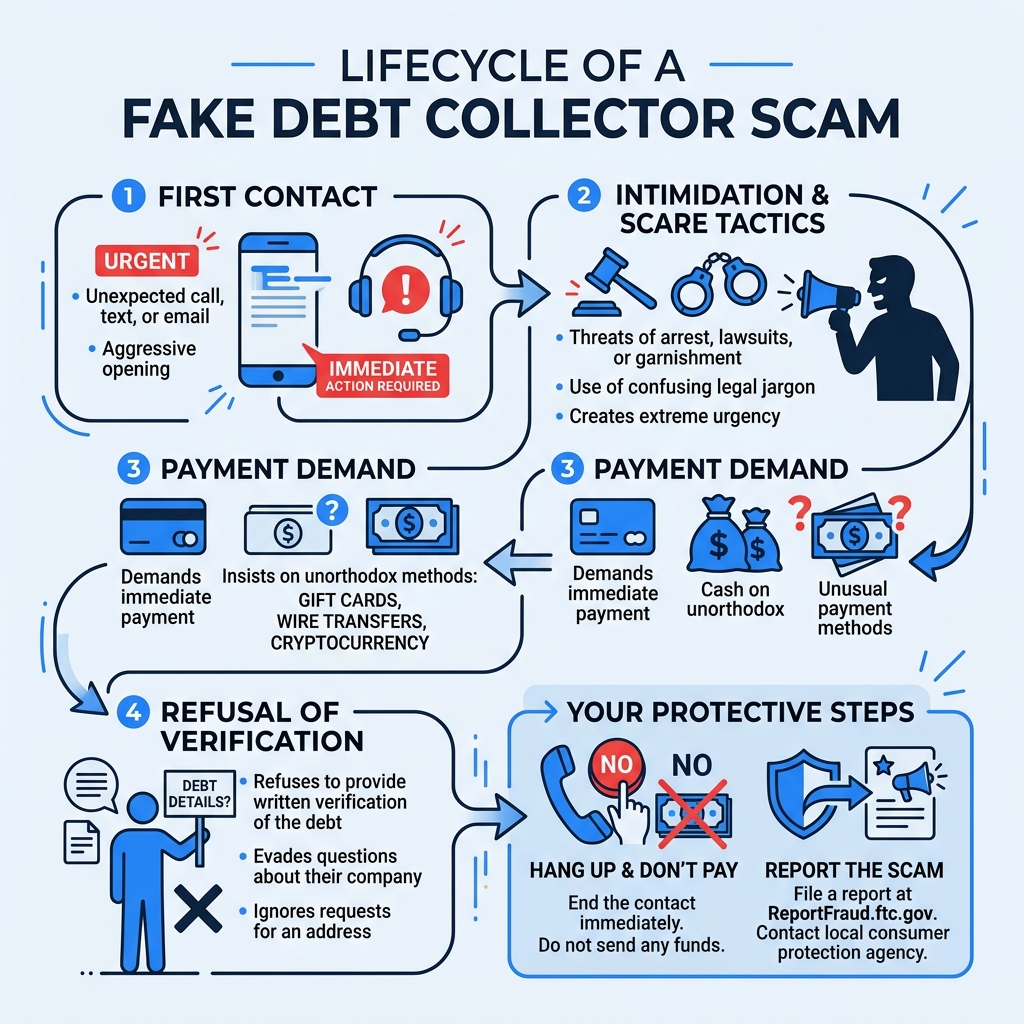
The fake debt collector scam is a psychological game. It relies on high-pressure tactics to bypass your logical thinking. We’ve seen these scammers evolve from simple cold calls to sophisticated operations that use official-sounding names and legal jargon to make you believe a lawsuit is imminent.

Scammers often impersonate lenders, law firms, or even government agencies like the IRS. They might claim you owe money on a payday loan you never took out, or a credit card you closed a decade ago. According to The debt collection scam 2.0 is making the rounds, this "2.0" version of the scam is resurfacing with a vengeance because high national debt levels mean almost everyone has a reason to be a little bit worried about their finances.
One of the most common tools in their arsenal is "zombie debt." This refers to old, time-barred debts that are past the statute of limitations. Scammers buy these "dead" debts for pennies and try to "bring them back to life" by tricking you into making a small payment. Once you pay even a single dollar, you might accidentally restart the clock on the debt's legal lifespan, giving them more leverage to harrass you.
The Mechanics of a Fake Debt Collector Scam
How do they find you? Usually, it starts with a data breach. Scammers don't just guess your name; they often have access to spreadsheets containing partial personally identifiable information (PII). This might include your old addresses, the last four digits of your SSN, or even your bank's name.
They use caller ID spoofing to make it look like they are calling from a local courthouse or a government office. If they can't reach you by phone, they turn to phishing emails or texts. We’ve analyzed cases like the unifin-text-scam-real-debt-collector-or-fraud where people receive urgent messages about "unresolved accounts" designed to spark panic.
By using these fragments of your real life, they build a facade of legitimacy. They count on you being too embarrassed or scared to ask for proof.
Red Flags: Spotting a Fake Debt Collector Scam
Knowing the difference between a legitimate collector and a criminal can save you thousands of dollars. Legitimate collectors are bound by strict federal laws, while scammers follow no rules at all.
| Feature | Legitimate Debt Collector | Fake Debt Collector Scam |
|---|---|---|
| Payment Method | Check, credit card, or bank transfer | Gift cards, wire transfers, cryptocurrency |
| Contact Info | Provides physical address and phone | Refuses to give a physical mailing address |
| Verification | Sends a written validation notice | Demands immediate payment over the phone |
| Tone | Professional (though firm) | Aggressive, threatening, or abusive |
| Legal Threats | May mention a lawsuit (if true) | Threats of immediate arrest or jail time |
According to the CFPB in How do I tell if a debt collector is legitimate or a scam?, a major red flag is the refusal to provide a professional license number or a physical street address. If they only give you a P.O. Box or a generic website, walk away.
Warning Signs of a Fake Debt Collector Scam
If you encounter any of the following, you are likely dealing with a fake debt collector scam:
- Demands for Untraceable Payments: No real business asks to be paid in iTunes gift cards or via a Western Union wire transfer. These methods are preferred by scammers because once the money is sent, it is gone forever.
- The "Agency" Doesn't Exist: Scammers often make up official-sounding names. For example, we've warned about the traffic-compliance-department-scam-that-agency-doesnt-exist, where callers pretend to be from a non-existent government branch to collect "fines."
- Aggressive Threats: Real collectors cannot legally tell you that the police are on their way to arrest you. They cannot threaten to have your driver's license suspended or tell your boss about your debt.
- Unrecognized Debt: If you have no record of the debt and it doesn't appear on your credit report, treat the call as a scam until proven otherwise.
Your Legal Rights Under the FDCPA
The Fair Debt Collection Practices Act (FDCPA) is your primary shield. This federal law dictates what collectors can and cannot do. If a collector violates these rules, they aren't just being "mean"—they are breaking the law.
Key FDCPA Protections:
- Calling Time Restrictions: They can only call between 8 a.m. and 9 p.m. local time.
- Harassment Prohibitions: They cannot use profane language, threaten violence, or call you repeatedly (the rule is generally no more than 7 calls in a 7-day period).
- Workplace Rules: If you tell them your employer doesn't allow personal calls at work, they must stop calling you there.
- The 5-Day Rule: Within five days of first contacting you, a collector must send you a written "validation notice."
Verification Requirements for Legitimate Debt
A legitimate collector will have no problem putting things in writing. In fact, the law requires it. If you are unsure about a debt, such as in the cnfi-usa-loan-text-scam-what-you-need-to-know, you should always demand a validation letter.
This letter must include:
- The exact amount of money owed.
- The name of the current creditor.
- A statement that you have 30 days to dispute the debt.
- The name of the original creditor (upon request).
If you dispute the debt in writing within that 30-day window, the collector must stop all collection activities until they provide you with proof that the debt is actually yours.
What to Do If You’re Targeted by a Fake Debt Collector Scam
If you suspect you're being targeted, the most important thing is to stop talking. Scammers are trained to keep you on the phone, using "fear, uncertainty, and doubt" to wear you down.
Immediate Steps After a Fake Debt Collector Scam
- Hang Up and Verify: Do not engage. Instead, find the phone number of the original creditor (like your bank or doctor’s office) from a trusted source, like your last statement or their official website. Call them directly to ask if your account has been sent to collections.
- Check Your Credit Report: Visit AnnualCreditReport.com to get your free report from Equifax, Experian, and TransUnion. If the debt is real, it will almost always show up there. If it's not on your report, it’s a massive red flag.
- Document Everything: Write down the time of the call, the number that showed up on your ID, and exactly what the person said. This is vital for reporting.
- Report to the Authorities:
- FTC: Report at ReportFraud.ftc.gov.
- CFPB: Submit a complaint at consumerfinance.gov/complaint.
- State Attorney General: Your state’s AG office often has a consumer protection division specifically for these scams.
- Place a Fraud Alert: If you’ve already shared personal info like your SSN, contact one of the three credit bureaus to place a free fraud alert on your account.
Frequently Asked Questions about Debt Scams
Can I be arrested for an unpaid consumer debt?
No. This is one of the biggest myths used in a fake debt collector scam. In the United States, we do not have "debtors' prisons." Unpaid consumer debt (like credit cards, medical bills, or student loans) is a civil matter, not a criminal one. A collector can sue you in civil court, but they cannot have you arrested. The only rare exception involves ignoring a court order to appear, but even then, the "crime" is contempt of court, not the debt itself. Any collector threatening jail is a scammer.
What exactly is 'zombie debt'?
Zombie debt is debt that is very old—often 10 to 20 years old. In every state, there is a "statute of limitations" (usually 3 to 10 years) after which a creditor can no longer win a lawsuit to collect the money. Scammers buy this "time-barred" debt for fractions of a penny and use aggressive tactics to scare you into paying. Be careful: in many states, if you make even a $5 payment "just to get them to stop calling," you "reset" the statute of limitations, making the entire debt legally enforceable again!
What information must a collector provide to prove a debt is real?
A legitimate collector must provide their full company name, a physical mailing address, and a professional license number (if your state requires one). They must also provide the "Validation Notice" mentioned earlier. If they refuse to give you a phone number where you can call them back, or if they give you a generic name like "The Litigation Department," you are likely dealing with a fraudster.
Conclusion
The fake debt collector scam thrives on the fact that our personal information is often floating around the internet due to various data breaches. When a scammer calls you and knows your address or the last four digits of your SSN, it’s not because they are "official"—it’s because your data was likely leaked or sold.
At Tempo Mail USA, we believe the best way to stop a scam is to prevent it from starting. By using our temporary email aliases, you can create a "privacy firewall." When you sign up for services, apps, or newsletters, you don't have to give away your real PII (Personally Identifiable Information). If that service later suffers a data breach, the scammers won't have your real email or the data linked to it.
Protecting your identity is the first step in staying off a scammer's call list. Stay vigilant, know your rights, and never let a caller pressure you into a snap decision.