

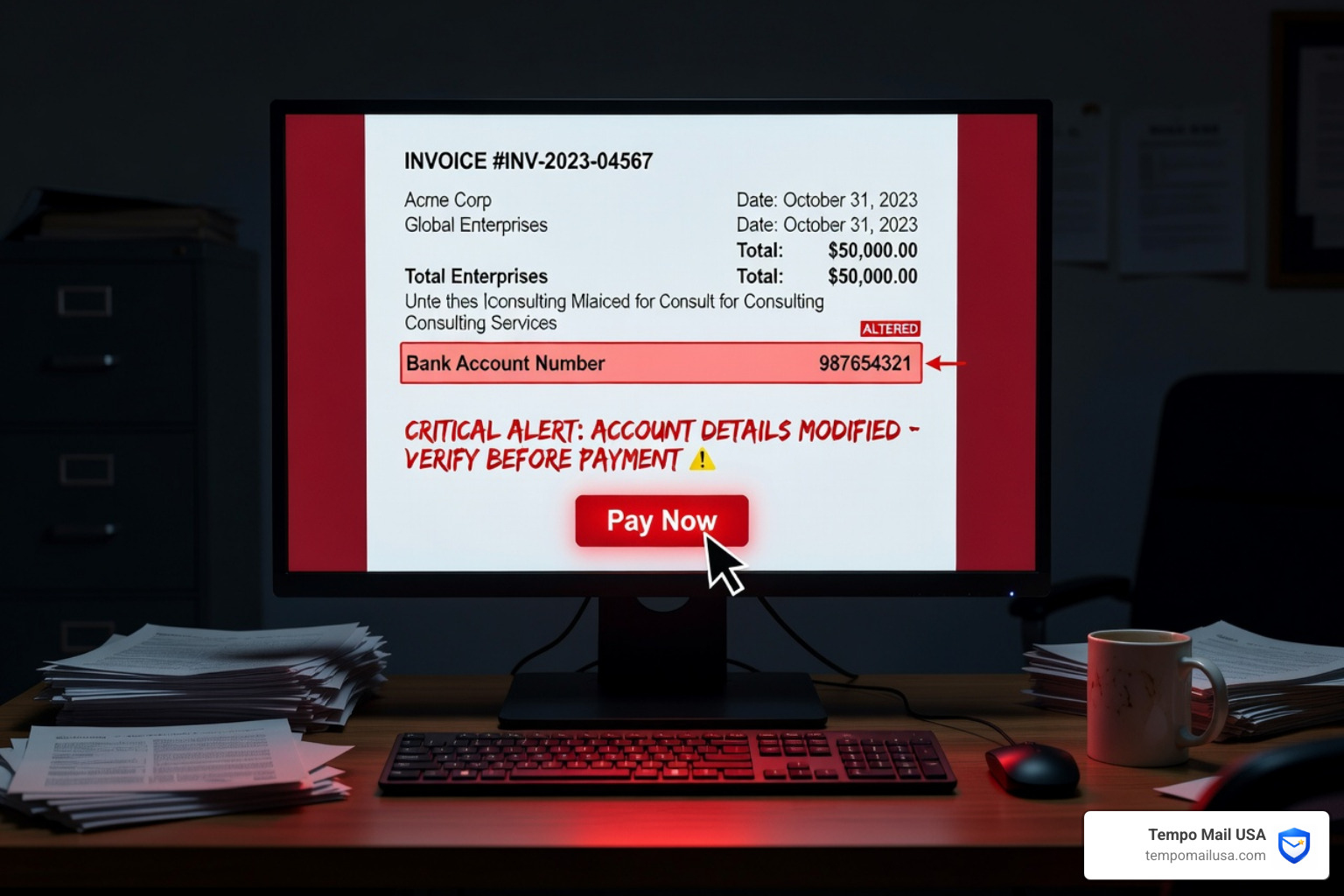

The Fake Invoice Email Scam Business Is Costing Companies Billions
Fake invoice email scam business fraud is one of the fastest-growing financial crimes targeting organizations of every size. Here's a quick breakdown of what it is and why it matters:
What is a fake invoice email scam?
- Scammers impersonate a vendor, supplier, or service provider you trust
- They send a realistic-looking invoice by email with altered payment details
- You (or your accounting team) pay — but the money goes to the fraudster
- The real vendor never receives payment
Key facts at a glance:
| Fact | Detail |
|---|---|
| Average loss per BEC incident | $120,000+ |
| Total US losses from BEC in 2022 | $2.7 billion |
| Share of fraud caused by invoice scams | 44.8% of all fraudulent payments |
| Organizations targeted monthly | Most mid-to-large businesses |
| Fraud driven by generative AI | Cited by 62% of businesses |
These scams work because they're designed to look completely normal. A fraudulent invoice can include your vendor's real logo, a copied tax ID, and a professional email format. The only thing that changes is the bank account number — and that's all it takes.
The financial damage is staggering. In 2021 alone, business email compromise (BEC) scams — with invoice fraud as a major driver — cost organizations more than $2.4 billion. And the problem is accelerating, with generative AI now helping scammers produce more convincing, personalized fake invoices at scale.
This guide walks you through exactly how these scams work, how to spot them, and what your business can do right now to stay protected.
What is a Fake Invoice Email Scam Business?
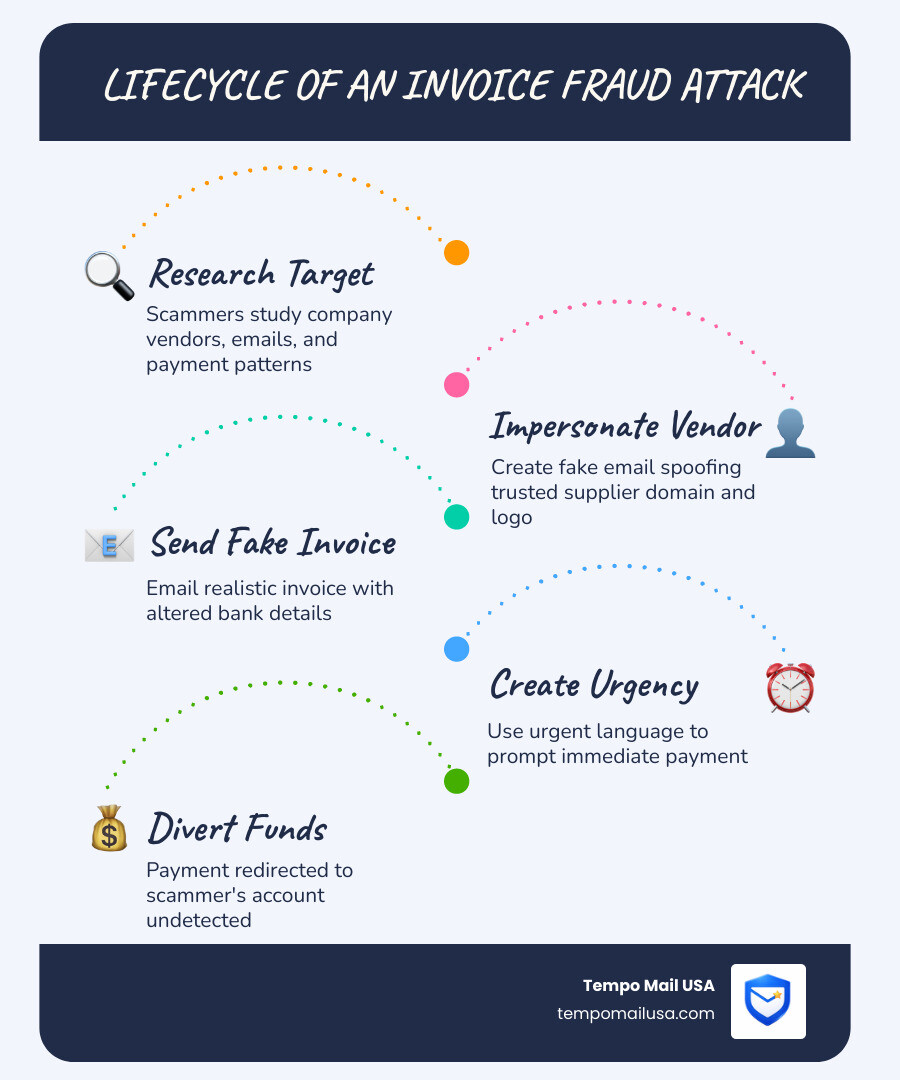
At its core, a fake invoice email scam business is a sophisticated operation where attackers impersonate a legitimate vendor or partner to divert payments into their own pockets. This isn't just a lone hacker in a basement; it’s a well-coordinated ploy often involving extensive research into a company’s supply chain.
According to the 2021 FBI Report, invoice fraud is a major subset of Business Email Compromise (BEC). Attackers spend weeks or months monitoring email threads after gaining unauthorized access to a vendor’s account. They wait for the perfect moment—usually when a large payment is due—to swoop in and "update" the payment instructions.
The Mechanics of Deception
The goal is simple: payment redirection. By the time the real vendor calls to ask why their bill hasn't been paid, the money is long gone. Scammers use several high-level tactics to achieve this:
- ABN and Logo Theft: In Australia and other regions, scammers clone Australian Business Numbers (ABNs) and high-resolution logos to make documents look identical to the real thing.
- Vendor Impersonation: They don't just pretend to be any company; they pretend to be your company's specific partner.
- Identity Shielding: To prevent your team from spotting the ruse, they often use spoofed domains that are off by just one letter (e.g., @suppl1er.com instead of @supplier.com).
Understanding these basics is the first step in learning how to protect yourself from phishing.
Common Types of Invoice Fraud and How They Work
The fake invoice email scam business isn't a "one size fits all" operation. Fraudsters have developed a variety of methods to bypass traditional accounting checks.
1. Copycat and Third-Party Invoices
This is the most common form. A fraudster creates an invoice that looks exactly like one from a known supplier. They might even include the correct "Accounts Payable" headers. The only difference? The bank account details have been changed to a "new" account allegedly belonging to the vendor.
2. Duplicate Billing
Sometimes, the scam is simpler. A fraudster (or even a shady vendor) sends the same invoice twice, hoping the accounting department will pay both without noticing the overlap. While it sounds basic, in a busy office processing thousands of payments, it happens more than you'd think.
3. Internal Collusion
We often think of threats as external, but a survey by PwC revealed that 31% of fraud attacks were perpetrated by internal employees. Another 26% resulted from internal and external players working together to funnel money to outside accounts.
4. Fabricated Threading
This is a high-level social engineering tactic. The attacker fakes an entire email history. They might forward a fake invoice to you, making it look like your CEO or a department head has already approved it in a previous (but non-existent) email thread.
Legitimate vs. Fake Invoice Traits
| Feature | Legitimate Invoice | Fraudulent Invoice |
|---|---|---|
| Sender Address | Matches known contact exactly | Slight misspelling or "spoofed" name |
| Payment Details | Matches your ERP/records | "Updated" or "Temporary" bank info |
| Urgency | Standard net-30 or net-60 terms | Demands immediate payment to avoid "penalties" |
| Language | Professional and consistent | Poor grammar or unusual syntax |
| Formatting | High-quality, consistent branding | Pixelated logos or inconsistent fonts |
Identifying a Fake Invoice Email Scam Business in Your Inbox
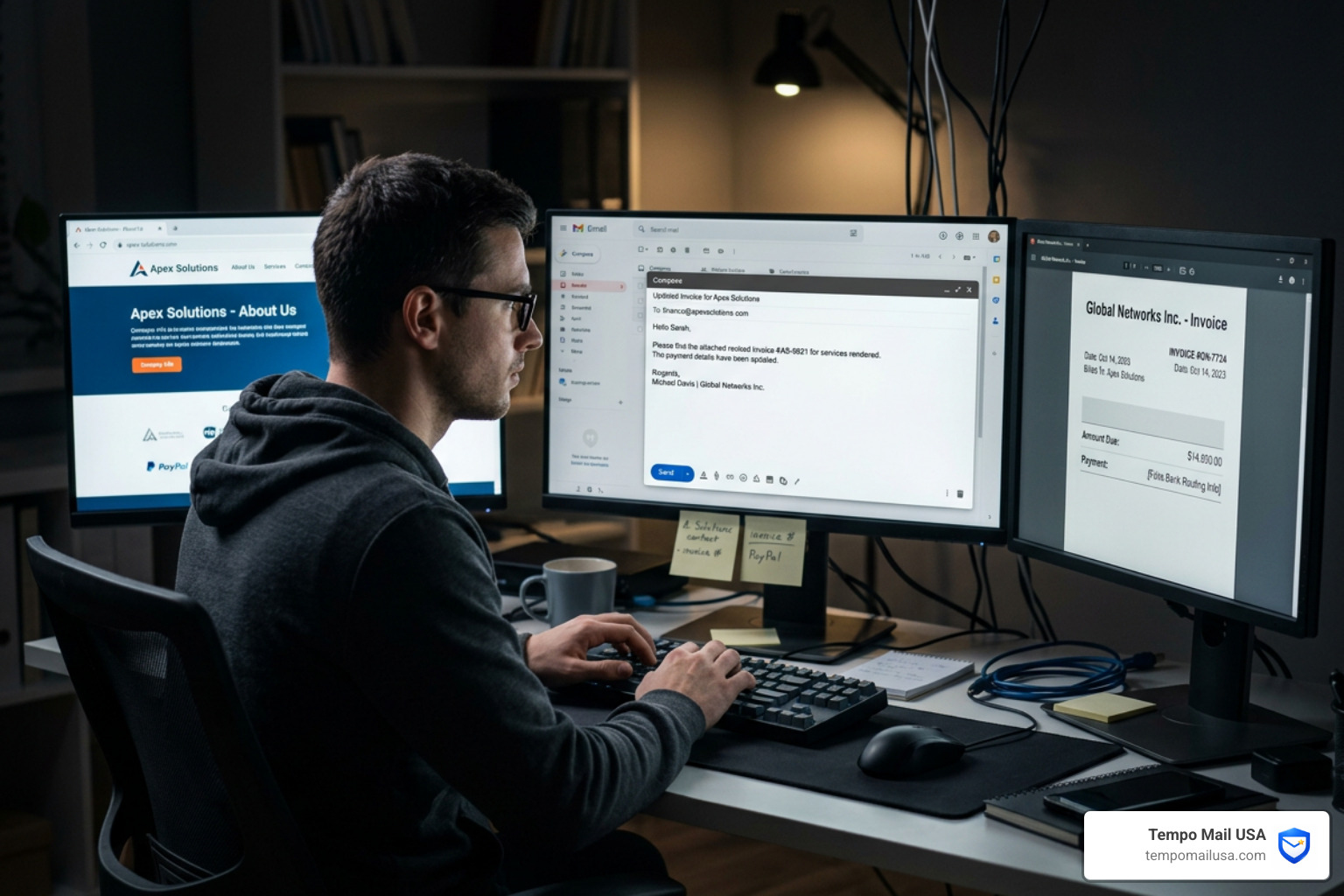
Scammers often use "phishing for access" as their opening move. They don't want your money yet; they want your login credentials. By stealing your email password, they can monitor your conversations to find out when the next big invoice is expected. Learning to master how to spot phishing emails is your best defense against this initial breach.
Key Red Flags: How to Spot a Fraudulent Invoice
Even the most sophisticated fake invoice email scam business leaves clues. If you know where to look, you can catch these "perfect" fakes before hitting the "send" button on a wire transfer.
- Behavioral Urgency: If an email pressures you to pay "within the hour" or threatens legal action for a bill you didn't know existed, your internal alarm should go off. Urgency is designed to make you skip verification steps.
- PII Requests: Be extremely wary if a sender asks for Personally Identifiable Information (PII) or sensitive financial details via email. Legitimate vendors usually have secure portals for this.
- Unusual Dollar Amounts: Scammers sometimes use odd numbers or rounded "whole" numbers that don't match your typical purchase patterns.
- Mismatched Bank Details: This is the smoking gun. If a vendor suddenly claims they have changed banks and provides new wire instructions, never follow them without calling a known contact at that company first.
- Suspicious Links: Instead of a PDF, the email might contain a link to a "secure portal." These are often cloud storage scams designed to steal your credentials or deliver malware.
For a deeper dive, check out these 10 warning signs of a fake invoice email provided by industry experts.
Best Practices to Prevent Falling Victim to Scams
Protecting your business requires a mix of strict internal policies and smart technology. According to the 2023 AFP Payments Fraud and Control Survey, 65% of treasury practitioners reported being victims of payment fraud. Don't let your company be part of the next statistic.
1. Out-of-Band Verification
If you receive an email about a change in payment details, verify it using a different communication channel. Call the vendor using a phone number you already have on file—not the one listed in the suspicious email.
2. Multi-Person Approval
Never allow one person to have the power to both approve and execute a payment. Implementing a "dual-control" system ensures that at least two sets of eyes see every transaction, making it much harder for a fake invoice email scam business to succeed.
3. Employee Training and Reporting
Your team is your first line of defense. Regular, gamified training can help employees recognize the latest tactics. It is also vital to have a clear process for reporting phishing attacks so the IT department can alert the rest of the company.
4. Automation and PO Matching
Use automated Accounts Payable (AP) software to match incoming invoices against Purchase Orders (POs) and Goods Received Notes (GRNs). If the details don't match your internal records, the system should automatically flag the invoice for review.
Using Technology to Combat the Fake Invoice Email Scam Business
Modern problems require modern solutions. AI-driven email security can detect "anomalous" behavior—like a vendor who usually emails from New York suddenly sending an invoice from an IP address in another country.
Furthermore, implementing DMARC (Domain-based Message Authentication, Reporting, and Conformance) helps prevent scammers from spoofing your own company's domain. If you do encounter a suspicious file, knowing what to do with ransomware emails can prevent a single click from locking down your entire network.
Frequently Asked Questions about Invoice Fraud
What should I do if I pay a fake invoice?
Time is your enemy here. If you realize you've sent money to a fraudster, take these steps immediately:
- Notify your bank: They may be able to freeze the transfer if you act within minutes or hours.
- Contact law enforcement: File a report with your local police and the FBI’s Internet Crime Complaint Center (IC3).
- Report the fraud: Use official channels to report phishing in the USA via the FTC.
- Internal Audit: Change all passwords and check your email logs for unauthorized access.
Which industries are most at risk from the fake invoice email scam business?
While any business can be hit, scammers love high-value transactions.
- Real Estate: Large wire transfers for home purchases are prime targets.
- Manufacturing: Complex supply chains provide many opportunities for impersonation.
- Healthcare: High volumes of billing and sensitive data make this sector vulnerable.
- Travel and Automotive: Recent warnings from Scamwatch highlight an uptick in fake invoices for car purchases and travel bookings.
- Retail: Be careful of Amazon refund scams that use the "invoice" theme to lure victims.
How has AI changed the landscape of invoice scams?
AI has been a game-changer for the fake invoice email scam business. Scammers now use Generative AI to write perfect, error-free emails in any language. They can also use "Deepfake" audio to impersonate an executive's voice over the phone to "confirm" a fraudulent invoice. Even common terms in Docusign email scams are being refined by AI to look more official than ever before.
Conclusion: Build Your PII Firewall
The fake invoice email scam business relies on one thing: your information. The more a scammer knows about who you do business with, the easier it is to trick you. Vigilance and strong internal controls are your best weapons, but technology can give you the upper hand.
At Tempo Mail USA, we believe the best way to stop a scam is to prevent the scammer from ever getting your real contact details. Our temporary email aliases act as a PII firewall, shielding your primary identity from the services you use. By using a unique alias for different vendors and services, you make it significantly harder for fraudsters to map out your business relationships or target you with personalized phishing lures.
Stay safe, stay cynical, and protect your business's hard-earned revenue. Visit https://tempomailusa.com today to start building your defense.