



What Is a Risk to Government Systems Posed by Removable Media — Quick Answer
What is a risk to government systems posed by removable media is one of the most tested questions in DoD cybersecurity training — and for good reason. The answer affects national security every single day.
The short answer:
Removable media can lead to unintended transfers of information — including the introduction of malicious code and spillage of classified data — due to their storage capacity and ability to connect directly to systems.
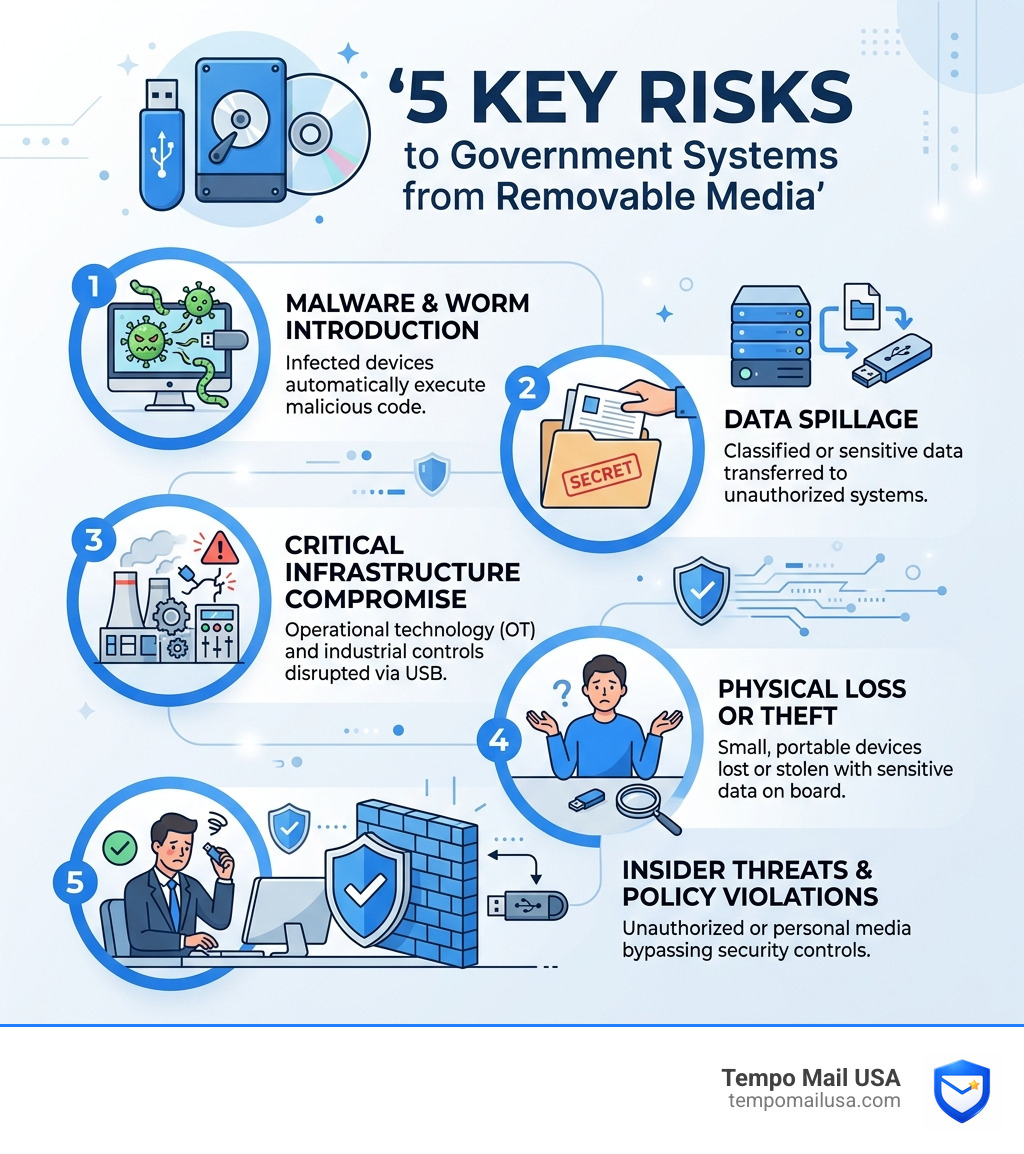
Here are the 5 key risks at a glance:
- Malware and worm introduction — infected devices execute malicious code automatically
- Data spillage — classified or sensitive information transferred to unauthorized systems
- Critical infrastructure compromise — OT and industrial control systems disrupted via USB
- Physical loss or theft — small, portable devices lost or stolen with sensitive data on board
- Insider threats and policy violations — unauthorized or personal media bypassing security controls
These aren't theoretical. Government training programs, CISA alerts, and NIST guidance all flag removable media as a persistent, high-priority threat vector in 2026.
The problem is simple: a device small enough to fit in your pocket can bring an entire classified network to its knees. And because these devices move between systems, they bypass many of the perimeter defenses agencies rely on.
In this guide, we break down each of these five risks in detail — what they are, how they happen, and what government employees and security teams can do about them.
1. Introduction of Malicious Code and Malware Worms
One of the most immediate dangers to any government network is the introduction of malicious code. Removable media devices, such as thumb drives and external hard drives, are notorious vectors for malware. Because these devices are designed to be "plug-and-play," they often bypass the rigorous scrutiny that an email attachment or a downloaded file might undergo.
According to Removable Media Security Practices | CISA, even newly purchased devices can be pre-infected with malware. This often occurs during the manufacturing or distribution process, where a worm is loaded onto the device, waiting for the moment it is plugged into a workstation. Many users now rely on advanced security tools and VPN protection to prevent these attacks, but once a device is physically connected to a system, the threat becomes much harder to contain.
What is a risk to government systems posed by removable media regarding malware?
The specific risk involves how Windows and other operating systems handle these devices. Historically, features like "Autorun" or "Autoplay" allowed a device to execute code as soon as it was plugged in. While many modern government systems have disabled these features, vulnerabilities still exist.
Infected devices can carry worms that propagate across a network, seeking out administrative credentials or sensitive databases. As noted in the DOD Cyber Awareness Challenge 2025 Flashcards - Quizlet, the primary risk is that the device's storage and connectivity lead to unintended transfers of information, specifically the introduction of malicious code that can compromise the entire system's integrity.
2. Data Spillage and Unauthorized Information Transfers
Data spillage occurs when sensitive or classified information is transferred to an unauthorized system or a lower security domain. Removable media is the "perfect" tool for this kind of accident—or intentional act. Because they are high-capacity and highly portable, they make it incredibly easy to move gigabytes of data in seconds.
We often see cases where an employee unknowingly copies a classified file onto a thumb drive intended for unclassified work. This is a primary way How Removable Media Leads To Data Exfiltration In Government occurs. Once that data is on a device that leaves a secure facility, the information is effectively compromised.
Risks of data spillage in Sensitive Compartmented Information Facilities (SCIFs)
Working in a SCIF (Sensitive Compartmented Information Facility) requires even stricter adherence to protocols. According to the Removable Media and Mobile Devices - DoD Cyber Exchange guide, any media used in these environments must be strictly identified and disclosed to Configuration Management (CM) authorities.
The risks in a SCIF include:
- Improper Labeling: Failing to label media with its classification level, date, and Point of Contact (POC).
- Unauthorized Cross-Domain Transfers: Attempting to move data between networks of different classification levels without using an authorized Cross-Domain Solution (CDS).
- Policy Violations: Bringing personal electronic devices (PEDs) or unapproved media into the secure space.
3. Compromise of Operational Technology (OT) and Critical Infrastructure
While we often think of "systems" as desktop computers and servers, government systems also include Operational Technology (OT). This includes the industrial control systems (ICS) that manage power plants, water treatment facilities, and manufacturing lines.
OT environments are often "air-gapped," meaning they are not connected to the public internet for security reasons. However, this creates a reliance on removable media for firmware updates and log retrieval. As highlighted by Cyber Risks of Portable Storage Media in OT | CSRC, an infected USB drive can jump the air gap, spreading malware to systems that were never meant to face the open web.
What is a risk to government systems posed by removable media in OT environments?
The risk here is not just data loss; it is physical safety and mission failure. A malware infection in an OT environment can lead to the disruption of critical services or even the physical destruction of hardware.
The Cyber Awareness 2026 Flashcards - Quizlet emphasize that using portable media in these settings requires specific technical controls. NIST SP 1334 provides a framework for managing these risks, recommending that organizations implement scanning stations—often called "sheep dip" computers—to check media for viruses before they are allowed near critical infrastructure.
4. Physical Loss and Theft of Sensitive Assets
The very thing that makes removable media useful—its portability—is also a massive security liability. These devices are small, easy to misplace, and easy to steal. If a government-issued thumb drive containing sensitive data is lost at a coffee shop or stolen from a vehicle, the consequences can be catastrophic.
To mitigate this, the Security considerations for the use of removable media devices for Protected C and Classified information - ITSB-112 bulletin mandates strict cryptographic and physical controls.
Safeguarding hardware with cryptographic and physical controls
We recommend a layered approach to protecting the hardware itself:
- CMVP-Validated Modules: Devices must use encryption modules validated under the Cryptographic Module Validation Program (CMVP), operating strictly in FIPS mode.
- GSA-Approved Containers: When not in use, media should be stored in GSA-approved security containers to prevent unauthorized physical access.
- Inventory Management: Every piece of removable media should be treated as an accountable asset, with regular inventories to ensure nothing has gone missing.
- Physical Sensitivity: Treat the physical device with the same level of sensitivity as the highest classification of data it has ever held.
5. Insider Threats and Policy Non-Compliance
Sometimes, the risk isn't an outside hacker; it's a "trusted" insider. Insider threats can be malicious, but more often, they are simply employees trying to be "efficient" by bypassing security rules. Using personal media on government systems is a classic example of this.
When users bring in their own thumb drives to finish work at home, they are significantly increasing How Removable Media Poses Risks To Government Systems. These personal devices lack the managed encryption and antivirus protections required for government work, creating a massive hole in the agency's defensive perimeter.
Appropriate use of government-owned removable media
To stay compliant and secure, we must follow these best practices:
- Operational Necessity: Only use removable media when it is absolutely necessary for the mission.
- Agency Approval: Only use Government-Furnished Equipment (GFE). Never plug a personal device into a government system.
- Sanitization and Destruction: When a device is no longer needed, it must be sanitized or physically destroyed according to agency policy. Simply "deleting" files is not enough to prevent data recovery.
How to Choose the Right Protection: Technical and Procedural Controls
Protecting government systems requires a combination of "hard" technical locks and "soft" procedural rules. While technical controls stop the malware, procedural controls stop the human error that lets the malware in.
Comparison of Security Controls
| Control Type | Examples | Purpose |
|---|---|---|
| Technical | Encryption (FIPS 140-3), Port Disabling, Mandatory Scanning | Prevents unauthorized data reading and stops malware execution. |
| Procedural | Labeling Policies, Sign-out Logs, SCIF Disclosure | Ensures accountability and maintains the "chain of custody." |
| Physical | Locked Safes, Tamper-evident Seals | Prevents the physical theft or tampering of the media. |
Beyond these internal controls, maintaining general digital hygiene is vital. Using advanced privacy solutions and identity theft protection services helps ensure that if a breach does occur, the impact on individual employees is minimized.
One of the smartest habits for government employees—especially those handling Controlled Unclassified Information (CUI)—is to use a "PII Firewall." At Tempo Mail USA, we provide temporary email aliases that shield your real identity. By using a proxy for your email, you prevent your personal data from being linked to your professional accounts, adding a vital layer of defense against phishing and social engineering.
What is a Risk to Government Systems Posed by Removable Media? (2026 Summary)

As we look toward the remainder of 2026, the risks associated with removable media remain a top-tier concern for the DoD and civilian agencies alike. The primary risk to government systems posed by removable media is their ability to facilitate the unintended transfer of information.
Whether it is a pre-infected "gift" from a foreign intelligence service or a simple case of data spillage by a distracted employee, the consequences are the same:
- Loss of Confidentiality: Sensitive data ends up in the wrong hands.
- Integrity Compromise: Malicious code alters system behavior or data.
- Availability Issues: Ransomware or worms shut down critical mission systems.
By strictly adhering to the "GFE-only" rule, maintaining rigorous scanning habits, and respecting SCIF protocols, we can mitigate these risks and keep our systems secure.
Frequently Asked Questions about Removable Media Risks
What are common examples of removable media used in government?
Common examples include USB flash drives (thumb drives), external hard drives, optical discs like CDs and DVDs, memory sticks, and even portable music players or smartphones when connected via USB.
How should removable media be handled in a SCIF?
In a SCIF, you must disclose all media to Configuration Management (CM) authorities. It must be labeled with the classification level, date, and POC. When not in use, it must be stored in a GSA-approved container.
Why is personal removable media prohibited on government systems?
Personal media is prohibited because it lacks government-mandated encryption, hasn't been scanned for malware, and can easily lead to data spillage. It is one of the most common ways malware enters "air-gapped" government networks.
Conclusion
Understanding the risks of removable media is just one part of a larger commitment to cybersecurity. In an era where data is our most valuable asset, protecting it requires constant vigilance. From disabling autorun to using encrypted GFE devices, every step matters.
We also believe in protecting the people behind the systems. By practicing good digital hygiene and using tools like Tempo Mail USA to proxy your identity, you create a personal "PII firewall" that keeps your private life separate from your professional responsibilities. Protect your data with secure email practices and ensure that your digital footprint doesn't become a roadmap for adversaries. Stay safe, stay compliant, and keep our systems secure.