

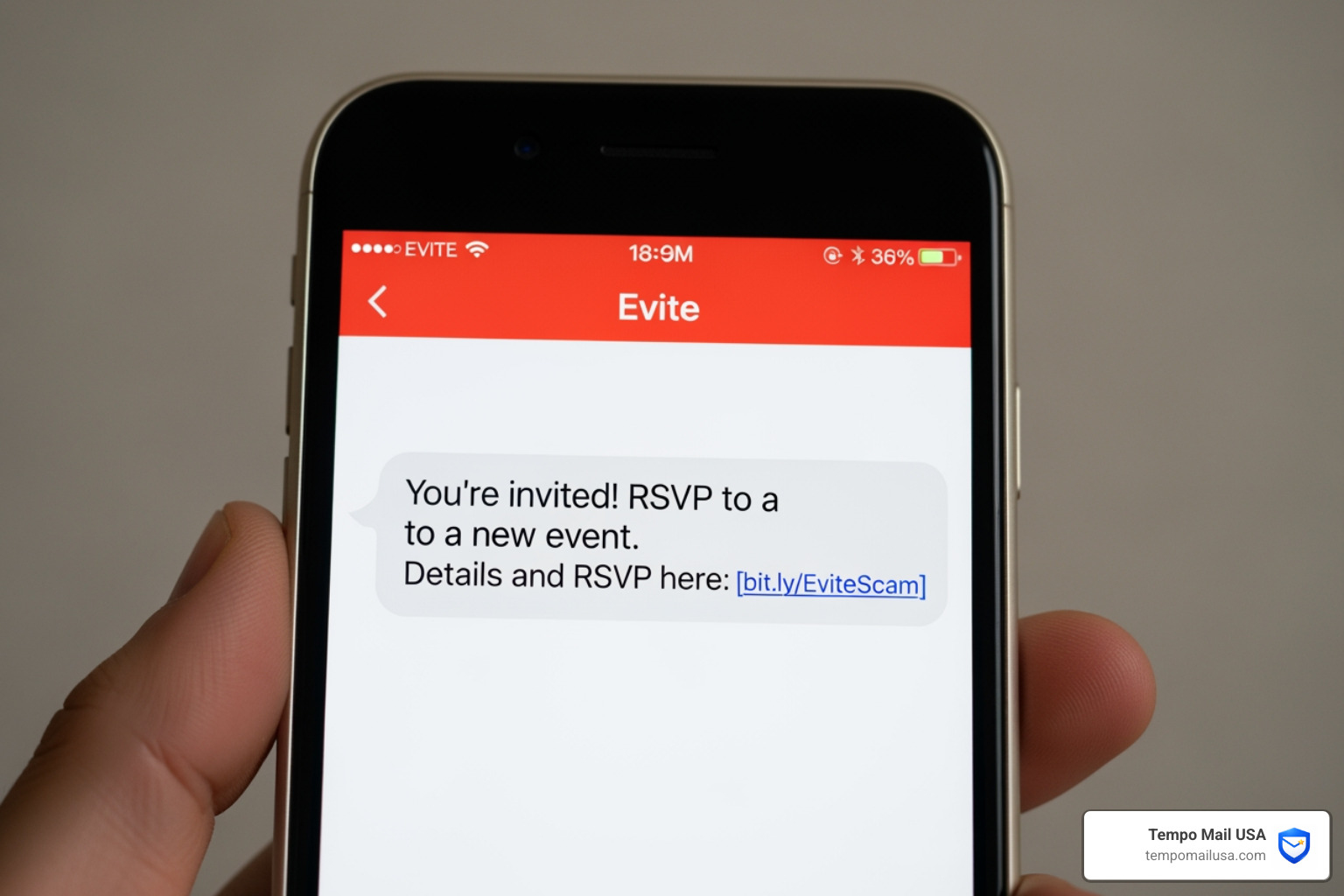

That "RSVP" Text Could Be a Trap
An evite scam text is a smishing (SMS phishing) attack where cybercriminals impersonate the legitimate Evite platform to trick you into clicking a malicious link — one designed to steal your login credentials, harvest your personal information, or silently install malware on your device.
If you just received a suspicious Evite text, here's what to know immediately:
| Question | Quick Answer |
|---|---|
| Is it a scam? | Likely yes, if it came from a random 10-digit number |
| What do scammers want? | Your email login, personal data, or device access |
| Should you click the link? | No. Close the message now |
| What should you do? | Verify with the sender directly via a separate channel |
| How do you report it? | Forward the text to 7726 (SPAM) |
You just got a text: "Someone has invited you to an event! Click here to RSVP."
It looks official. It feels urgent. You don't want to miss a friend's birthday or a wedding. But that instinct — that fear of missing out — is exactly what scammers are counting on.
This is not a party invitation. It's a digital ambush.
Consumers lost $15.9 billion to scams in 2025, according to the FTC's latest fraud reports, up from $12.5 billion the year before — and phishing attacks like this one are a major driver of that number. Evite itself has reported a significant rise in these impersonation scams since early 2026. The attacks work because they don't feel like attacks. They feel like a friend reaching out.
One tech expert described nearly falling for exactly this: a message appearing to come from a known contact, with the subject "Special Celebration of Life" — emotionally loaded enough that most people click before they think.
That one click can hand scammers your email credentials, your contact list, and access to your financial accounts.
This guide walks you through exactly how these scams work, how to spot them, and what to do if you've already clicked.
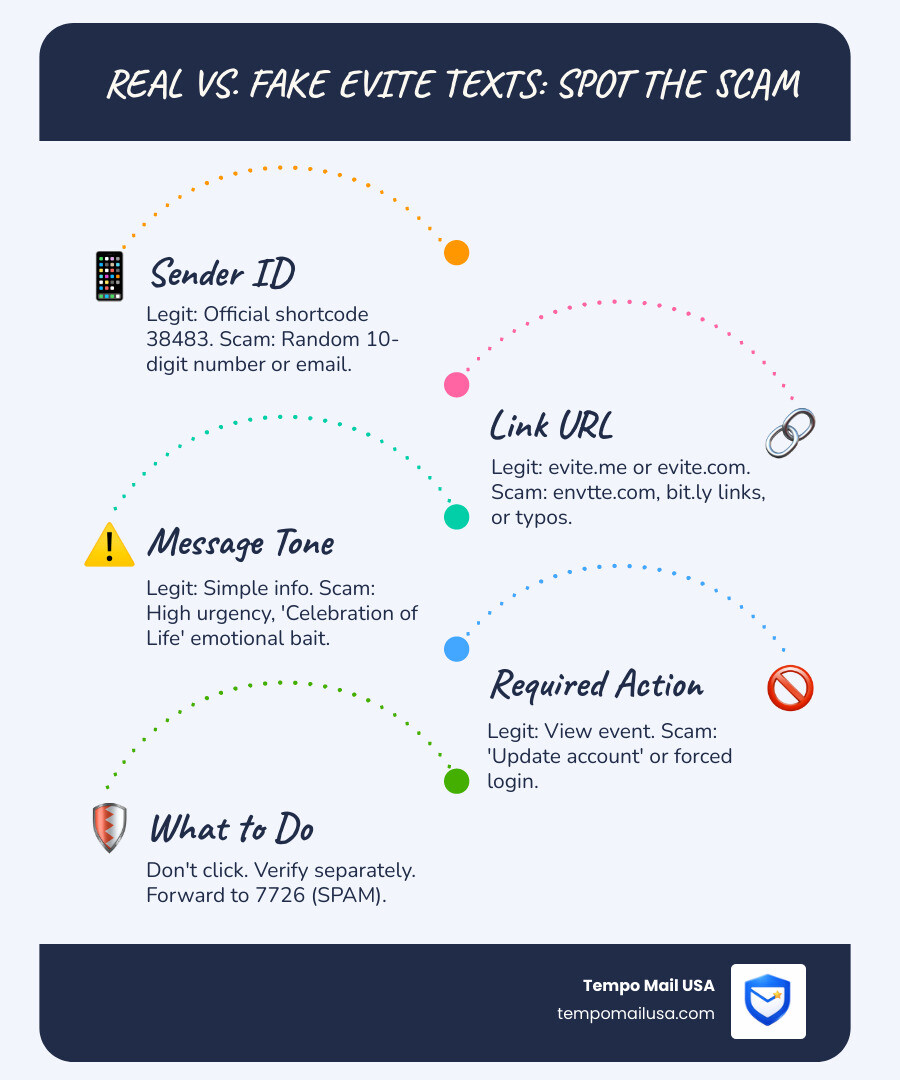
Quick Fact Box: Real vs. Fake Evite Texts
Before you interact with any digital invitation, compare it against these established patterns. Scammers are professional, but they often leave digital fingerprints that give them away.
| Feature | Legitimate Evite Text | Evite Scam Text |
|---|---|---|
| Sender | Official Shortcode (38483) | Random 10-digit number or email address |
| Link URL | evite.me or evite.com | envtte.com, evite-rsvp.top, bit.ly/xyz |
| Tone | Informational and specific | High urgency or generic (e.g., "Party") |
| Action | View invitation details | "Update account" or "Verify identity" |
| Requirement | RSVP/Details visible | Forced login before seeing the invite |
How the Evite Scam Text Works in 2026
The evite scam text isn't just a nuisance; it's a calculated social engineering attack. In 2026, we've seen these tactics evolve from simple "Nigerian Prince" emails into highly sophisticated mobile-first traps. According to recent data, reported fraud losses have skyrocketed by nearly 430% since 2020. Criminals have moved away from hacking servers and toward "hacking" humans.
The process usually follows a specific script:
- The Lure: You receive an SMS from an unknown number. It uses the Evite brand name and a generic but intriguing title like "Save the Date" or "You're Invited!"
- The Hook: The message includes a link. Because we are accustomed to receiving digital invites for weddings and birthdays, our "threat radar" is naturally lower than when we receive a Coinbase text scam or a bank alert.
- The Payload: Clicking the link leads to a cloned website that looks identical to the real Evite portal.
Spotting an Evite Scam Text in the Wild
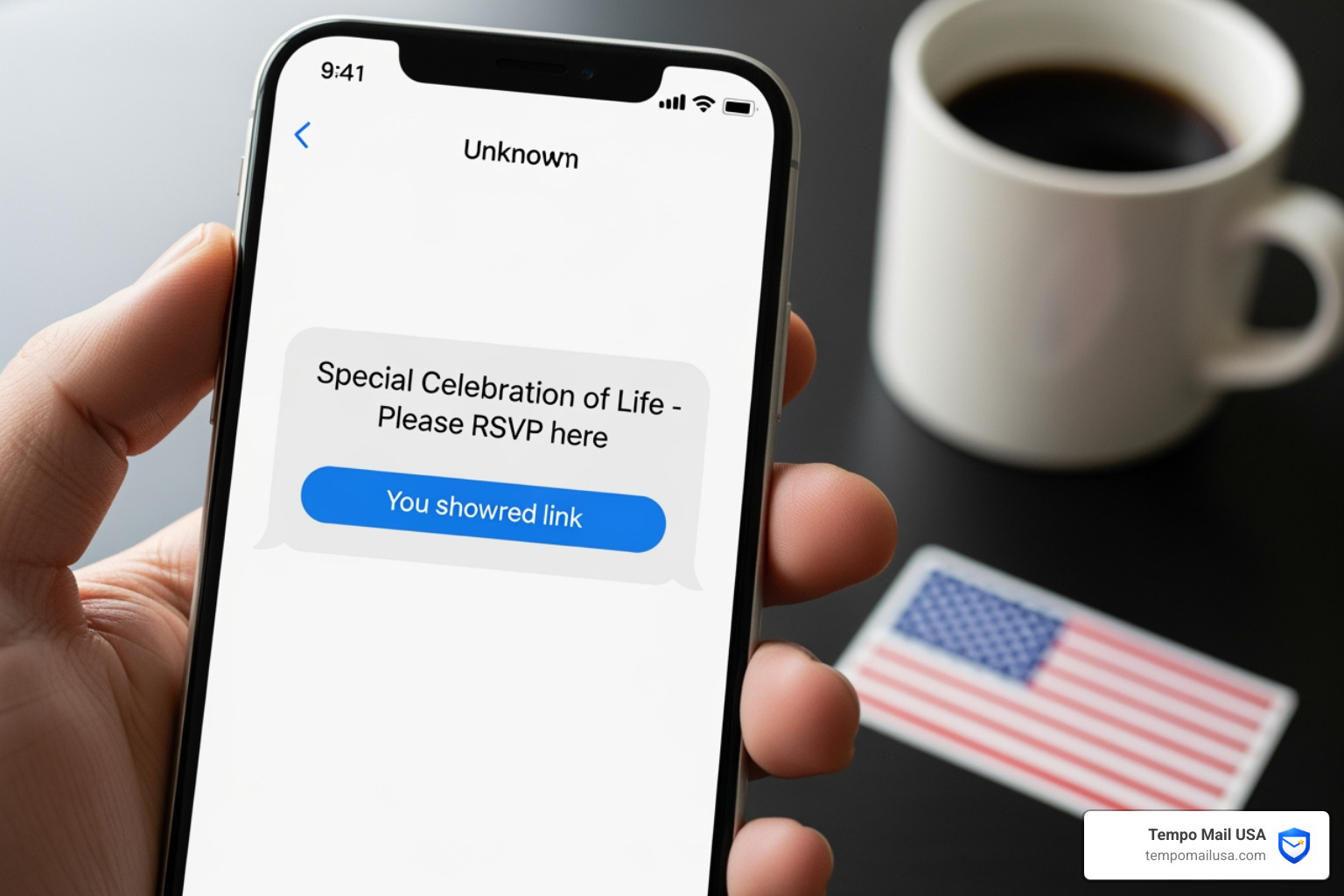
One of the most insidious versions of this scam uses "emotional engineering." Scammers have been observed using subject lines like "Special Celebration of Life" or "Memorial Service Update." These are designed to bypass your skepticism. After all, who wants to be the person questioning the legitimacy of a funeral notice?
This is where it turns into a scam: The link doesn't take you to a guest list or a venue map. Instead, it presents a "login" screen. It might say, "Please log in with your email to view this private invitation."
If you enter your credentials, the hackers now own your account. Because most people reuse passwords, they likely now have access to your primary email, which is the "master key" to your entire digital life.
Identifying Red Flags: Is Your Invitation Real?
Knowing how to identify a fake is your best defense. Scammers rely on you being in a hurry. If you slow down, the cracks in the facade become obvious.
- The "Look-Alike" Domain: This is called typosquatting. A scammer might use
envtte.com(replacing the 'i' with an 'n') orevite-rsvp.org. If the URL isn't exactlyevite.comorevite.me, it’s a trap. - The Forced Login: A real Evite link typically allows you to see the basic event details—who is hosting, the date, and the time—without demanding your password immediately. If the very first thing you see is a login wall, walk away.
- The Random Number: Official Evite texts come from a verified 5-digit shortcode (38483). If the text comes from a standard 10-digit mobile number or a strange email address, this is not normal.
- Generic Titles: Legitimate invites usually mention a name you recognize (e.g., "Sarah's 30th Birthday"). Scam texts often use vague language like "The Celebration" or "The Event."
For more examples of how these fake messages look across different industries, check our guide on how to spot fake invites.
Why Scammers Target Digital Invitations
Why Evite? Why not just stick to DMV scam texts or traffic court text scams?
The answer is Social Trust.
We are conditioned to trust invitations. They represent our social circles, our friends, and our families. Scammers exploit this "FOMO" (Fear of Missing Out) to make you act impulsively. Furthermore, once a scammer compromises one person’s account, they can send the evite scam text to that person's entire contact list. When you receive an invite from "Sarah," a person you actually know, your guard drops completely.
Here’s the mistake people make: They assume that because the text mentions a personal-sounding event, it must be legitimate. In reality, scammers are using your own contact list against you. Beyond credential theft, these links can also deliver "zero-day" malware—malicious software that exploits previously unknown vulnerabilities in your phone's operating system. This can lead to keystroke logging, where every password you type is sent directly to the criminal.
What to Do If You Clicked a Malicious Link
If you've already tapped the link or, worse, entered your information, do not panic. Panic leads to more mistakes. Follow this containment protocol immediately.
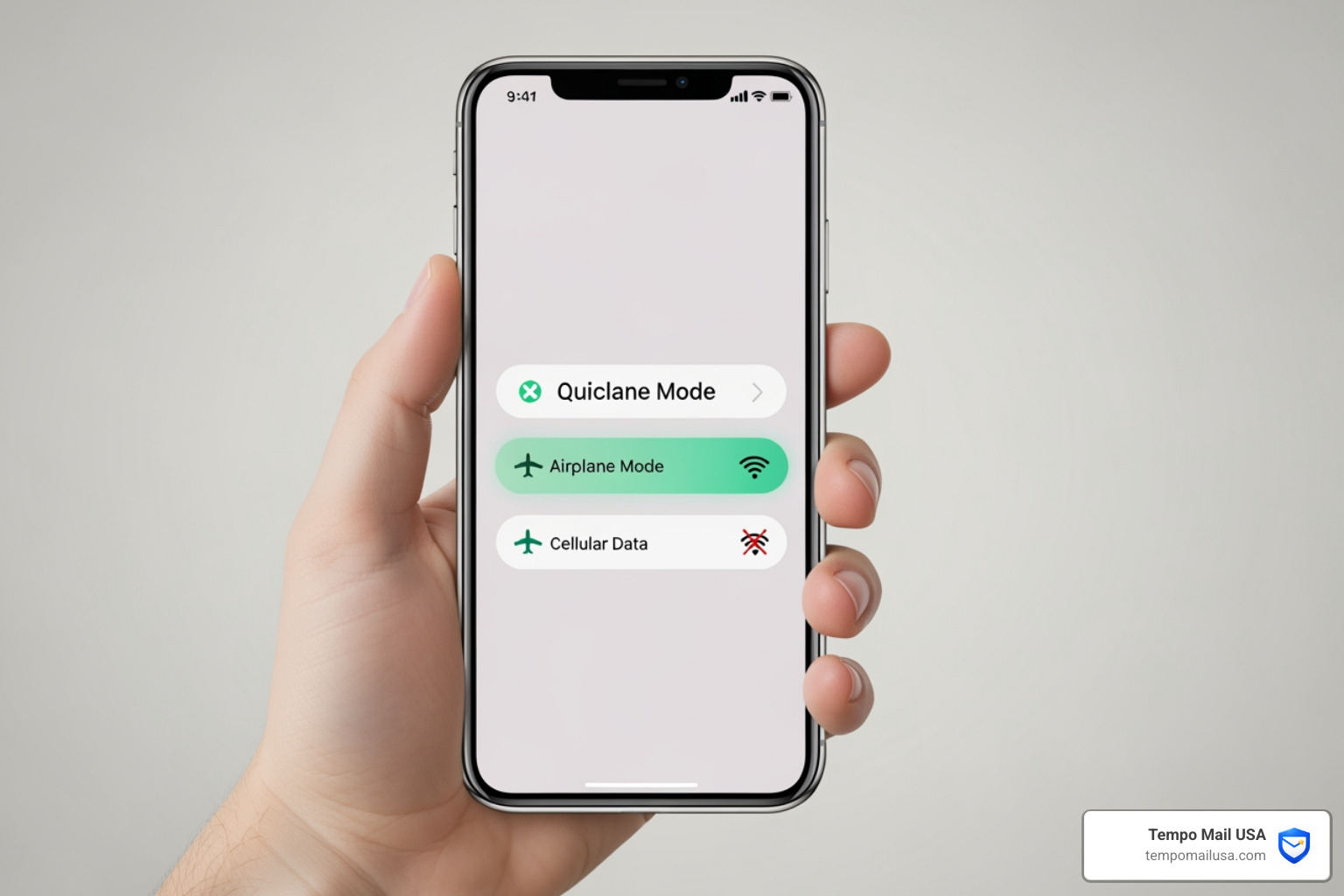
Immediate Steps for an Evite Scam Text Victim
- Kill the Connection: Put your phone in Airplane Mode immediately. This cuts the "umbilical cord" between your device and the scammer's server, potentially stopping a malware download or data upload in progress.
- Audit Your Sessions: Using a different, clean device, log into your primary email and your real Evite account. Go to security settings and select "Log out of all other sessions." This evicts the hacker if they have already logged in.
- Change Your Passwords: Update your passwords for your email, bank, and social media accounts. Ensure you are using a unique, complex password for every site.
- Enable MFA: If you haven't already, turn on Multi-Factor Authentication (MFA) or Two-Factor Authentication (2FA). This ensures that even if a scammer has your password, they can't get in without a secondary code.
- Report the Crime: Forward the scam text to 7726 (which spells SPAM on most keypads). This alerts carriers to block the sender. You should also report the incident to the FTC at ReportFraud.ftc.gov.
If you entered financial information, contact your bank immediately to freeze your cards. We've seen similar patterns in Amazon recall scams where a single click leads to unauthorized charges within minutes.
Building a PII Firewall Against Phishing
The most effective way to stop an evite scam text is to ensure the scammer never gets your phone number or primary email in the first place. This is where the concept of a PII Firewall comes in.
Scammers can't target you if they don't have your real data. In the cybersecurity world, we call this "Identity Proxying." Instead of giving your real, permanent email address to every social platform or RSVP service, you use a temporary email alias.
At Tempo Mail USA, we provide these aliases to act as a shield. When you use a proxy identity:
- Your real inbox stays hidden.
- If a service you used (like a digital invite platform) suffers a data breach, the scammers only get a "dead-end" alias.
- If that alias starts receiving Afterpay text scams or fake invites, you simply delete the alias. The "firewall" has done its job, and your primary identity remains untouched.
Frequently Asked Questions about Evite Scams
Does Evite ever send texts from random numbers?
No. Official Evite communications are sent via their verified shortcode: 38483. If you receive an invite from a standard 10-digit mobile number, it is almost certainly a scam. Even if the name of a friend appears in the text, scammers can "spoof" names or use compromised accounts.
Can clicking a link install malware on my phone?
Yes. While many scams aim to steal your password (credential harvesting), some are designed to install malware. In 2026, we have seen links that trigger the download of remote access tools like Screenconnect.exe or mobile-specific spyware. This is why "killing the connection" by using Airplane Mode is a critical first step if you accidentally click.
How do I report a fake Evite text?
You should take three steps:
- Forward the message to 7726.
- Block the number on your device.
- Report the phishing attempt to the FBI’s Internet Crime Complaint Center (IC3) at ic3.gov. Reporting is vital because it helps authorities track and shut down the infrastructure scammers use.
Conclusion: Protect Your Identity
The evite scam text is a reminder that in our connected world, our social nature is often our greatest vulnerability. Scammers don't need to break through your phone's encryption if they can simply convince you to hand over the keys.
Don't let a fake invitation compromise your real-world security. By staying vigilant, checking for red flags like misspelled domains, and using a PII Firewall to shield your personal information, you can enjoy your social life without the risk.
The Tempo Mail USA PII Firewall is your first line of defense against the rising tide of smishing and identity theft. By proxying your personal data, you stay invisible to scammers and keep your primary inbox for the people who actually matter.