



The Traffic Court Text Scam Targeting Drivers Right Now
A traffic court text scam is a fake SMS message designed to look like an official court notice, claiming you owe fines for an unpaid traffic or toll violation. It is a scam. Do not click any links or scan any QR codes in the message.
Quick facts if you just received one of these texts:
- It is not real. Courts, the DMV, and law enforcement do not contact you by text to demand payment or threaten suspension.
- Do not scan the QR code or click any link in the message.
- Do not enter your credit card number, Social Security number, or any personal information.
- Verify independently by going directly to your state court's official website or calling the clerk of court.
- Report it to the FTC at ReportFraud.ftc.gov and forward the text to 7726 (SPAM).
These scam texts are not rare or random. The FTC reported a sharp spike in complaints about this exact scam as of April 2026. Researchers have confirmed it is active in at least nine states, including California, Texas, Illinois, New Jersey, North Carolina, Virginia, Connecticut, and Georgia.
The messages look surprisingly convincing. They arrive as images showing official-looking court notices, complete with state seals, fake case numbers, a judge's name, a hearing date, and a QR code to "pay now or face a default judgment."
That urgency is the entire point. A calm person verifies. A panicked person pays.
Scammers are counting on you to act fast before you think clearly. This guide breaks down exactly how the scam works, what to look for, and what to do whether you just received the text or have already clicked through.
How to Spot a traffic court text scam
Spotting a traffic court text scam in May 2026 requires a sharp eye because scammers have significantly leveled up their design game. Gone are the days of simple "Your ticket is due" texts with a broken link. Today, they send high-resolution images that mimic legal documents.
One of the most common versions currently circulating features a fake seal—sometimes labeled with nonsense like "Cockerel Coney"—and names a specific judge, such as Judge Michael Rodriguez, to add an air of authority. These texts often include a QR code, which is a major red flag.
The Federal Trade Commission (FTC) has warned that these messages are designed to bypass your natural skepticism by using visual cues of authority. According to the Consumer Advice from the FTC, the presence of a QR code in a text about a legal matter is almost a 100% guarantee that you are looking at a scam.

The Evolution of the traffic court text scam
The traffic court text scam has undergone a massive evolution. In 2025, these were mostly "smishing" (SMS phishing) links that led to poorly designed websites. Now, scammers are using AI to generate grammatically perfect text and realistic-looking court headers. By sending the notice as an image rather than plain text, they often bypass the spam filters built into your smartphone.
Furthermore, the switch to QR codes is a tactical move. Security software often struggles to "read" a QR code inside an image, allowing the malicious link to reach your eyes. This evolution is part of a broader trend of sophisticated impersonation. For instance, we have seen similar tactics in the Traffic Compliance Department Scam, where scammers invent entire government agencies to bully people into paying.
Red Flags in Digital Citations
If you receive a text claiming you have a violation, look for these specific red flags:
- The Format: Official court notices are sent via U.S. Mail. They are almost never sent as an SMS image.
- Geographic Errors: Scammers often send these in bulk. You might live in San Diego but receive a notice for a Los Angeles court, or even see a notice that lists a Missouri city as a county in California.
- Non-Government Domains: If you scan the code (which we don't recommend!), the website will likely be a .com, .life, or .net address instead of a .gov domain.
- Pressure Tactics: Real courts don't use "pressure-cooker language" like "Pay within 2 hours or an arrest warrant will be issued."
- Default Judgments: Mentioning a "Notice of Default" for a ticket you’ve never heard of is a classic scare tactic.
The Anatomy of a Modern Phishing Trap
To understand why people fall for this, we have to look at the psychology behind the "trap." Scammers aren't just looking for a one-time payment; they are harvesting your data.
| Feature | Real Court Notice | Scam Text Notice |
|---|---|---|
| Delivery Method | Physical U.S. Mail | SMS / Text Message |
| Payment Method | Official .gov portal or in-person | QR code or suspicious link |
| Fine Amount | Varies by violation | Often small (e.g., $6.99) |
| Urgency | Specific legal deadlines | "Immediate" or "Final Warning" |
| Verification | Searchable via case number | Fake case numbers provided |
Why is the amount often as small as $6.99? This is a brilliant, albeit evil, strategy. Most people won't fight a $7 charge. They think, "I'll just pay this so it goes away." But the goal isn't the $7—it's your credit card number, your address, and your name. Once they have that, they can sell your profile on the dark web or attempt much larger fraudulent purchases.
Some of these fake sites even use CAPTCHA tests. This makes the site feel more "official" and secure, even while it's actively stealing your information. Security plugins like Wordfence, which protects over 5 million WordPress sites, often flag these domains, but scammers create new ones daily, such as "probioticsimmunity.com" or "neoxf.life," which have nothing to do with traffic law. For a deeper look at these traps, see The FAKE Traffic Ticket TRAP.
What Happens if You Scan the QR Code?
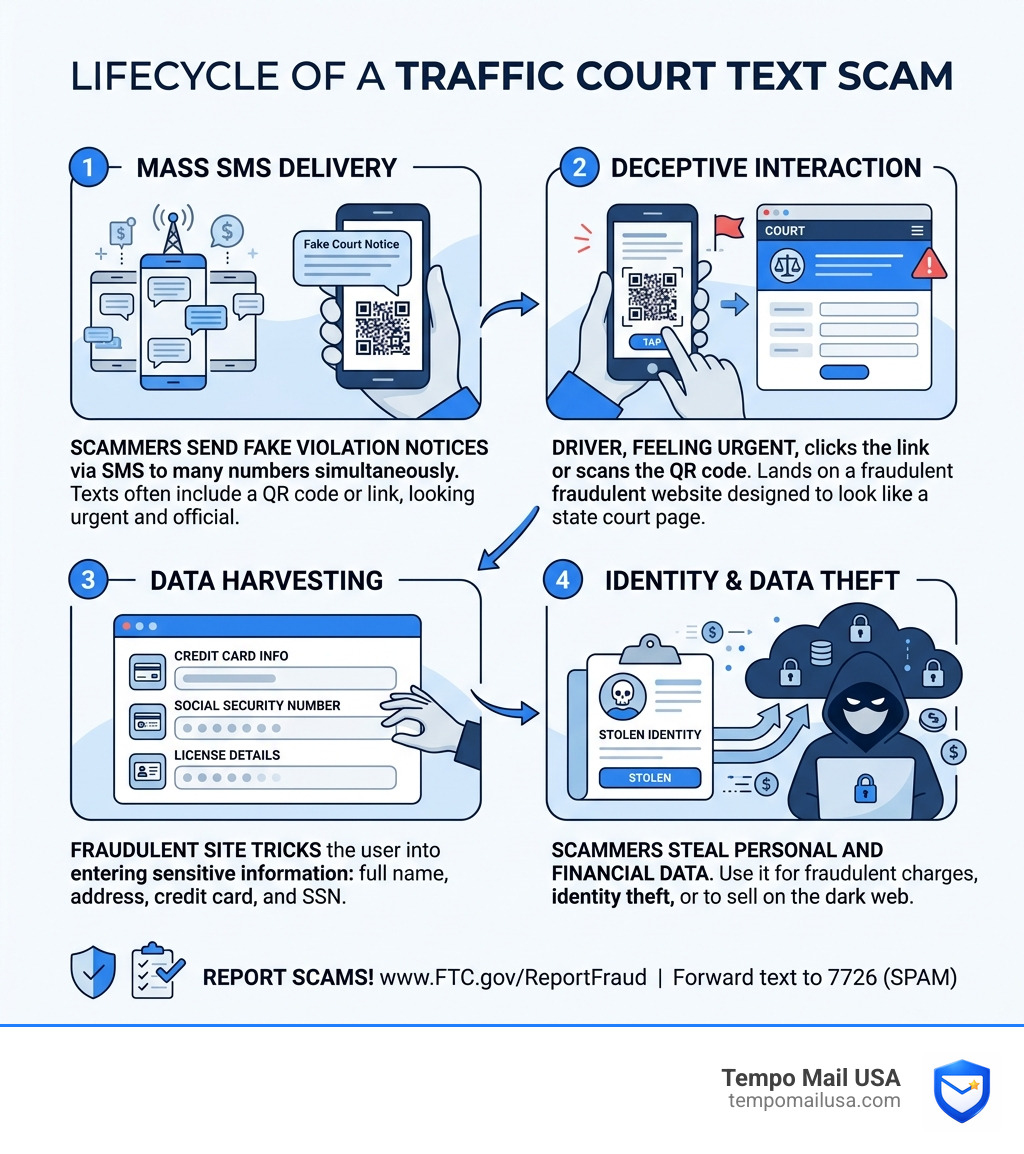
Scanning the QR code in a traffic court text scam is like opening your front door to a burglar. Here is the typical chain reaction:
- The Redirect: The code sends your browser through several "redirect loops" to hide the final destination from security software.
- The Phishing Site: You land on a page that looks exactly like a DMV or a court payment portal, complete with state logos.
- Data Harvesting: You are asked to enter your name, address, and driver's license number to "find your case."
- Credit Card Theft: Finally, you are asked for payment details.
- Malware Installation: In some advanced cases, the site may attempt to download a small "tracking" file or malware onto your device to monitor your keystrokes for bank passwords later.
How to Verify Legitimate Citations
We cannot stress this enough: No legitimate court in the United States will demand immediate payment via a QR code sent in a text message. If you are worried you might actually have a ticket, there are safe ways to check.

First, official agencies like the Florida Department of Highway Safety and Motor Vehicles (FLHSMV) have explicit policies stating they will never contact you via text for payments. Similarly, in Hawaii, you can use the official eCourt Kokua system to search for citations by your name or license plate number.
If you receive a notice and want to be 100% sure:
- Go to the source: Search for your local "Clerk of Court" on Google (look for the .gov link).
- Call the office: Use the phone number listed on the official government website, not any number provided in the text.
- Check your mail: Real summons and notices arrive via the postal service.
If the agency mentioned in the text sounds suspicious, it probably is. We’ve even seen cases where scammers use names like the "Traffic Compliance Department"—an agency that doesn't actually exist. You can read more about that specific red flag here: Traffic Compliance Department Scam That Agency Doesnt Exist.
Reporting a traffic court text scam to Authorities
Reporting is the only way to help authorities shut down these operations. Don't just delete the text—report it first.
- Forward to 7726: This is a universal short code for mobile carriers. Forwarding the text to 7726 (which spells SPAM) alerts your provider to the scammer's number.
- The FTC: File a report at ReportFraud.ftc.gov.
- The FBI: Use the Internet Crime Complaint Center (IC3) at ic3.gov.
- State Authorities: If you're in North Carolina, you can call 1-877-5-NO-SCAM to reach the Department of Justice.
Recovery Steps for Victims
If you’ve already clicked the link or entered your information, don't panic. You need to act quickly to minimize the damage.
- Call Your Bank Immediately: If you entered credit card info, tell your bank you've been the victim of a phishing scam. They will cancel your card and issue a new one.
- Monitor Your Statements: Look for "test charges"—small amounts like $1.00 that scammers use to see if a card is active before making a big purchase.
- Update Your Passwords: If the scam site asked you to "create an account," and you used a password you use elsewhere, change it immediately.
- Enable 2FA: Use Two-Factor Authentication (preferably an app like Google Authenticator rather than SMS) on all your sensitive accounts.
- Preserve Evidence: Take screenshots of the text and the website before you block the sender. This helps law enforcement if you decide to file a police report.
Frequently Asked Questions about Traffic Court Text Scams
Do courts ever text you for payment?
No. While some courts may offer "opt-in" text reminders for court dates you have already scheduled, they will never send an unsolicited text demanding payment or threatening you with arrest. Official financial transactions are handled through secure .gov portals or by mail.
What should I do if I already entered my credit card info?
Contact your financial institution right away to freeze or cancel the card. You should also place a fraud alert on your credit report via Equifax, Experian, or TransUnion to ensure no one tries to open new accounts in your name using the personal data you provided.
Why is the fine amount in the text so small?
Scammers use small amounts (like $6.99 or $9.99) to bypass your "fraud radar." Most people won't call a lawyer over $7, but they will hand over their credit card details to make the "problem" go away. The goal is the data, not the $7.
Conclusion
The traffic court text scam is a sophisticated reminder that our personal information is constantly under fire. Scammers are getting better at mimicking the look and feel of government authority, but they can't mimic the official processes that protect your rights.
At Tempo Mail USA, we believe the best way to stay safe is to prevent scammers from getting your contact info in the first place. By using temporary email aliases and secure identity proxies, you can shield your real PII (Personally Identifiable Information) from the data breaches that fuel these scam lists. Think of it as a privacy firewall between you and the digital world.
Stay vigilant, never scan a mystery QR code, and Protect your data with Tempo Mail USA.