

Temp Email for Coinbase Signup: The Verification Mail Arrives — Then KYC Asks for Your ID, Your Selfie, and Your Social Security Number
Ask whether a temp email works for Coinbase signup and you will get two confident answers, both wrong in the interesting way. The temp-mail sites will tell you yes, the verification mail arrives instantly, and they are right. The privacy guides will tell you never to use a disposable address for a financial account, and they are also right. The two answers are talking about different minutes of the same signup. The verification email lands in a disposable inbox without a problem, and that is the only part of the Coinbase signup a temp email can do. Everything after it — the phone, the government ID, the selfie, the Social Security number — is the part the disposable address was never going to survive, and the inbox you used becomes the key to whatever money you put in.
That split is worth spelling out gate by gate, because Coinbase is not a streaming trial or a shopping account. It is a regulated financial account, and its signup funnel is built to prove who you are, not just to confirm that an inbox exists. The numbers Coinbase reported two weeks ago explain why the funnel looks the way it does, and why the people signing up now are walking into a narrower, more serious door than the one that existed a year ago.
The quarter that shrank the funnel
Coinbase reported its third-quarter 2026 results on October 29, and the headline looked better than the business underneath it. Net income was $719 million, up 66% year over year, with diluted earnings of $2.51 a share. But $715 million of the $824 million in pre-tax profit came from gains on crypto Coinbase itself holds — roughly 87% of the profit was the portfolio going up, not customers trading. Operating income, the number that reflects the actual business, was $61.7 million, down 87% year over year. Total revenue fell 35% to $1.216 billion.
The customer numbers tell the same story from the other side. Monthly transacting users fell to 7.4 million from 9.3 million a year earlier, a drop of 20%. Consumer transaction revenue fell 47% to $450 million as consumer spot trading volume shrank 59%. Platform assets stood at $376.6 billion, down 27% year over year, most of that decline from falling coin prices. The steadiest block in the whole report was stablecoin revenue at $307 million, down just 5%, with average USDC balances inside Coinbase products at an all-time high. Subscription and services revenue was $570 million, down 20%, but its share of net revenue rose from 41% to 49%.
Read that as a signup funnel and the picture is clear: fewer people are opening Coinbase to trade, the ones who are opening it are arriving in a quieter market, and the company is leaning harder on subscriptions and stablecoins than on trading fees. The signup process reflects that shift. It is not the breezy email-and-password form of a consumer app. It is a financial onboarding flow, and it treats the email address as the first of several identity anchors, not as the account itself.
Gate one: the email address, and it is the easy one
The first screen asks for the least. An email address, a password, your first and last name, and your state of residence. Coinbase then sends a verification email from no-reply@coinbase.com, and clicking the link in it confirms the address. A temp inbox receives that mail without trouble — the temp-mail services that publish Coinbase-specific pages say so themselves, and the mechanics are on their side: Coinbase sends a standard confirmation link, and any working inbox can open it.
There is one detail on this screen that matters more than it looks. Coinbase's own help guide instructs you to enter your first and last name exactly as they appear on your government-issued ID. That is not a formatting suggestion. The name you type here is checked against the ID you upload later, and a mismatch — a nickname, a missing middle name, a married name that differs from the legal name on the document — is the most common reason the later steps stall. The email address passes gate one in about a minute. The name you attach to it is already being measured against a document you have not shown yet.
So the honest answer to the question as literally asked is yes. A temp email gets you through the first screen. It is also the last screen a temp email gets you through.
Gate two: the phone number you cannot fake
The second gate is the one that ends the disposable plan for most people, and it has nothing to do with email. Coinbase requires a phone number connected to a smartphone, and it sends an SMS verification code to that number before the account goes any further. The phone is not a backup contact. It is the two-factor authentication channel for the account, the thing that stands between your balance and anyone who guesses your password.
There is no temp-email equivalent for this step, and the workarounds people reach for are worse than the problem. A virtual number that cannot receive the next SMS, a borrowed number, a number you will not own in six months — each one creates the same trap the temp email creates, one step later. When Coinbase needs to confirm a withdrawal, a new device sign-in, or a password reset, it goes to the phone on file. A phone number you do not control is a recovery channel you do not own, attached to an account that holds money.
This is also where the comparison with the other money apps in this series sharpens. The Robinhood post found the same wall: a brokerage that asks for an email, a phone, and a Social Security number, in that order, and where the email is the least important of the three. Cash App's version leans even harder on the phone, because the phone number is the account identifier. Venmo's version adds the bank link on top. In every one of them, the email is the screen you pass in a minute and the phone is the anchor that actually holds the account.
Gate three: the identity file — ID, selfie, and Social Security number
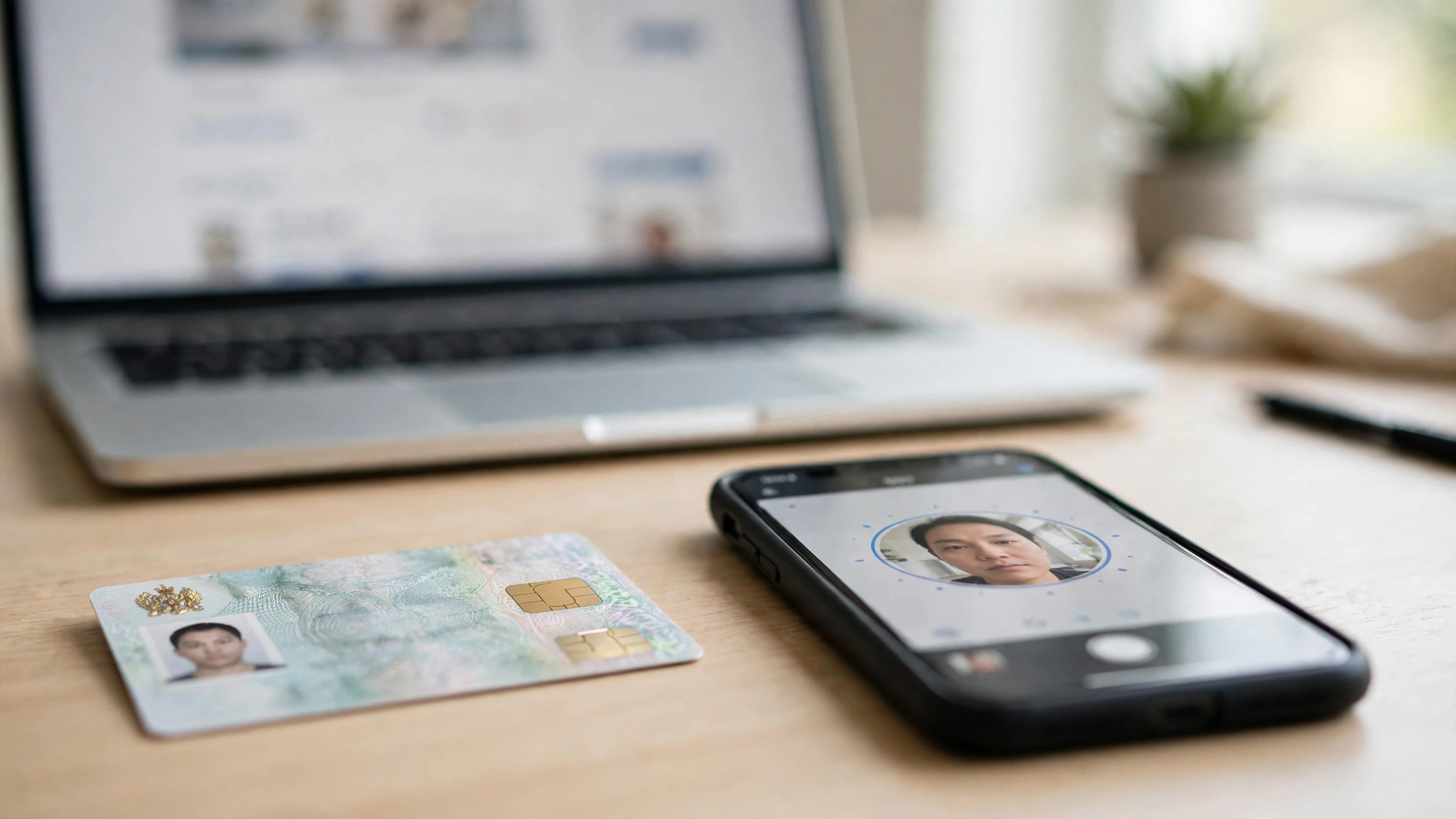
Then comes the step that makes the temp-email question almost beside the point. To buy, sell, or send crypto on Coinbase, you have to verify your identity, and the requirements are the full KYC file: a government-issued photo ID — a passport, a driver's license, or a national ID card, with passport cards explicitly not accepted — a photo of that ID, a selfie or a short video to match your face to the document, your date of birth, your address, and your Social Security number on every US account. Coinbase also asks the personal information questions the law requires, and since January 1, 2026 it asks for tax residency and a Tax Identification Number before you can start trading.
Most US accounts are approved in minutes, according to the verification guides that tracked the flow through November 2026. The ones that are not approved in minutes are the ones that run for days or weeks: manual reviews, documents that do not match the name on the account, selfies that do not match the ID photo, restricted-account appeals that wait on an internal review nobody can speed up. Coinbase does have a phone line, which is rare among exchanges, but reviewers are blunt that the line and the chat mostly route to scripted answers when an account is restricted.
There is a useful parallel here with a very different kind of account. The Etsy post in this series found the same identity wall on the seller side: a government ID and a selfie checked by a verification partner, with the name on the ID required to match the name on the bank account. Coinbase asks for the same documents, plus the Social Security number, plus the tax number, because it is a financial institution and the law requires it to know its customer. A disposable email does not hide you from any of that. It just means the company that holds your ID, your selfie, and your Social Security number has a contact address for you that stops working.
The part nobody prices in: the inbox after signup
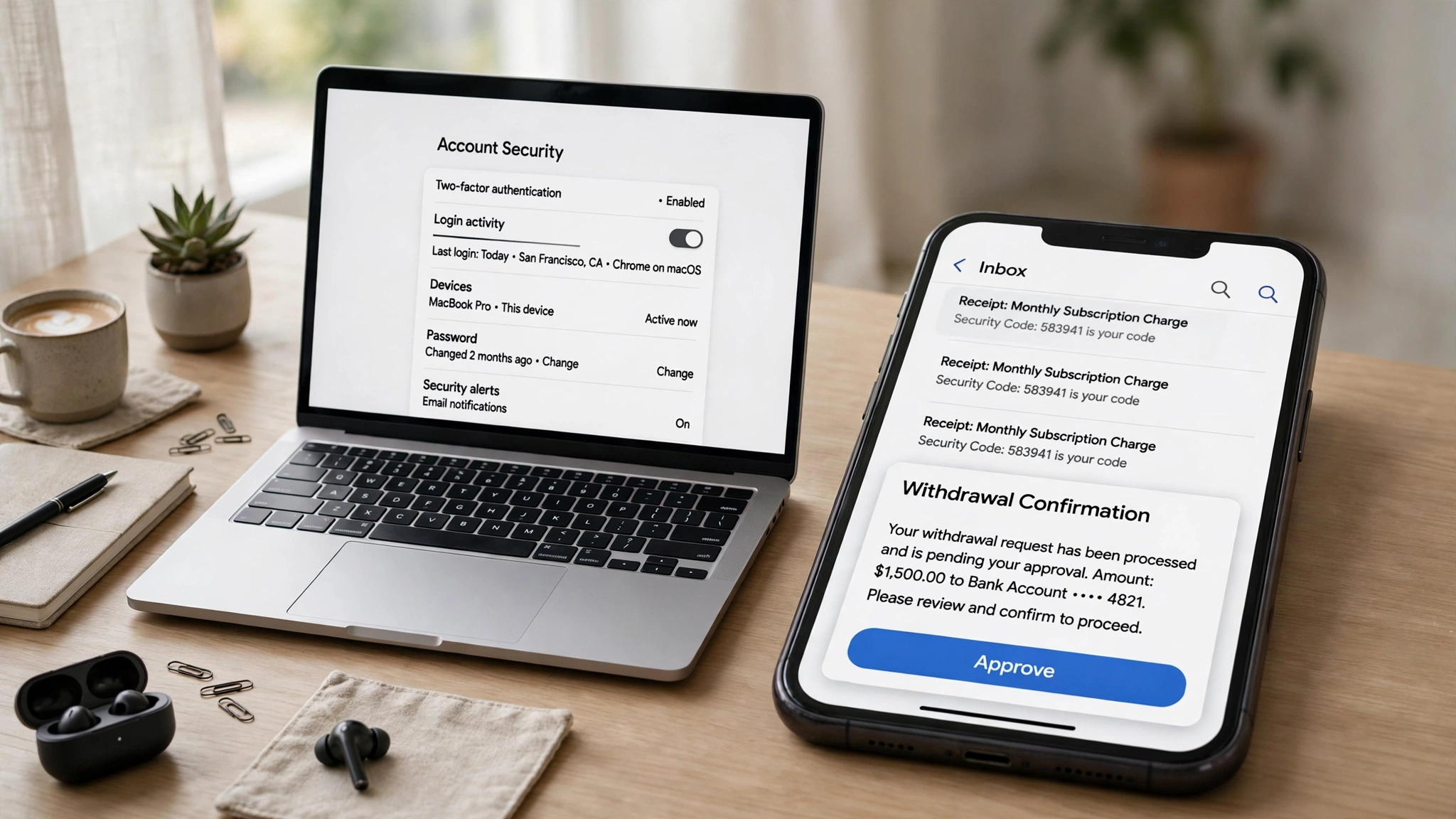
Suppose you clear all three gates with a temp email anyway. The verification mail arrived, the SMS code worked, the ID passed. Now the account exists, it holds money, and the email address on it is the channel Coinbase uses for everything that matters after signup. Withdrawal confirmations. New-device sign-in alerts. Password resets. Security notices. Tax documents — the 1099 forms for your crypto activity arrive by email, and missing one does not make the tax bill disappear. Notices that your account has been restricted, and the document requests for the appeal, arrive by email too.
That last one is the expensive scenario, and it is not hypothetical. Coinbase's own help pages describe restricted accounts waiting on internal review, and the verification guides that checked the flow in November 2026 say the same thing: when verification stalls, the account waits, and the waiting happens by email. If the inbox that receives the "we need another document" message expired three weeks after signup, the appeal does not pause politely. It stalls, and the funds sit frozen while you try to prove you are the person on an account whose contact address no longer exists.
There is also a breach-history reason to think about which address Coinbase holds. In May 2025, Coinbase disclosed that bribed overseas support agents had exposed the personal data of about 69,000 customers — names, addresses, phone numbers, and email addresses among them. The email address on a Coinbase account is the identifier that ties a person to a financial account in a breach file. A disposable address would have limited that exposure, which is a genuine point in its favor, but it is a point about the breach, not about the account. The account still needs a working inbox for as long as it holds money, and a disposable one stops working on a timer.
The money test: three ways a dead inbox costs real money
The abstract risk becomes concrete fast. Here are the three failure modes that actually happen, and what each one costs when the inbox on the account is gone.
| What happens | What Coinbase sends | With a dead inbox |
|---|---|---|
| Withdrawal from a new device or to a new address | Confirmation email you must approve before the withdrawal clears | Withdrawal blocked or delayed until you can prove ownership another way |
| Account restricted, appeal requested | Document requests and status updates by email | Appeal stalls, funds frozen, no way to receive the next step |
| Password or 2FA reset | Reset link sent to the email on file | Locked out; recovery means re-verifying identity with documents, days or weeks |
Notice what the three rows have in common: in each one, the email is not a marketing channel. It is the approval mechanism, the appeal channel, or the recovery key. A temp inbox is built to receive one message and disappear. A Coinbase account is built to send you messages for as long as it holds your money. Those two designs do not fit together, and the mismatch only shows up at the worst moment — when you are trying to move money out.
The alias, not the disposable address
There is a middle path that gives you almost everything the temp email was supposed to give you, without the expiry date. It is a permanent email alias: a forwarding address that receives mail at your real inbox while keeping your real address off Coinbase's marketing lists and out of the next breach file in its raw form. The alias survives the refund thread, the withdrawal confirmation, the restriction appeal, and the tax-form delivery, because it never expires. A disposable inbox survives the signup and then becomes a liability with a timer on it.
The distinction matters more for Coinbase than for most accounts, because the account is not just a login. It is a financial record with a tax number attached, a Social Security number on file, and a balance. The alias keeps the privacy benefit — your primary address stays out of the marketing database — while keeping the recovery channel alive for the life of the account. That is the trade the temp email gets backwards: it maximizes privacy for the first four minutes and destroys recoverability for every year after.
The broader crypto-exchange post in this series reached the same conclusion for the category as a whole: exchanges are the one place where the disposable inbox is the wrong tool, because the account is the money. Coinbase is the purest form of that pattern — the largest US exchange, the strictest identity requirements in the category, and the longest list of emails that only ever go to the address on file.
The verdict
Use a temp email for Coinbase only if you are testing the interface with a zero balance and you will never put money in. The verification mail arrives, the signup screen passes, and you can look around. The moment you deposit a dollar, the email address stops being a signup detail and becomes the key to the money — the approval for withdrawals, the channel for appeals, the recovery path for the password. That key has to be permanent, secured with two-factor authentication, and checked regularly.
Even the temp-mail services themselves draw this line. Their own guidance says disposable addresses are for testing on a regulated financial account, not for an account that will hold crypto, and their own rules pages list banking and cryptocurrency among the accounts to avoid. When the people selling the tool tell you not to use it for this, believe them. For a real Coinbase account, use your permanent address, or an alias that forwards to it forever. The temp inbox is for the four minutes before the money arrives, and never for a minute after.
Frequently asked questions
Can I sign up for Coinbase with a temp email?
Yes, for the first step. The verification email from no-reply@coinbase.com arrives in a disposable inbox without trouble. But signup continues with a phone SMS code, a government ID, a selfie, and a Social Security number, and the account needs a permanent, recoverable email for withdrawals, appeals, and password resets. A temp email works for testing only, never for an account that will hold funds.
Will Coinbase block my disposable email address?
Coinbase does not publish a disposable-domain blocklist, and the verification mail generally arrives in a temp inbox. The blocklist question is beside the point: even if the address is accepted, the KYC steps and the recovery requirements make a disposable address the wrong choice for a real account. No published list means no guarantee either way.
Does Coinbase require a phone number?
Yes. Signup requires a phone number connected to a smartphone, verified by SMS code, and the phone becomes the two-factor authentication channel for the account. Withdrawals, new-device sign-ins, and password resets all run through it. A number you do not control long-term creates the same trap as a disposable email.
What ID does Coinbase ask for?
A government-issued photo ID — passport, driver's license, or national ID card, with passport cards explicitly not accepted — plus a photo of the ID, a selfie or short video to match your face, your date of birth, your address, and your Social Security number on US accounts. Since January 1, 2026, Coinbase also asks for tax residency and a Tax Identification Number before trading.
Can I change the email on my Coinbase account later?
Yes, you can change the email in your account settings, but the change itself requires verification of the new address and usually confirmation through your phone or two-factor authentication. Changing it does not erase the risk — the new address has to be permanent and recoverable too, or you have just moved the same trap to a different inbox.
What happens if I lose access to the email on my Coinbase account?
You lose the recovery path. Password resets, withdrawal confirmations, and restriction-appeal notices all go to the address on file, so a lost inbox means proving your identity with documents to regain access — the same ID, selfie, and review process as signup, on a timeline of days or weeks rather than minutes, while your funds sit untouched.
Need a disposable temporary email?
Protect your real inbox from spam and promotional clutter instantly and free.
Received a suspicious email, text, or charge alert?
Verify whether the sender domain is disposable, spoofed, or unverified before clicking links.