

Temp Email for Etsy Signup: The Buyer Door Opens Easily — the Seller Door Wants Your ID, Your Bank, and Your Real Inbox
Etsy is the only marketplace in this series where the signup question has two completely different answers, and which answer you get depends on which door you walk through. Walk through the buyer door and a temp email works about as well as it works anywhere: the form asks for an email address, a first name, and a password, and the confirmation mail lands in the inbox a minute later. Walk through the seller door and the same disposable address runs into a government ID, a selfie, a bank account, and a two-factor requirement — and even if it survives all of that, Etsy can freeze your payouts months later over an identity re-check that is delivered, of course, to the email on the account.
Most of the advice about temp mail and Etsy only talks about the first door. That is a strange omission, because the second door is where the money is, and the money is the whole reason people get hurt. A buyer who loses access to an Etsy account loses an order history and a few saved favorites. A seller who loses access to an Etsy shop loses the payout for everything they already shipped. The email address on an Etsy seller account is not a login detail. It is the channel Etsy uses to tell you that your income is on hold.
This post covers both doors, in order, with the numbers Etsy itself reported two weeks ago. If you only want the short answer: a temp email is a defensible choice for buying a single handmade gift, and a bad choice for selling anything at all.
The quarter that explains why everyone is asking
Etsy reported its third-quarter 2026 results on October 28, and the numbers explain why this question is suddenly everywhere. Marketplace gross merchandise sales were $2.6 billion, up 8.8% year over year. Active buyers reached 88 million, up 1% — the first return to buyer growth in two years — with 540,000 buyers added in a single quarter. Spending per buyer rose 3.9%. The quarter before that, Etsy's own SEC filing put active sellers at 5.7 million.
Read those numbers as a signup funnel and the picture is obvious: more than half a million new buyers in three months, and nearly six million seller accounts competing for them. Every one of those new buyers created an account with an email address, and a meaningful share of them typed the first address that would keep the marketing mail away from their real inbox. Every new seller did the same thing, except the seller version of that choice has consequences the buyer version does not.
The timing matters for another reason. The fourth quarter is Etsy's biggest by a wide margin — holiday shopping, gift guides, and the annual wave of people opening shops in November to catch Christmas orders. The people asking whether a temp email works for Etsy right now are disproportionately the people about to sell on Etsy for the first time, in the busiest quarter of the year, with a disposable inbox standing between them and their payouts. That is the audience this post is really for.
Door one: the buyer account asks for almost nothing
Creating an Etsy buyer account takes about ninety seconds. The form asks for an email address, a first name, and a password, and then Etsy sends a confirmation email to the address you entered. Click the link in it and the account is live. There is no phone number required at signup, no payment method on file, and no identity check. You can browse, favorite, and message sellers before you ever buy anything.
That lightness is the entire case for using a temp email, and it is not a foolish case. The confirmation mail arrives fast, the link works, and the account functions. What most people do not think through is what the inbox on that account receives after the confirmation link, because Etsy is a marketplace where the email is the receipt, the tracking number, the conversation, and the refund. Order confirmations, shipping notifications, delivery updates, messages from the seller about a customization, a notice that your item was delayed, and the refund confirmation if the order goes wrong — all of it goes to the address on the account, and none of it is stored anywhere else you can reach. Etsy keeps your messages in the site's own inbox, which helps, but the shipping and refund notices live only in email.
So the honest buyer verdict is conditional, not absolute. If you are buying one thing — a birthday gift, a custom print, a replacement part for something handmade — and you will be watching for the delivery yourself, a temp email gets you through the purchase. The confirmation arrives, the order goes through, and the account has nothing in it you would miss. But the moment the purchase becomes anything more than a one-off, the math flips. A refund for a damaged item takes days of back-and-forth with the seller, and every message in that thread generates an email notification. A custom order takes weeks to make, and the seller messages you when it ships. A dispute with a shop that stops responding escalates through Etsy's case system, and the case updates arrive by email. In each of those situations the temp inbox has to still exist, still be open, and still be checked — weeks after the ten-minute timer that created it ran out.
The comparison with the other marketplaces in this series is worth making here, because the pattern repeats. The eBay post in this series found the same split: the signup is easy and the account becomes expensive to lose, because purchases, disputes, refunds, and payouts all live in the same inbox. The Amazon post found a different version of the same trap — the company that charges you is not always the company that emails you, so the address that matters is the one the marketplace has on file, not the one your bank sees. Etsy is the purest form of the pattern: a marketplace where the email address is the only copy of your receipt.
There is a better tool for the buyer door, and it is not a temp email at all. It is an email alias — a permanent forwarding address that receives mail at your real inbox while keeping your real address off Etsy's marketing lists. An alias survives the refund thread, the custom-order wait, and the dispute, because it never expires. A disposable inbox survives the signup and then becomes a liability with a timer on it. For a buyer, the alias gives you everything the temp email was supposed to give you, without the expiry date.
Door two: the seller account wants seven things
Opening an Etsy shop is a different process from creating a buyer account in every way that matters. Etsy lists the requirements plainly in its help center, and the seller guides that checked them against Etsy's own pages in October and November 2026 all agree on the same seven items. You need an Etsy account, a shop name between 4 and 20 characters, a bank account in a country where Etsy Payments operates, a debit or credit card for Etsy's bills, a government-issued photo ID plus a selfie, two-factor authentication turned on, and a first listing. You must be 18 or older. There is also a one-time shop setup fee, which Etsy shows you during the process.
The identity check is the step that surprises new sellers, and it is the step that makes the temp-email question almost beside the point. Etsy verifies identity through a partner called Persona. You photograph an unexpired government ID — a driver's license or passport — and take a selfie, and Persona matches the two. You can choose express review, which uses biometric matching, or manual review without it. The name on the ID must match the name on the bank account, and the name on the bank account must match the legal name on the Etsy Payments account. US sellers connect their bank through Plaid. If the names do not line up — a married name, a middle initial, a trading name that differs from the legal entity — verification stalls, and the seller guides are blunt that this is the most common reason a new shop gets stuck.
Then there are the fees, which are the other thing new sellers underestimate. The listing fee is small. Everything after it is not.
| Fee | Amount | When it applies |
|---|---|---|
| Listing fee | $0.20 | Per listing, renews every 4 months |
| Transaction fee | 6.5% | On each order total, including shipping |
| Payment processing (US) | 3% + $0.25 | Per order, on the total including shipping and sales tax |
| Currency conversion | 2.5% | When the payout currency differs from the bank account currency |
| One-time shop setup fee | Shown at signup | Once, when opening the shop |
Add those up on a $40 handmade item and the seller keeps roughly $35 before materials, packaging, and their own time. That is a thin margin to protect with an email address that expires. And the email address is involved in every step of getting that $35: the payout schedule notices, the deposit confirmations, the notices when a payout is delayed, and the identity re-verification requests that arrive without warning.
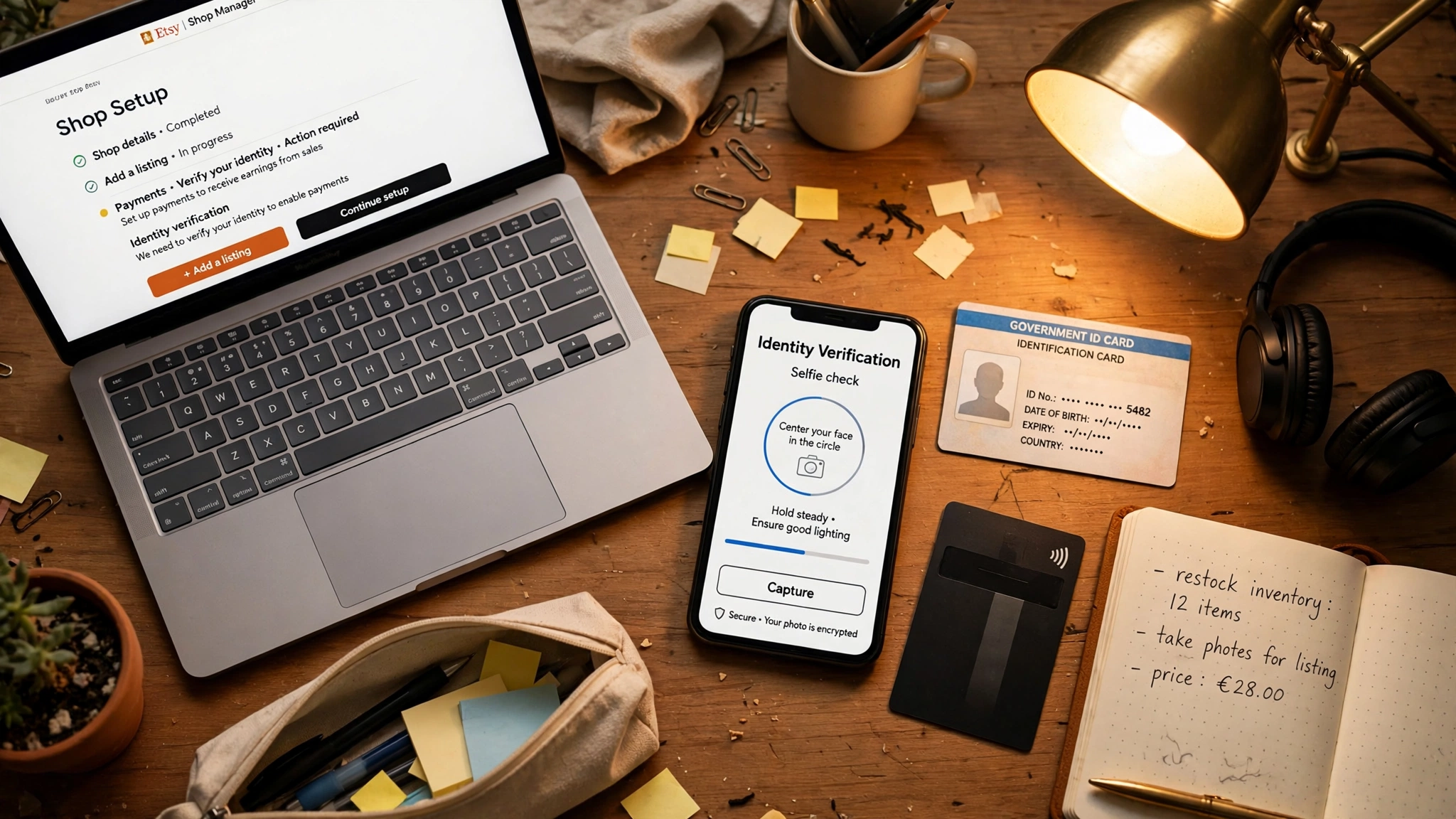
The setup fee deserves a sentence of its own, because it changes the temp-email calculation in a way people miss. A buyer account costs nothing to abandon. A seller account costs the setup fee, the listing fees, the time spent photographing products and writing listings, and the ID verification — all before the first sale. An account you paid to open, verified with your face, and tied to your bank is not an account you can walk away from when the inbox dies. It is an account you now have to recover, and recovery runs through the email address you no longer control.
If you are thinking about selling on Etsy, the secondhand-marketplaces post in this series covers the same seller-side trap from the other direction — every marketplace that pays you needs a durable way to reach you, and the payout is always the thing that breaks first.
The three moments a disposable inbox breaks a seller
The seller door does not fail at signup. It fails later, at three specific moments, and all three arrive by email. Understanding them is the difference between a shop that runs and a shop that goes dark in December.
The first moment is the identity re-verification. Etsy does not only check your ID when you open the shop. It re-checks when a shop crosses a sales threshold, when the payout bank details change, when the legal name or tax information is updated, or when an automated risk review flags the account. When that happens, Etsy asks for documents again — a photo ID, proof of address such as a utility bill or bank statement, and business documents if the shop is an entity rather than a sole proprietorship — and the request goes to the email on the account. A review of twelve seller threads from 2024 to 2026, compiled in October 2026, found that five of the holds cleared inside a week and five ran past thirty days, with a median of 20.5 days. Three weeks is a long time for a shop to sit paused in the middle of the holiday quarter, and the clock starts when the seller reads the request. If the inbox is gone, the clock never starts, and the first sign of trouble is the payout that does not arrive.
The second moment is two-factor authentication. Etsy requires 2FA on seller accounts, and it offers an authenticator app, SMS, or a phone call. An authenticator app is the option Etsy itself recommends, and it is the only one that does not depend on the email address. But the recovery path for 2FA — the thing you use when you lose the phone, replace the device, or get locked out of the authenticator — runs through the email on the account. A seller who set up 2FA with an authenticator app and a temp email has built a lock with two keys and thrown one of them away. The authenticator works until the day it does not, and on that day the recovery email goes to an inbox that expired months ago.
The third moment is the payout notice. Etsy deposits seller earnings on a schedule, and when a deposit is delayed, held, or returned, the notice goes to the email on the account. The usual causes are mundane: a bank detail that changed, a name mismatch between the ID and the account, a payout that failed verification. None of them are the seller's fault in any dramatic sense, and all of them are fixable — if the seller sees the notice in time. A temp inbox turns a two-day fix into a mystery: the money does not arrive, there is no notice anywhere, and the seller discovers the problem by checking the bank account, not by reading Etsy. By then the shop may already be paused, and unpausing it requires the identity documents and the email access the seller no longer has.
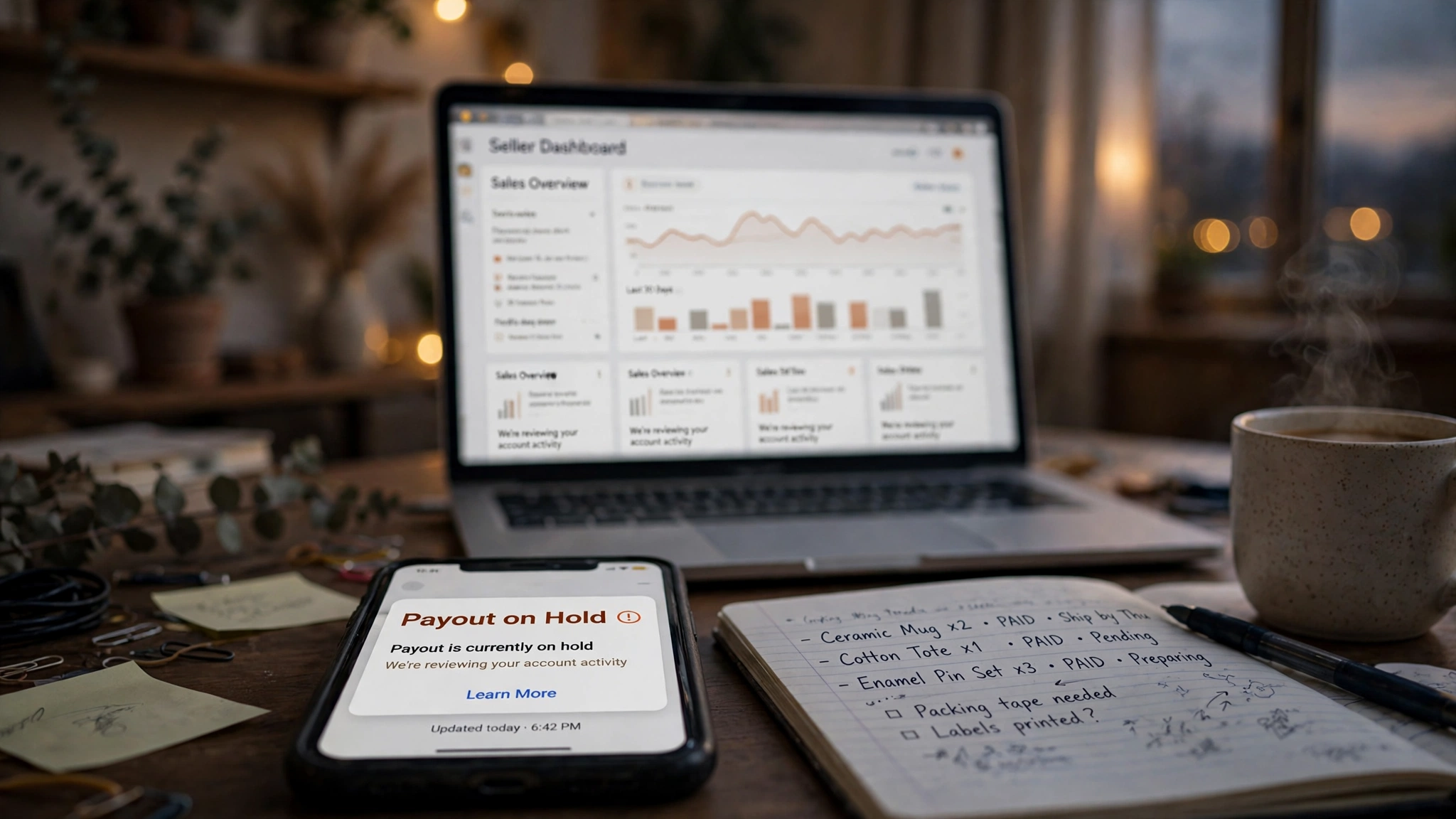
There is one more detail that belongs in this section, because it catches sellers who think they can outsmart the problem with volume. Etsy allows multiple accounts and multiple shops, but it links them by IP address and device, and if one account is suspended, the accounts associated with the same IP and device can face the same consequences. Opening a second shop on a second temp email does not isolate the risk. It multiplies the number of accounts that share it. The seller guides that document this are blunt: changing browsers or Chrome profiles does not help, because the linkage is at the IP and device level, not the browser level.
Does Etsy block disposable domains at signup?
This is the question most people typed to get here, so here is the straight answer: there is no public evidence that Etsy blocklists disposable email domains at the buyer signup form, and I am not going to invent a blocklist that nobody has published. The buyer form asks for an email address, a first name, and a password, and the confirmation mail is sent to whatever address you enter. If the domain is a well-known disposable one, it may fail silently — the confirmation mail never arrives, with no error message to explain why — but that is the generic fate of disposable domains on any form that checks them, not an Etsy-specific policy anyone has documented.
That honesty cuts both ways. The absence of a published blocklist is not a green light. It is a warning about the failure mode. A form that rejects your address tells you immediately, and you can try another one. A form that accepts your address and then never sends the mail tells you nothing, and you waste the attempt finding out. Worse, the enforcement that matters for Etsy is not at the form at all. It is delayed: the account works until a risk review runs, and then verification is re-requested — after the temporary inbox has already expired. The blocklist explainer in this series covers exactly that pattern: the domain list is always incomplete and always out of date, which is why a fresh domain usually works at signup, and why the failure arrives months later instead of at the form.
The practical rule that follows from this is simple. If the buyer form refuses your address, do not cycle through disposable domains trying to find one that slips past. The refusal is information: the marketplace has decided it does not want throwaway inboxes, and the address that gets through today is the address that gets re-verified tomorrow. Use an alias from a permanent provider instead — it looks like a normal address to every blocklist, because it is one, and it forwards to an inbox you will still own in six months. The distinction between an alias and a disposable address is the distinction that matters here: one is a permanent address that hides your real inbox, and the other is a temporary address that hides your real inbox and then disappears. Etsy treats the first like a customer and the second like a risk.
The verdict, split in two
The buyer verdict and the seller verdict are different verdicts, and any post that gives you one answer for both is selling you a slogan. Here is the split.
If you are buying one thing on Etsy, a temp email is a defensible choice and I will not pretend otherwise. The confirmation arrives, the order goes through, and the account holds nothing you would miss. The conditions are narrow and worth stating plainly: one purchase, a seller with a solid track record, no customization that takes weeks, and a delivery you will watch yourself. The moment any of those conditions breaks — a refund, a custom order, a dispute, a second purchase from the same shop — the temp inbox stops being a privacy tool and becomes a missing receipt. And the test that sorts the honest uses from the bad ones is the same one the rest of this series keeps landing on: a temp email is fine for an account you can walk away from, and a bad idea for an account that holds anything you would miss.
If you are selling on Etsy, a temp email is not a privacy tool at all. It is a single point of failure sitting between you and your income, installed at the exact moment you handed Etsy your government ID, your face, your bank account, and your card. The setup fee and the listing fees mean the account costs money to abandon. The ID verification means it costs identity to abandon. The payout schedule means it costs income to abandon. And the re-verification holds, with a median of three weeks in the seller threads reviewed this year, mean the cost arrives in the middle of the busiest quarter of the year, when a paused shop loses the sales it exists to catch. Use a permanent address you control for the seller account — an alias dedicated to the shop is the best version of this, because it keeps the payout notices, the tax documents, and the re-verification requests in one place without exposing your personal inbox to buyers. Set up two-factor authentication with an authenticator app, and store the recovery codes somewhere that is not the inbox itself, because the recovery path is the one thing the email cannot be allowed to own.
Etsy grew by 540,000 buyers in a single quarter, and most of them will never sell anything. For them, the buyer door is genuinely light, and a temp email is a reasonable way through it. But the sellers are the ones this post is for. If you are about to open a shop, the email address is not the cheapest part of the setup. It is the most important part, because it is the only part that can take the whole shop down by expiring. Pick one that will still be there in January.
Frequently asked questions
Can I sign up for Etsy with a temp email?
For a buyer account, almost certainly yes — the form asks for an email, a first name, and a password, and there is no published Etsy blocklist of disposable domains. The confirmation mail usually arrives. The risk is not the signup. It is everything after it: order updates, seller messages, refunds, and disputes all go to that address, and a temp inbox expires long before a custom order ships.
Does Etsy block disposable email addresses?
No published policy says so, and no blocklist has been documented for the buyer form. What happens in practice is quieter: a well-known disposable domain may be silently dropped, with the confirmation mail never arriving and no error to explain it. And enforcement can be delayed — the account works until a risk review re-requests verification, after the inbox is already gone.
Can I open an Etsy shop with a temp email?
You can create the account, but you cannot run the shop on it safely. Opening a shop requires a government ID and selfie through Persona, a bank account, a card, and two-factor authentication, and the name on the ID must match the bank account. Payout notices, deposit confirmations, and identity re-verification requests all go to the email on the account. A temp inbox puts your income behind an expiry date.
What happens to my Etsy shop if my email expires?
The shop keeps existing, but you lose the channel Etsy uses to reach you. Payout holds, re-verification requests, and 2FA recovery all go to the dead address. Seller threads from 2024 to 2026 show identity holds lasting a median of 20.5 days, and a hold you never see is a hold that never starts clearing. Recovery requires proving ownership through support, starting from an account whose recovery address you no longer control.
Is it safe to use a temp email for one Etsy purchase?
For a single, simple purchase from an established seller, yes — with conditions. The order confirmation arrives, the item ships, and the account holds nothing you would miss. It stops being safe the moment the purchase needs follow-up: a refund, a custom order that takes weeks, a seller message about a delay, or a dispute. For those, use an alias that forwards to your real inbox instead.
What should sellers use instead of a temp email?
A permanent address you control, ideally an alias dedicated to the shop. It keeps payout notices, tax documents, and re-verification requests in one place without exposing your personal inbox to buyers. Pair it with two-factor authentication through an authenticator app, and store the 2FA recovery codes outside the inbox itself. The 2FA recovery post in this series explains why that last step matters — the recovery email is the one message that can lock you out of your own shop.
Need a disposable temporary email?
Protect your real inbox from spam and promotional clutter instantly and free.
Received a suspicious email, text, or charge alert?
Verify whether the sender domain is disposable, spoofed, or unverified before clicking links.