

Temp Email for Robinhood Signup: The 6-Digit Code Works — Then Federal Law Asks for Everything a Temp Inbox Cannot Give
Robinhood is the one signup where your email address is the least interesting thing you hand over. You are not creating an account. You are applying to a federally regulated brokerage, and the application wants your legal name, your date of birth, your Social Security number, your home address, your phone number, your bank account — and, almost as an afterthought, an email address it can send a six-digit code to.
That order matters, because it decides what a temp email can and cannot do here. The code works. A disposable inbox receives a six-digit number as well as any other inbox does, and Robinhood will let you past that screen. Everything after that screen is the reason this post exists: the inbox that received the code is also the inbox that will receive your password resets, your security alerts, your deposit confirmations, your tax documents, and the notice that your account needs attention. A temp inbox can open the door. It cannot live in the house.
The short answer: the code works, and it is the only part that does
Yes, a temp email can get you through Robinhood's first screen. Robinhood's own signup page says you need "an email address you can verify with a 6-digit code when you apply," and a working disposable inbox does exactly that. Type the address, read the code, type the code, move on. If the domain you picked is on Robinhood's blocklist of known disposable addresses, the form may refuse it — that is how email blocklists work at the platform level, and the only fix is a less famous domain. But most of the time, the code lands and the door opens.
Then the application starts, and the email stops mattering. Robinhood asks for your full legal name, your date of birth, your Social Security number, your residential address, and your phone number, and it verifies your identity against government records before you can trade. None of those fields accept a disposable answer. A temp email is a key cut for one lock on a door with six locks, and the other five do not care what inbox you used.
This is the sharpest version of a pattern I keep finding across money apps. Cash App's signup works the same way — the email gets you in, the identity check decides whether you stay — and the lesson transfers directly: on any service that moves money, the email is the receipt printer, not the vault.
What Robinhood actually collects — and what each piece is for
The table below is the whole argument in one glance. Every row is something Robinhood asks for, when it asks, and what breaks when the inbox behind it dies.
| What Robinhood collects | When it is asked for | What breaks if the inbox dies |
|---|---|---|
| Email address | First screen, verified with a 6-digit code | Password resets, security alerts, deposit confirmations, tax-document notices — all of it |
| Phone number | Signup and two-factor authentication | SMS codes and account-recovery texts stop reaching you |
| Social Security number | Identity verification, required by federal law | Cannot be swapped for a disposable substitute; it is the account |
| Government ID and selfie | When electronic verification needs a human look | Re-verification requests go to the dead inbox |
| Bank account | Funding the account and withdrawing money | Deposit and withdrawal confirmations have nowhere to land |
| Home address | Residency check and tax paperwork | Tax forms and mailed notices go to an address you may have left |
Read the first row again, because it is the one people get wrong. The email is not one field among six. It is the delivery address for everything the other five fields produce. Your Social Security number identifies you. Your email is how Robinhood talks to you about that identity, for the entire life of the account. A temp inbox makes the first screen easy and every screen after it fragile.
The identity check is federal law, not a Robinhood preference
Here is the part that separates Robinhood from every social app and shopping site in this series: the identity check is not a company policy. It is a legal requirement. Under the customer identification rules that the SEC and FINRA enforce — the framework Congress built into the USA PATRIOT Act — a brokerage must verify who you are before you can trade. Robinhood collects the information to comply with those rules, and it says so plainly on its own signup page.
In practice, the check runs like this. You enter your legal name, date of birth, and Social Security number, and Robinhood verifies them electronically against records. If the match is clean, many applications are approved within minutes. If anything needs a closer look, Robinhood asks for a government-issued ID and a selfie, and the application review can take one to two weeks. You also need to be 18 or older, hold a valid Social Security number — a taxpayer identification number does not count — and have a legal residential address in the 50 states, Puerto Rico, or the U.S. Virgin Islands.
None of this is negotiable, and none of it is about your email. A temp inbox does not make you anonymous to a broker, because the broker is legally forbidden from letting you be anonymous. The email is the only field where a disposable address even functions, and it functions for about ninety seconds: long enough to read a code. After that, you have handed a regulated financial institution your real name, your real Social Security number, and your real bank account — and attached them all to an inbox that will stop existing. The privacy you bought with the temp email was never real. The exposure is.
One more thing worth noting, because it shows how alive this rulebook is: FINRA replaced its long-standing pattern day trader rules with new intraday margin standards in June 2026, under amendments to FINRA Rule 4210. The point is not the rule itself. The point is that your account sits inside a regulatory machine that changes its rules while you hold positions, and every change, every notice, every new requirement arrives by email.
The money pipes: bank link, deposits, withdrawals
Money moves in and out of Robinhood through a linked bank account, and the inbox is the receipt for every movement. You link a checking or savings account, Robinhood verifies it, and then deposits and withdrawals run through that link. Every step generates an email: the link confirmation, the deposit receipt, the withdrawal notice, the alert if a transfer fails or a bank rejects it. A failed transfer you never hear about is a failed transfer you never fix, and the money sits in limbo while you assume it moved.
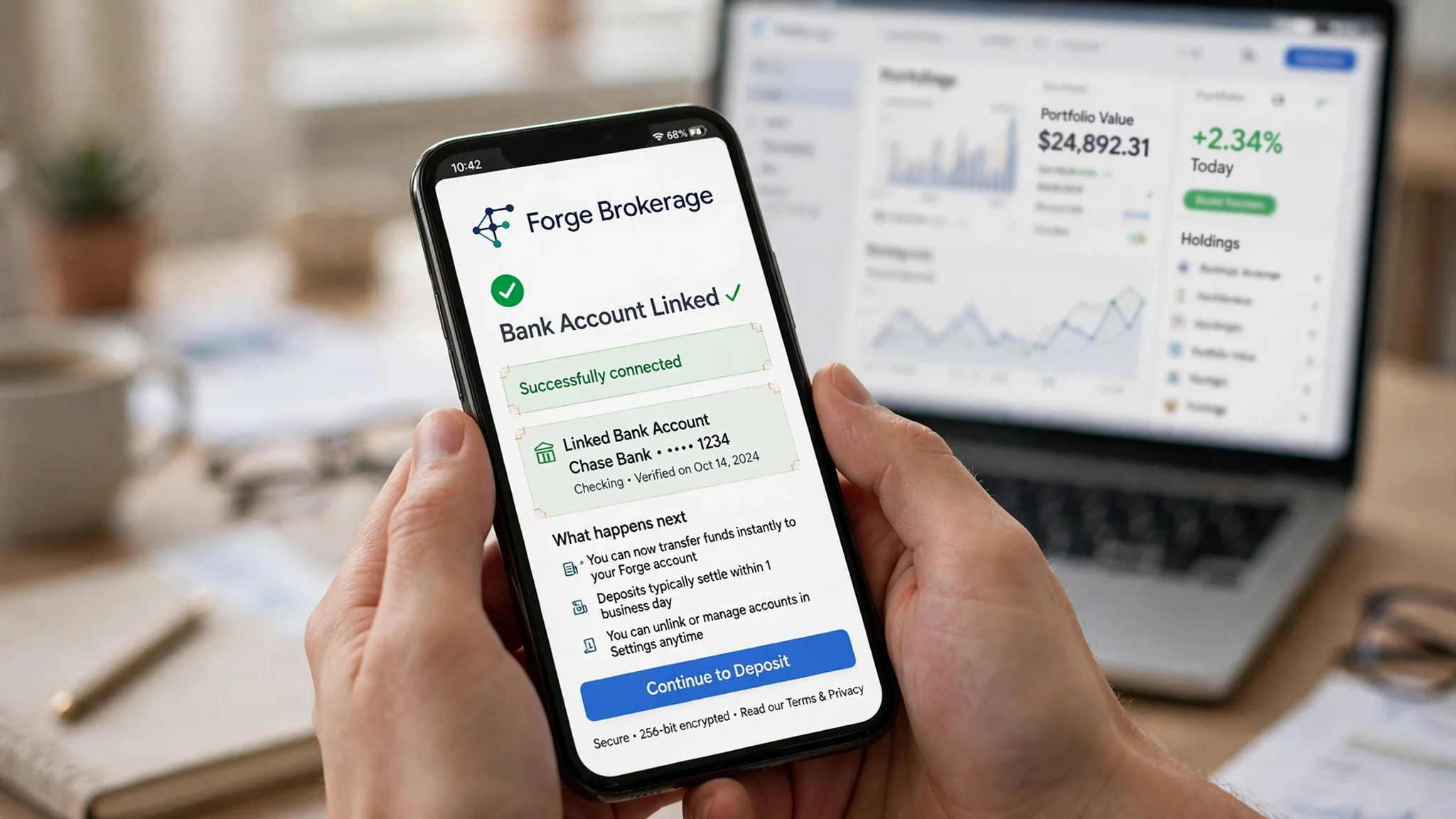
The same logic that applies to PayPal applies here, and for the same reason: your money and your identity sit behind one inbox, and the inbox is the only way the service reaches you when something needs your attention. A brokerage that cannot reach you does not stop moving your money. It moves it, tells an inbox that no longer exists, and waits for a response that never comes.
There is a second, quieter risk in the pipes. Robinhood can ask you to re-verify a linked bank account — a new device, an unusual transfer, a bank-side flag — and the request arrives by email. Miss it and the link can be frozen while a deposit you were counting on sits unprocessed. Nothing about this is dramatic. It is administrative, slow, and entirely dependent on an inbox that works on the day the message arrives, which is a day you cannot predict.
The tax file: your 1099 exists whether your inbox does or not
Every year, Robinhood produces a consolidated 1099 for your account: the 1099-B that reports the proceeds from the securities you sold, the 1099-DIV for dividends, the 1099-INT for interest, cost basis included. The IRS gets its copy directly. You get yours through the app and by email, each tax season, with a notice that your documents are ready and, sometimes, a corrected version when a figure changes.
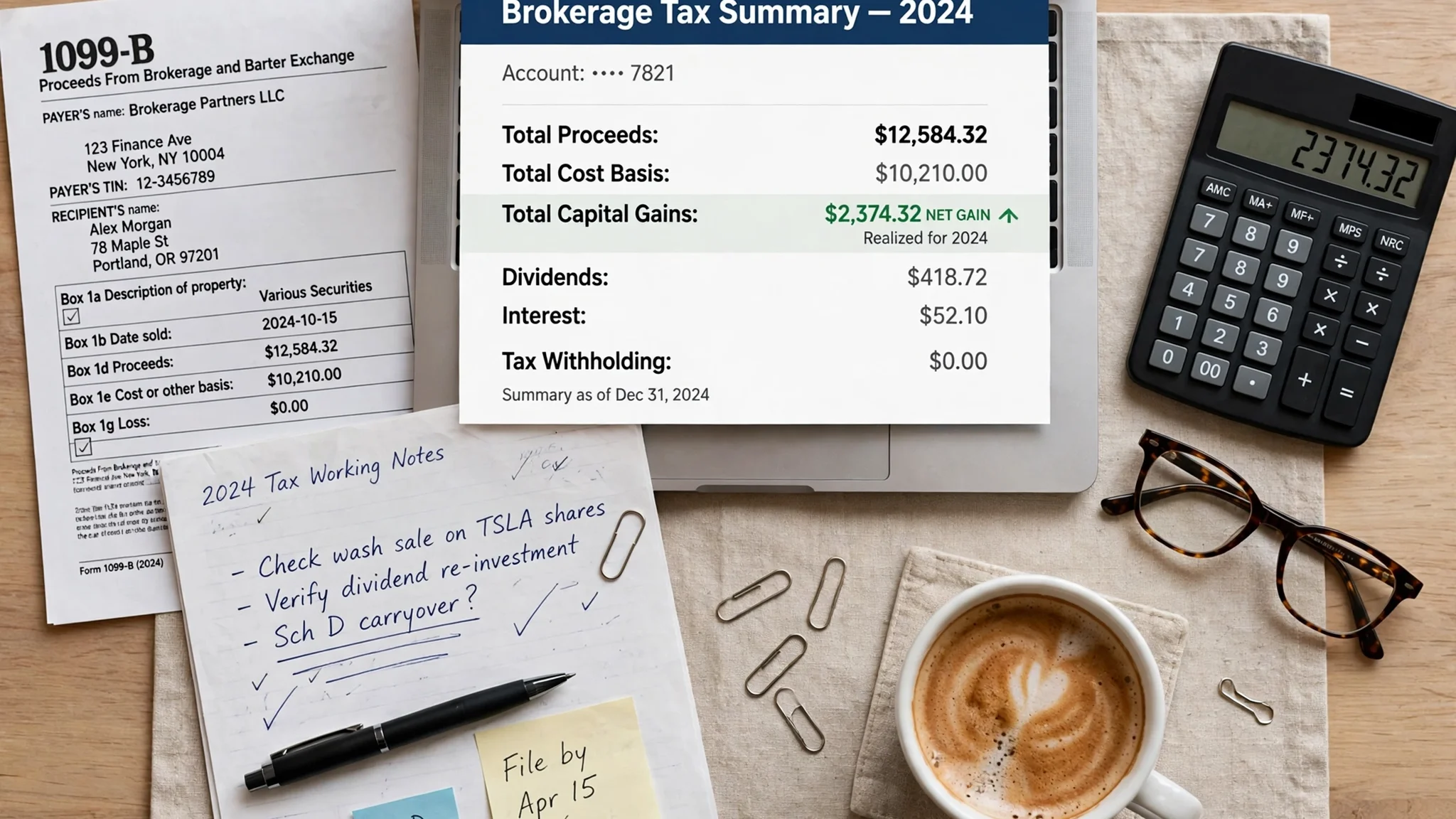
A dead inbox does not stop the tax file from existing. It stops you from knowing about it. The notice that your documents are ready goes nowhere. The corrected 1099-B — the one that changes your cost basis on a sale you already reported — goes nowhere. You file with the numbers you remember, the IRS files with the numbers Robinhood reported, and the gap between the two becomes a letter you receive months later, from an agency that does not accept "my temp email expired" as an explanation.
This is the row in the table that should end the argument for anyone who trades more than once. A brokerage account is a tax relationship that lasts years. It generates paperwork every year, on a schedule you do not control, delivered to an address you chose on day one. Choosing an address with a lifespan measured in hours for a relationship measured in tax years is not a privacy strategy. It is a filing error you schedule in advance.
The lockout math: three doors, one dead key
Getting locked out of Robinhood is not one failure. It is three, and they all lead to the same dead inbox.
The first door is the password. Forget it, and the reset link goes to your registered email. A temp inbox that expired months ago cannot receive it, and there is no alternate route that skips the email.
The second door is two-factor authentication. Robinhood offers two-factor authentication through an authenticator app or by SMS, and the authenticator app is the right choice — unless you set it up, lost the phone, and never saved the backup codes. Then the recovery path leans on the email and the phone together, and one of the two being dead is survivable while both being dead is usually the end of the line. Losing the recovery address on a two-factor account is a known way to lock yourself out of your own data, and a brokerage is the worst place to learn that lesson.
The third door is the new device. Sign in from a phone Robinhood has never seen, and it may ask you to confirm the sign-in through your email before it lets you in. That is the security feature working as designed. It is also the moment a temp-email account stops being yours in any practical sense: you know the password, you hold the phone, you can see the account, and you cannot get in.
Support will not rescue you quickly, either. Robinhood's help runs through the app and email, and an account-recovery case means proving you are the person who owns an inbox that no longer exists, with documents, while your positions sit untouched. Your money is still there. Your access to it is not.
One account per person — there is no fresh start with a second inbox
Robinhood allows one account per person. You cannot open a second account while the first is open, and you cannot use a new temp email to start over while the old account still holds your positions. The only legitimate path to a fresh account is to close the first one, move your assets out, and then apply again — and closing an account requires access to it, which requires the email.
That closes the last escape hatch people imagine. With a social app, a dead inbox means making a new account and losing your posts. With a brokerage, a dead inbox means you cannot even reach the exit. The account, the positions, the tax file, and the bank link all stay exactly where they are, attached to an address that no longer exists, until you prove your identity to support and rebuild access from scratch.
The scenario nobody plans for: the restriction notice you never see
Let me make this concrete, because abstract warnings do not change behavior and one specific story does. You open a Robinhood account with a temp email in November, fund it with $4,800 from your checking account, and buy a handful of stocks you intend to hold. The inbox expires eleven days later. You forget about it, because the app works fine — you are logged in, your positions are right there, and nothing seems wrong.
In February, Robinhood flags your account for a routine re-verification: your address on file does not match a record, and it needs you to confirm a document. The request goes to the temp inbox, which has been dead for three months. A second notice follows. Then a restriction: no new trades until the verification is complete. You do not see any of this, because you are logged in and not checking email — the app shows your positions, and you assume everything is fine.
In March, one of your holdings drops 18 percent on bad earnings, and you open the app to sell. The order is refused. The account is restricted. You tap through to the notice, and the notice tells you to check your email for the verification link — an email that was sent to an inbox that expired in November. The loss is not a fee and not a hack. It is the inability to act, at the one moment acting mattered, caused by silence.
Nothing in that story is exotic. Every step is ordinary brokerage behavior, and every step assumes the inbox works. The temp email did not cause the earnings miss. It caused the silence that made the earnings miss unfixable. That is the honest way to think about the risk: not "will Robinhood block me," but "what happens the first time something needs my attention, and who hears about it?"
What to do instead: a permanent mailbox built for money
The fix is boring, and that is the point. Create a permanent email address used only for money: your brokerage, your bank, your tax software, nothing else. It does not need to be your main inbox. It needs to exist in five years, receive mail, and be an address you check at least once a week. A free Gmail or Outlook address created for this single purpose gives you nearly all the separation a temp email promises, with none of the lockout risk.
Then set the account up properly. Turn on two-factor authentication with an authenticator app, not SMS, and save the backup codes in a password manager. Store the password in the same manager. Add a recovery email that is also permanent. Check the inbox once a week, the way you would check a mailbox outside a house you own — because that is what it is.
If you already registered with a temp email, change it now, today, while you can still log in. Robinhood lets you change the email on your account from your settings, and the change is confirmed through the new address. Every week you wait is a week in which a forgotten password turns a five-minute settings change into a support case that asks you to prove you are the person who owns an inbox that no longer exists. The full list of accounts that should never get a temp email is worth reading before you register anywhere that holds your money.
The verdict
A temp email gets you past Robinhood's first screen. It does not get you through Robinhood. The signup is a federal identity check, the account is a tax relationship that lasts years, the money moves through a bank link that emails you at every step, and the recovery paths all assume the inbox still exists. The six-digit code is the only part of the process a disposable address can do, and it is the least important part by a wide margin.
My recommendation, without hedging: never register a brokerage with an address you do not control permanently. Use a temp email for a newsletter, a free trial, a one-week browse — the low-stakes edges where the value arrives while the inbox is alive. For an account that holds your money, your positions, and your tax file, use a permanent mailbox, turn on authenticator-app two-factor authentication, and save your backup codes. That is the whole strategy, and it costs five minutes.
Frequently asked questions
Can I sign up for Robinhood with a temporary email?
The first screen, yes. Robinhood sends a 6-digit verification code to the address you enter, and a working temp inbox receives it. But the rest of the application — your legal name, date of birth, Social Security number, address, phone, and bank account — is a federal identity check that a disposable address cannot help with, and the account that follows will email you for years.
Does Robinhood require a phone number and Social Security number?
Yes, both. You need to be 18 or older, hold a valid Social Security number — a taxpayer identification number does not count — and have a legal US residential address. Robinhood verifies your identity against government records under the customer identification rules the SEC and FINRA enforce, and it may ask for a government ID and a selfie if the electronic check needs a closer look.
Can I change the email on my Robinhood account later?
Yes, while you can still log in. You can change the registered email from your account settings, and Robinhood confirms the change through the new address. Do it now if you signed up with a temp email. After a lockout, the change flow itself becomes a support case that asks you to verify your identity with documents.
What happens if I lose access to the email on my Robinhood account?
Password resets, security alerts, deposit confirmations, and tax-document notices all stop reaching you. Your positions and money stay where they are, but getting back in means proving your identity to support — a slow process, during which you cannot trade, withdraw, or respond to account notices.
Is it illegal to use a temp email for Robinhood?
Using a disposable address for the signup code is not itself a crime, but the account is tied to your real identity by federal law, and the practical risk is lockout, not prosecution. What the rules do forbid is holding more than one Robinhood account at a time, so a second temp-email account is not a way around a restriction on the first.
Need a disposable temporary email?
Protect your real inbox from spam and promotional clutter instantly and free.
Received a suspicious email, text, or charge alert?
Verify whether the sender domain is disposable, spoofed, or unverified before clicking links.