



Why the $70 Million AI.com Domain Purchase Has Everyone Asking Questions
Is ai.com a scam? No, AI.com itself is not a scam. It's a legitimate platform owned by Crypto.com CEO Kris Marszalek, who purchased the domain for $70 million in early 2025 to launch a consumer-facing AI agent platform. However, the confusion around AI.com is understandable given the surge in fraudulent schemes using "AI" in their names - like Quantum AI and AIMS AI - that have defrauded consumers of millions.
Quick Answer:
- AI.com Status: Legitimate platform for autonomous personal AI agents
- Owner: Kris Marszalek (Crypto.com CEO)
- Purchase Price: $70 million (most expensive domain in history)
- Launch Date: February 2025, with Super Bowl advertising
- Common Confusion: Many AI-related scams use similar names but are unrelated to AI.com
The timing of AI.com's launch has coincided with an explosion of AI-related fraud. The Canadian Anti-Fraud Centre reported that seniors lost over $9.2 million to emergency scams in 2022 alone - many now improved with AI voice cloning technology. Meanwhile, the FTC has launched Operation AI Comply to crack down on deceptive AI claims, including chatbots falsely offering "legal advice" and AI-powered business opportunities promising guaranteed returns.
I'm Mohammad Waseem, a tech-focused web creator who builds practical online platforms and has extensively tested digital tools, ad networks, and online security measures. Given the rise in sophisticated AI scams targeting personal information, understanding whether platforms like ai.com are legitimate is crucial for anyone concerned about is ai.com a scam and protecting their digital identity.
What is AI.com and Who Owns the $70 Million Domain?
When we first hear about a domain like AI.com changing hands for an astronomical sum, our ears perk up. It’s natural to wonder about its legitimacy, especially with so much buzz around AI and, unfortunately, an equal amount of scam activity. So, let's clarify: what exactly is AI.com, and who made the audacious move to acquire it for a staggering $70 million?
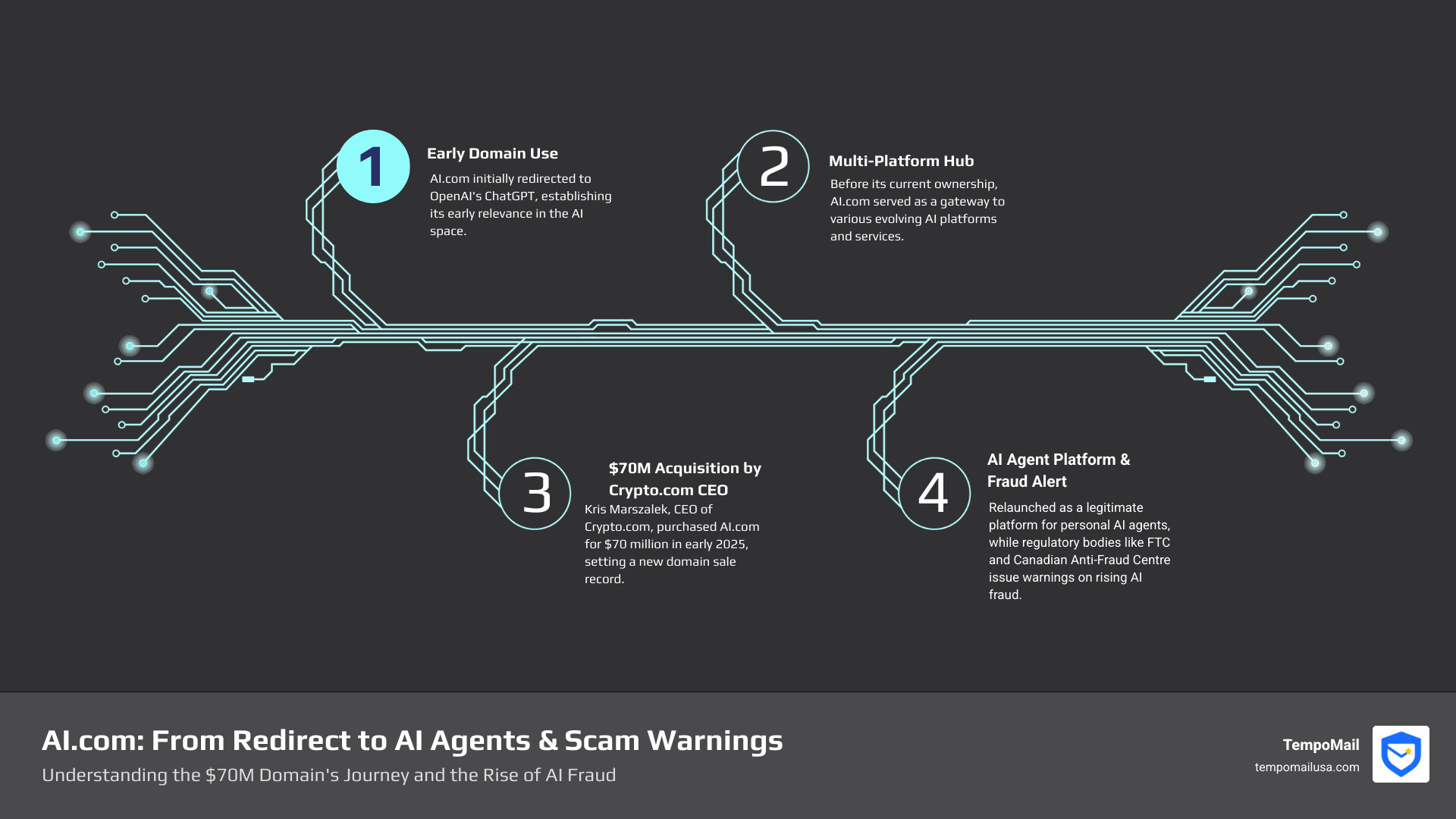
AI.com has been relaunched as a consumer-facing platform dedicated to autonomous personal AI agents. Imagine having a digital assistant that doesn't just answer questions but can actively use applications, manage your work, send messages, and even trade stocks on your behalf. That's the vision Kris Marszalek, the founder and CEO of Crypto.com, has for AI.com. He sees it as a hub where users can create private AI agents equipped with their own virtual computers, designed to simplify and automate various aspects of their digital lives.
The acquisition of AI.com for approximately $70 million by Kris Marszalek was, without a doubt, a colossal statement. This deal isn't just significant for the AI world; it ranks as the most expensive domain name purchase in history. To put that into perspective, it eclipses previous record holders like CarInsurance.com ($49.7 million in 2010), VacationRentals.com ($35 million), and Voice.com ($30 million). The transaction itself was completed entirely in cryptocurrency, adding another layer of modern financial flair to the deal.
Before Marszalek's acquisition, the history of the AI.com domain was quite interesting. For years, it served as a high-profile redirect, pointing users to major players in the artificial intelligence landscape. It briefly redirected to OpenAI, the creators of ChatGPT, then to Elon Musk's xAI, Google's Gemini, and even the Chinese startup DeepSeek. This history underscores the domain's inherent value as a prime piece of digital real estate, universally recognized as synonymous with artificial intelligence, despite .ai technically being Anguilla's country-code domain.
Marszalek framed this massive investment as a long-term bet on AI, believing it to be one of the greatest technological waves of our lifetime. The timing of the relaunch, coinciding with a massive Super Bowl advertising blitz, was a strategic move to maximize visibility and signal Crypto.com's aggressive pivot towards AI, aiming to define the next era of financial technology through the convergence of cryptocurrency and AI.

For those looking to understand the mechanics of how AI traffic and tools can be leveraged, we have more information about AI traffic tools that dig into how modern AI platforms are designed and used.
Is AI.com a Scam or a Legitimate Platform?
Given the substantial investment and the high-profile nature of the domain, many are asking: is ai.com a scam? We can confidently state that AI.com, under its current ownership and direction, is a legitimate platform. It is not one of the many fraudulent schemes that have unfortunately sprung up to capitalize on the AI boom.
The platform's core offering revolves around "autonomous personal AI agents." What does this mean for us, the everyday users? It signifies a step beyond simple chatbots. These AI agents are envisioned as digital entities with their own "virtual computers," capable of performing tasks independently. Think of them as your personal digital assistants, but with a much broader scope:
- Using apps: Your AI agent could interact with various applications, from productivity suites to social media, without you needing to manually open each one.
- Sending messages: It could manage your communications, drafting emails or responding to texts based on your preferences.
- Managing work: Automating routine tasks, organizing schedules, or even assisting with project management.
- Trading stocks: Potentially executing trades based on predefined strategies or market analysis, though this aspect would likely come with significant disclaimers and regulatory oversight.
This concept of personal AI agents with virtual computers represents a significant leap from the conversational AI we're familiar with. Instead of just generating text, these agents aim to interact with the digital world on our behalf, making decisions and executing actions.
To better understand AI.com's offering, let's compare it to a well-known AI service like ChatGPT.
| Feature | AI.com (Vision) | ChatGPT (Current) |
|---|---|---|
| Primary Function | Autonomous personal AI agents with virtual computers for task execution and automation. | Conversational AI for text generation, answering questions, and content creation. |
| Interaction | Proactive action and interaction with other applications/services. | Reactive responses to user prompts; primarily text-based. |
| Scope | Broad automation across digital tasks (messaging, work, potential trading). | Focused on language understanding and generation. |
| Goal | Simplify daily digital life through independent AI action. | Assist with information, writing, and creative tasks. |
| Underlying Tech | Advanced AI models integrated with virtualized environments. | Large Language Models (LLMs). |
While the full scope of AI.com's capabilities is still unfolding, its legitimacy is rooted in its transparent ownership by Kris Marszalek and Crypto.com, a well-established (though sometimes controversial) player in the tech and finance space. The hefty investment and strategic branding around the Super Bowl further solidify its status as a serious venture, not a fly-by-night operation. The goal is to create a robust, consumer-facing AI platform, not to deceive users with false promises.
Distinguishing AI.com from Malicious "AI" Schemes
The question, is ai.com a scam, often arises because the term "AI" has been heavily co-opted by fraudsters. It's crucial for us to distinguish legitimate ventures like AI.com from the truly malicious "AI" schemes that are actively targeting and defrauding individuals. These scams often leverage the hype and complexity of AI to create convincing, yet entirely fake, investment opportunities or deceptive narratives.
Two prominent examples of such malicious schemes are "Quantum AI" and "AIMS AI." These are not legitimate platforms and have been flagged by various regulatory bodies and consumer watchdogs:
- Quantum AI: This is a global scam that uses AI to impersonate celebrities and organizations, including the BBC, Elon Musk, David Beckham, Martin Lewis, and Richard Branson, to promote fraudulent investment schemes. Ads for Quantum AI often circulate on social media, promising unrealistic daily earnings (e.g., hundreds of euros a day, or €5,000 weekly for a €250 investment). These ads frequently feature deepfake videos or images, fake tweets, and lead to websites that impersonate legitimate news organizations. Victims are then contacted by "financial advisors" who pressure them into making initial investments, typically £200-£250, and later prevent them from withdrawing funds. The Financial Conduct Authority (FCA) and other regulators have issued warnings against Quantum AI for providing or promoting financial services without permission. The Canadian Financial and Consumer Affairs Authority of Saskatchewan (FCAA) also warned investors about Quantum AI, noting it is not registered to trade or sell securities in the province.
- AIMS AI: This scam typically begins with social media advertisements boasting incredible money-making abilities through an AI app. These ads feature videos of people who have supposedly earned thousands in record time. Users are lured into paying a seemingly reasonable initial fee (e.g., $67) to access the "groundbreaking app." However, this payment often enrolls victims into expensive recurring subscription plans (up to $97 monthly) that deduct funds from their accounts without proper authorization. What victims receive in return are generic training materials and PDFs, not the promised AI insights or effortless income. The scam relies on exaggeration, doctored payment proofs, and fake testimonials to create a mirage of opportunity.
These examples highlight common types of AI scams targeting consumers, especially vulnerable populations like seniors:
- Deepfake Voice and Video Scams: AI technology can clone voices from short audio clips (often sourced from social media) and create convincing deepfake videos. This is used in "grandparent scams," where a scammer impersonates a grandchild in distress, asking for urgent money. The Canadian Anti-Fraud Centre reported that over $9.2 million was lost by seniors to emergency-grandparent scams in 2022, a huge uptick from $2.4 million in 2021, often improved by AI voice cloning.
- Romance Scams with AI Chatbots: AI chatbots can generate highly convincing, human-like text responses, allowing scammers to maintain long, elaborate conversations to build trust in romance scams. Deepfake videos can also be used to create fake personas, making the deception even more potent.
- Fake Investment Platforms: Scammers create realistic-looking websites or marketing materials using AI to promote non-existent or fraudulent investment opportunities, often promising guaranteed high returns with little to no risk. They might even impersonate legitimate investment professionals using phony personal websites.
- Business Opportunity Scams: These schemes use AI hype and false earnings claims to trick people into investing in "AI-powered" business opportunities that don't deliver.
These scams exploit the public's excitement and lack of understanding about AI. They often demand untraceable forms of payment (wire transfers, cryptocurrency, gift cards) and pressure victims into quick decisions.
To protect ourselves, we must be vigilant. Always verify the legitimacy of any AI-related service or investment opportunity. We can consult resources like The Canadian Anti-Fraud Centre for information on recent scams and fraud.
The "AI Money Loop" and Regulatory Crackdowns
Beyond outright scams, there's a fascinating, albeit potentially concerning, financial dynamic at play in the AI industry that some have dubbed the "AI Money Loop." This concept describes how massive investments and spending circulate within a somewhat closed ecosystem, raising questions about the true nature of the AI boom's growth.
The "AI Money Loop" works something like this: tech giants (like Microsoft or Amazon) invest billions into promising AI startups (like OpenAI or Anthropic). These AI startups then use that capital to pay for the cloud computing services offered by the very same tech giants (e.g., OpenAI spending on Microsoft's Azure, Anthropic on Amazon Web Services). Crucially, both the tech giants and the AI startups require powerful hardware, primarily high-end GPUs, which are predominantly supplied by companies like Nvidia. Nvidia, in turn, sees its stock soar (up nearly 1,000% since ChatGPT launched) and may even reinvest some of its profits back into other AI companies. It's a circular economy where money flows, creating an illusion of exponential growth, but it's largely recycled capital.
This loop raises a critical question: is the AI boom real growth, or just money spinning in circles? While it's not a scam in the traditional sense, some argue it might be unsustainable if genuine new revenue streams don't eventually catch up to the inflated valuations. Nvidia, in this scenario, is often seen as the primary beneficiary, "selling shovels" in the AI gold rush, regardless of which individual AI companies succeed.
This intense financial activity and the potential for deceptive claims have not gone unnoticed by regulators. The Federal Trade Commission (FTC) is actively cracking down on AI-infused frauds and deception through initiatives like Operation AI Comply. We've seen them target various forms of AI-related misconduct:
- Chatbots giving false advice: The FTC is pursuing cases against companies like DoNotPay, which marketed itself as a "robot lawyer" providing legal advice, when AI responses can be inaccurate, inadequate, or misleading. We should never rely solely on chatbots for critical advice, especially concerning medical, legal, or financial matters.
- AI software for fake reviews: Companies like Rytr have been flagged for selling AI tools that enable the creation of fake online reviews on a massive scale, undermining consumer trust.
- False earnings claims for business opportunities: The FTC has sued companies such as Ascend, Ecommerce Empire Builders, and FBA Machine for using AI hype and false promises of huge earnings to trick people into investing in their business opportunities.
Other regulatory bodies are also stepping up. The Securities and Exchange Commission (SEC), the North American Securities Administrators Association (NASAA), and the Financial Industry Regulatory Authority (FINRA) have jointly issued an Investor Alert: AI Fraud to warn investors about the increase in investment frauds involving AI. They caution against unregistered platforms claiming AI trading systems that "can't lose," "pump-and-dump" schemes using false AI claims to inflate stock prices, and the use of deepfakes to impersonate individuals for fraudulent purposes. The Financial Conduct Authority (FCA) in the UK also issues warnings about unauthorized firms promoting AI-related investments.
These actions underscore a clear message: while AI offers immense potential, its rapid rise has created fertile ground for both sophisticated financial maneuvering and outright fraud. Consumers and investors alike need to exercise extreme caution and due diligence.
Frequently Asked Questions about AI.com
The rapid evolution of AI and the proliferation of both legitimate and fraudulent platforms can make it difficult to steer the digital landscape. Let's address some common questions regarding AI.com and AI-related scams.
Is ai.com a scam or a safe site?
Based on our research and understanding, AI.com itself is not a scam. It is a legitimate platform owned by Kris Marszalek, the CEO of Crypto.com, who acquired the domain for $70 million. The platform is being developed to offer autonomous personal AI agents that can interact with various applications and perform tasks on behalf of users. While any new technology platform carries inherent risks related to data privacy and security, the ownership and the significant investment behind AI.com indicate a serious and legitimate business venture, distinct from the fraudulent "AI" schemes we've discussed.
Who currently owns the AI.com domain?
The AI.com domain is currently owned by Kris Marszalek, the founder and CEO of Crypto.com. He acquired the domain for approximately $70 million in early 2025. This acquisition marked a strategic pivot for Crypto.com, signaling its aggressive move into the artificial intelligence space and its ambition to be at the forefront of the convergence between AI and blockchain technology.
How can I tell if an AI service like ai.com is a scam?
Distinguishing a legitimate AI service from a scam requires vigilance and a critical eye. Here are key indicators and steps we can take to protect ourselves:
- Verify Ownership and Reputation: For a site like AI.com, we looked at who owns it (Kris Marszalek/Crypto.com) and their existing reputation. Scams often hide ownership or use fake company names.
- Unrealistic Promises: Be highly skeptical of any AI service or investment opportunity that guarantees huge, quick, or unrealistic returns with little to no risk. "If it sounds too good to be true, it probably is."
- Lack of Transparency: Legitimate services will have clear terms and conditions, contact information, and explanations of how their technology works. Scams often have vague descriptions, hidden fees (like the recurring charges in AIMS AI), or anonymized customer support.
- Pressure Tactics: Fraudsters frequently use urgency or high-pressure sales tactics to rush you into making a decision or sending money. Legitimate services allow you time to research and decide.
- Payment Methods: Be wary if a service demands untraceable payment methods like cryptocurrency, wire transfers, or gift cards, especially for an initial investment.
- Deepfakes and Celebrity Impersonation: As seen with Quantum AI, scammers use AI to create fake videos or audio of celebrities or news anchors endorsing their product. Always verify the source of such endorsements.
- Regulatory Warnings: Check if financial regulatory bodies (like the FCAA, FCA, SEC, FINRA, or NASAA) have issued warnings about the service. You can use tools like the free "Check Out Your Investment Professional" on Investor.gov or Canada's National Registration Search.
- Independent Research: Don't rely solely on information provided by the service itself. Search for independent reviews, news articles, and discussions on reputable forums.
- Protect Your PII: Be cautious about entering personal and financial details into unfamiliar websites. Fraudulent sites are often designed to harvest your Personally Identifiable Information (PII).
- Report Suspicions: If something feels off, report it to consumer protection agencies like the FTC at ReportFraud.ftc.gov or The Canadian Anti-Fraud Centre.
By following these guidelines, we can better arm ourselves against the deceptive tactics employed by AI-related scams.
Conclusion
The question, is ai.com a scam, is a valid one in today's rapidly evolving digital world. Our research clearly shows that AI.com itself is a legitimate and ambitious venture, acquired by Crypto.com CEO Kris Marszalek for a record-breaking $70 million. Its aim is to pioneer a new era of personal AI agents, empowering users with autonomous digital assistants. This is a far cry from the deceptive practices of "AI" schemes like Quantum AI and AIMS AI, which prey on the public's excitement about AI with false promises, celebrity deepfakes, and hidden fees, leading to significant financial and emotional distress for countless victims.
The "AI Money Loop" also highlights a complex financial ecosystem where investments circulate, sometimes creating an illusion of growth that demands closer scrutiny. Regulators, including the FTC with its Operation AI Comply, are actively combating these deceptive AI claims and schemes, underscoring the urgent need for consumer awareness and protection.
In an environment where AI's potential is immense, but so is the risk of sophisticated fraud, our personal vigilance is our strongest defense. Protecting our Personally Identifiable Information (PII) and being critical of online claims are more important than ever. This is where services like TempoMail come into play. We understand the critical need for digital security and privacy. TempoMail offers identity proxying services, generating secure aliases that act as a firewall, protecting your PII from online services and helping you maintain control over your digital footprint. In a world increasingly shaped by AI, both good and bad, securing our personal information is paramount.
To learn more about how we can help you safeguard your digital identity, we invite you to Protect your identity with TempoMail.