


The Real Price Tag of Identity Fraud
The cost of identity fraud is staggering — and it's getting worse every year. Here's a quick breakdown of what it's costing Americans right now:
| Category | Estimated Cost |
|---|---|
| Total consumer fraud losses (2024, FTC) | $12.5 billion |
| Total crimes reported to FBI IC3 (2024) | $16.6 billion |
| Identity fraud losses to Americans (2023) | $43 billion |
| Synthetic identity fraud losses (2023) | $35 billion |
| Government UI program fraud (pandemic era) | $191 billion |
| True cost per $1 of fraud loss (financial sector) | $5.75 |
These aren't just numbers on a spreadsheet. They represent real people — roughly 15 million Americans in 2023 alone — dealing with drained accounts, destroyed credit, and months of stressful paperwork.
And the trend is moving in the wrong direction. The FBI's Internet Crime Complaint Center reported a 33% jump in stolen funds in 2024 compared to the year before. The FTC saw a 25% rise in consumer fraud losses over the same period. Year after year, the losses climb.
What's driving this? A combination of factors: more of our personal data sitting in vulnerable databases, increasingly sophisticated AI-powered scams, and an identity verification system that still relies heavily on static information — Social Security numbers, passwords, and paper documents — that fraudsters have learned to exploit with ease.
This guide breaks down exactly where the money goes, who pays the price, and what actually works to stop it.
The Staggering Financial Cost of Identity Fraud in 2026
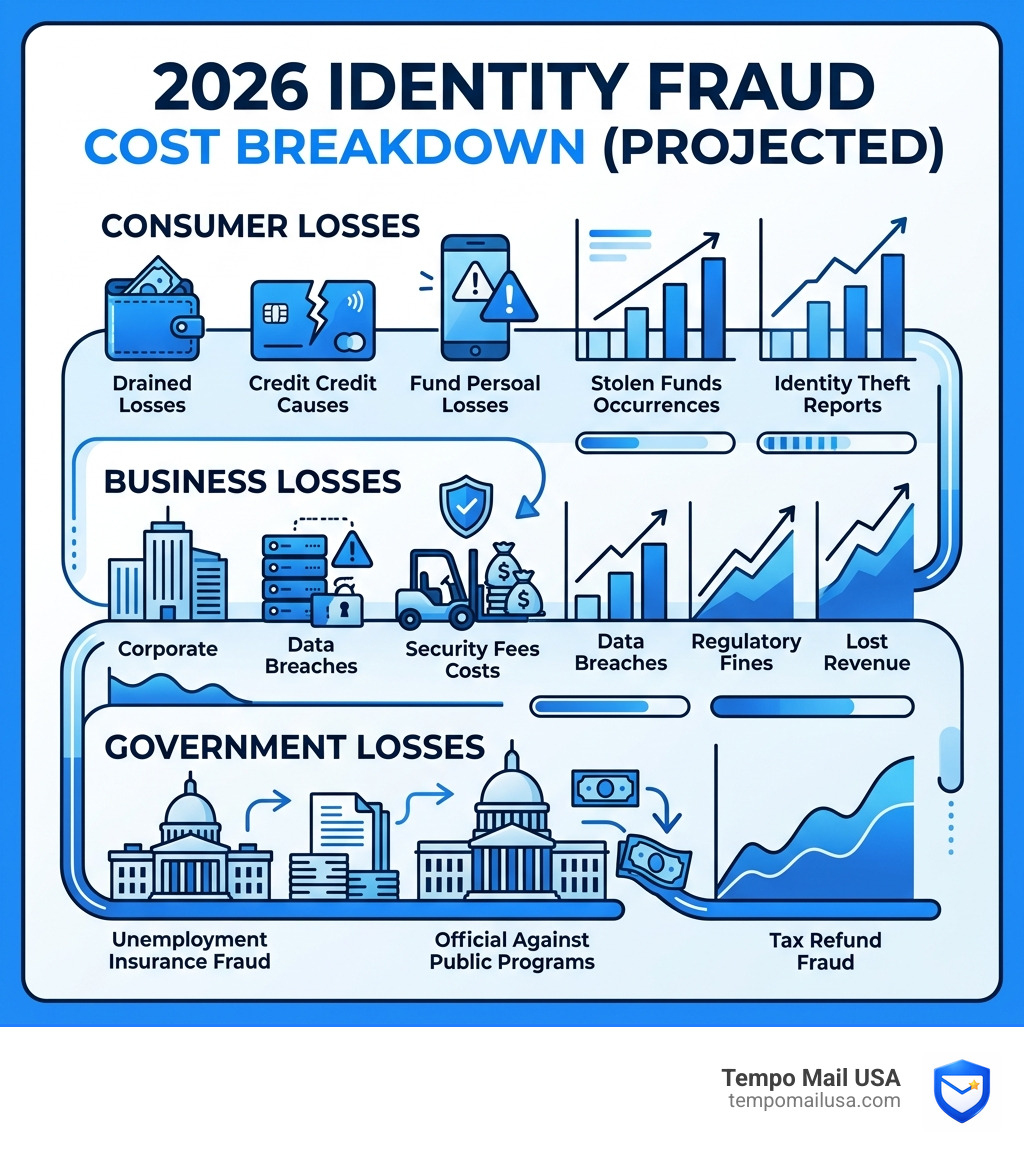
As we navigate through April 2026, the financial landscape of fraud has shifted from a series of isolated incidents to a full-blown economic crisis. When we look at the data from the last couple of years, the numbers are difficult to wrap our heads around. According to the FBI’s Internet Crime Complaint Center (IC3), scammers managed to siphoned off a record-breaking $16.6 billion from Americans in 2024. This wasn't just a minor uptick; it represented a massive 33% increase from the previous year.
The Federal Trade Commission (FTC) tells a similar story. Their Consumer Sentinel Network reported that U.S. Fraud and Identity Theft Losses Topped $12.7 Billion In 2024, marking a 25% rise compared to 2023. These figures highlight a grim reality: criminals are getting better at what they do, and they are scaling their operations faster than most individuals can update their security settings.
The LexisNexis Fraud Multiplier Effect
To understand the true cost of identity fraud, we have to look past the initial stolen dollar. For businesses, especially in the financial sector, a $1 loss is never just $1. LexisNexis refers to this as the "Fraud Multiplier."
In their 2025 True Cost of Fraud Study, researchers found that for every $1 lost to fraud, U.S. financial services firms actually incur $5.75 in total costs. This includes the cost of the investigation, legal fees, recovery efforts, and the technology required to prevent a repeat performance.
| Type of Cost | Impact on Organization |
|---|---|
| Direct Loss | The actual value of the stolen funds or goods. |
| Operational Cost | Labor for investigators, customer service, and claims processing. |
| Compliance Cost | Legal fees and regulatory fines for failing to protect PII. |
| Opportunity Cost | Lost revenue from legitimate customers blocked by "false positives." |
Escalating Losses in Government Programs
It isn't just individuals and banks footing the bill; taxpayers are also taking a massive hit. The U.S. Department of Labor’s Office of Inspector General recently estimated that at least $191 billion in pandemic Unemployment Insurance (UI) payments were likely improper, with a huge portion attributed directly to identity fraud.
When criminals use stolen identities to raid public coffers, it erodes trust in the very systems designed to help us during a crisis. We are seeing similar trends in tax fraud, where the IRS dirty dozen 2026 45b in tax fraud report highlights how sophisticated rings are using leaked data to file fraudulent returns before the real citizens even have their W-2s ready.
Beyond the Dollar: The Human and Operational Toll

While the billion-dollar headlines grab attention, the "human cost" is often much more devastating. Recovering from identity theft is essentially a second full-time job that you never applied for and definitely don't want.
Recent studies from Javelin Strategy & Research show that the average time spent resolving identity fraud issues jumped to nearly 10 hours per victim in 2023, up significantly from 6 hours in 2022. This increase is largely because criminals are no longer just hitting one credit card; they are performing "account takeovers" across social media, email, and multiple bank accounts simultaneously.
The emotional toll is even more concerning. Data indicates that 16% of identity theft victims in 2023 contemplated suicide — a heartbreaking statistic that has risen dramatically from just 2-3% a few decades ago. You can read more about this in the 2024 Identity Fraud Study: Resolving the Shattered Identity Crisis | Javelin.
Long-term Credit and Recovery Challenges
Once the initial shock wears off, victims face a long road of financial repair. The average out-of-pocket cost for a victim is roughly $202, but that doesn't account for the "invisible" costs. A trashed credit score can mean higher interest rates on mortgages, denial of car loans, or even trouble landing a job that requires a background check.
We always recommend taking immediate defensive action if you suspect your data has been compromised. A crucial first step is learning How to freeze your credit after identity theft guide to prevent thieves from opening new lines of credit in your name.
The Hidden Cost of Identity Fraud for Businesses
For the enterprise world, the cost of identity fraud has become a line item that can't be ignored. Compliance costs tied specifically to identity management reached $274.1 billion in 2022. Beyond the fines, there is the massive issue of "customer churn." When a business suffers a data breach, customers lose faith and take their business elsewhere.
Navigating the aftermath of a breach is complex, as seen in the Understanding the Integris data security settlement process, where legal settlements and remediation costs can linger for years.
Synthetic Identity Fraud and the AI Revolution
One of the most dangerous trends we’ve seen emerge in 2026 is the rise of synthetic identity fraud. Unlike traditional identity theft, where a criminal steals a "whole" person, synthetic fraud involves creating a "Frankenstein" identity. They might take a real, unused Social Security number (often from a child or a deceased person) and combine it with a fake name and a real address.
This type of fraud accounted for an estimated $35 billion in losses in 2023. It’s particularly difficult to catch because there isn't a "real" victim to notify that their account has been compromised. The "person" simply doesn't exist, yet they can build credit scores for years before "busting out" — maxing out every credit line and disappearing.
Generative AI has acted as a turbocharger for this crime. Fraudsters now use AI to create deepfake documents, such as utility bills or driver’s licenses, that look perfectly legitimate to automated verification systems. You can find a deeper dive into these mechanics at What Are the Costs of Identity Fraud? | SpruceID.
How AI Accelerates Modern Imposter Scams
AI isn't just creating fake IDs; it’s being used for social engineering. We are now seeing "voice cloning" scams where a criminal uses a 3-second clip of a loved one's voice to trick someone into sending money.
The root of most of these attacks is leaked PII (Personally Identifiable Information). If your SSN leaked on dark web what to do immediately to stay safe is a question you're asking, you're already at higher risk for these AI-driven imposter attacks.
Calculating the Total Cost of Identity Fraud by Attack Type
Not all fraud is created equal. The costs vary wildly depending on how the criminal gets in:
- Account Takeover (ATO): This resulted in nearly $13 billion in losses in 2023. This is when a thief gets into your existing bank or Amazon account.
- New Account Fraud: This reached $5.3 billion. This is when a thief uses your info to open new credit cards or loans.
If you are worried about your exposure, it is vital to know How to check if your data was breached so you can change your passwords before the ATO occurs.
Data Breaches: The Catalyst for Identity Theft
Data breaches are the "raw materials" for the identity fraud industry. In 2023 alone, there were 3,205 reported data compromises. When a company like a healthcare provider or a telecom giant loses your data, it doesn't just disappear; it ends up on dark web marketplaces where it is sold in bulk.
The HCIAactive data breach explained what you need to know is a perfect example of how sensitive information can suddenly become public property, fueling thousands of individual fraud cases.
Monitoring the Dark Web for Stolen Credentials
Many people used to rely on Google for their security insights, but since the Google killed its dark web report 5 free alternatives are now necessary for proactive monitoring.
Understanding the Google dark web report essential findings you must know can help you realize just how often your email and passwords are being traded by criminals. Once a password is out there, "credential stuffing" bots will try that same password on every bank and social media site until they find a hit.
Why Traditional Verification is Failing
The underlying problem is that our current "identity" system is based on secrets that are no longer secret. Your mother's maiden name, your childhood street, and your SSN are all likely available for $5 on a hacker forum.
Government reports like the Victims of Identity Theft, 2021 show that as long as we rely on static, "knowable" information, we will continue to lose the war against fraud. The future lies in cryptographic credentials and biometric liveness — things that are much harder for an AI to fake.
Strategic Defenses: Protecting Your Identity and Assets
So, how do we fight back? While the cost of identity fraud is high, the cost of prevention is relatively low. It requires a shift in mindset: from "I hope I don't get hacked" to "I will assume my data is leaked and build a firewall around it."
Comparing Identity Protection Methods
When choosing a defense strategy, it's helpful to look at the tools available:
- Identity Theft Protection Services: These are paid services that monitor your credit and PII 24/7. They often include "fraud resolution" experts who do the heavy lifting if you are victimized.
- Credit Monitoring Software: Often free through your bank, these alert you to new inquiries on your credit report.
- Secure VPNs: Using a service like NordVPN encrypts your data on public Wi-Fi, preventing "man-in-the-middle" attacks where hackers sniff out your login credentials.
- Credit Freezes: The single most effective free tool. It prevents anyone (including you) from opening new credit until you "unfreeze" it with a PIN.
Reducing the Cost of Identity Fraud Through Digital Hygiene
The most effective way to reduce the cost of identity fraud is to stop it before it starts. This comes down to "PII Minimization." The less information you give out, the less there is to steal.
- Use Multi-Factor Authentication (MFA): Never rely on just a password. Use an authenticator app or hardware key.
- Password Managers: Every single account should have a unique, 16-character random password.
- Email Aliasing: This is where we come in. At Tempo Mail USA, we believe your real email address is a key to your identity. By using our temporary email aliases, you create a "PII Firewall." If a site you signed up for gets breached, the hackers only get a proxy email that you can delete instantly, keeping your real inbox and identity safe.
As the Identity Fraud Cost Americans $23 billion in 2023 report suggests, the majority of traditional fraud starts with a simple phishing link or a leaked email. By proxying your identity, you remove yourself from the target list.
Frequently Asked Questions about Identity Fraud Costs
What is the average out-of-pocket cost for an identity theft victim?
While many people think the bank covers everything, the average victim still pays about $202 out-of-pocket. This includes legal fees, notary costs, and postage for dispute letters. However, for "new account fraud" cases, this number can jump to over $1,100.
How much does identity fraud cost the U.S. economy annually?
When you combine consumer losses, business compliance, and government fraud, the total impact is estimated to exceed $300 billion annually. This includes the $43 billion lost by individuals and the $274 billion businesses spend on identity management.
Why is synthetic identity fraud more expensive for banks than traditional fraud?
Synthetic fraud is more expensive because it is harder to detect. Banks often mistake these accounts for "bad debt" or "credit losses" rather than fraud. Because there is no real person to report the crime, the fraudster can keep the account open for years, building a massive credit line before "busting out," leading to losses that are 5 times higher than traditional credit card fraud.
Conclusion
The cost of identity fraud in 2026 is a heavy burden, but it isn't an inevitable one. By understanding the "Fraud Multiplier," the rise of AI-driven synthetic identities, and the sheer scale of modern data breaches, we can take better steps to protect ourselves.
At Tempo Mail USA, our mission is to provide you with the tools to stay anonymous in a world that wants to track and store your every move. By using a secure identity proxy, you aren't just protecting your inbox; you're protecting your bank account, your credit score, and your peace of mind.
Don't wait for the next breach notification to take action. Start building your PII firewall today at https://tempomailusa.com.