

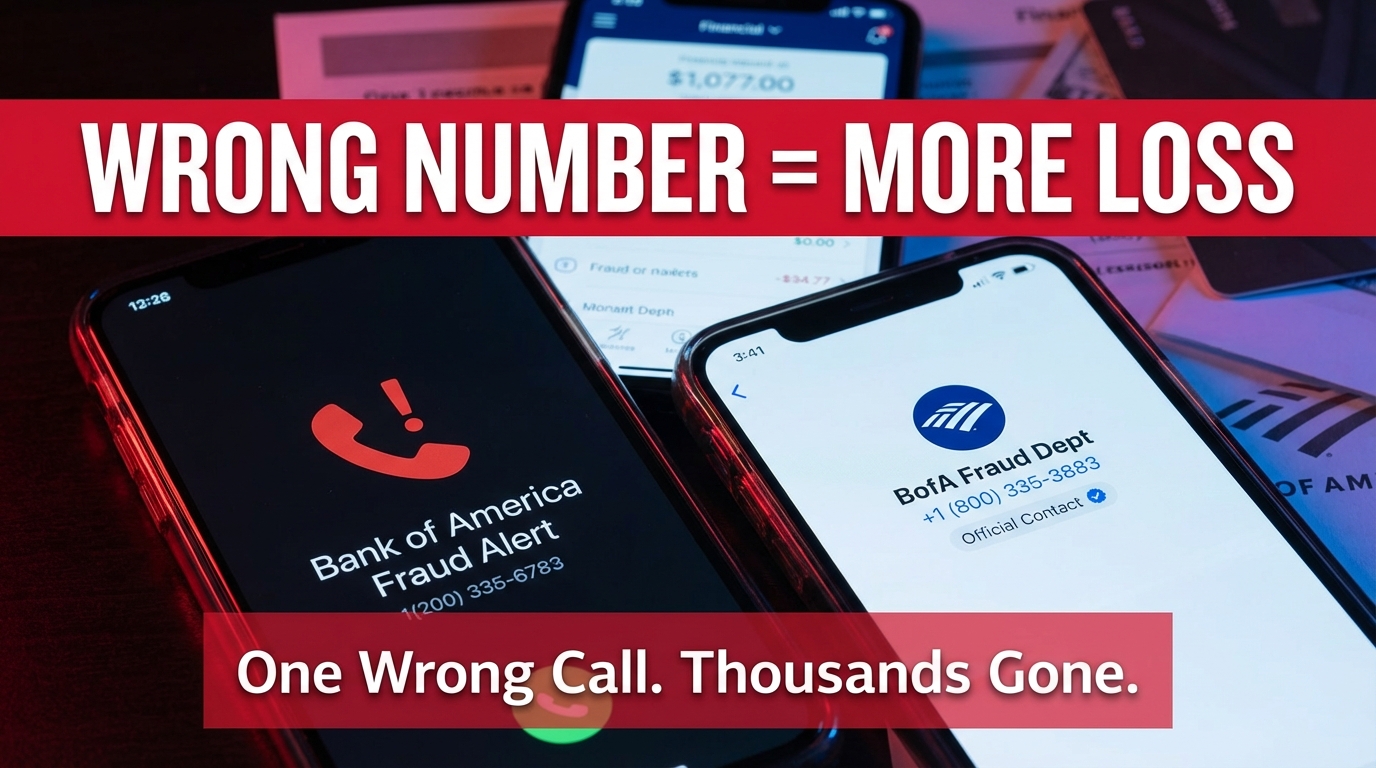

Why Calling the Wrong Number Could Cost You When Reporting Bank of America Fraud
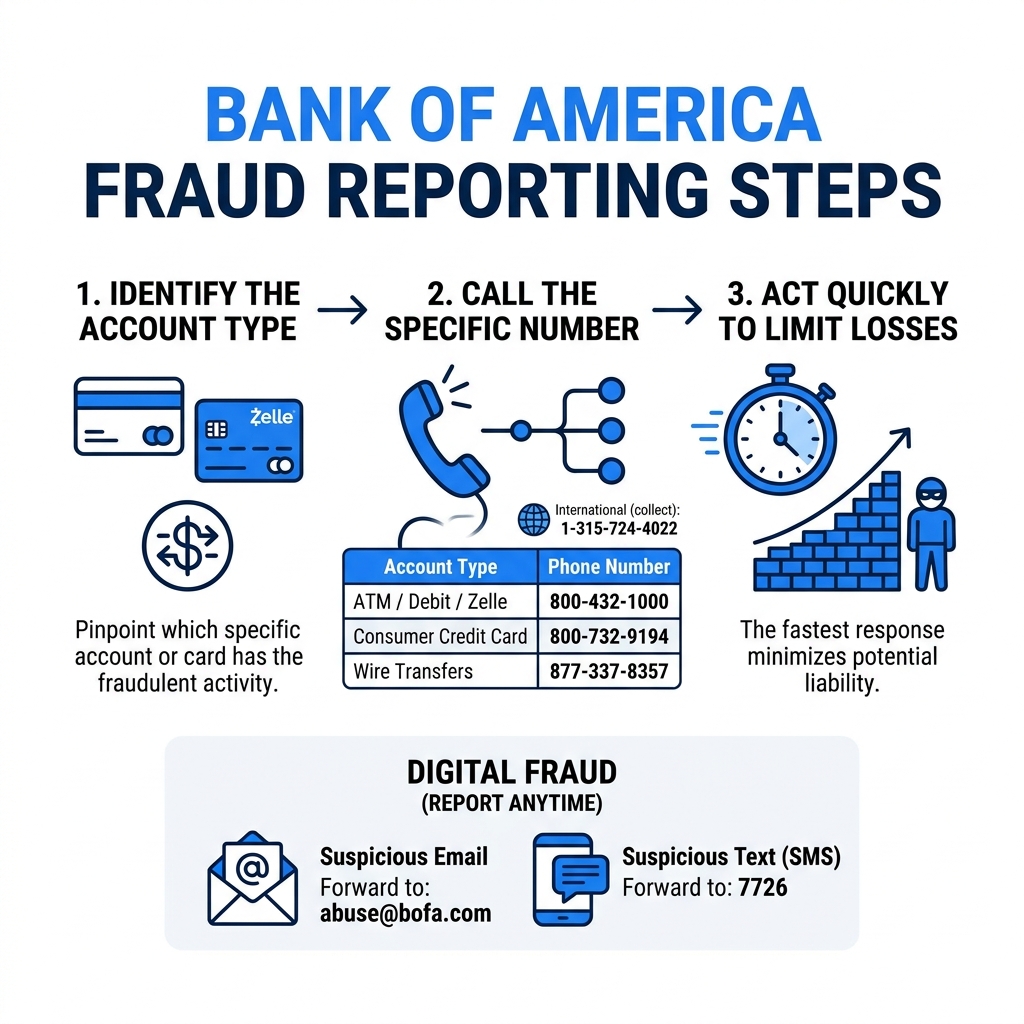
The bank of america fraud department phone number is not a single number — it depends on what type of account or card was affected.
Here are the key numbers to know right now:
| Account Type | Phone Number | Hours |
|---|---|---|
| ATM / Debit / Zelle | 800-432-1000 or 877-366-1121 | Mon-Fri 7am-10pm, Sat-Sun 8am-5pm ET |
| Consumer Credit Card | 800-732-9194 | 24/7 |
| Wire Transfers | 877-337-8357 | Business hours |
| Home Loans / Mortgage | 800-669-6607 | Mon-Fri 7am-7pm local time |
| International (collect) | 1-315-724-4022 | Varies |
| Suspicious emails | abuse@bofa.com | Anytime |
| Suspicious texts | Forward to 7726 | Anytime |
Fraud moves fast. Every minute you spend searching for the right number — or worse, calling the wrong one — is time a fraudster has to do more damage.
Bank of America has multiple fraud reporting lines, each tied to a specific product. Most people don't know this. They call a general number, get bounced around, and lose precious time.
There are also five surprisingly common mistakes people make when trying to report fraud to Bank of America. Some of these mistakes can delay your claim, increase your liability, or even expose you to more fraud.
This guide breaks down each mistake clearly — so you know exactly what to do (and what not to do) the moment something looks wrong on your account.
Mistake #1: Calling the Wrong Bank of America Fraud Department Phone Number
One of the most frustrating experiences during a financial emergency is being stuck in a "transfer loop." We've all been there: you call a number, wait on hold, explain your life story to an agent, only to hear, "I'm sorry, you actually need the credit department. Let me transfer you."
When you are searching for the bank of america fraud department phone number, it is vital to realize that the bank separates its fraud teams by the "rail" the money moved on. A specialist who handles stolen physical checks usually isn't the same person who investigates a fraudulent Zelle transfer or a compromised credit card.
If you have an unauthorized charge, you should first identify the source. Was it a swipe of your debit card? An ATM withdrawal you didn't make? Or a mysterious charge on your monthly credit statement? Each of these requires a different point of contact. For digital-first users, you can often skip the phone call initially by using the Dispute an ATM/Debit Card Transaction tool or the Dispute a Credit Card Transaction portal within the mobile app or online banking.
Specific Bank of America Fraud Department Phone Number for Cards
If you prefer to speak to a human — which we often do when we're panicked — make sure you dial the direct line for your specific card type.
- Debit Card and ATM Fraud: If your actual bank account balance is dropping due to fraud, call 800.432.1000. This line also handles Zelle-related fraud and issues where a physical checkbook has been stolen.
- Credit Card Fraud: For consumer credit cards, the 24/7 dedicated line is 800.732.9194. Bank of America is quite firm about its "Total Security Protection" for credit cards, meaning you typically won't be held liable for fraudulent charges if you report them promptly.
It's worth noting that different banks have different structures. For instance, if you also carry an Amex, you might be used to the Amex Fraud Department: Your Ally Against Financial Fraud protocols, but Bank of America’s systems are highly segmented by product. Using the wrong line doesn't just waste time; it can delay the "freezing" of the account, giving the thief more time to spend.
Dedicated Lines for Loans and Wires
Fraud isn't always about card swipes. Sometimes, it involves high-value transfers or even your home equity.
- Wire Transfers: If you suspect a wire transfer was sent from your account without permission, call 877.337.8357 immediately. Wire fraud is incredibly time-sensitive because once the money leaves the domestic system, it is nearly impossible to recover. You can also Manage/Cancel Funds Transfers online if the transfer is still in a "pending" state.
- Mortgage and Home Equity: If you see suspicious activity related to your home loan, the dedicated number is 800.669.6607. This line is generally available Monday through Friday, 7 a.m. to 7 p.m. local time.
Mistake #2: Delaying Immediate Action and Card Locking
In the "old days," reporting fraud meant you had to wait until business hours to call the bank. Today, that delay is a choice — and it's a dangerous one. Many people notice a suspicious $1.00 "pre-authorization" charge and decide to wait until the morning to deal with it. This is a mistake. Fraudsters often run small test charges to see if a card is active before draining the account with a massive purchase.
Immediate Steps for Compromised Accounts
The moment you suspect something is wrong, you should utilize the "Lock" feature. Bank of America allows you to lock your debit or credit card instantly via the mobile app or online banking.
- Lock the Card: This prevents any new purchases or ATM withdrawals. It’s like a digital pause button.
- Check for Virtual Cards: Locking a physical card might not automatically lock a "virtual" card or a digital wallet (like Apple Pay). Check those individually.
- Report to the FTC: If your personal information was also stolen, you should follow the steps in How to Report Identity Theft to the FTC.
The stakes are high. According to recent data, Americans Lost $43 Billion to Identity Theft in a single year. By locking your card the second you feel uneasy, you move from being a victim to being an active defender of your wealth. Bank of America provides 24/7 automated support for lost and stolen cards, so there is truly no reason to wait for "opening hours."
Mistake #3: Falling for Phishing and Imposter Scams
This is perhaps the most "meta" mistake: getting scammed while trying to avoid being scammed. Fraudsters are now sending texts and emails that look identical to official Bank of America alerts. They might say, "Urgent: Suspicious activity on your account. Call 1-800-XXX-XXXX to verify."
The problem? That number isn't the bank of america fraud department phone number. It’s a direct line to a scammer who will ask for your Social Security number, PIN, and password to "verify your identity."
Identifying a Fake Bank of America Fraud Department Phone Number
To protect yourself, follow these rules:
- Never click the link: If you get a text about fraud, don't click the link. Instead, open your Bank of America app manually or type the official website address into your browser.
- Use the "Back of the Card" Rule: The safest bank of america fraud department phone number is the one printed on the back of your physical card.
- Forward Suspicious Texts: If you receive a "smishing" (SMS phishing) text, forward it to 7726 (which spells SPAM on most keypads). This alerts carriers to the scam.
- Forward Emails: Send any suspicious emails to abuse@bofa.com.
We've seen similar tactics used in other schemes, such as the Department of Legal Compliance Scam: Do Not Pay. The goal is always the same: to create a sense of urgency so you stop thinking clearly. If you have already interacted with a scammer, don't be embarrassed — it happens to the best of us. Check out How to Resolve First Financial Scam: 5 Guaranteed Methods for recovery strategies that apply across many financial institutions.
Mistake #4: Not Having Your Information Ready for the Call
When you finally get through to the fraud department, the agent is going to ask a series of very specific questions. If you are fumbling through your wallet or trying to remember when you last used an ATM, the call will take much longer, and it may even delay the filing of your claim.
Before you dial the bank of america fraud department phone number, have this information sitting in front of you:
| Information Needed | Why It Matters |
|---|---|
| Account/Card Number | To identify which "bucket" of money is at risk. |
| Transaction Date/Time | Helps the agent pinpoint the exact breach. |
| Transaction Amount | Necessary for the formal dispute filing. |
| Merchant Name | Helps distinguish between a "forgotten" charge and a "fraudulent" one. |
| ATM ID/Location | Critical if you are reporting a deposit or withdrawal error. |
If you have recently moved or changed your phone number, make sure you Update Contact Information through the secure portal before the call if possible. The bank uses your registered contact info to verify your identity. If they have an old phone number on file, they might not be able to send you the "one-time passcode" needed to verify that it's really you calling.
Mistake #5: Ignoring International Support and Operating Hours
Fraud doesn't care if you're on vacation in Paris or a business trip in Tokyo. In fact, many people experience fraud more often while traveling because their guard is down or they are using public Wi-Fi.
If you are outside the U.S., dialing an 800 number often won't work, or it will cost a fortune in roaming charges. Bank of America provides international collect call numbers specifically for this reason.
- International Debit/ATM Fraud: Call 1.315.724.4022 (collect).
- International Credit Card Fraud: Call 1.302.738.5719 (collect).
Social Media as a Backup
If you can't get through via phone, Bank of America has a surprisingly robust social media presence. While you should never share your account number or SSN publicly, you can send a private message to their verified accounts to request a callback or guidance.
- Facebook: Privately message us on Facebook
- X (Twitter): Direct message @BofA_Help on X
Their social media teams are generally available Monday through Friday from 8 a.m. to 9 p.m. ET, Saturday from 9 a.m. to 6 p.m. ET, and Sunday from 8 a.m. to 5 p.m. ET. This can be a great alternative if you are having trouble with the phone lines or have a general question about the fraud process.
Frequently Asked Questions about Bank of America Fraud Reporting
What are the operating hours for the fraud department?
While credit card fraud reporting is available 24/7 at 800.732.9194, other departments have specific hours. General fraud support for debit and checking accounts is usually available Monday through Friday from 7 a.m. to 10 p.m. and Saturday/Sunday from 8 a.m. to 5 p.m. local time. Automated systems for reporting a lost or stolen card are always active.
How do I report fraud from outside the U.S.?
You should use the international collect numbers: 1.315.724.4022 for debit/ATM issues and 1.302.738.5719 for credit cards. To avoid roaming charges, tell the local operator you wish to make a "collect call" to the United States.
Can I report an ATM deposit or withdrawal claim online?
Yes. You can log into Online Banking and navigate to the transaction in your history to start a dispute. If you prefer the phone, call 844.401.8500 (Option 3). Be ready with the ATM location and the specific amount of the discrepancy.
Conclusion
Navigating a fraud claim is stressful, but calling the right bank of america fraud department phone number is the first and most important step to reclaiming your peace of mind. By avoiding these five common mistakes — calling the wrong department, delaying action, falling for phishers, being unprepared, or ignoring international options — you put yourself in the best position to recover your funds.
At Tempo Mail USA, we believe that the best way to handle fraud is to prevent it from happening in the first place. One of the biggest ways scammers get your information is by harvesting your real email address from data breaches or "free" sign-up offers.
Our service provides you with temporary email aliases that act as a secure proxying firewall. By using a temporary email for online shopping, newsletters, and apps, you keep your real PII (Personally Identifiable Information) hidden from potential hackers. If a site you signed up for gets breached, your real email — and the banking identity attached to it — remains safe.
Protect your real email address at tempomailusa.com and stay one step ahead of the fraudsters. Stay safe, stay vigilant, and always double-check that number before you dial!