

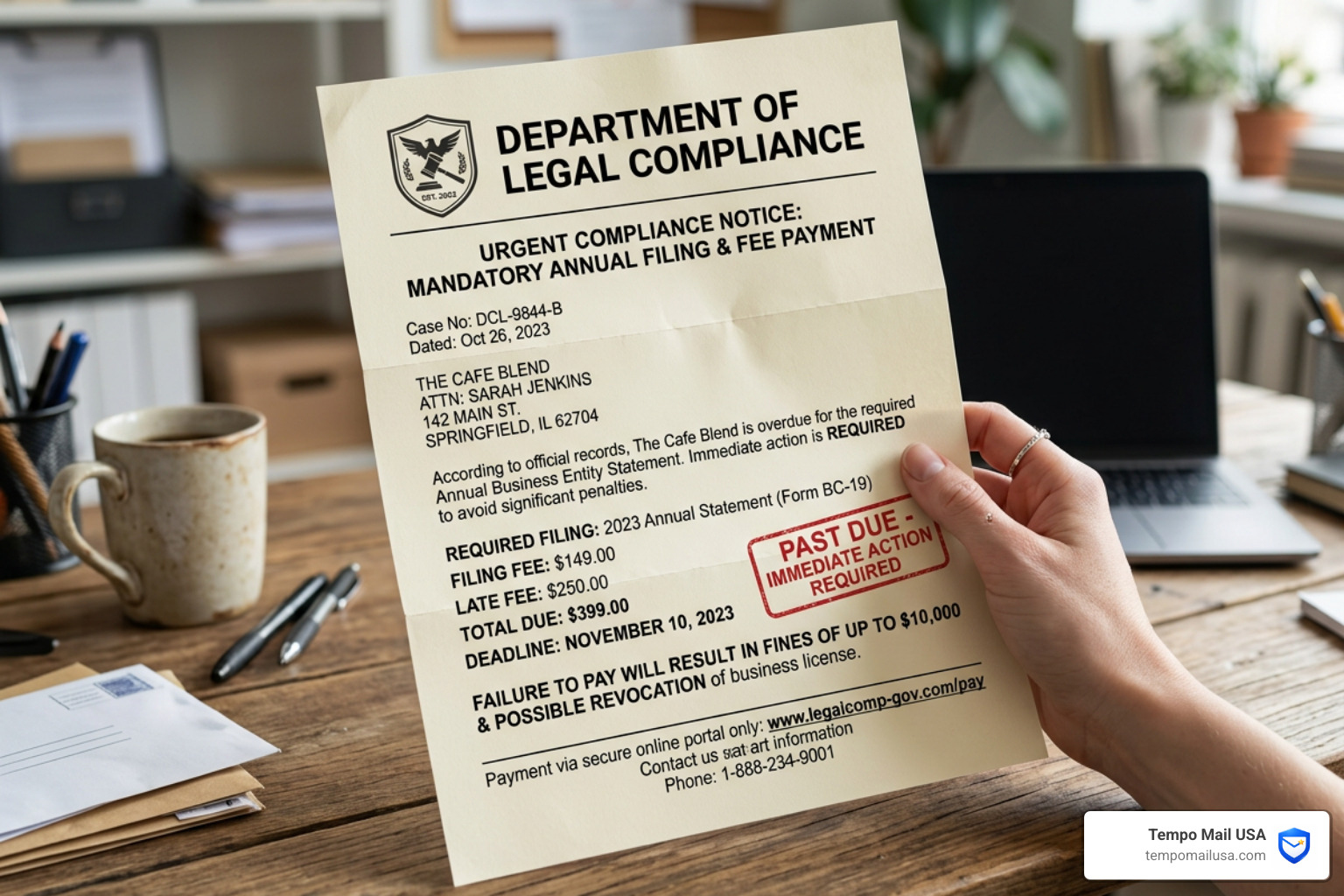

Is the Department of Legal Compliance Scam Real? Here's What You Need to Know Fast
The Department of Legal Compliance Scam is a fraud where fake "government agencies" send threatening letters, emails, or robocalls to businesses demanding payment for compliance filings — or face heavy fines.
Quick answer — here's what to know right now:
- It is not a real government agency. No legitimate U.S. federal or state department operates under this name.
- Scammers impersonate real agencies like the USDOT, Department of Labor, or Secretary of State.
- They demand payments ranging from $85 to $550+ for filings that are either free or not legally required.
- Threatened fines can look alarming — up to $17,000 for labor posters, or $10,000 for fake BOI reporting violations.
- If you received one of these notices, do not pay until you verify directly with the actual government agency.
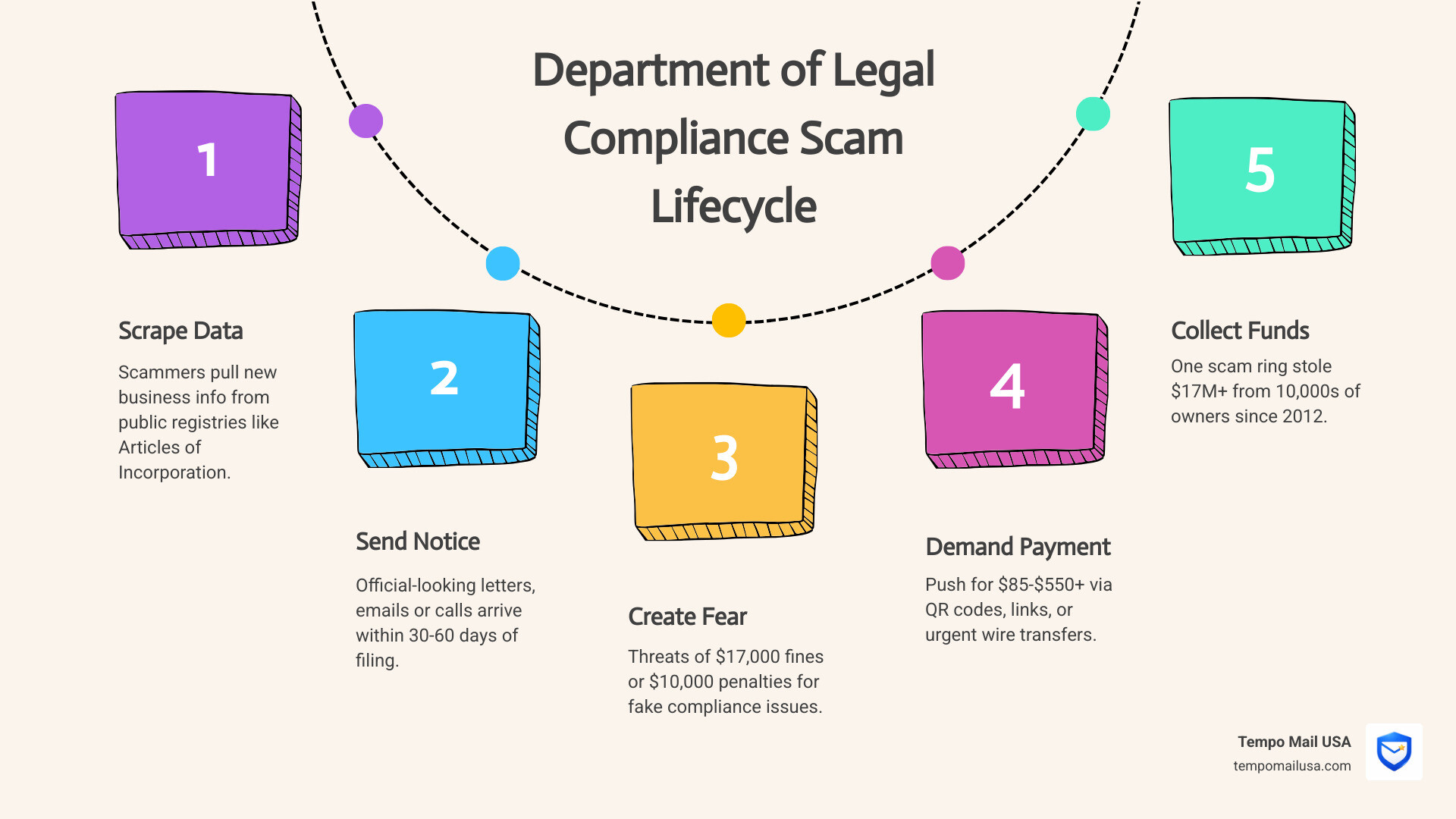
These scams have caused real damage. A federal complaint documented one operation alone collecting over $17 million from tens of thousands of small business owners since 2012 — by doing nothing more than pretending to be a government enforcement body.
The playbook is simple: create fear, look official, get paid.
New business owners are especially vulnerable. The moment your company registers publicly, your information becomes available — and scammers are fast. Many businesses report receiving fraudulent compliance notices within the first 30 to 60 days of filing.
What is the Department of Legal Compliance Scam?
The Department of Legal Compliance Scam is an umbrella term for a variety of deceptive solicitations targeting business owners. These scammers create fictitious entities with names that sound authoritative to trick you into thinking you are dealing with the government. Common fake names include the "United States Business Regulations Department," the "Department of Records Management," or "Corporate Compliance Services."
These operations typically work by scraping public business registries. The moment you file your Articles of Incorporation or LLC paperwork, your business address and owner name become public record. Scammers pounce on this data, sending official-looking mail that arrives just as a new owner is feeling overwhelmed by legitimate paperwork.
The reach of these scams is massive. Statistics show that related entities impersonating government agencies for motor carrier registrations alone have taken over $17 million from tens of thousands of consumers. They don't just stop at physical mail; they use a multi-channel approach including:
- Phishing Emails: These often contain links to unsecured websites or attachments that look like invoices. It is vital to check your email spam score and stay vigilant against digital masquerades.
- Robocalls: Automated voices may claim that "enforcement is in progress" or that your business license is at risk of being revoked.
- Text Messages: Scammers are increasingly moving to SMS, sending "urgent" alerts about filing deadlines.
To stay safe, we recommend reviewing a quick guide: how to spot phishing emails to recognize the digital red flags before clicking any links.
Common Tactics and Targeted Filings
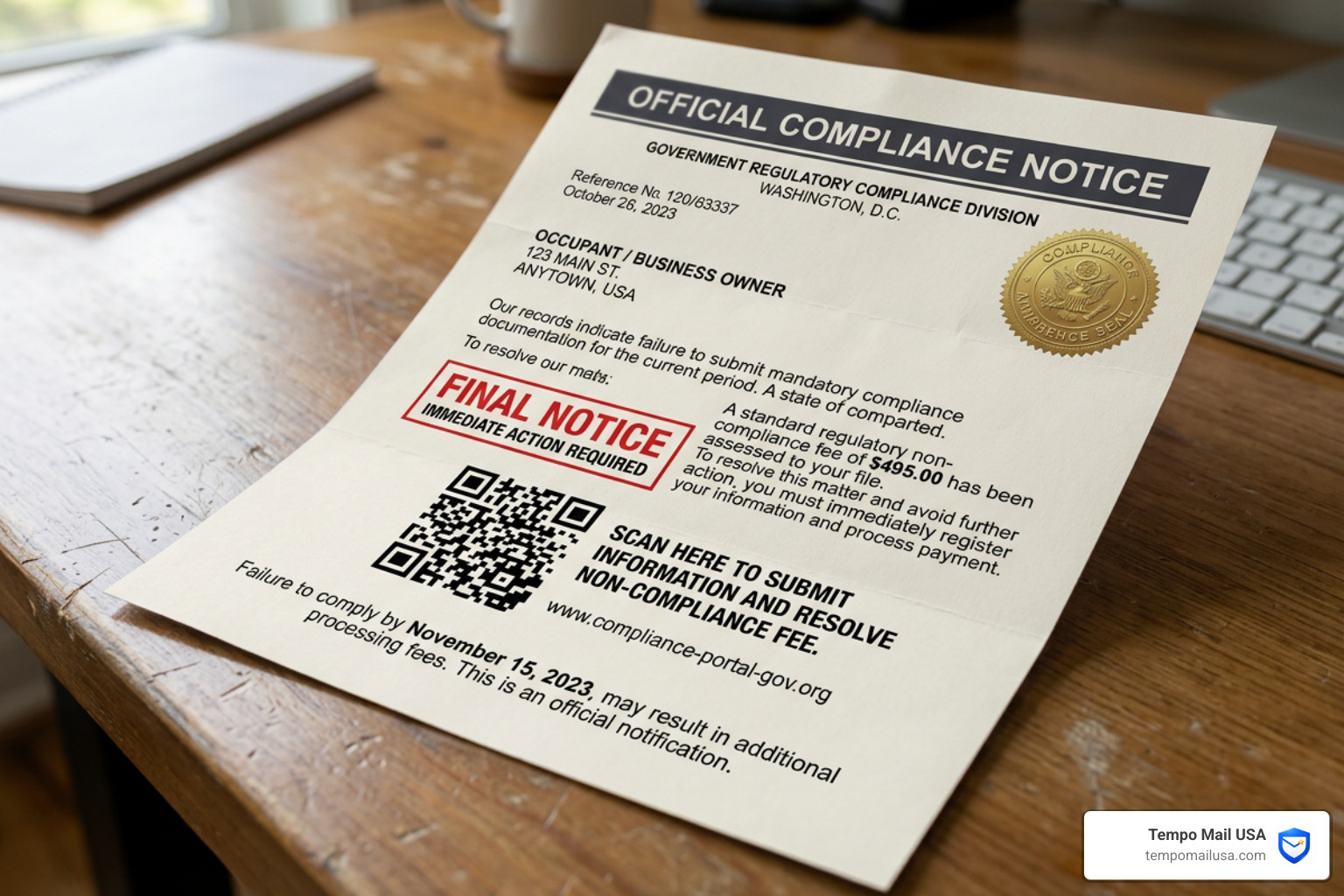
Scammers are masters of psychological manipulation. They use "fear-ware" tactics—language designed to make you panic and pay without thinking. You might see phrases like "FINAL NOTICE," "NON-COMPLIANCE ALERT," or "IMMEDIATE ACTION REQUIRED" in bold red letters.
One of the most effective tricks is the use of QR codes and fake seals. By placing a QR code on a physical letter, they lead you to an unsecured website that mimics a government portal. This bypasses the natural suspicion you might have if you had to type in a suspicious URL yourself.
The Threat of Fines
To force your hand, these notices claim astronomical penalties. We have seen letters threatening:
- Fines of $17,000 or more for not having specific labor law posters.
- Daily civil penalties of $591 for Corporate Transparency Act (CTA) non-compliance.
- Total civil penalties up to $10,000 and even criminal charges.
Some scammers even use "negative option billing" or "SafeRenew" programs. This means once you pay them once, they hide a clause in the fine print that allows them to charge your credit card annually for "renewal services" you never asked for. This is similar to tactics seen in the Docusign email scam: how to spot it, where legitimate-looking digital signatures are used to authorize fraudulent transactions.
Impersonating Government Agencies
Scammers frequently wrap themselves in the flags of real agencies to gain trust. They often impersonate:
- USDOT (U.S. Department of Transportation): Targeting truckers with fake Unified Carrier Registration (UCR) notices.
- Secretary of State: Sending fake "Annual Minutes" or "Statement of Information" forms.
- Department of Labor (DOL): Demanding payment for official DOL posters that are actually free.
- FinCEN: Exploiting the new Corporate Transparency Act to charge for Beneficial Ownership Information (BOI) filings.
- OSHA: Selling "Safety Manuals" for $150 that the government provides for free.
High-Risk Compliance Filings Targeted
The Department of Legal Compliance Scam specifically targets filings that business owners know they should do but might not fully understand:
- Labor Law Posters: Scammers charge $80–$200 for posters you can download for free from DOL.gov.
- UCR Filings: Truckers are told they must pay $550+ in "service fees" on top of standard government fees.
- Corporate Transparency Act (BOI Reporting): This is a new 2024 requirement. While many businesses must file, the official process is free at FinCEN.gov. Scammers charge $85–$200 for this "service." For more details, see the FinCEN Small Business Compliance Guide.
- Annual Minutes & Statements of Information: Scammers claim you must file your internal meeting minutes with the state (you don't) and charge $175+ for the "privilege."
How to Verify the Legitimacy of a Compliance Notice
How do you tell a real government notice from a Department of Legal Compliance Scam? It comes down to the details.
| Feature | Legitimate Government Mail | Scam Compliance Notice |
|---|---|---|
| Sender Name | Specific (e.g., "California Secretary of State") | Generic (e.g., "Compliance Division") |
| Website URL | Ends in .gov | Ends in .org, .com, or .net |
| Payment Method | Official portal, check, or credit card | Bitcoin, wire transfer, or "processing fee" |
| Tone | Informational/Regulatory | Threatening/Urgent |
| Fine Print | Privacy notices/Contact info | "This is an advertisement" (often hidden) |
Legitimate government websites will almost always have a URL ending in .gov. For example, if you are a California business owner, you should always verify business filings at bizfileOnline.sos.ca.gov rather than following a link in a random letter.
If you are ever in doubt, stop and call the agency directly. Do not use the phone number provided in the suspicious letter. Instead, look up the agency on an official government directory.
Red Flags of a Department of Legal Compliance Scam
Keep an eye out for these specific warning signs:
- Grammar and Spelling Errors: Real government documents go through rigorous editing. Scams often have awkward phrasing or typos.
- Unsecured Websites: If the URL starts with
http://instead ofhttps://, it is a massive red flag. - Payment via Cryptocurrency: No government agency will ever ask you to pay a compliance fee in Bitcoin.
- 24-Point Font Disclaimers: In many states, these scam letters are legally required to include a disclaimer stating they are not a government agency. Scammers often hide this in tiny text or on the back of the page, but sometimes they are forced to use a large 24-point font. If you see "This is a solicitation" or "This is not a government document," throw it away.
- Requests for Sensitive Info: Be wary if they ask for your Social Security Number or passport images upfront.
If your phone is blowing up with "enforcement" calls, you might wonder, "Why am I getting so many spam calls?" It is likely because your business phone number was sold by a data broker or scraped from a public filing.
Protecting Your Business and Reporting Fraud
If you have identified a Department of Legal Compliance Scam, the first thing to do is stop all communication. Do not call the scammers back to "complain"—this only confirms your number is active and leads to more calls.
Where to Report
Reporting is crucial to help authorities shut these operations down. You should:
- Report to the FBI IC3: Use the FBI Internet Crime Complaint Center for any scams that originated online or via email.
- FTC Report Fraud: Visit the FTC's reporting portal to help them build cases for permanent injunctions against these companies.
- BBB Scam Tracker: Check the Better Business Bureau to see if others have reported the same "company" name.
Take Recovery Steps
If you have already provided personal information, visit IdentityTheft.gov to create a recovery plan. This is vital because scammers often use the data they steal to open lines of credit in your business's name. You should also alert your financial institution immediately if you shared bank details or credit card numbers.
We understand the pressure of keeping your business data safe. One of the hidden dangers of sharing your email online is that it makes you a permanent target for these compliance "sharks." Using a protective layer for your business identity is one of the best ways to prevent these notices from ever reaching your primary inbox.
Frequently Asked Questions about Compliance Scams
Do I have to pay for labor law posters?
No. You are legally required to display them, but you do not have to buy them from a third party. You can download every required federal poster for free from the US Department of Labor website. Most state-specific posters are also available for free on your state’s Department of Industrial Relations (DIR) or equivalent website. Scammers charge $80–$200 for something that costs you only the price of printer ink.
Is the Department of Legal Compliance a real government agency?
No. It is a fictitious name used by scammers. Legitimate agencies have specific names like "The Department of Labor" or "The Secretary of State's Office." Always look for the official letterhead and the name of the elected official (like the Secretary of State) on the document. If the letterhead is generic or missing a physical government address, it is likely a scam.
What should I do if I already paid a Department of Legal Compliance Scam?
- Contact your bank: Request a chargeback or stop-payment immediately.
- Cancel Auto-Renewals: Many of these scams enroll you in "SafeRenew" programs that charge you every year. You may need to cancel your credit card to stop the cycle.
- Report to IC3: File a report at ic3.gov to help law enforcement track the money.
- Monitor your credit: Scammers may have enough info to attempt identity theft. Use IdentityTheft.gov to set up alerts.
Conclusion
The Department of Legal Compliance Scam relies on the fact that business owners want to do the right thing and stay "legal." By weaponizing fear and official-sounding jargon, these fraudsters steal millions of dollars every year. Remember: if a notice threatens you with immediate $17,000 fines or demands payment via Bitcoin, it is not the government.
At Tempo Mail USA, we believe the best way to avoid these scams is to prevent scammers from getting your contact information in the first place. When you register your business or sign up for services, using a secure email alias acts as a PII firewall. Our temporary email aliases shield your personal information from data scrapers and scammers, ensuring that your real inbox stays clean and your identity stays protected.
Stay vigilant, verify every "official" notice, and protect your business data. For more tools on how to shield your identity, visit https://tempomailusa.com.