

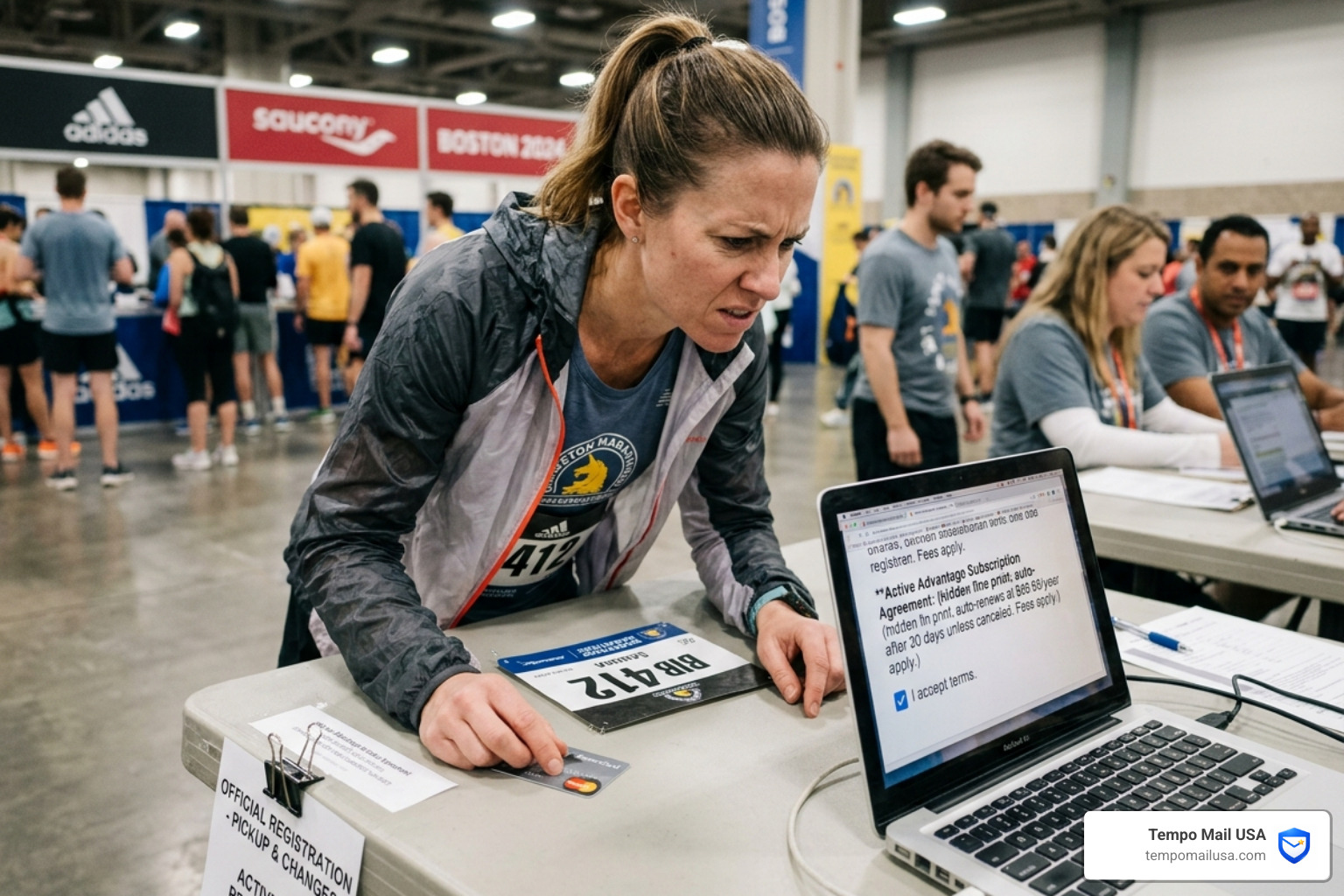

The Active Advantage Scam: What You Need to Know Before Your Next Race Registration
The active advantage scam is a widespread consumer complaint involving unauthorized subscription charges — often discovered weeks or months after registering for a 5K, triathlon, or other event on ACTIVE.com.
Is Active Advantage a scam? Here's the short answer:
- Active Advantage is a real membership program — but thousands of users report being enrolled without clearly consenting
- A hidden or easy-to-miss "Accept" button during event checkout can trigger a 30-day free trial
- After 30 days, the trial automatically converts to a $99.95 annual fee (up from $89.95)
- The charge appears on statements as ACT*ACTIVE-NETWORK or ACT*-Advantage-Endtrial — confusing many cardholders
- The U.S. Consumer Financial Protection Bureau (CFPB) sued ACTIVE Network in 2022, claiming the company generated over $300 million from these deceptive enrollments
- The BBB has logged 873 complaints against ACTIVE Network in the past three years alone
One blogger described opening an email with the subject line "Welcome to another year of Advantage!" — having never intentionally signed up for anything. That experience is far from unique.
If you've spotted an unexpected charge and want to act fast: you can cancel by logging into ACTIVE.com and clicking "do not renew," or by emailing activeadvantage@active.com. More detail on disputing charges and getting a refund is covered further below.
How the Active Advantage Scam Operates via Dark Patterns
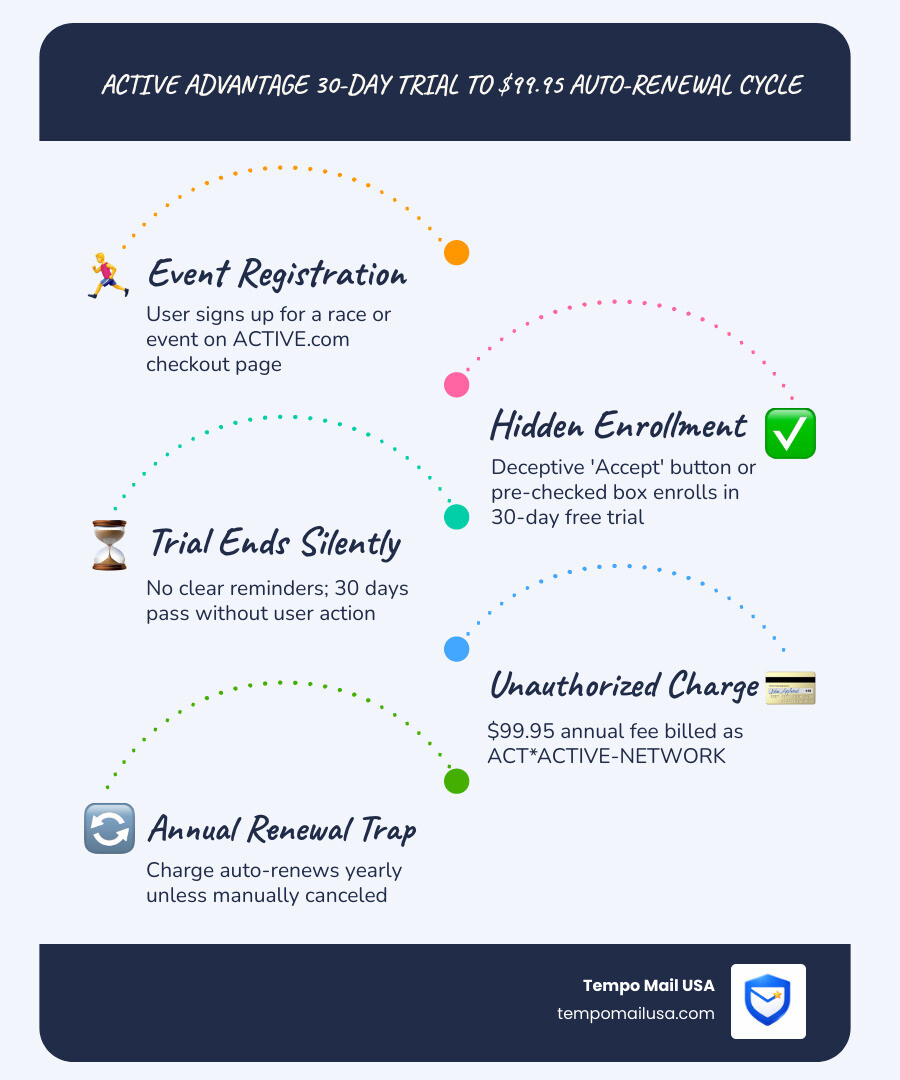
To understand the active advantage scam, we have to look at how the signup process is designed. It isn't a traditional "fake website" scam; instead, it uses what experts call "dark patterns." These are user interface designs specifically crafted to trick people into doing things they didn't intend to do—like signing up for a recurring $99.95 subscription while they're just trying to pay for a local 10K.

The enrollment typically happens on an "interstitial page." This is a screen that pops up after you have submitted your payment for a race or campsite but before you see your final confirmation. Because your brain is already in "checkout mode," you are more likely to click through quickly. Many users report seeing a large, colorful "Accept" or "Claim" button promising a rebate or discount on their current registration. By clicking it, you aren't just getting a coupon; you are agreeing to a 30-day trial that requires active cancellation to avoid being billed.
For more insights into how these digital traps work, you can Check for unwanted Active Advantage membership charges on community forums where thousands of others share their stories.
Identifying the Active Advantage Scam During Checkout
The most common way people fall into the active advantage scam is through pre-checked boxes or misleading button placement. When you are registering for an event on ACTIVE.com or booking a campsite through Reserve America (which is owned by the same parent company), keep your eyes peeled.
The trial conversion is the "gotcha" moment. If you don't manually opt-out or uncheck the membership box, the system assumes you want the "Advantage." Once that 30-day window closes, the $99.95 fee is hit against the credit card you used for the race registration. Since the company already has your billing info from the legitimate transaction, they don't need you to enter it again. This makes the process feel seamless—and dangerous. Understanding these tactics is similar to learning What is a Phishing Scam? Protect Yourself, as both rely on deceptive presentation to gain access to your finances.
Common Signs of Unauthorized Billing
Many of us don't check our credit card statements line-by-line every month, which is exactly what these "junk fee" models count on. If you see a charge for $89.95 or $99.95 that you don't recognize, look at the descriptor. Common labels include:
- ACT*ACTIVE-NETWORK
- ACT*-Advantage-Endtrial
- ACTIVE Advantage
- ACTIVE.COM
These mystery charges often appear months after you've completed your event. If you registered for a summer triathlon in June, you might not see the annual renewal charge until the following year, making it even harder to remember how they got your card info in the first place. This is a common pattern in digital billing fraud, much like the tactics explained in PayPal Scam Emails: How to Spot Them, where legitimate-looking brand names are used to mask unauthorized activity.
Legal Battles and the $300 Million Junk Fee Controversy
The scale of the active advantage scam reached the highest levels of government oversight in 2022. The Consumer Financial Protection Bureau (CFPB) filed a lawsuit against ACTIVE Network, alleging that the company used deceptive "negative option" billing to enroll consumers in Active Advantage. According to the CFPB, this practice generated more than $300 million in "junk fees" from unsuspecting athletes and campers.
Interestingly, as of May 2026, the legal landscape has shifted. While the lawsuit highlighted systemic issues, it was eventually withdrawn in April 2025 due to "new management" at ACTIVE, though many consumer advocates argue the practices haven't changed enough. You can see the ongoing impact of these practices by browsing the ACTIVE Network, LLC | BBB Complaints | Better Business Bureau, where hundreds of people still report identical issues today.
Consumer Complaints and the Active Advantage Scam Narrative
If you search Reddit threads in communities like r/triathlon or r/running, you'll find a decade’s worth of frustration. The narrative is always the same: "I just wanted to run a 5K, and now I'm out $100." The Better Business Bureau (BBB) data supports this, with nearly 900 complaints filed in recent years. Most of these are categorized as billing and product issues, specifically focusing on the difficulty of canceling the membership once it has started.
Some users have even compared the persistence of these charges to a Ponzi Scam Explained: Meaning & Red Flags because the revenue model seems so heavily dependent on new users unknowingly entering the system rather than the actual value of the "Advantage" perks.
The Evolution of Membership Fees in 2026
Despite the legal scrutiny, membership fees have continued to climb. In 2022, the fee was roughly $89.95. By 2025 and into 2026, many users are reporting charges of $99.95. When you consider that many of these members never wanted the service to begin with, the "value" of the membership—which includes small discounts on gear or race entries—rarely offsets the cost. For a deep dive into whether anyone actually benefits from this, check out Is Active Advantage Scam? A Comprehensive Review.
Financial Security: Protecting Your Credit Card from Unauthorized Charges
Protecting yourself from the active advantage scam requires a mix of vigilance and modern security tools. Many users now rely on advanced security tools and VPN protection to prevent these attacks and keep their data from being tracked across multiple registration platforms.

Using a NordVPN can help mask your digital footprint, but the real protection comes from monitoring your financial health. Services that offer credit monitoring and transaction alerts are essential. If your bank notifies you the second a "Card Not Present" transaction occurs, you can stop the Advantage charge before it even settles. For those who want the highest level of security, looking into the Best Identity Theft Protection USA: Top Services Compared is a smart move to ensure your PII (Personally Identifiable Information) isn't being used to fuel recurring subscription models.
How to Dispute Charges and Request a Refund
If you've already been charged, don't panic. You have options. ACTIVE Advantage has a "Member Satisfaction Pledge," which they often use to quiet complaints. If you contact them shortly after the charge, they are usually willing to offer a prorated or even a full refund to avoid a formal bank chargeback.
| Method | Speed | Effectiveness |
|---|---|---|
| Account Portal | Instant | High (stops future charges) |
| Email Support | 2-3 Days | Medium (good for paper trail) |
| Phone Call | 20-40 Mins | High (best for immediate refund) |
| Bank Dispute | 7-14 Days | Highest (recovers funds if company refuses) |
When you call, be firm. Mention that you did not intentionally sign up and that you are aware of the CFPB's previous interest in their "junk fees." This often speeds up the refund process.
Best Tools to Protect Yourself (Compared)
Beyond just watching your statements, consider using virtual credit cards. These allow you to set a "spend limit" or a "one-time use" limit. If you use a virtual card for a $35 race registration and set the limit to $35, ACTIVE Advantage will be unable to bill you the $99.95 trial conversion fee later because the transaction will be declined. This is widely considered the Best Way to Protect Against Identity Theft and subscription traps.
Advanced Privacy Solutions to Prevent the Active Advantage Scam
At Tempo Mail USA, we believe the best way to avoid the active advantage scam is to never give them your real identity or primary email in the first place. We advocate for a "PII Firewall" strategy. By using temporary identity proxies and email aliases, you break the link between your personal life and the services that use dark patterns.
Why Traditional Unsubscribe Links Fail
Many people think that clicking "unsubscribe" in an email is the solution. However, in data brokers and tracking pixels, clicking that link often just confirms that your email address is "active" and monitored by a real person. This can actually lead to more targeted marketing and "reminders" about your "membership."
The problem is that your primary email is often linked to your real name, address, and credit card. Once a company like ACTIVE has that link, they can track you across different events and sites. This is Why you should use a different email address for every site. If you use a unique alias for ACTIVE.com, you can simply "kill" that alias the moment the race is over, ensuring they can never contact you or link your data to other accounts.
Strategic Use of Temporary Identity Proxies
When you use a service like tempomailusa.com, you are creating a secure identity proxy. When the registration page asks for your email, you provide a temporary one. If ACTIVE Advantage tries to send "reminder" emails about a trial (which often end up in spam folders anyway), you can see them without cluttering your main inbox. More importantly, if you decide you're done with the service, you deactivate the alias.
This approach turns the "30-day trial" on its head. Instead of you having to remember to cancel, the company loses its ability to reach you. You can find more about the official membership terms in the Frequently Asked Questions | FAQ | ActiveAdvantage, but remember: their goal is to keep you enrolled, while our goal is to keep you protected.
Frequently Asked Questions about Active Advantage
How do I cancel my Active Advantage membership immediately?
Log into ACTIVE.com, navigate to "MY ACCOUNT," select the Active Advantage section, and click "do not renew" to stop the auto-renewal process. You should receive a confirmation email; keep this for your records in case you are charged anyway. If you cannot log in, email activeadvantage@active.com with your full name and the last four digits of the card charged.
Is Active Advantage a legitimate service or a scam?
While it offers real discounts on race entries and camping, its use of dark patterns and deceptive enrollment has led to a CFPB lawsuit and thousands of "scam" allegations from users charged without clear consent. It is a legitimate business that uses highly controversial and aggressive marketing tactics.
Can I get a full refund for an unauthorized Active Advantage charge?
Yes, the company offers a "Member Satisfaction Pledge" where you can request a prorated or full refund by contacting activeadvantage@active.com or calling 866-561-0647. Most users report success in getting a refund if they contact the company within 30 days of the charge appearing on their statement.
Conclusion
The active advantage scam serves as a stark reminder that even "reputable" registration platforms can use deceptive tactics to pad their bottom line. Whether you are a marathon runner or a weekend camper, the burden of protection unfortunately falls on you.
By utilizing tools like tempomailusa.com, you can build a PII firewall that protects your personal data from being harvested and exploited. Using email aliases and identity proxying isn't just a tech-savvy move; it's an essential part of digital hygiene in 2026. Stay vigilant, read the fine print, and never let a "free trial" turn into an expensive headache.