



Why Recognizing a Ponzi Scam Could Save Your Financial Future
A Ponzi scam is a fraudulent investment scheme where returns are paid to earlier investors using the capital of newer investors rather than from legitimate business profits.
Quick Summary of Ponzi Scams:
- Definition: A fake investment operation promising high returns with little or no risk.
- Mechanism: Uses new investor money to pay earlier participants to create an illusion of success.
- Failure Point: Collapses when new recruitment stops or mass withdrawals exceed available cash.
- Red Flags: Guaranteed returns, consistent profits regardless of market conditions, and unregistered investments.
- Famous Examples: Bernie Madoff ($64.8 billion), Charles Ponzi, and Scott Rothstein.
- Action Plan: Report suspicions to the SEC and verify all licenses through official channels.
Billions of dollars are lost to Ponzi scams every year. These schemes target both novice and experienced investors by creating a convincing illusion of financial growth.
Charles Ponzi himself summed up the appeal of his own scheme with chilling honesty. Near the end of his life, he reportedly said his investors had received "the best show" for their money — even if they got nothing back in return.
What is a Ponzi Scam and How Does it Work?
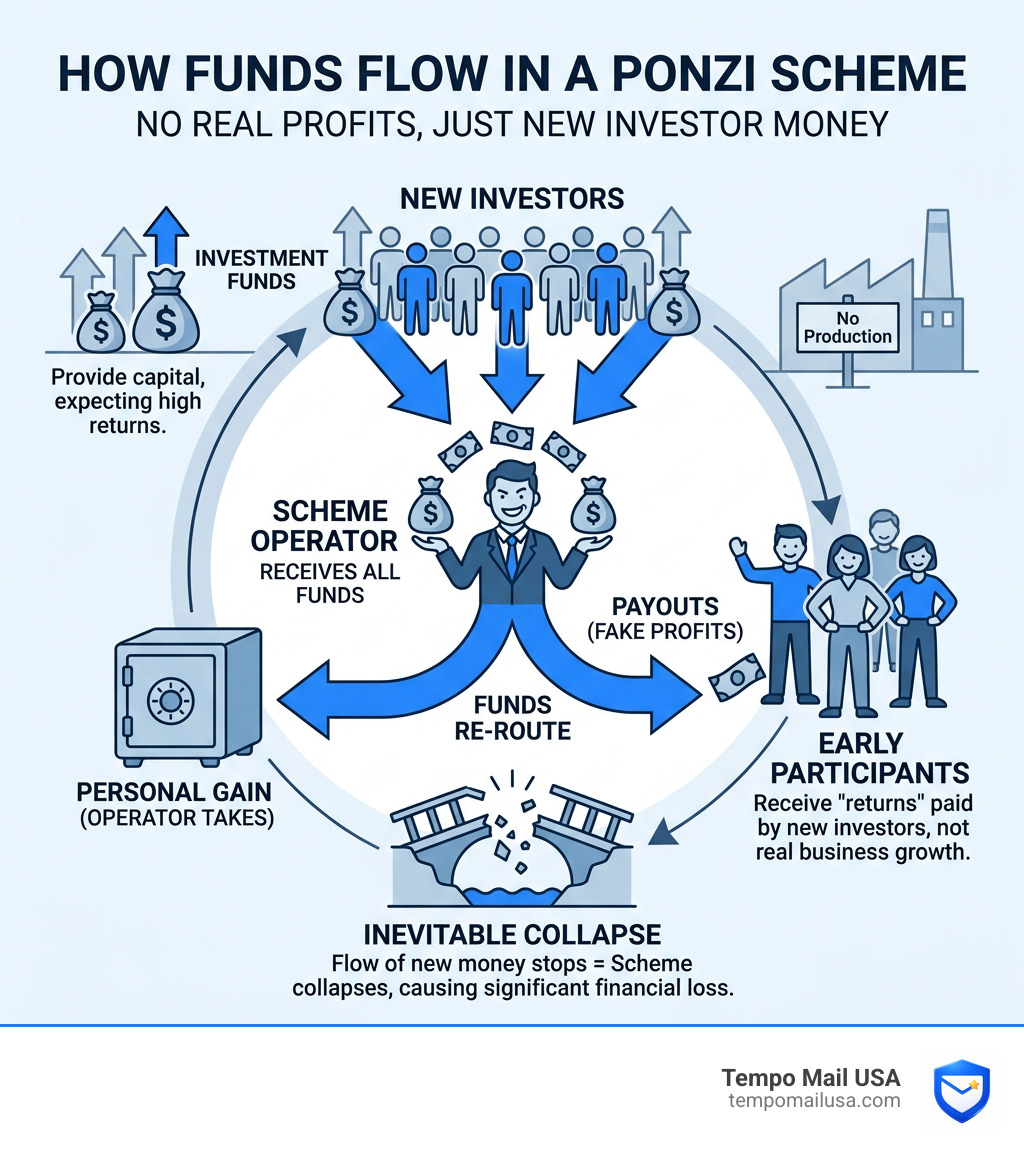
A ponzi scam functions as a financial shell game. The operator takes money from "Investor B" to pay "Investor A," while claiming the funds are profits from a legitimate business activity.
How the Ponzi Mechanism Works
- The Lure: The fraudster promises high, consistent returns that outperform the market.
- The Initial Payout: Early investors receive actual payments, which builds trust and encourages them to invest more.
- The Expansion: Word-of-mouth and fake account statements attract a larger pool of capital.
- The Collapse: The "house of cards" falls when the operator cannot find enough new investors to cover withdrawal requests.
No Legitimate Business Activity
Unlike real investments, a ponzi scam has no underlying revenue source. According to the Legal definition of Ponzi schemes, these are fraudulent operations where there is no source of revenue other than the contributions of new participants.
| Feature | Legitimate Investment | Ponzi Scam |
|---|---|---|
| Source of Returns | Profits from business operations or asset growth | Funds from newer investors |
| Risk Level | Varies, but always exists and is disclosed | Claimed to be "low" or "zero" |
| Consistency | Fluctuates with market conditions | Eerily consistent regardless of the economy |
| Transparency | Audited financials and clear strategies | Secretive, complex, or "proprietary" |
| Registration | Registered with SEC/regulators | Often unregistered and unlicensed |
The Infamous Legacy of Charles Ponzi and Modern Successors
While the concept of "robbing Peter to pay Paul" existed as far back as the 17th century, the name comes from Charles Ponzi, an Italian immigrant who turned 1920s Boston into his personal piggy bank.
The Original: Charles Ponzi
In 1919, Ponzi discovered a loophole involving International Reply Coupons (IRCs). These were coupons that could be exchanged for postage stamps in different countries. Because of fluctuating exchange rates after WWI, Ponzi claimed he could buy them cheaply abroad and redeem them for a higher value in the U.S.
He promised investors a 50% profit in 45 days or a 100% profit in 90 days. It sounded plausible, and soon he was raking in $1 million a day. However, the logistics were impossible. To cover the amount of money he was taking in, he would have needed 160 million IRCs in circulation; in reality, only about 27,000 existed globally. He wasn't buying coupons; he was just shuffling cash. You can read more about the history of the original Charles Ponzi scheme to see how his Securities Exchange Company eventually crumbled.
Modern Monsters: Madoff and Rothstein
The scale of Ponzi's $15 million fraud (roughly $237 million today) seems small compared to modern successors:
- Bernie Madoff: The undisputed heavyweight of fraud. Madoff ran a scheme for decades that reached a staggering $64.8 billion in paper wealth. He was a former chairman of NASDAQ, which gave him a "halo of legitimacy" that blinded even sophisticated regulators.
- Scott Rothstein: A prominent South Florida lawyer who operated a $1.4 billion scam. He sold fake legal settlement agreements to wealthy investors, claiming they were confidential to prevent anyone from doing actual due diligence.
- Wang Fengyou: In China, he ran an "ant-farming" scheme that defrauded over one million people out of more than $1 billion. Investors were told they were breeding ants for medicinal wine.
These examples prove that a ponzi scam doesn't just target the "uninformed." They target anyone who lets their desire for high returns override their skepticism.
How to Spot the Red Flags of a Ponzi Scam
To identify a ponzi scam, you must look for specific mathematical and regulatory warning signs. Use our guide on What is a Ponzi Scam? Definition, Examples, Red Flags as a primary checklist.
Top 5 Red Flags of Investment Fraud
- Unregistered Investments: Most Ponzi schemes involve securities not registered with the SEC or state regulators.
- Unlicensed Sellers: Operators often lack the required professional licenses to sell investments.
- Secretive or Complex Strategies: If the investment process is a "black box" or too complex to explain, it is likely a fraud.
- Paperwork Discrepancies: Errors on account statements or unprofessional formatting are major warning signs.
- Difficulty Receiving Payments: If a manager discourages withdrawals or offers "higher returns" to keep your money in the system, the cash is likely gone.
The "Guaranteed Return" Trap
The most reliable indicator of a ponzi scam is the promise of high returns with little to no risk. In finance, risk and reward are always linked. According to the SEC fast answers on Ponzi mechanics, overly consistent returns regardless of market conditions are a hallmark of fraudulent operations.
Why Every Ponzi Scam Inevitably Collapses
- Recruitment Exhaustion: The operator can no longer find enough new investors to pay the old ones.
- Mass Withdrawals: Economic downturns trigger more cash-out requests than the operator has on hand.
- The Exit Strategy: The operator decides they have enough money and vanishes to a non-extradition country.
Ponzi vs. Pyramid Schemes: Understanding the Mechanics
People often use these terms interchangeably, but they are different beasts. Think of it this way: a ponzi scam is a "hub-and-spoke" model, while a pyramid scheme is a "chain-link" model.
- The Ponzi Model: The operator is the central "hub." Investors believe they are giving money to a manager who is investing it for them. The investors don't necessarily have to do anything except wait for their checks.
- The Pyramid Model: This relies on recruitment chains. You pay a fee to join, and the only way to make money is to recruit others to join under you. It often masquerades as multi-level marketing (MLM), sometimes using a low-value product as a "front."
In a Ponzi scheme, the fraudster is the one doing the "work" of shuffling money. In a pyramid scheme, the victims are forced to become recruiters themselves to get their money back. Both, however, are illegal and destined for a messy end.
Taking Action: How to Protect Your Wealth from a Ponzi Scam
We believe that the best defense is a proactive offense. Protecting your wealth requires a combination of traditional due diligence and modern privacy tools.
1. Verify, Don't Trust
Never take an investment professional's word for it. Check the SEC’s Investment Adviser Public Disclosure (IAPD) website to see if the person and the firm are registered. If they aren't on there, walk away.
2. Demand Transparency
Ask for audited financial statements. A real firm will have an independent third-party auditor verifying their books. If the auditor is a tiny, unknown firm (or if there isn't one at all), be extremely cautious.
3. Protect Your Identity
Scammers don't just want your money; they want your data. Often, the process of "onboarding" into a scam involves giving away your full name, SSN, and primary email address. This information can be sold on the dark web or used for further identity theft.
This is where Tempo Mail USA comes in. By using secure email alias generation, you can proxy your identity when interacting with services you aren't 100% sure about. Our system acts as a firewall, shielding your real PII (Personally Identifiable Information) from potential fraudsters. If a "service" turns out to be a scam, they only have your alias, not your actual digital life.
For more information on staying safe, check out the SEC guide on protecting your investments.
What to Do if You Suspect a Ponzi Scam
If you realize you’ve been caught in a ponzi scam, every second counts.
- Stop Investing: Do not "throw good money after bad" in an attempt to get your original investment back.
- Gather Documentation: Save every email, contract, and bank statement.
- Report It: Submit a tip to the SEC or your local financial regulator. You can also find more info about reporting fraud to ensure you are talking to the right authorities.
- Consult a Lawyer: You may need to work with a bankruptcy trustee to try and recover assets during the "clawback" process, where profits paid to early investors are sometimes redistributed to those who lost their principal.
Frequently Asked Questions about Ponzi Schemes
Can you get your money back from a Ponzi scheme?
It is difficult but not impossible. Recovery usually happens through a court-appointed receiver or bankruptcy trustee who liquidates the scammer's assets. However, victims rarely get 100% of their money back. In the Madoff case, thousands of victims eventually recovered a significant portion of their principal, but it took over a decade of legal battles.
How do Ponzi schemes differ from legitimate hedge funds?
Legitimate hedge funds are transparent with regulators, have independent auditors, and store their assets with third-party custodians (like a major bank). In a ponzi scam, the operator often acts as their own custodian, meaning there is no "middleman" to verify that the money actually exists.
Are cryptocurrency "yield farms" a type of Ponzi scheme?
Not all of them, but many "high-yield" crypto projects have been exposed as "Smart Ponzis." If a project offers 20% or 100% APY on a stablecoin and the only source of that yield is new people buying the token, it is a Ponzi scheme by definition. The 2022 collapse of TerraUSD is a prime example of this dynamic in the digital age.
Conclusion
The world of finance is full of opportunities, but it is also a playground for charlatans. A ponzi scam succeeds by exploiting our natural desire for security and growth. By staying financially literate and recognizing the red flags — like "guaranteed" returns and secretive strategies — you can keep your capital safe.
Your digital identity is often the first thing a scammer targets. Using privacy tech like Tempo Mail USA allows you to explore the market with an extra layer of protection. We provide the data shielding you need to ensure that your personal information remains your own, acting as a firewall between you and the risks of the internet.
Stay skeptical, do your homework, and if you ever find yourself in a suspicious situation, know how to report fraud to FTC the right way. Your future self will thank you for the caution you exercise today.