


When You've Been Scammed on Zelle: What You Need to Know First
Getting a Zelle scam refund is possible — but it depends heavily on one key factor: whether your payment was authorized or unauthorized.
Here's the quick answer:
| Situation | Refund Likely? | Why |
|---|---|---|
| Someone hacked your account and sent Zelle without your knowledge | Yes | Covered under Regulation E as unauthorized fraud |
| You were tricked into sending money yourself | Sometimes | Depends on scam type and your bank's policy |
| You sent to a trusted contact who turned out to be a scammer | Rarely | Treated as authorized — like handing over cash |
| You were impersonated by a fake bank or government caller | Possibly | Qualifying imposter scams may be reimbursed since 2023 |
If you were just scammed, do these things right now:
- Call your bank's fraud line immediately
- Document everything — screenshots, names, amounts, dates
- Report to the FTC at reportfraud.ftc.gov and the FBI at ic3.gov
- Do not pay anyone who promises to recover your money for you
Zelle moves money fast — very fast. That's the whole point. But it's also what makes it a magnet for scammers. With roughly 2.8 billion transactions processed every year, even a fraud rate as low as 0.1% translates to an estimated $800 million in annual losses for real people.
One victim described getting a call that appeared to show the exact same number printed on the back of his Chase debit card. He followed the caller's instructions, sent money through Zelle thinking he was protecting himself from fraud — and lost $7,000.
That's how these scams work. They don't break into your account. They convince you to hand over the money yourself.
And that one detail — who pushed the button — is what determines whether you have any legal ground to stand on.
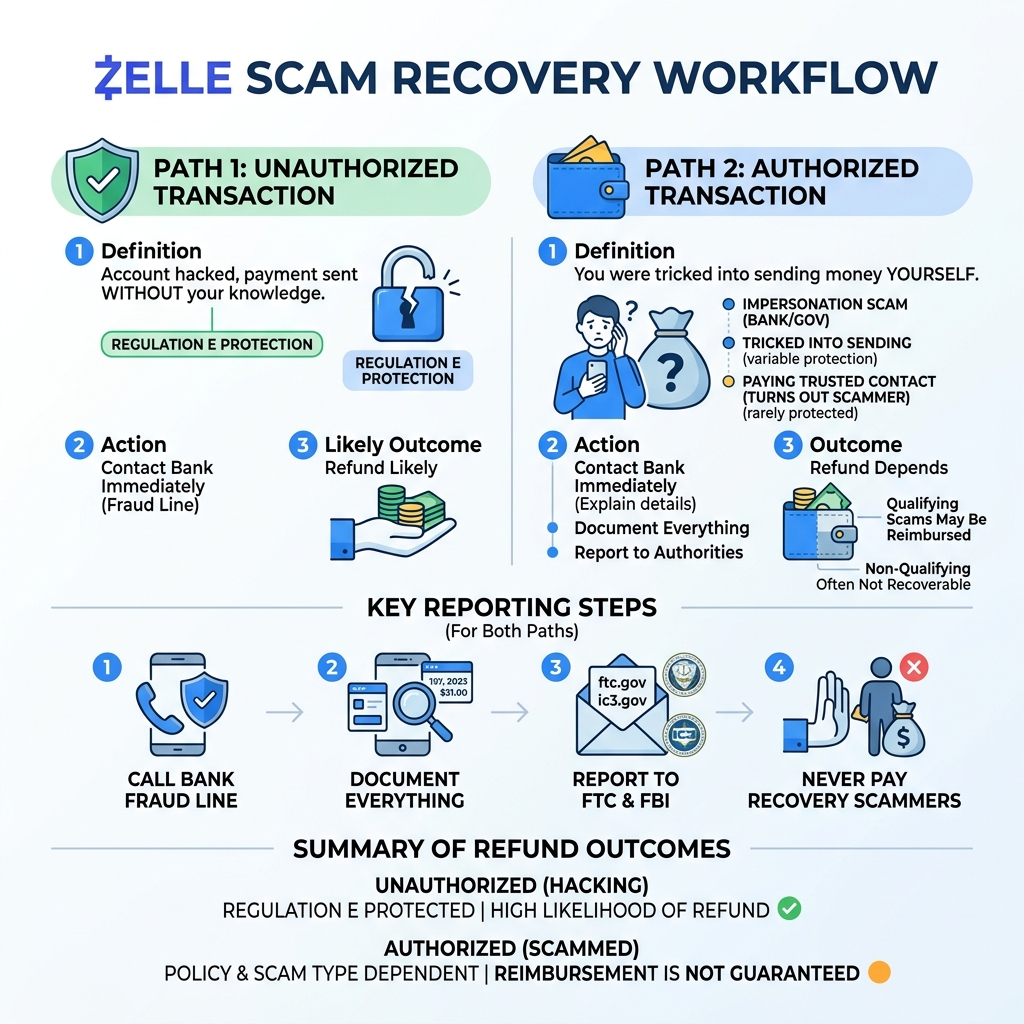
Understanding the Zelle Scam Refund: Authorized vs. Unauthorized Transactions
The most important lesson we can learn about Zelle is that it is designed to mimic cash. When you hand a twenty-dollar bill to someone on the street, you can't "undo" that transaction. Zelle operates on the same principle of "instant finality." However, the law treats your money differently depending on how it left your account.
To understand your chances of a zelle scam refund, we have to look at the legal definitions provided by the Electronic Funds Transfer Act and its implementation, known as Regulation E.
| Feature | Authorized Transaction (Scam) | Unauthorized Transaction (Fraud) |
|---|---|---|
| Definition | You pushed the "Send" button yourself. | Someone else accessed your account. |
| Typical Scenario | Paying for a puppy or tickets that don't exist. | An account takeover or stolen credentials. |
| Legal Protection | Very limited under Regulation E. | Strong protection under Regulation E. |
| Bank Liability | Usually denied (unless it's an imposter scam). | Bank is generally required to reimburse you. |
| Success Rate | Low to Moderate. | High (if reported quickly). |
The Official Zelle Safety Education page makes this distinction clear: if you were "tricked" into sending money, it’s a scam. If someone "hacked" you, it’s fraud. Understanding this difference is vital, especially since many scammers use phishing scams to gain the information they need to manipulate you.
The Legal Definition of Unauthorized Fraud
Unauthorized fraud occurs when a transaction is made by someone other than the consumer without actual authority to initiate the transfer. This usually happens through an account takeover. If a criminal steals your login credentials or uses PII (Personally Identifiable Information) theft to bypass security, the bank is legally liable for those losses under Regulation E.
To protect yourself from these technical breaches, we recommend using the best phishing detection tools and always enabling Multi-Factor Authentication (MFA). If you didn't authorize the payment, you have a very strong case for a full refund.
Why an Authorized Zelle Scam Refund is Harder to Get
This is where it gets tricky. In an "authorized" scam, you technically gave the bank permission to move the money. Scammers use social engineering to create a sense of urgency, fear, or excitement. Because you initiated the transfer, banks historically argued that they fulfilled their duty by sending the money where you told them to.
However, the tide is turning. Regulatory pressure from the CFPB (Consumer Financial Protection Bureau) has pushed banks to reconsider "fraudulently induced" transfers. While it is still harder to get a refund for a voluntary transfer, it is no longer impossible.
Can You Get a Zelle Scam Refund? Bank Policies and Regulation E
Zelle is owned by Early Warning Services (EWS), a company itself owned by seven of the largest U.S. banks. Because of this close relationship, your primary point of contact for a zelle scam refund is always your own bank or credit union. There are over 2,100 financial firms in the Zelle network, and while they all use the same platform, their internal reimbursement policies can vary.

New 2026 Policies for Imposter Scam Reimbursement
Recent shifts in the industry, often referred to in the context of the Zelle Scam Reimbursement Law 2026, have forced banks to be more accountable. Since mid-2023, Zelle has implemented a policy requiring banks to reimburse victims of "qualifying imposter scams."
These qualifying scams typically include:
- Bank Impersonation: Someone calls you spoofing your bank's official number.
- Government Impersonation: Scammers pretending to be the IRS or Social Security Administration.
- Service Provider Spoofing: Fake calls from utility companies or well-known brands.
In these cases, banks now have "clawback" mechanisms where the sending bank coordinates with the receiving bank to freeze and return the funds. If you believe you’ve been a victim of an imposter scam, you should mention these specific policies when talking to your bank's fraud department.
Evidence Needed for a Zelle Scam Refund Claim
To build a winning case, you cannot just say "I was tricked." You need a "prosecution file" of evidence. Banks are data-driven; give them data they can't ignore.
- Chronological Timeline: Write down exactly what happened, minute by minute.
- Screenshots: Capture every text message, email, and Zelle confirmation screen.
- Phone Logs: Take a screenshot of your call history showing the incoming number (especially if it was spoofed).
- Police Report: While a local cop might not be able to "arrest" a scammer in another country, a formal police report provides the legal documentation banks need to process high-value claims.
Learning how to report a phishing attack properly can also help you organize this evidence for the authorities.
Step-by-Step Guide to Recovering Zelle Scam Funds
If you’ve realized you’re a victim, the clock is ticking. Zelle transactions are nearly instantaneous, but the window for a zelle scam refund dispute is generally 120 days from the transaction date. However, your best chance of success is within the first 48 hours.
Immediate Actions to Take After Being Scammed
- Call Your Bank Immediately: Do not use the Zelle app contact form first; call the fraud number on the back of your debit card. Tell them you have a "fraudulently induced" transaction.
- Freeze Your Accounts: If the scammer had any access to your info, your entire balance is at risk.
- Report to Zelle: Visit the official Zelle report page to flag the recipient's account. This helps Zelle ban the scammer from the entire network.
- Change Your Credentials: If you clicked any links, your password is compromised. Check out our guide on how to spot phishing emails to see if you were lured into a fake login page.
Timelines for a Zelle Scam Refund Investigation
Once you file a dispute, the bank usually has 10 business days to investigate (though this can be extended to 45 or even 90 days if they provide a provisional credit).
- 7 Business Days: Most simple disputes are resolved within this window.
- 10–45 Days: Complex imposter scams requiring coordination between banks take longer.
- The Appeal: If your bank denies the claim, don't give up. File a complaint with the CFPB or the IC3. Often, a bank will suddenly find a "goodwill refund" once a federal regulator is involved.
For more long-term protection, we recommend looking into effective strategies to prevent attacks.
Common Zelle Scams and How to Prevent Them
Scammers are creative, but they usually stick to a few "greatest hits." Knowing these can help you spot the red flags before you ever hit "Send."
- The Puppy/Marketplace Scam: You see a great deal on a French Bulldog or a PS5. The seller insists on Zelle for a "deposit." Once you pay, they vanish.
- The "Pay Yourself" Scam: This is the most dangerous one. A scammer calls pretending to be your bank's fraud department. They tell you there is a "suspicious transfer" and you need to Zelle money to "your own account" to protect it. In reality, you are sending money to their account that they've named "My Savings."
- Ticket Fraud: Someone on social media claims they can't go to a concert and offers tickets at face value. They ask for Zelle, then block you.
- Investment/Cash Flips: Someone promises to double your money if you Zelle them an initial investment. This is always a scam.
Interestingly, many of these tactics are similar to the PayPal transfer fee scam, where users are asked to pay a small "fee" to unlock a larger sum.
How to Spot a Zelle Imposter Scam
Red flags include:
- Extreme Urgency: "You must do this in the next 10 minutes or your account will be locked!"
- Secrecy: "Don't tell the bank teller what this is for; they will stop the security protocol."
- Requesting Codes: Your bank will never ask for a one-time passcode (OTP) over the phone to "reverse" a transaction.
- Spoofed ID: Just because the caller ID says "Chase" or "Bank of America" doesn't mean it's them.
Best Practices for Future Payment Safety
- Treat Zelle Like Cash: Only send money to people you have met in person and trust implicitly.
- Verify by Calling Back: If your "bank" calls you, hang up. Call the number on your actual physical card.
- Use MFA: Always use an authenticator app rather than SMS codes if possible.
- Business Dual Approval: For small business owners, set up your account so that two people must approve any Zelle transfer over a certain amount.
Frequently Asked Questions about Zelle Scam Refunds
Can you cancel or reverse a Zelle payment?
Typically, no. Because Zelle is an instant transfer service, the money moves from your account to the recipient's in minutes. You can only cancel a payment if the recipient has not yet enrolled in Zelle. Once the money is in their account, it cannot be "pulled back" without their permission or a bank intervention.
Will my bank refund me if I was tricked into sending money?
It depends on the bank and the scam. If it was a "qualifying imposter scam" (someone pretending to be the bank or the government), your chances are much higher thanks to 2023 policy changes. If it was a marketplace scam (buying a fake item), banks are much less likely to offer a refund because they view it as a "buyer's remorse" or a private civil dispute.
Which agencies should I report a Zelle scam to?
You should report to:
- Your Bank: Your first and most important step.
- The FTC: reportfraud.ftc.gov helps track scam trends.
- The IC3 (FBI): ic3.gov is for reporting internet-based crimes.
- CFPB: If your bank unfairly denies your zelle scam refund claim, the Consumer Financial Protection Bureau is your best escalation path.
Conclusion
Navigating Zelle scams can feel like a losing battle, but being armed with the right terminology — like "unauthorized" vs. "authorized" — gives you a significant advantage when dealing with your bank. While Zelle offers incredible convenience, it lacks the built-in purchase protections of a credit card.
At Tempo Mail USA, we believe that the best way to stop a scam is to prevent the scammer from finding you in the first place. Scammers often get your phone number or email from data breaches or public listings. By using our temporary email aliases, you can create a secure PII (Personally Identifiable Information) firewall.
Our aliases act as a proxy for your identity, shielding your real contact information from services and potential bad actors. When you protect your data, you protect your money. Stay safe, stay skeptical, and always verify before you hit send.