

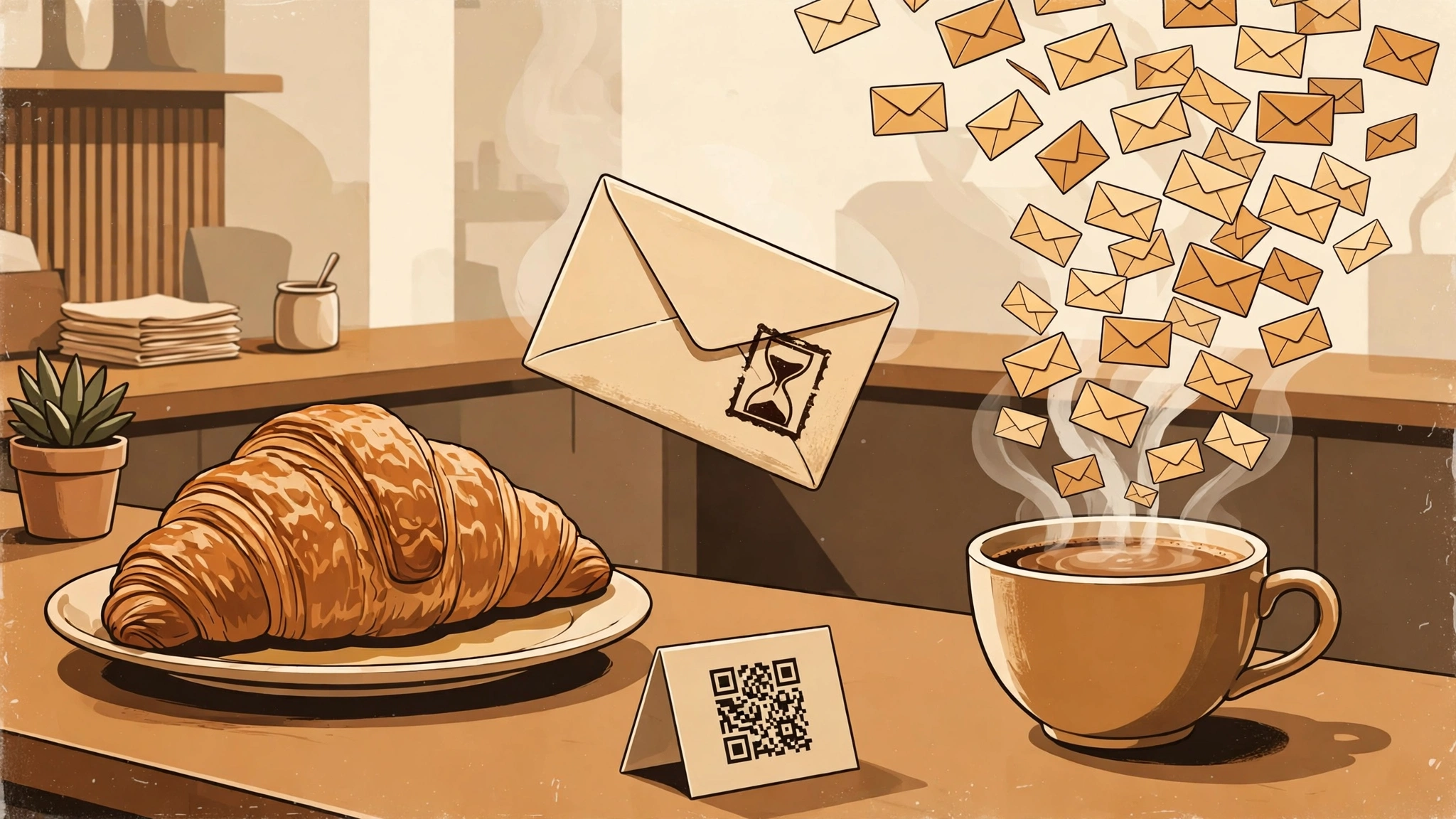
You are at the counter, the line is three people deep behind you, and the barista delivers the script with a smile: "Are you in our rewards club? You get a free croissant today if you sign up." Next to the register, a little table tent holds a QR code. Scan it, type your email, the free-pastry coupon lands in your inbox before your latte is ready.
It feels like a no-brainer. A croissant costs them maybe a dollar; you were going to buy coffee anyway. But watch what happens over the next six months: the "double points Tuesday" emails, the new seasonal menu announcements, the birthday reward, the survey for 50 bonus stars, the "we miss you" nudge when you skip a week. That croissant was not a gift. It was an acquisition cost, and it was cheap.
I run a temp mail service, so I think about this transaction more than is probably healthy. Restaurants and cafes have become some of the most aggressive email collectors in retail — and unlike the online coupon popups, which we covered in our holiday shopping guide, these asks happen in person, under mild social pressure, with a line forming behind you. That pressure changes the decision. So here is the honest version: when a disposable address is exactly right for the restaurant signup, when it will quietly cost you, and the twenty-second rule I use at every counter.
The Croissant Is Not Free — Your Inbox Pays for It
Start with why the barista asks at all, because the economics explain everything that follows.
When we checked the loyalty industry's own numbers, the scale of the harvest was striking. A 2025 analysis of loyalty-driven email programs by PerkStar, a UK loyalty platform, reported that coffee shops running email collection through loyalty programs see 60 to 70 percent email open rates, and attribute £800 to £1,200 a month in additional revenue to email campaigns. Salons in the same dataset saw a 45 percent lift in rebooking rates from email reminders; retail loyalty members who receive regular emails showed 34 percent higher lifetime value. These are the kinds of returns that make a free pastry the cheapest marketing spend a cafe will ever make.
The same analysis offered the industry's own best practice, almost as an aside: one email per week, maximum. Less is often more, they wrote. That is the stated ideal. In practice, once your address is in the system, the cadence is set by whatever the marketing calendar demands — and the marketing calendar always demands more than one email a week. You can unsubscribe, and the better programs make it one click, but the address is already in the database, already synced to the ad platform audiences, already working.
None of this is sinister. It is just business, and reasonably transparent business at that. But it reframes the counter transaction: you are not receiving a croissant. You are selling a permanent marketing channel into your inbox for roughly a dollar's worth of pastry. Once you see it that way, the question is not "should I take the free thing" — it is "what address do I want to sell, and for how much."
The QR Code Made It Instant — and Harder to Dodge
The old loyalty signup had friction that protected you: download our app, make an account, verify your email, wait for the confirmation. Half of all customers abandoned the process somewhere in the middle, which was, from your perspective, a feature.
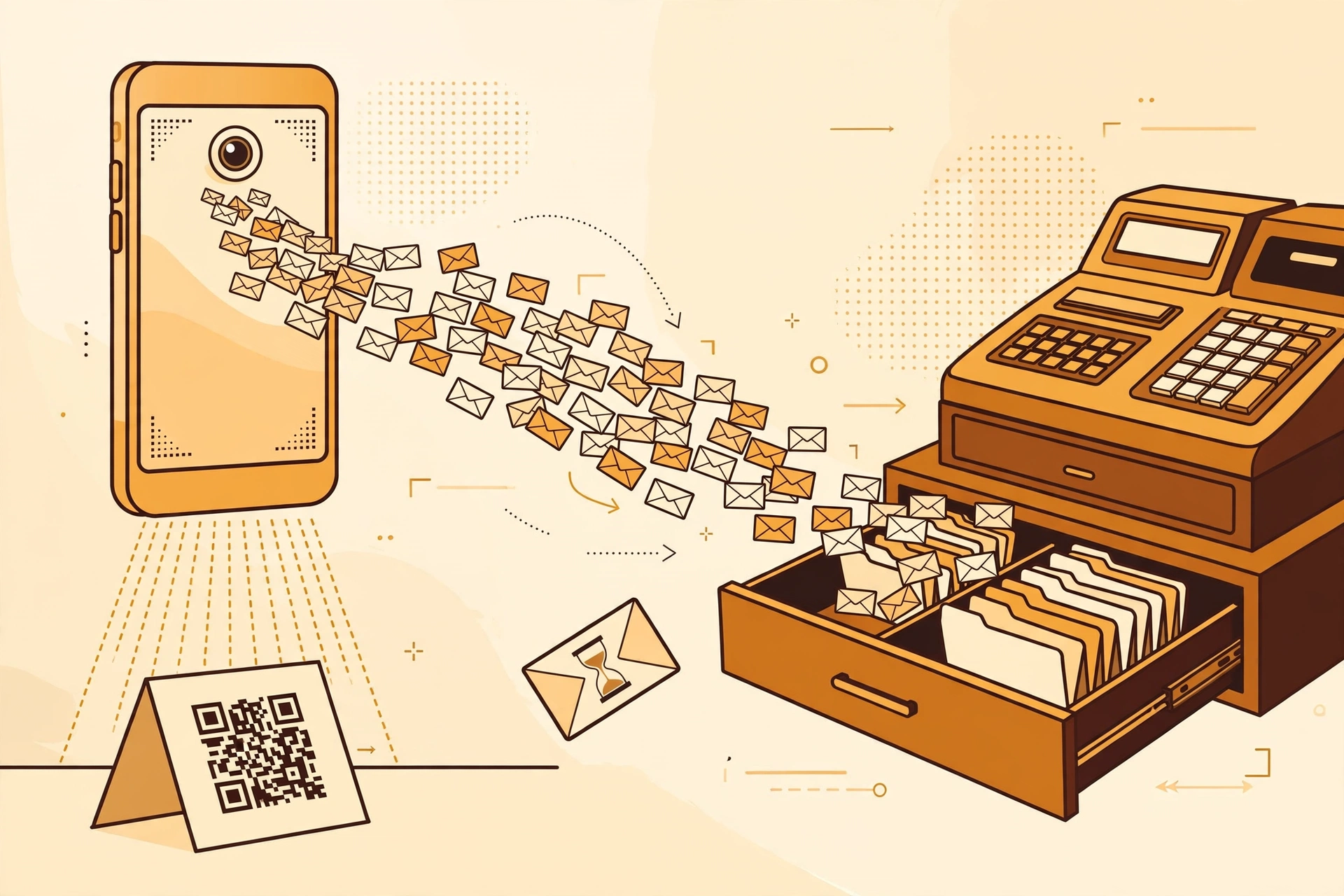
The QR table tent killed that friction. Coupon platform CouponCarrier describes the current standard setup plainly — their own documentation, updated this month, walks businesses through it: print a QR code on a table tent at the counter, the customer scans it, types an email into a hosted form, and gets a coupon (their example is 10 percent off) immediately. No app, no account, no waiting. The whole thing takes less time than the barista needs to steam your milk.
That speed is why the asks multiplied. It is not just the coffee chain anymore. The sandwich counter, the bubble tea window, the taco truck with a laminated QR taped to the register — every one of them can now run the same playbook for the cost of a printed tent. And the social dynamics do the rest: the barista is watching, the line is waiting, and typing a quick email feels easier than saying no out loud.
Here is the part the tent does not disclose: the scan grants more than a coupon. You are joining a marketing list, and in many setups, a loyalty account. The email you type becomes the account identifier — the thing your points, your visit history, and your future offers attach to. That distinction between "a coupon for an email" and "an account keyed to an email" is the entire decision, and most people make it without knowing there was one.
Three Programs Hiding Behind the Word "Loyalty"
Every counter signup calls itself a loyalty program, but there are three different things wearing that name, and they have opposite answers to the temp-mail question.
1. The one-time bribe. Scan, email, get the discount or free item today. No points, no balance, no ongoing relationship — the coupon is the whole program. This is the restaurant version of the online coupon popup, and it is temp mail's home turf. The email's job ends the moment the code arrives. A disposable address handles it perfectly: code in, croissant out, inbox gone by dinner.
2. The points wallet. Stars, stamps, punches that accumulate over weeks and months toward a real reward — the free drink after ten visits, the birthday treat, the tier that gets you early access to the new menu. This is an account with a balance, and the email address is the account key. Use a temp address here and you have built your savings on land that disappears. When the inbox expires, the points do not transfer to your real identity. They evaporate, because as far as the system is concerned, you evaporated.
3. The ordering account. The app where your saved orders, favorites, delivery addresses, and payment method live. This one is obviously permanent — nobody sensibly argues otherwise. But note how many "loyalty signups" quietly graduate into this category: the QR tent at the sandwich shop becomes an app download next month, and suddenly your throwaway email is the login for an account with your credit card on file.
The mistake is treating all three as the same signup. Before you type anything, ask which of the three you are actually joining. The tent will not tell you. The barista's script will not tell you. The form itself, if you read the fine print nobody reads, usually does.
The Dead-Inbox Problem at the Register
This is where temp mail goes wrong at restaurants, and it goes wrong in exactly the ways our password-reset postmortem describes for online accounts — except the stakes are measured in free coffee rather than locked logins, which makes people careless in precisely the wrong direction.
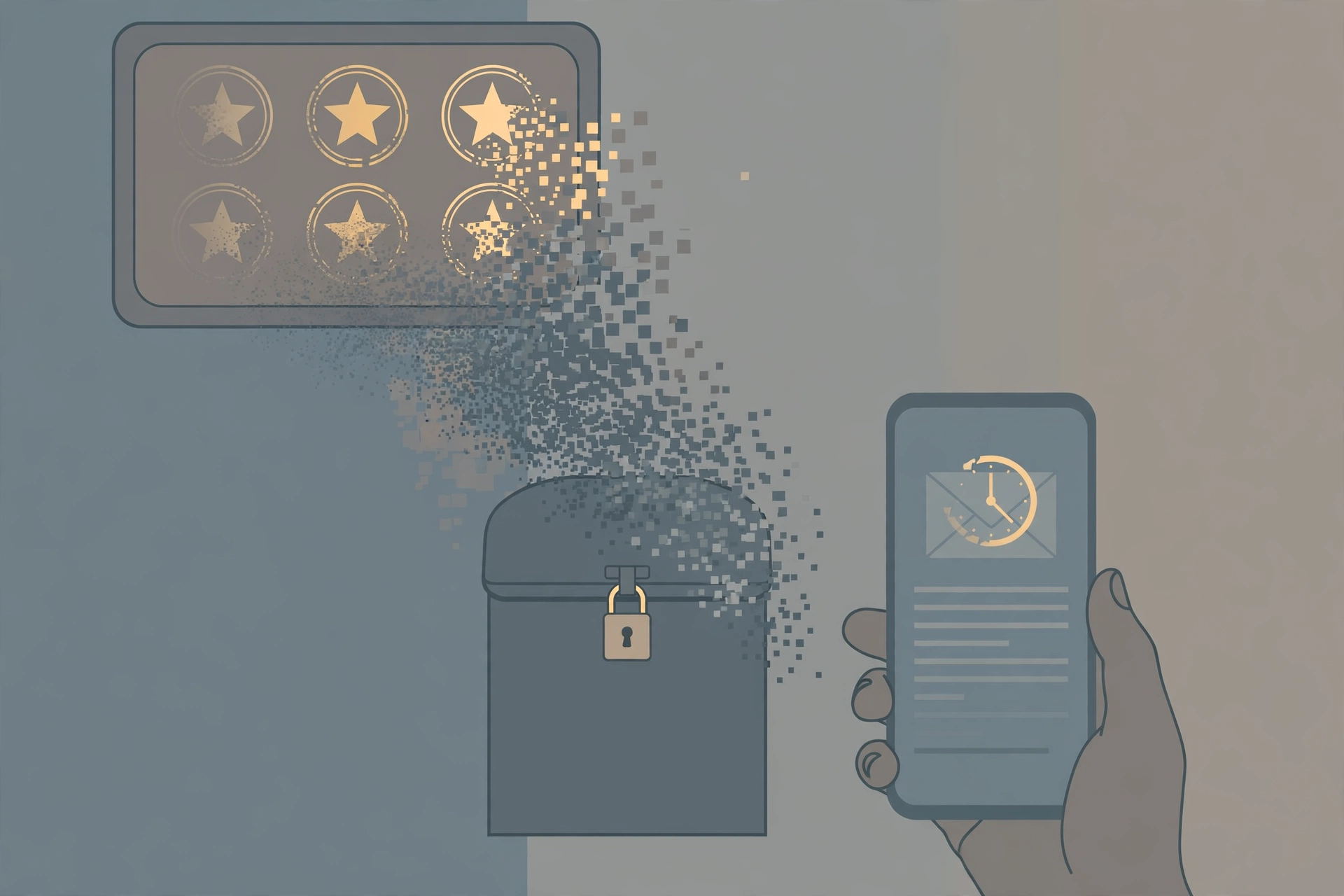
The scenario plays out like this. You scan the tent at a cafe near your office with a temp address, grab the free croissant, and forget about it. Three months later you have visited eleven times and earned a free drink — except the reward email went to an inbox that expired in October, and the points balance is attached to an address you cannot re-enter. Support cannot merge it into your real account, because from their side the temp-address account looks like a stranger's. The points were real. The identity holding them is gone.
There is a slower version of the same failure. The cafe sends a "we updated our terms — please re-verify your email" notice, or a password reset for the loyalty app, or a fraud alert on the stored payment method. Every one of those is a message to an address that no longer exists, which is the exact trap we documented in our guide to temp mail and the password reset trap. The restaurant version costs you loyalty points instead of an account, but the mechanics are identical: the account outlived the address.
And there is a third wrinkle unique to food: the receipt. Some loyalty programs email receipts for catering orders, large group orders, or expense-worthy business lunches. A temp address turns a reimbursable lunch into an unprovable one. If the meal might end up on an expense report, the address on the receipt needs to still exist when finance asks for it.
My opinion, stated plainly: the points wallet is where I see the most temp-mail regret in food and drink, because the loss is slow and invisible. Nobody notices at signup. They notice at visit number nine, staring at a "reward ready" screen they cannot open.
My Actual Playbook: The Twenty-Second Decision
Here is what I do at every counter, in the order I do it. The whole thing takes about twenty seconds, which is roughly how long the barista needs anyway.
First, classify the program before scanning. One-time coupon? Points that accumulate? Full ordering account? If it is the one-time bribe, I reach for a temp address without hesitation. If it is a points wallet at a place I visit weekly, it gets a masked alias on my real inbox — the per-service kill switch without the impermanence. Our four-way comparison of temp mail versus email aliasing maps this choice in detail, but the short version is: match the address's lifespan to the relationship's lifespan. Ten-visit loyalty is a months-long relationship. It needs an address with a future.
Second, open the temp inbox before you scan the QR. This is the operational detail everyone skips. The coupon email typically arrives within a minute or two, and some tents expire the session fast. Have the disposable address ready in a tab before the form asks for it — the same practice we recommend for hotel WiFi captive portals, where the access code has the same short fuse.
Third, screenshot the coupon immediately. Do not rely on the inbox surviving until you are ready to redeem. The code is the asset; the inbox is just the delivery truck. Screenshot goes to your photos, where it lives as long as you need it.
Fourth, the honest exit. If the signup turns out to be a points wallet you actually want — the cafe becomes your daily stop — migrate the account email to a permanent address while you still have access. Five minutes now beats a support ticket later. And if it was a one-time bribe, do nothing: the inbox expires, the marketing list gets a dead end, and there is nothing to unsubscribe from.
One more rule for the regulars: if you eat somewhere more than twice a month, skip the games entirely and give them the alias. The loyalty rewards at your actual regular spots — the birthday freebie, the double-points days, the "you have a reward expiring" nudge — are worth more than the spam costs, as long as the spam goes to an address you can burn with one click.
Frequently Asked Questions
Will the free-item code still arrive if I use a temp email? Yes — the tent's system sends the code to whatever address you type, and a temp inbox receives it like any other. The one failure mode is a restaurant platform that blocks known disposable domains at the form level, which is uncommon in food service but not unheard of. If the form rejects your address, that is the blocklist doing its job, and a masked alias is the graceful fallback.
Can the restaurant tell I used a disposable address? Not at the counter, and mostly not at all. The signup form sees a valid email that receives mail. What they can see, in aggregate, is that the address later bounces — which is why some loyalty platforms have started scoring list quality. For a one-time coupon, nobody cares. For a points program you intend to keep, use an address that will still bounce-check clean in a year.
What happens to points I earned on a temp address? They are stranded. The points belong to the account, the account is keyed to the email, and the email is gone. Most restaurant loyalty platforms will not merge a dead-address account into a new one, because they cannot verify you are the same person — which, from their fraud team's perspective, is indistinguishable from someone trying to steal points. This is the single most common loyalty-program regret we hear about.
Is it against the rules to use temp mail for a restaurant signup? You are providing a working email address and completing a legitimate signup. Loyalty terms virtually never require the address to be permanent — they require it to be valid, which it is. The gray area is no grayer than using a separate "dining" Gmail, which millions of people already do. Where I draw the line: do not use temp addresses to farm referral bonuses or stack new-customer offers. One signup, one reward, no games.
What if the signup also asks for my phone number? That is the tent upgrading its harvest — a verified number is worth more to their system than an email, exactly as we have seen with captive portal logins pushing SMS verification. A temp email protects your inbox; it does nothing for your number. Decide separately whether the free item is worth the texts, because those are harder to burn than an email alias.
Should I use temp mail for delivery apps like DoorDash or Uber Eats? No. Delivery apps are ordering accounts with payment methods, order history, refunds, and driver communication — the category where a dead address is actively dangerous. A refund for a missing order goes to the email on file; so does the "your account was accessed from a new device" alert. This is the restaurant equivalent of the online shopping rule: temp mail for the coupon, a real address for anything involving money or recourse.
The free croissant is a fair trade exactly once: when the address you give costs you nothing and the coupon costs them a dollar. Make it a disposable address, screenshot the code, and enjoy the pastry. Just never build a points balance on an inbox with an expiry date — that is the one trade at the counter you will always lose.