

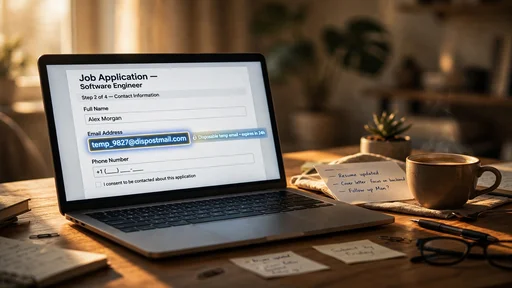
It is 11 PM on a Tuesday and you have just submitted your fourteenth job application. LinkedIn, Indeed, two company career pages, and a startup job board you found on Reddit. Tomorrow morning you will do it again, and the day after that, because that is what job hunting looks like now.
Then the emails start. Not the good kind. The "We found 47 jobs matching your profile!" kind. The "Dear candidate, exciting opportunity in [CITY YOU DO NOT LIVE IN]" kind. The third-party recruiter who harvested your address from somewhere and now considers you a lead. Within a week your inbox, the same inbox where your bank statements and doctor's appointments live, is a landfill.
So the idea arrives, and honestly, it is a reasonable one: what if I just use a throwaway email for the whole job hunt?
Here is the honest answer, and I am going to give it to you straight because I run a temp mail service and I would rather you use it correctly than angrily: for actual job applications, a temp email is mostly a bad idea. But there is one specific part of the job hunt where it is the perfect tool. This post is about knowing which is which — because getting it backwards costs people interviews.
The pain is real: why this idea keeps coming back

Before I tell you why the blunt version of this plan fails, let me validate the instinct, because the instinct is not wrong. The job-search email firehose is a documented, miserable phenomenon.
When you create accounts on the big job boards, you are not just applying for jobs. You are opting — often by default, through pre-checked boxes and sprawling privacy policies — into a marketing pipeline. Job alerts, "similar roles," partner offers, recruiter blasts, sponsored content that is barely content. Some of it comes from the board itself. A lot of it comes from third-party recruiters and lead aggregators who got your address downstream, and those senders have never heard of an unsubscribe link they respected.
Then there is the breach problem. Job boards are among the most targeted sites on the internet precisely because they warehouse exactly what identity thieves want: names, emails, phone numbers, work histories, addresses. LinkedIn had 500 million user records scraped and put up for sale in 2021, in an incident reported across the tech press. The resume you uploaded lives on servers you do not control, behind security you did not choose. Every application is a small privacy concession, and over a long job hunt they compound.
So yes: the urge to hand these platforms something disposable is completely rational. The problem is not the urge. The problem is what happens when the one email you actually wanted never reaches you.
Flaw one: interviews have an expiry date, and so does your inbox
Here is the scenario that kills this plan, and it is the one I hear about in support messages more than any other variant of it.
A recruiter finds your application. They send an interview invitation on a Friday afternoon. They need a response by Monday — scheduling windows close fast when a hiring manager has fifteen candidates to cycle through. Your temp inbox, the one you spun up three weeks ago when the search started, expired on Thursday. The invitation went nowhere. By the time you notice the silence and start wondering, the slot is filled.
This is the core asymmetry the whole plan ignores: job hunting is not a signup-and-forget flow. A temp email works beautifully for things where you need the email exactly once — a verification code, a download link, a coupon. A job application is the opposite: it is a slow-burn conversation that stretches over weeks or months, with messages arriving at unpredictable times, many of them time-sensitive. Offer letters, background-check authorizations, salary negotiations, onboarding paperwork. Every one of those has a clock on it.
A temp inbox that dies in days or weeks is fundamentally mismatched to a process measured in months. You are not buying a newspaper here. You are planting something you need to still be alive in sixty days.
Flaw two: recruiters can see the address, and they judge it
This is the part nobody tells you, and it is the part that makes the whole strategy self-defeating even when nothing technically breaks.
Your email address appears on your resume, in your application, and in every message the recruiter sees before they ever talk to you. Recruiters process volume — dozens of applications per role is normal, hundreds for popular postings — and they triage. An address from a known disposable domain does not read as "privacy-conscious professional." It reads as burner, bot, or not-serious. It reads the way a resume with no phone number reads: something is being hidden, and nobody has time to figure out what.
There is a technical layer too. Many job boards and applicant tracking systems run the same disposable-domain detection that e-commerce and SaaS signups run — blocklists of known temp domains, checked at the form level. When we checked how sites handle this class of address, the pattern was consistent: the form either rejects the domain outright or accepts it and silently throttles delivery afterward. A hiring platform is, of all things, the last place you want to gamble on whether your address survives the gate.
My opinion, stated without hedging: if a recruiter has forty seconds to decide whether your application is real, do not spend those seconds explaining why your email address looks fake.
Flaw three: the hiring pipeline outlives every temp inbox
Let us walk the timeline of a real hire, because the mismatch becomes obvious fast.
Week one: you apply. Week three: phone screen scheduled by email. Week five: take-home assignment, feedback, second round. Week eight: verbal offer, written offer, background check authorization — all by email, some with links that expire in days. Week ten: onboarding portal, benefits enrollment, payroll forms.
Now map a temp inbox onto that timeline. The longest-lived temp services keep mail for days, some for a week or two, a few up to a month — against a hiring process measured in months. The math does not work at any point in the process, and it fails worst exactly where the stakes are highest, and it fails worst exactly where the stakes are highest: the background check, the offer, the onboarding. Miss the background-check email and your start date slips. Miss the offer letter's response window and, in the worst case we have seen described, the offer goes to the next candidate.
This is the same failure mode as the password reset trap, just wearing a suit. An account — and a candidacy is an account, in every system that matters — whose only email is dead is an account you cannot recover, cannot log into, and cannot close out cleanly. The difference is that this time the thing you lose is not a forum login. It is a job.
The one legitimate use: shield the board, not the application
All of that is the "no." Here is the "mostly."
There is one part of the job hunt where a temp email is genuinely the right tool, and it is the part that generates most of the spam: browsing and account creation on job boards themselves.
Here is the distinction that matters. There are two different email roles in a job hunt, and they should be two different addresses:
- The application address — the one on your resume, the one recruiters reply to, the one that must survive the whole process. This should be a real, permanent, professional address. Ideally a dedicated one: firstname.lastname@gmail.com or similar, used for nothing else, checked daily. It is not disposable, but it is segregated — which gets you most of the benefit without any of the risk.
- The board account address — the one you hand to Indeed, LinkedIn, Glassdoor, and the seventeen niche boards to unlock saved searches, job alerts, and the "apply with profile" button. These accounts exist to let you browse and organize. Their inboxes receive the firehose: the alerts you asked for, the marketing you did not, the partner offers, the recruiter blasts. For this role, a temp address is ideal — and using it this way is perfectly legitimate. You get the saved searches and the apply buttons, and the marketing avalanche lands in an inbox you will abandon when the hunt ends.
When we checked what actually breaks in this split setup, the answer was: almost nothing. Job board accounts rarely need long-term recovery — the worst case of losing one is recreating a saved search. The applications, meanwhile, all carry your permanent address, so every recruiter reply lands somewhere alive.
One caution, and it is important: when a specific application asks for your email, use the permanent one — not the board's autofilled temp address. Autofill will happily paste the temp address from your board profile into the application form if you let it. Do not let it. This is the one place the split setup requires discipline, and it is a five-second habit: check the email field on every application before you hit submit.
The playbook: how job hunters actually beat the spam

Putting it together, here is the setup I would hand to a friend starting a job hunt tomorrow. It is boring, it costs nothing, and it works:
Create a dedicated permanent job-search email. Not your main inbox — a separate Gmail or similar, firstname.lastname style, used only for the hunt. This is your application address. It lives for the duration of the search and as long after as you want references and offer letters to remain reachable. After you are hired, it becomes a quiet archive; the spam that followed it stays there, quarantined away from your real life.
Use temp addresses for board accounts and alert subscriptions. Indeed, Glassdoor, the niche boards, the "sign up to see salary data" gates — these get the disposable address. When the hunt ends, you walk away and the firehose dies with the inbox. (If you want identity separation with more control over forwarding and replies, email aliasing is the middle ground worth comparing.)
Never put the temp address on the resume or in an application form. The resume is a permanent document. It will be forwarded, printed, stored in ATS databases for years. An expired temp address on a resume is a dead end for every future recruiter who finds it — including the one with the perfect role eighteen months from now.
Turn off the marketing at the source where you can. The big boards all have notification settings buried three menus deep. Spend ten minutes in each one turning off everything except the alerts you actually read. It will not stop everything, but it meaningfully reduces the volume hitting whichever address you gave them.
Keep the hunt's address alive for at least six months after you start the job. Background checks, tax documents, reference requests from former employers, and the occasional "we have a new role" message all arrive after the hire. Six months is cheap insurance.
That is the whole system. It is not clever, which is why it survives contact with reality.
The bottom line
The temp email is one of the best privacy tools on the internet, and I say that as someone whose business is selling you the habit. But tools have jobs, and this one was built for short, sharp, disposable interactions — not for the months-long, high-stakes, deadline-driven conversation that is a job hunt.
Use it to shield yourself from the boards. Use a real address for the applications. And check the email field before every submit. The five seconds it takes is the cheapest interview insurance you will ever buy.
Frequently Asked Questions
Can I use a temp email to apply for jobs?
Technically sometimes, but you should not. The inbox will likely expire before the hiring process finishes, many job boards and ATS platforms block or distrust disposable domains, and recruiters judge temp-looking addresses as unserious. The risks concentrate exactly where the stakes are highest: interview invites, offers, and background checks.
Will recruiters know I used a temporary email?
Yes. Your email address is visible on your resume and in every application. Addresses from known disposable domains are recognizable, and many hiring professionals treat them as a red flag — at best unprofessional, at worst a sign of a fake application.
What email should I put on my resume?
A permanent, professional address you control — ideally a dedicated one used only for the job hunt, like firstname.lastname@gmail.com. It must stay active for months after you are hired, because offers, tax documents, and reference requests arrive late in the process.
Is it okay to use temp mail for job board accounts?
Yes — this is the legitimate use. Creating accounts on Indeed, Glassdoor, and niche boards with a temp address lets you use saved searches and job alerts while the marketing firehose lands in a disposable inbox. Just make sure actual applications carry your permanent address, not the board's autofilled one.
What happens if my temp inbox expires mid-hunt?
You lose access to every message in it, including any interview invitations or recruiter replies sent there. If the address was on applications, there is no recovery — recruiters have no other way to reach you, and you have no way to know what you missed. This is why the application address must be permanent.
Do job boards block disposable email domains?
Many do, either at signup (rejecting known temp domains outright) or silently afterward (throttling or dropping delivery). Hiring platforms run the same disposable-domain detection as other high-trust signup flows. A blocked board account is a minor inconvenience; a blocked application is a lost opportunity.
How long should I keep my job-search email active?
At least six months after you start the new job. Background checks, tax paperwork, benefits enrollment, and reference requests all arrive by email after the hire, and some on tight deadlines. After that, you can let it go quiet — the spam it collected stays quarantined there, away from your real inbox.
Job hunting is a months-long conversation — give it an address that survives the whole thing. Grab a fresh temp address whenever the next throwaway signup comes along, and keep a permanent one for the applications that matter.