

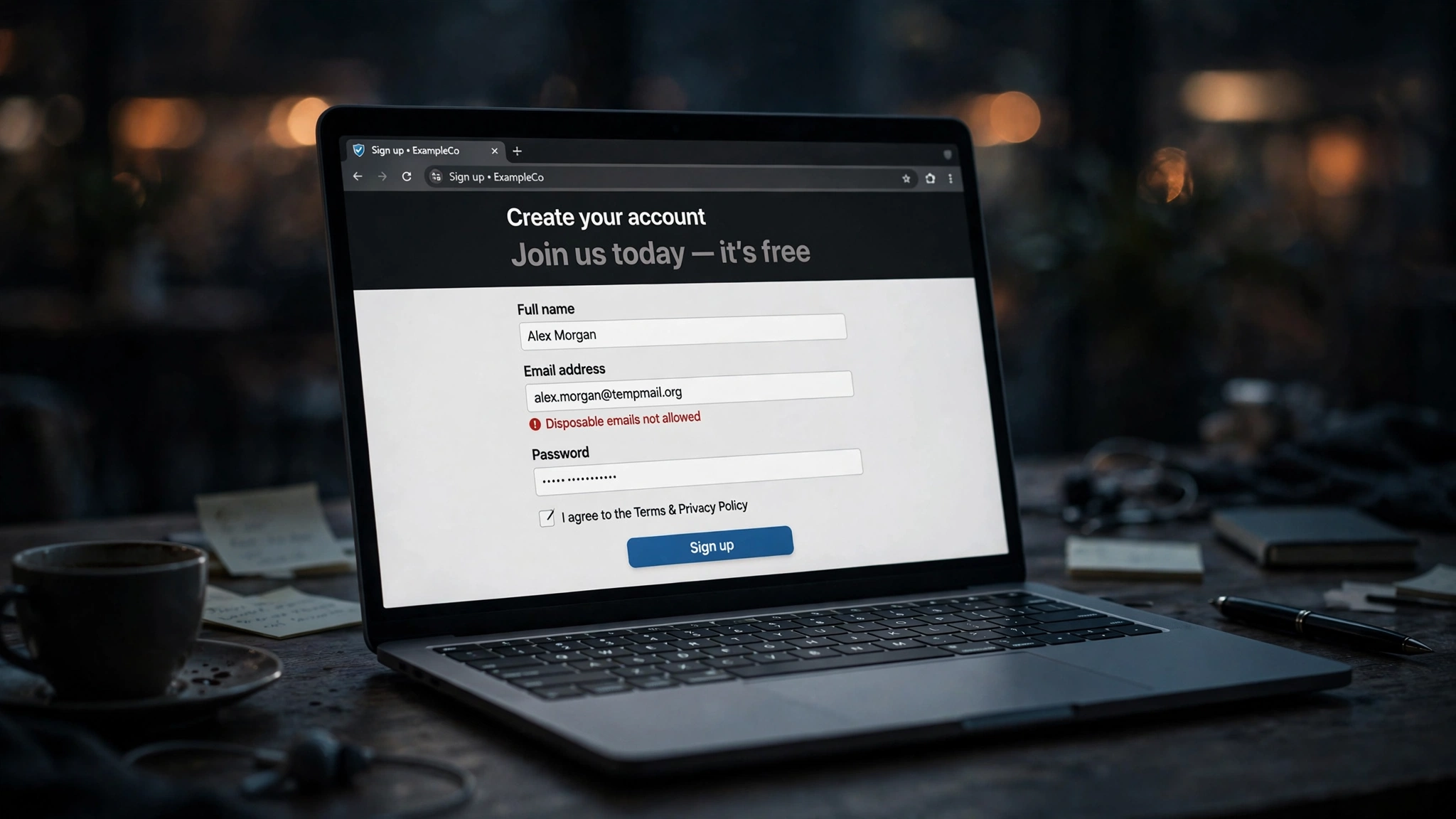
You know the exact moment. A website holds its content hostage behind a signup form — a whitepaper, a price list, a free chapter. You open a temp inbox, copy the address, paste it in, hit submit. And instead of the download, you get this:
"Disposable email addresses are not allowed."
Or the politer version: "Please enter a valid email address." The address is perfectly valid. It would receive mail just fine. The site simply looked at it and decided your kind isn't welcome here.
Most temp-mail blogs answer this with tips for sneaking past the bouncer. This post is different, because we are not writing it from the outside. We run a temp mail service. We watch this fight from our side of the fence every single day — we see our own domains get flagged, listed, and retired in real time. So here is the honest version: how detection actually works, why it keeps working, and what it means for you.
It's never about the part before the @
First, the misconception to kill: nobody is reading your mail, and nobody cares about your username. Every detection method we have ever encountered looks at exactly one thing — the domain, the part after the @.
That makes sense once you see how a temp mail service is built. The operator owns a domain, publishes mail-routing records for it, and runs a server that accepts messages for any name at that domain. There is no account, no password, no signup — the inbox exists the moment someone sends mail to it. A signup form can't see any of that. It can't see you at all. What it can see, instantly and for free, is which infrastructure stands behind the address. The entire game of detection is played on the domain. Change the username all you like; if the domain is flagged, you're done.
The five layers of the bouncer
When a signup form rejects a disposable address, one of these five things usually happened. They stack — big sites run several at once.

1. Community blocklists — the shared "do not admit" list. This is where most rejections come from, when we've checked. Volunteers maintain public lists of known disposable domains — thousands of entries, updated constantly — and any developer can drop one into a signup form in an afternoon. Your address gets looked up; if the domain is on the list, the form shakes its head. Free, fast, and brutally effective against every famous temp-mail provider. Obscure providers slip through precisely because nobody has bothered to list them yet.
2. Commercial validation APIs. The paid upgrade. Services exist that score every submitted address in real time — disposable or not, role-based or not, deliverable or not — and return a verdict in milliseconds. A site wires one of these into its registration flow and never maintains a list itself. The answer comes back as a cold boolean: disposable, true. Harder to evade than a static list, because the verdict is computed fresh each time.
3. MX and DNS fingerprinting. This is the clever one, and it catches domains that aren't on any list yet. How mail gets routed for a domain is public information — anyone can look up which servers receive mail for any domain on earth. If your domain's mail servers match the infrastructure of a known temp-mail operator, you're flagged before the domain ever appears on a blocklist. New domain, same servers, same verdict. This is why simply buying a fresh domain doesn't reset the clock the way people expect.
4. Domain age and reputation scoring. A domain registered last Tuesday, with no sending history and no reputation, looks different from one that's been quietly receiving mail for years. Young plus unknown equals a higher risk score. Honest footnote: this layer is blunt. It catches innocent small domains too — the hobby project, the tiny business that just launched. Collateral damage is real, and it's one reason aggressive blocking annoys legitimate users.
5. Behavioral signals. This layer doesn't care about your email at all — it watches what you do. A burst of signups from one IP range. Submissions timed like a machine. Referral codes harvested in sequence. Coupon after coupon claimed in minutes. Behavioral detection catches abuse regardless of which domain you used, which is why swapping addresses sometimes fails even with a pristine, unlisted domain. The email was never the problem; the pattern was.
The uncomfortable truth: popularity is the enemy
Here is the part most temp-mail blogs won't say plainly, so we will: we lose this fight eventually, on every domain, every time.

The logic is brutal and simple. A temp domain is useful because people use it. People using it means it shows up in signup logs across thousands of sites. Showing up in signup logs everywhere means it lands on the blocklists. The more popular a domain gets, the faster it gets listed. Obscurity is the only real protection a disposable domain has — and obscurity is the exact opposite of a useful service.
This is the arms race, and the blocking side has the structural advantage. A blocklist update propagates to every site that consumes it within hours. A temp operator's new domain takes weeks to become known and trusted by users. The defenders share intelligence for free; the operators work alone. Anyone promising you a temp domain that "never gets blocked" is selling you a bridge. What serious providers actually do is rotate: retire burned domains from the default pool, bring in fresh ones, and buy time. Not immunity. Time.
The history backs this up. Temporary email has been around since 10 Minute Mail launched in 2006, and the cat-and-mouse game is nearly as old. What changed recently is the economics of the defender's side. In 2024 and 2025, Google and Yahoo tightened bulk-sender rules, putting real weight on bounce rates and domain reputation. Every confirmation email a site sends to a dead disposable inbox now counts as a bounce against their reputation — validation providers cite danger zones around a fraction of a percent of hard bounces. Suddenly, letting disposable addresses through wasn't just a data-quality annoyance; it was a deliverability risk. Blocking got stricter because the cost of not blocking went up. That's not a trend that reverses.
What it looks like from our side of the fence
Since we're being honest: here is how we actually operate at tempomailusa.com.
We don't run one domain. We run many. When a domain starts getting rejected everywhere — and we can see it happening in our own metrics — we pull it from the default rotation and slot in a fresh one. Our premium domains stay cleaner longer for a boring reason: fewer hands touch them, so they show up in fewer signup logs, so they take longer to land on the lists. It's maintenance, not magic. There is no secret technique, no bulletproof domain, no trick the blocklists can't learn. We'd rather tell you that than pretend rejections don't happen.
If you take one thing from this post, take this: when a site rejects your temp address, it's not broken, and you're not doing anything wrong. You're just standing on the losing side of an arms race at that particular moment, on that particular domain.
When you shouldn't fight it at all
Real opinion, from people who sell the thing: sometimes the site is right, and you should just use your real email.
Don't use temp mail for anything involving money — banks, payment apps, crypto exchanges, tax portals. Don't use it for job applications; recruiters notice disposable domains, and "unprofessional" is the kindest word they'll use. Don't use it for any account you'd be upset to lose, because password recovery to an expired inbox is a special kind of helplessness we've watched users experience too many times. And don't try to outsmart fraud systems on financial or government sites. That is not a game you win, and the account ban is the good outcome.
Temp mail is for what it's for: the one-off download, the gated article, the newsletter you're test-driving, the forum you'll visit twice. The 30 seconds you save skipping a real signup aren't worth a locked account you'll need in a year. For a deeper look at where disposable addresses genuinely shine versus where they backfire, our guide on how long temp mail actually lasts pairs well with this one.
What to do when a site rejects your temp address
Practical options, in order of honesty:
- Try a different domain from the same service. Fresh domains often pass simply because they haven't been listed yet. On our homepage you'll usually find several to choose from — this is the single most effective move.
- Use a longer-lived or reusable inbox instead of a 10-minute one. Some rejections are about disposability signals (young domain, no history), and a stable address on an established domain trips fewer of them.
- For that one site, just use your real email — or an alias on it. If the service matters to you, it has earned a real address. You can also route it through one of our free tools to keep things organized.
- If the code never arrives even after acceptance, that's a different problem — delivery, not detection. We wrote a separate walkthrough for why temp mail sometimes never gets the OTP and the 90-second fix.
What doesn't work: changing the username before the @ (detection is on the domain, remember?), adding dots and plus-signs, or cycling through the same burned domain hoping for a different result. The bouncer isn't confused. It's just doing its job.
Frequently Asked Questions
Why do websites block temporary email in the first place?
Four reasons, roughly in order: spam and fake accounts, free-trial and promo abuse, data quality (dead inboxes poison analytics and email lists), and — increasingly since 2024 — sender reputation. Every bounce to an expired disposable inbox dings the site's standing with Gmail and Yahoo, so blocking became a deliverability decision, not just a preference.
How does a website know my email is temporary?
It checks the domain against blocklists, validation APIs, and DNS fingerprints. It never sees your inbox, your messages, or anything about you personally. The judgment is about the domain's reputation, not your identity.
Is it illegal to use temp mail to get past a block?
Using a disposable address isn't illegal in itself, but deliberately evading a site's protections usually violates its terms of service — and the practical penalty is a banned account, not a lawsuit. Our take: if a site clearly doesn't want disposable signups for something that matters (money, identity, security), respect it. The workaround isn't worth the fallout.
Do all temp mail domains get blocked eventually?
The popular ones, yes — that's the arms race described above. Obscure, low-traffic domains survive longer precisely because they're not worth anyone's time to list. Rotation is how providers cope: fresh domains buy time, not immunity.
Will changing the username part of the address help?
No. Detection keys on the domain after the @, not the name before it. A new username on a flagged domain fails exactly the same way.
The next time a form tells you disposable addresses aren't allowed, you'll know what's actually happening: five layers of quiet machinery, a shared intelligence network, and an economics of reputation that made blocking cheaper than tolerance. It's not personal. It's infrastructure. And now you know exactly where you stand in the fight.