

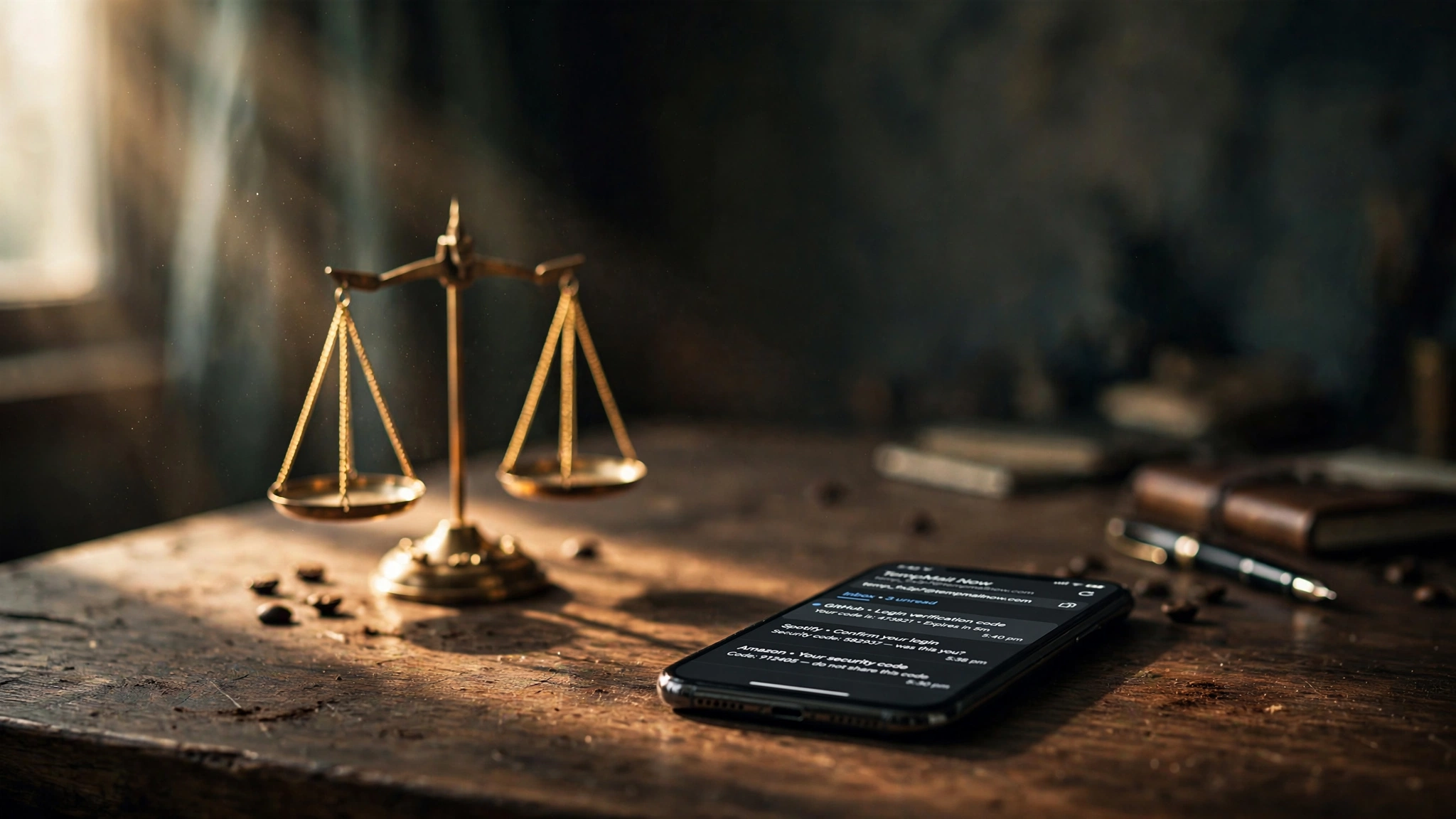
The question usually arrives at an ungodly hour. You're staring at a signup form at 1:14 AM — some forum, some download, some "free" tool that wants your email before it shows you anything — and a thought you can't quite shake surfaces: is this actually legal?
It is a fair question, and the fact that you're asking it says something decent about you. Most people either assume the worst ("this feels shady, so it must be illegal") or never think about it at all. Both instincts are wrong in interesting ways. The honest answer is short, but the honest answer is not the whole story, and the difference between the two is where people actually get into trouble.
One note before we start: I'm not a lawyer, this isn't legal advice, and if your situation involves real money or real consequences, talk to one. What follows is the plain-English version of how the law treats disposable email, researched properly, with the scare tactics removed.
The short answer, then the real one
The short answer: yes, using temp mail is legal. There is no federal law in the United States — and no law I'm aware of in any other country — that bans disposable email addresses, prohibits you from using an alternate address at signup, or requires you to hand every website your real inbox. You cannot be arrested, fined, or prosecuted for the act of generating a temporary address and pasting it into a form. Full stop.
The real answer: the law doesn't care about the tool. It cares about what you do with it. A disposable address used to dodge a newsletter's marketing list is the same technology as a disposable address used to run a fake-account farm harvesting signup bonuses — and the law treats those two acts completely differently, because of course it does. The email address was never the point. The behavior was.
This distinction is the entire article, really. Everything below is just me showing you where the line sits, with specifics, so you never have to wonder about it at 1:14 AM again.
What the law actually regulates (hint: it isn't your inbox)
When people worry that temp mail might be illegal, they're usually imagining some law that says "you must provide accurate contact information to websites." That law doesn't exist. Here's what does exist, and why none of it touches you:
The CAN-SPAM Act of 2003 is the big American email law, enforced by the FTC, and it regulates senders of commercial email — it demands truthful headers, honest subject lines, and a working opt-out. It says absolutely nothing about recipients choosing to receive mail at a disposable address. You are on the receiving end. The law wasn't written with you in mind at all.
The GDPR, in force across the EU since May 2018, actually points the other direction. Its data minimization principle (Article 5) says organizations should collect only the personal data they genuinely need. When you hand a coupon site a disposable address instead of the inbox tied to your name, your job, and your entire purchase history, you're doing voluntarily what the regulation nudges companies toward: less personal data changing hands. I'm not claiming the GDPR endorses temp mail — it doesn't mention it — but the spirit of modern privacy law is on the side of giving away less, not more.
No "accurate email" statute exists. Nobody — not the FTC, not Congress, not any state legislature — has passed a rule requiring consumers to use their primary email address when signing up for things. Websites are free to ask for whatever they want, and free to reject addresses they don't like (more on that below). But "the form asked for it" is a request, not a law.
The federal computer-crime law, the CFAA, is worth one sentence because it comes up in these discussions: it targets unauthorized access to computer systems, not the email address you typed into a signup form — and courts, including the Supreme Court in Van Buren v. United States (2021), have repeatedly pushed back on stretching it to cover mere terms-of-service violations. Typing a working email address into a form a site published for exactly that purpose is not "unauthorized access" by any reading a court has accepted.
So the tool itself sits on completely solid ground. Now let's talk about the four ways people take that solid ground and walk off a cliff with it.
The four ways people cross the line

Notice the pattern in all four: in every case, the crime is the underlying act. The disposable email is just the getaway car — and getaway cars don't make bank robbery legal or illegal. The robbery does.
1. Harvesting bonuses: the fake-account factory
This is the most common way temp mail meets actual fraud. The setup: a service offers $20 in credit for new accounts, or a referral program pays per signup, or a free trial resets for "new" users. Someone generates hundreds of disposable addresses, creates hundreds of accounts, and harvests the bonuses.
At small scale — you grabbed a second trial because the first one expired before you finished evaluating the tool — no prosecutor on earth cares, and I'd be surprised if the company does either. But at industrial scale, for real financial gain, this is textbook fraud: deceiving a company into paying out money or value under false pretenses. The FBI's Internet Crime Complaint Center logged $16.6 billion in reported losses for 2024, up 33% from $12.5 billion in 2023, across roughly 860,000 complaints — and the overwhelming majority of that was fraud, not hacking. Prosecutors understand fake-account schemes perfectly well. The disposable email in the story is incidental; the deception for financial gain is the whole case.
My honest take: if the "clever trick" you're considering would stop working the moment the company could see it was one person, that's your answer about whether it's honest.
2. The mask: threats, harassment, and impersonation
A disposable address gives you a mask. Masks are morally neutral — until you use one to do something the law already forbids. Sending threats, running a harassment campaign, impersonating a real person to damage them, stalking: every one of these is illegal regardless of which email address you use. Federal law (18 U.S.C. § 875, for the curious) criminalizes transmitting threats across state lines, and every state has its own harassment and stalking statutes.
The uncomfortable truth privacy advocates have to sit with: the same property that protects a whistleblower also protects a harasser. Temp mail doesn't change the legality of either act by one inch. If the message would be a crime sent from your Gmail, it's a crime sent from a disposable address — with the added aggravating detail that you deliberately obscured your identity, which prosecutors tend to read as consciousness of guilt.
3. Ban evasion: when a "fresh start" becomes circumvention
You get banned from a platform — a marketplace, a game, a forum — and you come back with a fresh disposable address and a new account. Is that illegal?
Usually, no — it's just against the rules, and the platform will ban the new account too when it figures it out. Platforms are private property; they can refuse you service, and "I'll just make a new account" is the digital equivalent of climbing back over the fence after being thrown out of a bar. Annoying, against the house rules, but not a crime.
The line moves when the ban exists for a legal reason or the circumvention itself breaks a law to get around it — say, bypassing technical access controls rather than just making a new account, or returning to commit the same fraud that got you banned in the first place. Then you're not being punished for the new email address; you're being punished for the underlying act, again. The pattern holds: the address is never the crime. The behavior is.
4. Lying where the law demands the truth
Some contexts legally require your real identity, and no privacy tool overrides that. Opening a bank or brokerage account (federal "know your customer" rules under the Bank Secrecy Act), filing taxes, dealing with government services, signing court documents, anything involving a background check — in these rooms, obscuring who you are isn't clever privacy hygiene, it's deception in a regulated process, and the underlying statutes carry real penalties.
This is also the practical reason every temp mail guide, including this site's, tells you never to use a disposable address for banking or anything tied to your identity. It's not just that you'll lose access when the inbox expires (you will). It's that the entire context assumes — and in some cases legally requires — that you are who you claim to be.
A website rejecting you is not the law (but it still wins)
Here's the confusion I see most often, and it's worth untangling carefully: a website is perfectly entitled to refuse your disposable address. That refusal feels like a legal judgment — rejected sounds so official — but it's just a business policy. Sites block temp mail to protect their metrics, their sender reputation, and their data collection, and courts have consistently treated that as their right. It's their form, their rules.
The practical upshot: getting your temp address bounced at signup carries zero legal consequences and exactly one practical one — you don't get in. No fine, no record, no knock on the door. You just need a different address. I've written before about how websites actually detect disposable email — the five layers they use, from domain blocklists to behavioral signals — and the honest summary is that blocking is a cat-and-mouse business decision, not a legal proceeding. Respect the site's terms where it matters, use a regular inbox where it's required, and save the disposable address for the thousand forms that don't deserve your real one.
Where temp mail is completely fine — and the three places it never belongs

Let's make this concrete, because abstract legal analysis is useless without a "so what do I actually do" section.
Completely fine — the home turf of disposable email. Newsletters and content gates. Free trials of software you're evaluating. Forum and community signups. Download forms. WiFi captive portals at hotels and airports. Beta tests. Any form where your gut says "this exists to harvest addresses." Nobody — not the site, not the law, not anyone — has a legitimate complaint about you protecting your inbox here. If anything, as I argued above, privacy law's direction of travel agrees with you. For the general case of keeping marketing spam out of your life, using temporary email to protect yourself from spam remains one of the highest-leverage habits in personal digital hygiene, and it's not close.
Never belongs — three hard lines.
1. Anything involving money or financial identity. Banks, brokerages, payment apps, crypto exchanges, tax services. Beyond the legal identity requirements, there's a brutal practical reason: these accounts live for years, and disposable inboxes don't. I've covered how long temp mail inboxes actually last — the answer ranges from minutes to days depending on the service — and none of those numbers is compatible with an account you'll need to recover in 2029.
2. Anything where losing the inbox means losing the account. This is the password-reset trap, and it's the single most expensive mistake in the disposable-email world: signing up for something that turns out to matter with an address that no longer exists, then discovering — during a lockout, a breach, a disputed charge — that the recovery path points at a demolished building. Read the full breakdown of what happens when your only email is a dead temp address before you decide which bucket a signup belongs in. The rule is absolute: no account that needs password recovery should live on an address that might not exist next month.
3. Anything where the law requires your real identity. Government services, legal filings, regulated financial products, employment verification. Not a gray area. Don't.
The one-sentence rule
If you remember nothing else from 2,000 words, remember this: the address is never the crime — the behavior is.
Using temp mail to keep a coupon site out of your real inbox is legal, sensible, and increasingly the norm. Using temp mail as one ingredient in a scheme to defraud, threaten, or deceive is illegal — and it would be illegal with a Gmail address too. The technology doesn't launder the intent. Once you see it that way, the 1:14 AM question answers itself: are you protecting your privacy, or are you hiding your behavior? One of those is what disposable email is for. The other was never going to be saved by which address you typed.
FAQ
Can I get arrested just for using temp mail? No. There is no law in the United States — or, to my knowledge, anywhere else — that criminalizes generating or using a disposable email address. Arrests happen for fraud, threats, harassment, or other underlying crimes; the email address used is evidence, not the offense.
Is it illegal to use a fake email for signups? "Fake" covers a lot of ground. Using a working disposable address to receive a newsletter: completely fine. Inventing a false identity to deceive a company out of money or services: that's fraud, and the falsity that matters is the deception, not the domain on the email.
Can a website sue me for using temp mail? In theory a site could try to frame systematic abuse of its systems (mass fake accounts, bonus harvesting) as a terms-of-service violation or worse — but nobody gets sued for signing up for a newsletter with a disposable address. Lawsuits target the abuse at scale, not the tool.
Is temp mail legal in the EU and UK? Yes. Nothing in the GDPR or UK data protection law prohibits consumers from using disposable addresses. If anything, the GDPR's data minimization principle favors sharing less personal data with sites that don't need it.
Does using temp mail violate CAN-SPAM? No. CAN-SPAM regulates the senders of commercial email — truthful headers, honest subject lines, working opt-outs, enforced by the FTC. It imposes zero obligations on recipients and says nothing about which address you choose to receive mail at.
What should I never use temp mail for? Banking and financial accounts, government or legal matters, and anything where you'll need password recovery later. Short version: if losing the inbox would cost you the account, the address was never disposable — your judgment about the signup was.